BIPOC nonprofit professionals need and want support

By Anna Rebecca Lopez, AR Lopez Consulting

This infographic is part of a multi-part series. View the first infographic in the series here and the second here. Follow CCF on Instagram, Facebook, or sign up for our mailing list to get notified of the next part!

Anna Rebecca Lopez

Anna Rebecca Lopez

Anna Rebecca Lopez (she/they) is an experienced Evaluator and consultant, using mixed-method approaches to social science research, statistical analysis, community engagement & collaboration, digitization and more. She is the Principal Evaluator at AR Lopez Consulting, where she specializes is disaggregating data in a way that tell authentic and useful stories. You can find her on IG @anna_.rebecca. You can send her a tip via her Venmo, @annarebecca13. 

BIPOC NONPROFIT PROFESSIONALS NEED AND WANT SUPPORT

By Anna Rebecca Lopez, AR Lopez Consulting

Go back to the infographic via this link

(Introduction text)

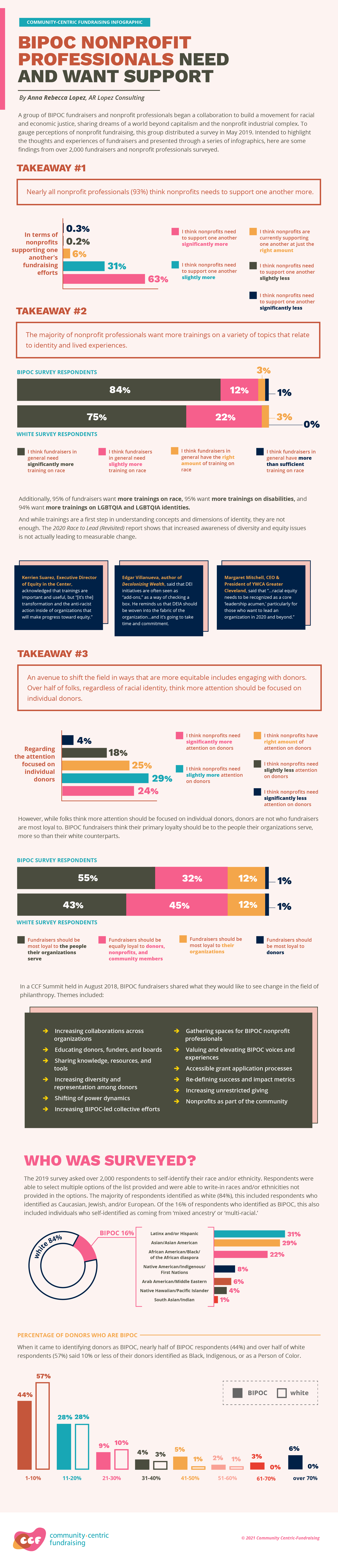
A group of BIPOC fundraisers and nonprofit professionals began a collaboration to build a movement for racial and economic justice, sharing dreams of a world beyond capitalism and the nonprofit industrial complex. To gauge perceptions of nonprofit fundraising, this group distributed a survey in May 2019. Intended to highlight the thoughts and experiences of fundraisers and presented through a series of infographics, here are some findings from over 2,000 fundraisers and nonprofit professionals surveyed. 

TAKEAWAY #1

(The following section is visualized through a brown box wrapped around the following text:)

Nearly all nonprofit professionals (93%) think nonprofits needs to support one another more.

(The next subsection features bar graphs in multiple colors, showing what survey respondents answered in response to “In terms of nonprofits supporting one another’s fundraising efforts.”)

In terms of nonprofits supporting one another’s fundraising efforts,

63% said “I think nonprofits need to support one another significantly more”

31% said “I think nonprofits need to support one another slightly more”

6% said “I think nonprofits are currently supporting one another at just the right amount”

0.2% said “I think nonprofits need to support one another slightly less”

0.3% said “I think nonprofits need to support one another significantly less”

TAKEAWAY #2

(The following section is visualized through a brown box wrapped around the following text:)

The majority of nonprofit professionals want more trainings on a variety of topics that relate to identity and lived experiences.

(This next section is visualized through two horizontal line graphs stacked on top of each other, one of BIPOC survey respondents, and the other graph is of white survey respondents. Both graphs are colored in dark green, pink, yellow and indigo. The charts show what survey respondents think regarding training on race.)

(The BIPOC graph)

84% said “I think fundraisers in general need significantly more training on race”

12% said “I think fundraisers in general need slightly more training on race”

3% said “I think fundraisers in general have the right amount of training on race”

1% said “I think fundraisers in general have more than sufficient training on race”

(The white graph)

75% said “I think fundraisers in general need significantly more training on race”

22% said “I think fundraisers in general need slightly more training on race”

3% said “I think fundraisers in general have the right amount of training on race”

0% said “I think fundraisers in general have more than sufficient training on race”

(This next section is text. It says:) 

Additionally, 95% of fundraisers want more trainings on race, 95% want more trainings on disabilities, and 94% want more trainings on LGBTQIA and LGBTQIA identities.

And while trainings are a first step in understanding concepts and dimensions of identity, they are not enough. The 2020 Race to Lead (Revisited) report shows that increased awareness of diversity and equity issues is not actually leading to measurable change. 

(This next section are three quotes that are stylized in indigo boxes. It says:) 

Kerrien Suarez, Executive Director of Equity in the Center, acknowledged that trainings are important and useful, but “[it’s the] transformation and the anti-racist action inside of organizations that will make progress toward equity.” 

Edgar Villanueva, author of Decolonizing Wealth, said that DEI initiatives are often seen as “add-ons,” as a way of checking a box. He reminds us that DEIA should be woven into the fabric of the organization…and it’s going to take time and commitment. 

Margaret Mitchell, CEO & President of YWCA Greater Cleveland, said that “…racial equity needs to be recognized as a core ‘leadership acumen,’ particularly for those who want to lead an organization in 2020 and beyond.”

TAKEAWAY #3

(The following section is visualized through a brown box wrapped around the following text:)

An avenue to shift the field in ways that are more equitable includes engaging with donors. Over half of folks, regardless of racial identity, think more attention should be focused on individual donors.

(The next subsection features bar graphs in multiple colors, showing what survey respondents answered in response to “Regarding the attention focused on individual donors.”)

Regarding the attention focused on individual donors,

24% said “I think nonprofits need  significantly more attention on donors”

29% said “I think nonprofits need  slightly more attention on donors”

25% said “I think nonprofits have right amount of attention on donors”

18% said “I think nonprofits need  slightly less attention on donors”

4% said “I think nonprofits need  significantly less attention on donors”

(This next section is text. It says:) 

However, while folks think more attention should be focused on individual donors, donors are not who fundraisers are most loyal to. BIPOC fundraisers think their primary loyalty should be to the people their organizations serve, more so than their white counterparts. 

(This next section is visualized through two horizontal line graphs stacked on top of each other, one of BIPOC survey respondents, and the other graph is of white survey respondents. Both graphs are colored in dark green, pink, yellow and indigo. The charts show who survey respondents think fundraisers should be most loyal to.)

(The BIPOC graph)

54% said “Fundraisers should be most loyal to the people their organizations serve”

32% said “Fundraisers should be equally loyal to donors, nonprofits, and community members”

12% said “Fundraisers should be most loyal to their organizations”

1% said “Fundraisers should be most loyal to donors”

(The white graph)

43% said “Fundraisers should be most loyal to the people their organizations serve”

45% said “Fundraisers should be equally loyal to donors, nonprofits, and community members”

12% said “Fundraisers should be most loyal to their organizations”

1% said “Fundraisers should be most loyal to donors”

(This next section is text. It says:) 

In a CCF Summit held in August 2018, BIPOC fundraisers shared what they would like to see change in the field of philanthropy. Themes included:

(This next section is a green box around a series of bullet points. It says:) 

  • Increasing collaborations across organizations
  • Educating donors, funders, and boards
  • Sharing knowledge, resources, and tools
  • Increasing diversity and representation among donors
  • Shifting of power dynamics
  • Increasing BIPOC-led collective efforts
  • Gathering spaces for BIPOC nonprofit professionals
  • Valuing and elevating BIPOC voices and experiences
  • Accessible grant application processes
  • Re-defining success and impact metrics
  • Increasing unrestricted giving 
  • Nonprofits as part of the community

WHO WAS SURVEYED?

The 2019 survey asked over 2,000 respondents to self-identify their race and/or ethnicity. Respondents were able to select multiple options of the list provided and were able to write-in races and/or ethnicities not provided in the options. The majority of respondents identified as white (84%), this included respondents who identified as Caucasian, Jewish, and/or European. Of the 16% of respondents who identified as BIPOC, this also included individuals who self-identified as coming from ‘mixed ancestry’ or ‘multi-racial.’ 

(Here, there is a dark indigo pie chart showing that 84% of respondents were white and 16 percent of respondents, shown as a pink wedge, were BIPOC.)

(Next to the BIPOC percentage, there is deeper-dive information. There is a breakdown of ethnicities of respondents who were surveyed. The list is shown as a bar graph in descending order, from highest percentage to smallest percentage. The list says:)

Latinx and/or Hispanic – 31%

Asian/Asian American – 29%

African American/Black/of the African diaspora – 22%

Native American/Indigenous/ First Nations – 8%

Arab American/Middle Eastern – 6%

Native Hawaiian/Pacific Islander – 4%

South Asian/Indian – 1%

(The next section shows the percentage of donors who are BIPOC in a multi-colored bar graph, as answered by BIPOC respondents and white respondents.)

When it came to identifying donors as BIPOC, nearly half of BIPOC respondents (44%) and over half of white respondents (57%) said 10% or less of their donors identified as Black, Indigenous, or as a Person of Color.

1-10%

BIPOC – 44%

white – 57%


11-20%

BIPOC – 28%

white – 28%


21-30%

BIPOC – 9%

white – 10%


31-40%

BIPOC – 4%

white – 3%


41-50%

BIPOC – 5%

white – 1%


51-60%

BIPOC – 2%

white – 1%


61-70%

BIPOC – 3%

white – 0%

over 70%

BIPOC – 6%

white – 0%

(The very bottom of the infographic shows the CCF logo on the left hand side. On the right hand side, it says: “© 2021 Community Centric-Fundraising”)

This infographic is the fourth and final part of a multi-part series. Read part one, two, and three of the series here.

This infographic is part of a multi-part series. Read part one of the series here. Read part two of the series here. Follow CCF on Instagram, Facebook, or sign up for our mailing list to get notified of the next part!

Anna Rebecca Lopez

Anna Rebecca Lopez

Anna Rebecca Lopez (she/they) is an experienced Evaluator and consultant, using mixed-method approaches to social science research, statistical analysis, community engagement & collaboration, digitization and more. She is the Principal Evaluator at AR Lopez Consulting, where she specializes is disaggregating data in a way that tell authentic and useful stories. You can find her on IG @anna_.rebecca

Tis the season: But is Giving Tuesday really community-centered?

By Nikkia Johnson, development and operations professional

PSL season has started so you know what that means. Thanksgiving. Black Friday. Small business Saturday. Cyber Monday. Giving Tuesday.

It’s the season to give … and give and give.

During the week of Giving Tuesday (or more accurately, the month leading up to Giving Tuesday), you are probably inundated with emails and bombarded with marketing about it. Everyone is writing hot tips and hosting webinars on how you can up your Giving Tuesday campaign game. 

Reminiscent of the nonprofit hunger games, you’re fielding tons of work and marketing emails — all the while figuring out which strategic subject line will yell, “Pick me!” and help your nonprofit stand out among the many others. 

If you’re like me, you probably dread checking your email during this end-of-year season. Also like me, maybe you end up deleting emails in bulk because the constant reminder of the sheer number of unread emails in your inbox feels hopeless (or maybe opening yet another email is just absolutely dreadful). 

As Giving Tuesday starts inching closer, I have to wonder, for all the work we put into it – is Giving Tuesday even equitable and community-centered?

The origins of Giving Tuesday

According to its website, GivingTuesday was created in 2012 simply as a day that encourages people to do good. Since then, GivingTuesday has become an independent nonprofit, a global movement, and has inspired hundreds of millions of people to give and “reimagine a world built upon shared humanity and generosity.” In 2020, GivingTuesday reported that $2.47 billion in donations was given in the U.S. alone on December 1st. 

So why wouldn’t you want to join the movement?

Even though the movement is steadily growing, more and more I’ve noticed that many local organizations and smaller shops opt out of participating in the global campaign. Organizations I was and am a part of have also internally debated whether or not Giving Tuesday is worth doing.

Part of how we would figure out whether we participate during a given year involved having many conversations with other nonprofits to understand all of the different approaches to Giving Tuesday. While there are a myriad of reasons why organizations take part in it, those who decided to opt out had reasons that generally fell into two camps

1) Their message gets too lost in the crowd, and 

2) The prep work for just one day is too time consuming for so little return.  

In these conversations that I had with other organizations, I learned that only one of them had Giving Tuesday in their annual development plan. This tells me many of us are putting our Giving Tuesday strategies together on the fly — which may be a contributing factor to lower numbers. 

It’s not always about the numbers though. One big reason I don’t feel enthusiastic about Giving Tuesday is what it inherently portrays. While the concept of Giving Tuesday is fairly straightforward, the way many of us currently approach Giving Tuesday is very transactional. We bombard folks with emails and hope we get enough donations to make it a good return. This is not exactly community-centered, is it?

Alternatives for a CCF Giving Tuesday

If we were to think of Giving Tuesday in the context of being community-centered and keeping CCF principles in mind, here are some ideas to try:

1. Start your own online giving campaign

Over the years, I’ve seen more and more organizations re-channel the efforts formerly used to pull off a Giving Tuesday campaign and apply those efforts into creating a branded, organization-specific campaign. This is a great idea. 

First, because you aren’t obliged to one specific day of the year, you don’t have to worry as much about your emails going to spam or getting lost in the holiday shuffle. 

Second, you can take a longer time to highlight your work. ART 180’s campaign, The Amazing Dream, is an example of this. It is held annually over five days in the early fall. 

Lastly, it is much more likely that you put in the time and effort to curate a campaign that upholds your values as an organization when you make it your own. The extra time and effort will also help get supporters in the mindset of sustainability, that giving can be year-round. We should not have to do a mad dash to end the year in the green.

2. Highlight partner organizations/movements

One of CCF’s principles is, “Nonprofits are generous with and mutually supportive of one another.” To be more community-centered in the context of Giving Tuesday, this can look a few different ways.

For instance, you can use the day to give thanks to and highlight any organizations you partner with. You could also use the day to fundraise with or for BIPOC led organizations in your community who are doing great work, since we know that they are not funded at the same rate as white-led organizations.

Last year, The Movement for Black Lives started a #RepartionsMonday campaign. In lieu of the typical Giving Tuesday strategy, the campaign focused on a toolkit with racial and equity justice recommendations and resources as well as a collective fund set up to benefit 150 Black-led organizations.

Not only will shifting the focus highlight that our individual organizational missions are not as important as the collective community — doing so uses your organizations’ power to amplify your partners and show the interconnectedness of our work, our organizations, and communities.

3. Forgo it altogether

Is Giving Tuesday even worth it for your organization? 

The essence of what Giving Tuesday has become may no longer align with your organization’s values. It has become a day where you’re competing with other nonprofits and focusing solely on dollars raised. Giving Tuesday is not community-centered — honestly it’s not even donor-centered. But if that argument isn’t enough, do an analysis of how much your Giving Tuesday campaign has brought in year over year. Then think about your staff capacity. Many development offices are already stressed with end of year activities; is Giving Tuesday the best use of your resources? If you’re not seeing the level of participation you hoped for, it’s better to put your efforts into your annual planning and end-of-year strategy.


As we seek to make all facets of our work more transformative, equitable, and community-centered, we must reconsider how we approach Giving Tuesday. If you have yet to internally discuss your Giving Tuesday strategy for the year, it’s okay to forgo a year (and I promise, most donors won’t even notice). If 2020 has taught us anything, it’s that the status quo is no longer acceptable and we need to examine the way we operate with a different lens. If you decide you’re gonna do it, invest the time to be sure it is strategic and mission-aligned, and do your best to fine tune a community-centered Giving Tuesday campaign.

Nikkia Johnson

Nikkia Johnson

Nikkia Johnson (she/her) is a nonprofit development and operations professional. She was born and raised in Queens, NY and currently lives in Richmond, VA — which greatly informed her career choice in nonprofits, and later fundraising. Her career has been centered on nonprofit development and management, relationship building, and empowering marginalized communities through equity-based initiatives. Nikkia is passionate about mentoring, therefore very involved in many mentorship groups and community organizations (in hopes more people will choose a development career instead of falling into the work like most of us). She currently serves on the VAFRE Board of Directors and programs committee, and is in the 2021 cohort of AFP Central Virginia’s Inclusive Fundraising Fellowship. She can be reached via LinkedIn, or via email. You can send her a tip via her Venmo, @nikkij1021

Listen to the children … (because the world hasn’t ruined them yet)

Listen to the children … (because the world hasn’t ruined them yet)

By Rachel D’SouzaFounder + Chief Purpose Officer, Gladiator Consulting, Justice Philanthropy Catalyst, Forward Through Ferguson

Shoutout to my two sweetest teachers: C+E, I can’t wait to see what you’ll show me next.

I have never been a ‘kids person.’ I did not babysit as a teen. I never dreamt of becoming a camp counselor for my summer job nor did I have any interest in coaching a gaggle of youth. I’m fairly positive that I didn’t even fawn over the first wave of babies my friends welcomed in our 20s. 

So, when I became a parent for the first time in 2011, I was fully freaked out. How was I supposed to be responsible for raising a human (two humans actually, because the second and final one came along in 2015)? 

One of the biggest lessons I’ve learned in my first decade of parenthood is that I have so much more to learn from my children than they will ever learn from me. They are curious, kind, and optimistic. They feel their feelings in a big way and have not succumbed to shame and self-doubt. They are excellent at speaking their truth and voicing their own needs. They could probably use some work on their boundaries (who needs privacy in the shower, anyway?), but, if there’s any force that can teach us to be the best, most unapologetic versions of ourselves, it is our children.

I’ve long believed “work-life balance” to be some epic gaslighting that perpetuates the most harmful – that is, patriarchal, white-centric, heteronormative – aspects of work culture. When I made space for my work and my life as a parent to co-exist, I opened myself up to a blended reality I never thought possible. 

Here are five lessons where letting my kids teach me made me a better human and, thus, better at my work:

Be curious.

There are so many things in the world that my children are not afraid of — perhaps they haven’t yet learned to be. They don’t hesitate to let their curiosity take the wheel and while sometimes there are lessons to be learned — like how high is high enough to climb this tree before mom gets worried. To them, it is always worth learning more about the world.

Similarly, there will always be more to learn as those of us in the nonprofit sector cast a critical eye toward philanthropy and the systems of charitable giving. While unsettling, we need to sit with the reality that what we thought was true yesterday might not be true tomorrow. The fundraising world that we move through today operates much differently than it did for generations before us. We’ve started to unlearn what doesn’t work and how the entrenched power dynamics maintain a harmful reality that is, in fact, unable to redistribute wealth in the way that we may have intended. 

And yet, we cannot truly have empathy and understanding without a lived experience. We must open our minds to different perspectives and ways of fundraising, so that we may have more empathy for those around us and bring our organizations’ dreams to fruition. 

Fall down, get back up, try again.

It was heartbreaking to watch both my kids wipe out on their journey to riding a two-wheel bicycle. 

As working professional adults, we are also going to wipe out sometimes, and sometimes that is going to hurt like hell — that’s what happens when we are learning (or unlearning) something new. Just like our amateur cyclists, we need to get right back on that bike. 

Community-Centric Fundraising is a movement, and movements advance when we all decide to try it in our respective corners of the world. I have shared my failures in CCF here and continue to hear about ways in which other members of our community used my failures to inform their next steps. 

Savor the joyful moments.

After weekend soccer games, my partner and I take our kids for ice cream. The only thing that exists in that moment is the ice cream — not how hot the day was, not who accidentally kicked them instead of the ball, not how they lost this game. The moment is about cold, sweet, melting ice cream. 

As you know, our work is often hard. So when the joy arrives, sit in it. Scream from the mountain tops. Because soon enough, the ice cream will melt, and the work will get hard again. Take a shower, wash the grass stains out of your jersey, and get some rest. Tomorrow is another match. 

Be fearless.

Sometimes, we have to try the things that scare us. Things that feel risky. Things that might get us in trouble. Things that might require unlikely partners. 

Some days after school, my family stops at the park playground to burn some energy. I am always fascinated at how my kids can not only meet, but undertake epic play with other children that they have never met. Scaling the play structure, spinning until they fly off the merry-go-round, or concocting a game where Ninja Warrior meets the Floor is Lava; they play on the edge. 

Community-Centric Fundraising demands our bravery and requires a level of risk-taking we may not have ever tried before in our paid work. Taking risks and succeeding is exhilarating. Taking risks and failing – well that’s painful, but how can we grow if we never try anything but what makes us feel safe? We may not be as physically swift as a typical ninja, but our agility is tested — and growing — regularly. 

Make time for rest. 

As an adult, I have learned to worship the naptime. I question my children’s sanity every time they insist on skipping theirs. I know how a missed nap works out: screaming, exhausted toddlers who can’t even get a full sentence out between sobs. Kids literally cannot control their bodies without enough rest. 

If we are going to do the hard work of Community-Centric Fundraising, we have to commit to a practice of self- and community-care. We need to be both mentally and physically prepared for the journey of transforming fundraising. 

Choosing to be a parent is one of the hardest choices (with the most lasting consequences) I have ever made. I never could have imagined this chapter of my life and how being a mama could make me a better leader and colleague. Everyday, we encourage our children to explore, to be kinder humans, feel joy, and learn from mistakes. Yet it is a major oversight to assume we know more than they do. 

So every day, I work to keep my heart open to whatever next lesson they have in store for me. This is a vulnerability I bring to my clients and my CCF practice. Holding this space to learn from my children has shown me a much simpler version of the world where all the things I dream of feel possible.

Rachel D'Souza

Rachel D'Souza

Rachel D’Souza (she/her) is the Founder+Principal of Gladiator Consulting in St. Louis, Missouri. Through Gladiator, Rachel has combined her knowledge of organizational culture and fund development with her deep personal commitment to centering community, seeking justice and creating belonging for those who have been disenfranchised or targeted by institutions, systems, and policy.

Born to parents who immigrated to the U.S. from India, Rachel has always been passionate about bridging differences and celebrating what’s possible when we collaborate from a mindset of abundance, learning, and risk-taking. Rachel loves cooking, snuggling her kids, and Instagram.

Tip Rachel — PayPal: rachel.d.siebert@gmail.com; Venmo: @RD-Siebert0620; CashApp: $GladiatorRDS

What TikTok taught me about capitalism and nonprofits

I spend a lot of time engaging with the world virtually these days — especially on TikTok. In addition to viral dances and meme-ified sounds, my TikTok “For You Page” offers videos of creators dancing, making art, sharing their pains and joys, telling jokes, and engaging in political education and discussion. Although I’ve felt particularly isolated during this last year and a half, TikTok has helped me find community and confirm that I’m not the only one frustrated by capitalism.

In fact, much like some of my fellow TikTokers, I believe this current economic system isn’t sustainable.

It’s time to try something else.

@jordanoccasionally Give the #landback to Indigenous folks and abolish capitalism 🤷🏾‍♀️ #blackleftist ♬ soundcloud is crazed - nick

As a queer, trans, Black, disabled person, I’ve been taught to fight for my right to exist in a system designed to hinder my survival. No matter how many different ways we name and describe oppression — whether it’s racism: 

@tblizzy Yt people are really off their rocker.... this has been going on for the past 3 months #racism #republican #american #wtf #blackwomen #whiteallies #fy ♬ Wii Shop Channel Trap - Osrsbeatz

Transphobia:

Ableism and eugenics: 

@sugarspicennuthnnice #stitch with @anaykashe @crutches_and_spice I apologize for not fully listening #disabilitytiktok #eugenics #parenting #politics #ableism #classism ♬ original sound - Kiki

Colonialism:

Or violence against animals:

@kodjikawashere

lecture by christopher sebastian on the connections between black liberation and animal liberation | insta: @the_christopher_sebastian

♬ original sound - kodjikawashere

Naming doesn’t result in equitable access to resources.

How long do we expect people to continue working despite this global Panera Bread — just to make ends meet? 

How many more people need to burn out from work or die from COVID-19, wildfires, climate change, or whatever else because of a discriminatory system? 

How long can we continue to rely on performative activism? (I’m looking at you, nonprofits.) 

@moneyisstupid I can't recommend this book enough- from "Work Won't Love You Back" by Sarah Jaffe (clip edited) #leftist #philanthropy #nonprofit #capitalism ♬ original sound - moneyisstupid

What if we try what TikToker Isaias Hernandez suggests and root ourselves in “equity, justice, and accountability?”

As someone who is burnt out from working in nonprofits, I am tired of relying on them to support my needs or give me access to resources that could and should be free anyway.

Our current economic system discriminately limits access to resources. Is it useful to maintain an inherently harmful system? 

How can nonprofits center the support needs of those they purportedly serve when they actively ignore their role in reinforcing and upholding capitalism?

If the “nonprofit industrial complex helps the rich maintain control of their wealth — and of our movements,” why do we rely on it for our communal survival?

TikTok got me feeling curious and excited about alternatives. I wanna try something new.

@mistercapehart Abolition 101 in 1 min. Questions w/ most likes may receive a video (or live) response 🙏🏿 #fyp #blm #abolition #teachersoftiktok ♬ original sound - Mr. Capehart

If you want to help your community, consider contributing to mutual aid efforts in your area. 

@andi.elicious when i have extra funds i usually try to contribute to a couple GFMs #charity #nonprofit #socialimpact #socialjustice ♬ original sound - ANDiE 🌻

We can implement temporary measures to support our immediate needs while building sustainable community-centered alternatives. 

Many communities already have some alternatives in place such as:

  • community gathering spaces for organizing and redistributing resources.
  • community farm plots, gardens, kitchens, fridges, and pantries.
  • mutual aid networks that help with immediate community needs, including food, water, and shelter.

Shout out to my Tiktok creators and community. Y’all kept me going through this panorama even though I almost gave up (multiple times). As we heal together from the trauma of this system, I hope we can continue imagining, building, and implementing alternatives so we can move beyond surviving and begin to thrive.

Leo Amosah

Leo Amosah

Leo Amosah (they/them) is a writer and a budding community doula based in Piscataway territories (Nacotchtank/Washington, DC). Leo offers full spectrum doula services, including pregnancy and abortion care (especially for their QATS: queer, autistic, trans siblings). 

In addition to writing, Leo loves gardening and reading books by rad theorists. Most recently, they had the pleasure of completing Aph Ko’s Racism as Zoological Witchcraft: A Guide to Getting Out.

If you’re interested in contacting Leo for doula services (or anything else), please email qatsdoula@gmail.com.

Venmo: @Leo-Amosah, CashApp: $russkiboi