Can people change? Captain America: Brave New World and CCF.

Can people change? Captain America: Brave New World and CCF.

By Abigail Oduol, CCF Movement Coordinator

This is about superheroes, but more than that, it’s about how we judge changing, redemption, and accountability in our real-world institutions.

This piece contains spoilers. The writer acknowledges that Disney+ is currently on the BDS list, and does not encourage readers to break the boycott. Reading this piece is a substitute for watching the movie. 


Hi. It’s me again. Resident fundraising nerd and superhero IP lover. If you haven’t been keeping up with Marvel, it’s okay, you don’t have to be up-to-date to enjoy the lessons. We’re in our Sam Wilson Captain America era (played by Anthony Mackie). Marvel did an excellent series as a lead in, embracing the tensions of being a Black man wrapped in the American flag. 

Let’s recap the story, explore why believing in change is hard, and unpack what it means for us in nonprofit fundraising. 

This is about superheroes, but more than that, it’s about how we judge changing, redemption, and accountability in our real-world institutions. 

Brave New World: A Complicated Villain

In this movie, Captain America uncovers a government plot. The central antagonist? The President of the United States, Thaddeus Ross (more on Ross here for the lore). 

Ross has held super-powered statistician Samuel Sterns/the Leader in a black site for 16 years, promising exoneration in exchange for one more favor. President Ross’s love of power, control, and certainty prevent him from doing the right thing. When it’s clear Ross doesn’t intend to keep his word, the Leader hatches an elaborate plan to escape. 

A part of this elaborate plan is microdosing Ross with gamma radiation without his knowledge. 

Meanwhile, President Ross has a poor relationship with his estranged daughter because of his mishandling of the Hulk in the past. He leaves her voicemails about how much he’s changed. 

Eventually, he’s battling his own demons literally and figuratively as he transforms into the Red Hulk. Destruction and heavy CGI ensue until Sam Wilson gives him a lullaby.

At the end of the movie, President Ross steps down from power. He gets a peace treaty named after him. He gets to see his daughter, who he hasn’t seen in years. 

All of this is framed as a redemption arc, to be admired: a world leader who has made personal mistakes with public outcomes accepting responsibility and making right choices. But has he changed? 

I bet you’re saying “no.” 

Why We Struggle to Believe In Change

From real-life villains seeking redemption for their past misdeeds, from transgender care to the reintegration of formerly incarcerated individuals, we resist believing people can change. When people do in fact change – when they’ve been through a process we have only seen some of – we don’t believe them. Maybe we’ve been burned before, hurt by people saying they’ve changed, but who haven’t done the work that real change requires. Maybe we liberally apply our traumatic experiences as context, projecting those experiences on to others trying to change. We want people to suffer visibly, and then we cast our vote in the court of public opinion as to whether their change is “real.” 

Here’s an example from the nonprofit industrial complex: Behaviorally-based work interviews are a part of how most of us hire. We look at past behavior as the best indicator of future behavior. It also means that we assume that how you’ve been is how you’ll always be. 

That means no one gets a redemption arc. You’re either already where you need to be or you aren’t. There’s no room for growth, only judgment.

But We Love A Glow Up

Despite our skepticism, we love stories of change. 

The stories that we tell in songs, books, and other media are all about the human drama of change and transformation. We want stories of people being in a new situation, getting a new skill set or powers, or changing from a normie into a hero. We want to hear about someone turning into an underworld boss, a cop becoming a beauty queen, or moving from a desk job to become a super spy. 

The best stories show us why the change happened. The Falcon and the Winter Soldier (TV series) did this well. It begins with Sam Wilson unsure if he wants to become Captain America because he feels unworthy and is aware of what it means to follow a white man in a job he did well. He returns the shield to the US Government, and they promptly choose a blonde-haired, blue-eyed replacement. As he experiences racism from the systems he encounters and bias from the people around him, relationships with others like his sister, Bucky, and the first Black super soldier, he gradually accepts the hero’s call and forms his own reasons for becoming Captain America.

But in this particular Captain America story, Ross’ change feels like a sugar rush with little substance. One moment, one piece of evidence in an arc isn’t enough and feels incomplete. 

Implications for Fundraising and Nonprofits

We have ideas on how these things look interpersonally. Some people live by “once a ____ always a ____.” Others lean in to opportunities for redemption and believing in growth. Some may even err in offering too cheap a version of unity at times, or absolving people too quickly. 

What does that mean in fundraising and nonprofits? What are things we should consider in order to manage the idea that people and the institutions they are in might change for the better?

Create a gift acceptance policy.

In your institution, ask, “Do we want your money? What does it mean if we take your money? What if you have a heel turn? Do we still want your money?” 

Instead of binary acceptances and rejections, consider what it means to have a conversation about the money on the table first. What does giving the opportunity to change and to grow into a new person or institution look like? Is the institution in question systemically problematic? Who in your organization is best positioned to evaluate this? 

Most changes can best be discerned by those who are in community with the institution and clear eyed about what is happening internally and the culture. Who is their community? What do they know? How have they experienced this growth story?

Create a fundraiser rights document and maybe a donor expectations agreement.

How are you letting supporters know what they can expect from you when such a situation arises? Just like interpersonal interactions, how important are safety and distance relative to proximity? Are you the right organization or person to help that donor or institution grow? Are you in a relationship with them that you can tell them the truth? Are you a part of their community? 

That is very different from being someone from outside the orbit and being a critical onlooker with no direct power to affect change. How close do you need to be to speak into the situation in a way that will be heard? 

Are you getting so much out of your proximity to a donor or institution that you individually or as an institution don’t actually tell them the truth and only bask in their glow? Do you love the microphone opportunities so much that you won’t speak into it to say what’s necessary? Are you providing people and entities absolution from their ethnocentrism, transphobia, etc. too quickly rather than allowing them the chance to sit in their apology or feelings and learn from it? 

What does your proximity to these institutions and individuals and the harm they’ve caused to others signal to your community? Will they believe those institutions are safe because you work with them? Consider if your proximity is signaling legitimacy, inadvertently providing cover for ongoing harm.

Accountability Starts With Me

Be aggressive in personal examination and motives, and be kind when examining others.

Don’t read this and send it to your partner, spouse, adult child, or someone in the CCF community who has highlighted your problematic behaviors. Take a moment and sit with it. Be aggressive in personal examination and motives, and be kind when examining others. 

Instead of viewing yourself as the hero of every story and reinterpreting your choices through your own motives (like the Brave New World movie does with Red Hulk), take ownership of the impact your choices have had on others. When others make choices that you disagree with, acknowledge their agency and provide the understanding that you would request for others to have of you.

Like Captain America said, “I know what it’s like feelin’ like you have something to prove. When everyone only sees one thing. Showing there is more to you, it’s not about when times are easy. It’s about moments like this.” The proof of change is how someone has responded to things that are hard, decisions where doing the wrong thing might be easier or more convenient. 

Institutions can change, but not without accountability. Institutions are just organized groups of people. Maybe just like you’re growing and changing, they might be too. But that doesn’t mean they get to Hulk-smash the city and hide people in black sites on the way to their redemptive arc. 

Change must be earned, examined and held accountable. 
Abigail Oduol

Abigail Oduol

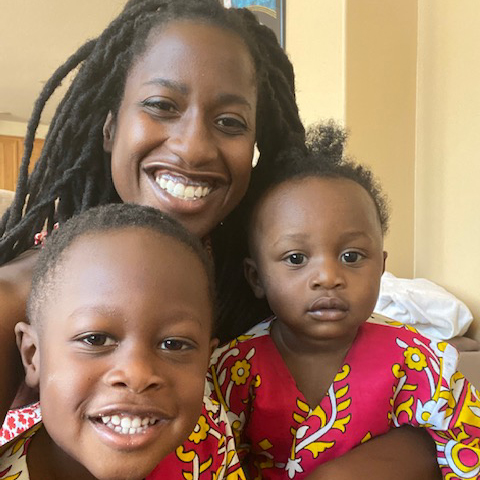
Abigail Oduol’s (she/hers) surname is not Irish or Pennsylvania Dutch. It’s Kenyan. Abigail is the CCF Movement Coordinator and is a member of too many committees. She invests time thinking about how popular culture informs fundraising and how people connect to each other. Follow Abigail on LinkedIn.
“I would have done more, but…” text

“I would have done more, but…” text

By Chris Talbot, communications professional and educomics creator

Go back to the educomic via this link

Introduction

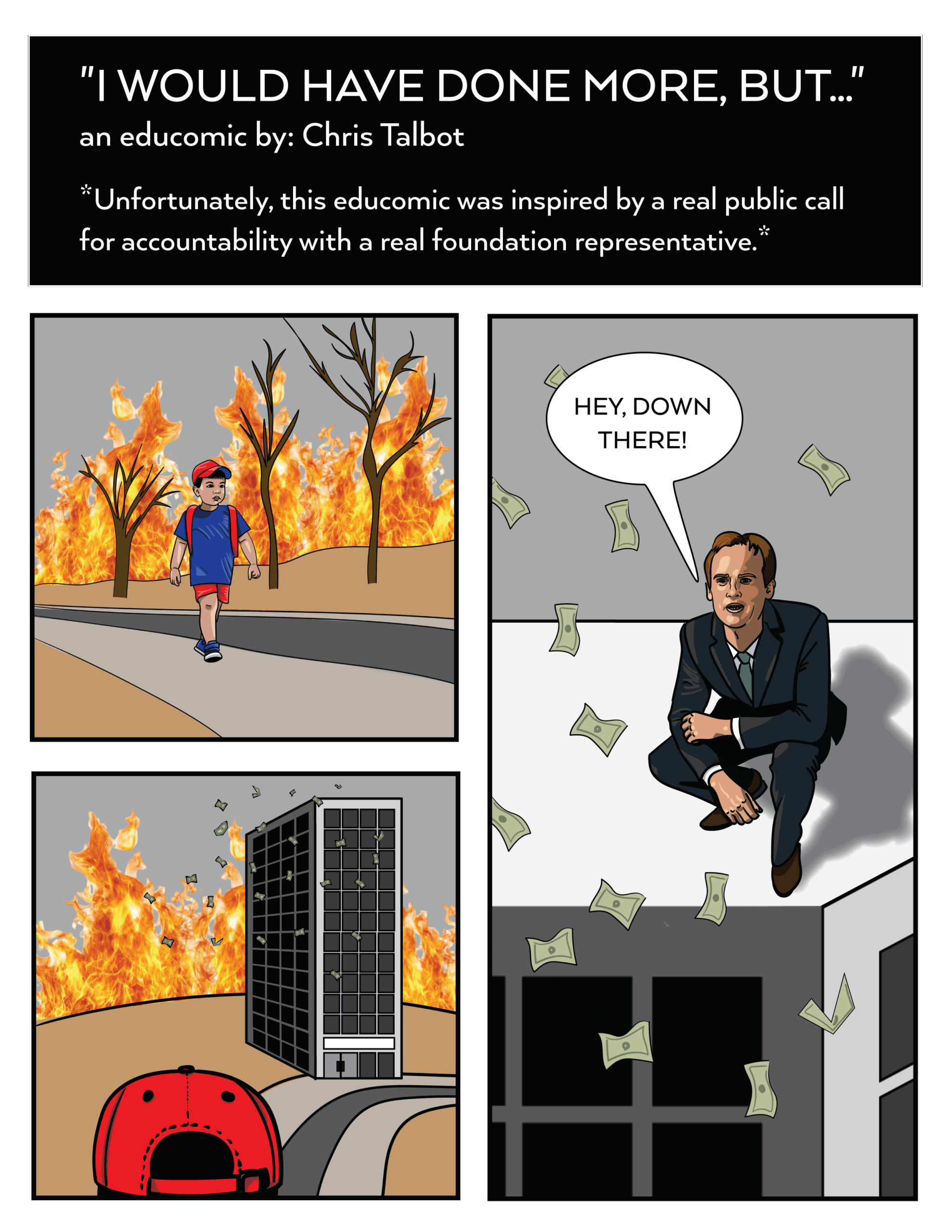
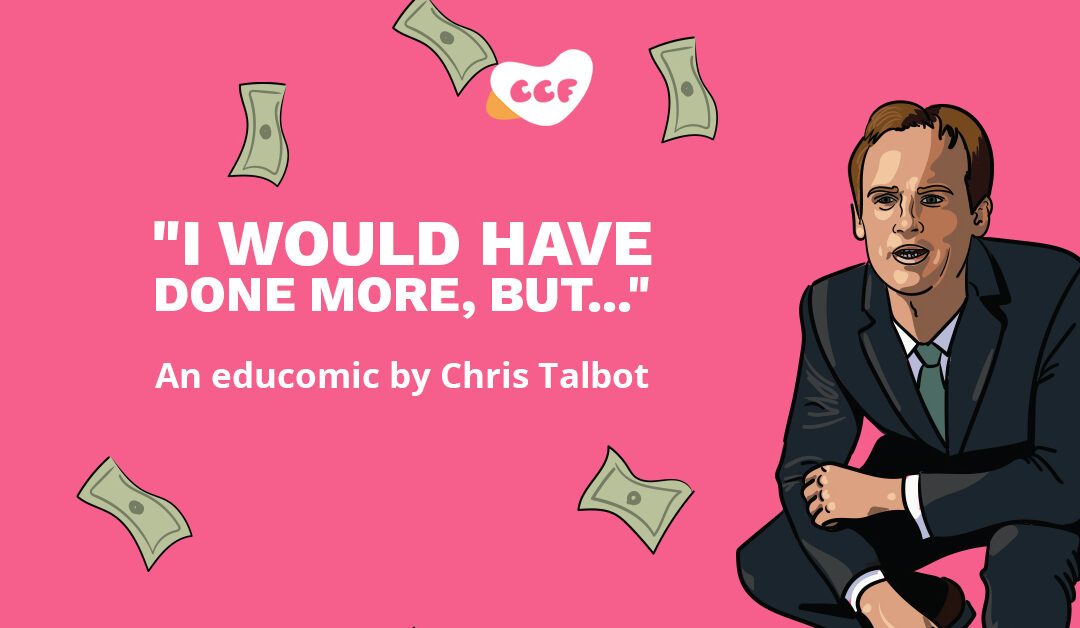
The header says “I would have done more, but…” an educomic by Chris Talbot. *Unfortunately, this educomic was inspired by a real public call for accountability with a real foundation representative.

First Section

A small child walks along a concrete walkway. Around them, the land is barren, the trees are without leaves, and the world is literally burning.

In the second cell, the child approaches a tall building where money is raining down.

In the third cell, there’s a man in a business suit standing on top of the building where money is raining down. The man shouts down, “Hey, down there!”

Second Section

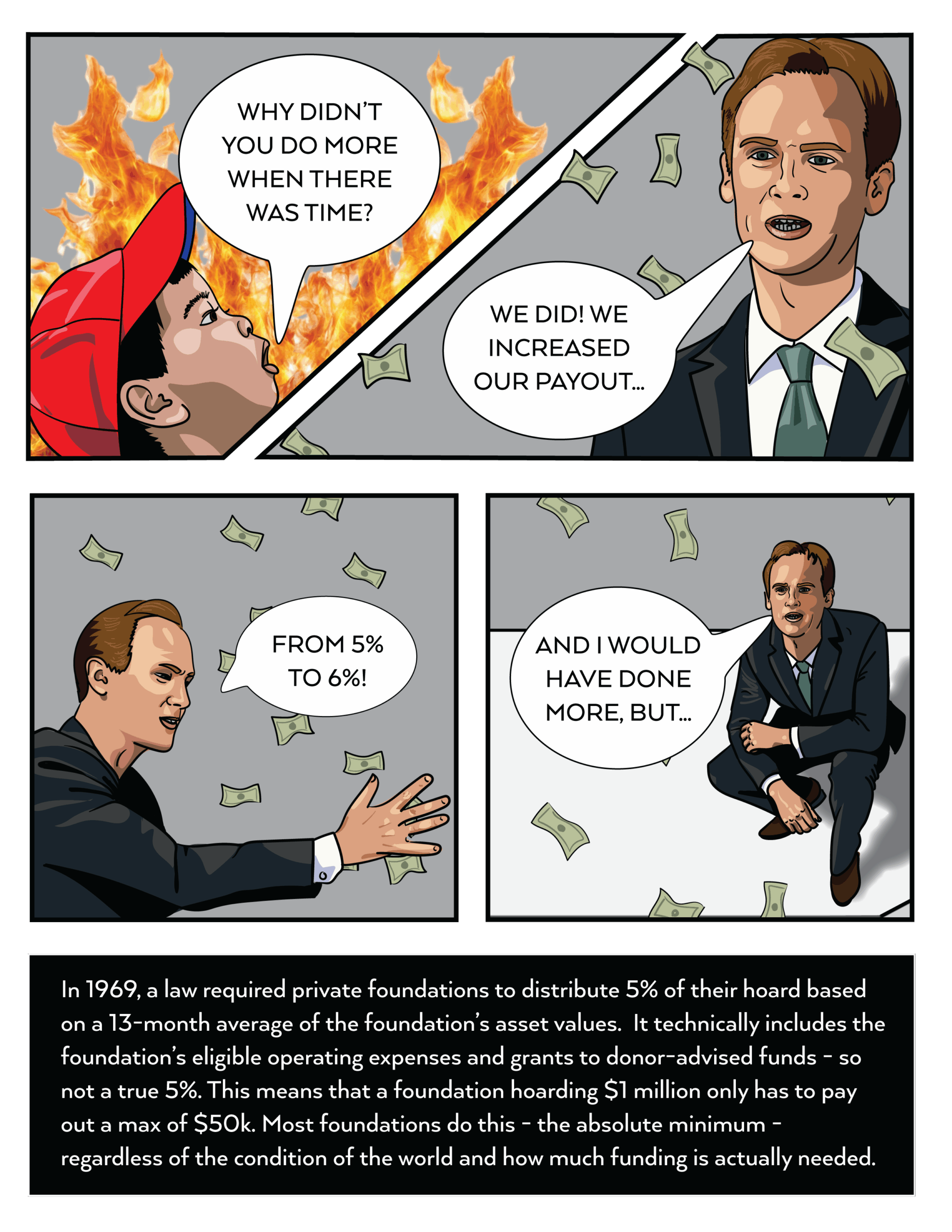
In the next cell, the small child looks up and asks “Why didn’t you do more when there was time?” There are flames in the background.

In the next cell, the man answers “We did! We increased our payout…” Money rains down around him.

In the next cell, he’s gesturing with all five fingers splayed out with one hand. He finishes “From 5% to 6%!”

In the next cell, he says, “And I would have done more, but…”

Below this illustration is a text box which says, “In 1969, a law required private foundations to distribute 5% of their hoard based on a 13-month average of the foundation’s asset values. It technically includes the foundation’s eligible operating expenses and grants to donor-advised funds — so not a true 5%. This means that a foundation hoarding $1 million only has to pay out a max of $50k. Most foundations do this — the absolute minimum — regardless of the condition of the world and how much funding is actually needed.”

Third Section

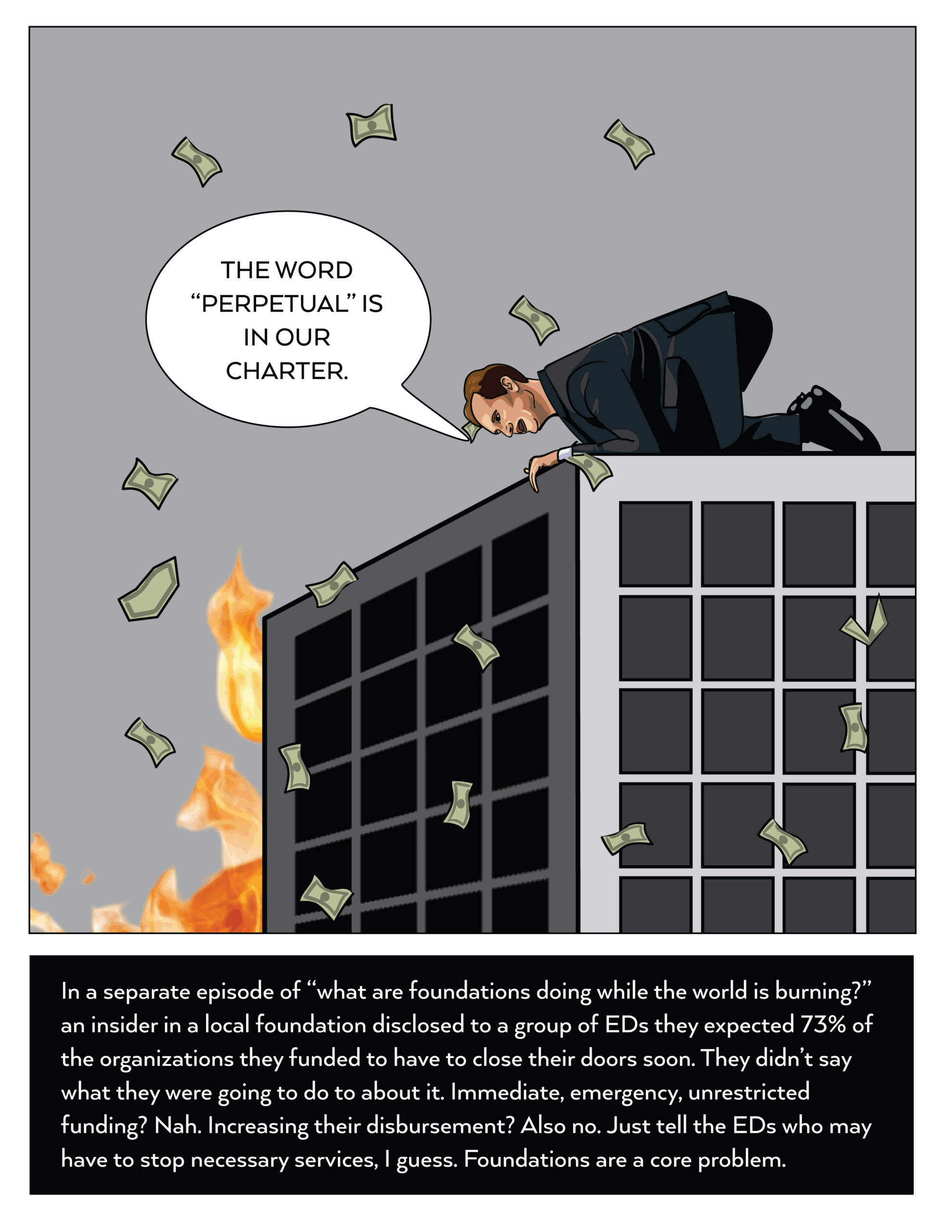
In this cell, The man is on all fours, looking down from the building. There are flames behind the building and money raining down on it. He finishes, “…the word ‘perpetual’ is in our charter.”

In a final text box, it says, “In a separate episode of ‘what are foundations doing while the world is burning?’ an insider in a local foundation disclosed to a group of EDs they expected 73% of the organizations they funded to have to close their doors soon. They didn’t say what they were going to do about it. Immediate, emergency, unrestricted funding? Nah. Increasing their disbursements? Also no. Just tell the EDs who may have to stop necessary services, I guess. Foundations are a core problem.”

Chris Talbot

Chris Talbot

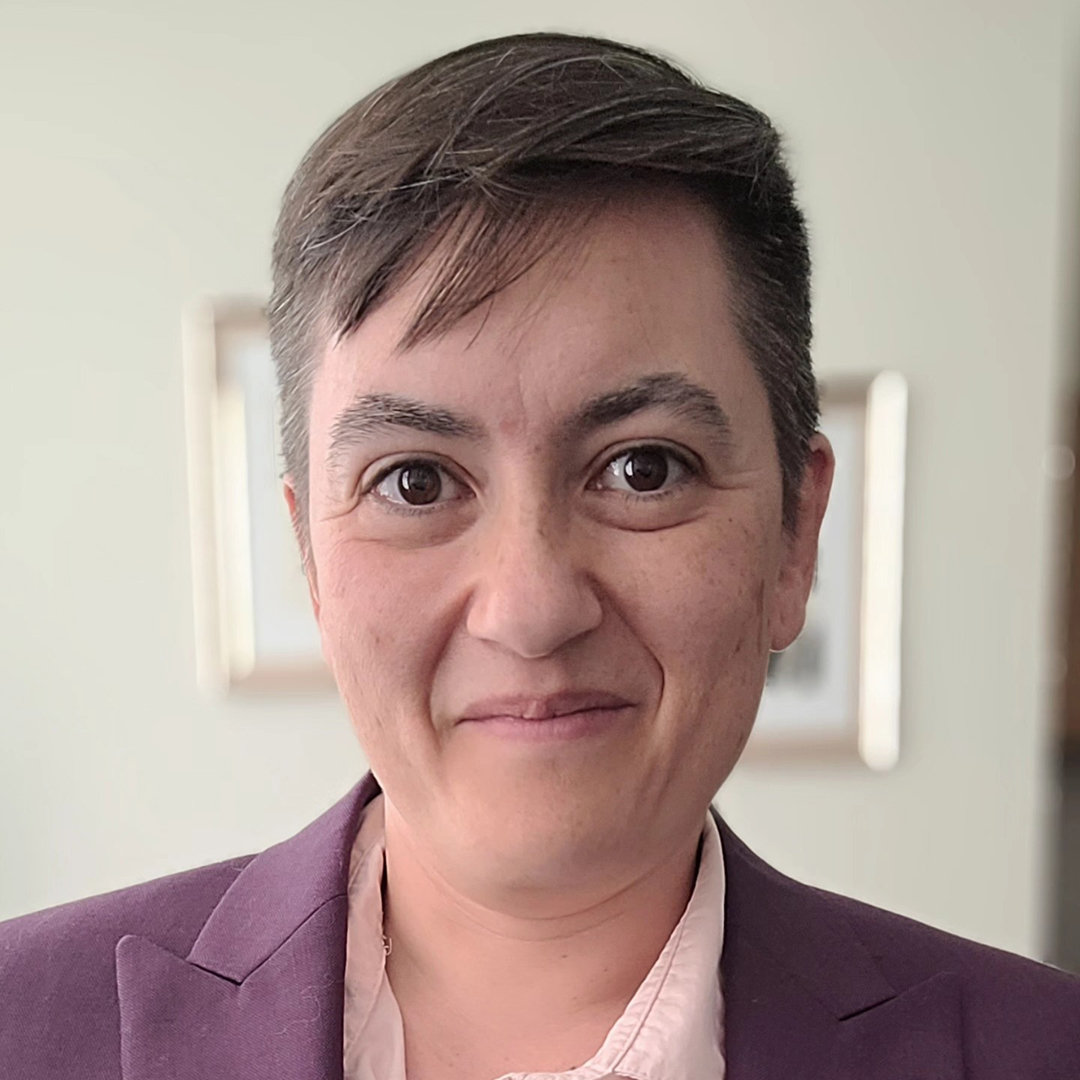
Chris Talbot (they/them) is a queer, trans nonbinary, mixed-race artist, activist, and nonprofit employee. When they aren’t working the day job, they spend their free time editing art and literature magazines, writing and illustrating educomics to help folks affirm their nonbinary pals, creating a graphic novel to describe what it’s like to be nonbinary in a gender binary world, cuddling their cat, and quad skating in the park. Purchase their debut book, Why Must the White Cis Nonprofit Workers Angry React to All My Posts? A compilation of essays, posts, and thoughts by a queer, trans, mixed-race professional surviving predominantly white cisgender heterosexual institutions.

You can find Chris at mxchristalbot.com, on LinkedIn, Instagram, Bluesky, and Twitter — and tip them on Venmo or PayPal or join as a patron on their Patreon.

“I would have done more, but…” text

“I would have done more, but…”

By Chris Talbot, communications professional and educomics creator

View accessible/text-only version

The first three cells of the educomic "I would have done more, but..." See the text version linked at the top


Middle five cells of the educomic "I would have done more, but..." See the text version linked at the top


Last two cells of the educomic "I would have done more, but..." See the text version linked at the top


Chris Talbot

Chris Talbot

Chris Talbot (they/them) is a queer, trans nonbinary, mixed-race artist, activist, and nonprofit employee. When they aren’t working the day job, they spend their free time editing art and literature magazines, writing and illustrating educomics to help folks affirm their nonbinary pals, creating a graphic novel to describe what it’s like to be nonbinary in a gender binary world, cuddling their cat, and quad skating in the park. Purchase their debut book, Why Must the White Cis Nonprofit Workers Angry React to All My Posts? A compilation of essays, posts, and thoughts by a queer, trans, mixed-race professional surviving predominantly white cisgender heterosexual institutions.

You can find Chris at mxchristalbot.com, on LinkedIn, Instagram, Bluesky, and Twitter — and tip them on Venmo or PayPal or join as a patron on their Patreon.

Becoming the desert’s memory

Becoming the desert’s memory

By nae vallejo, a Black, queer, trans, disabled experiential archivist and access designer

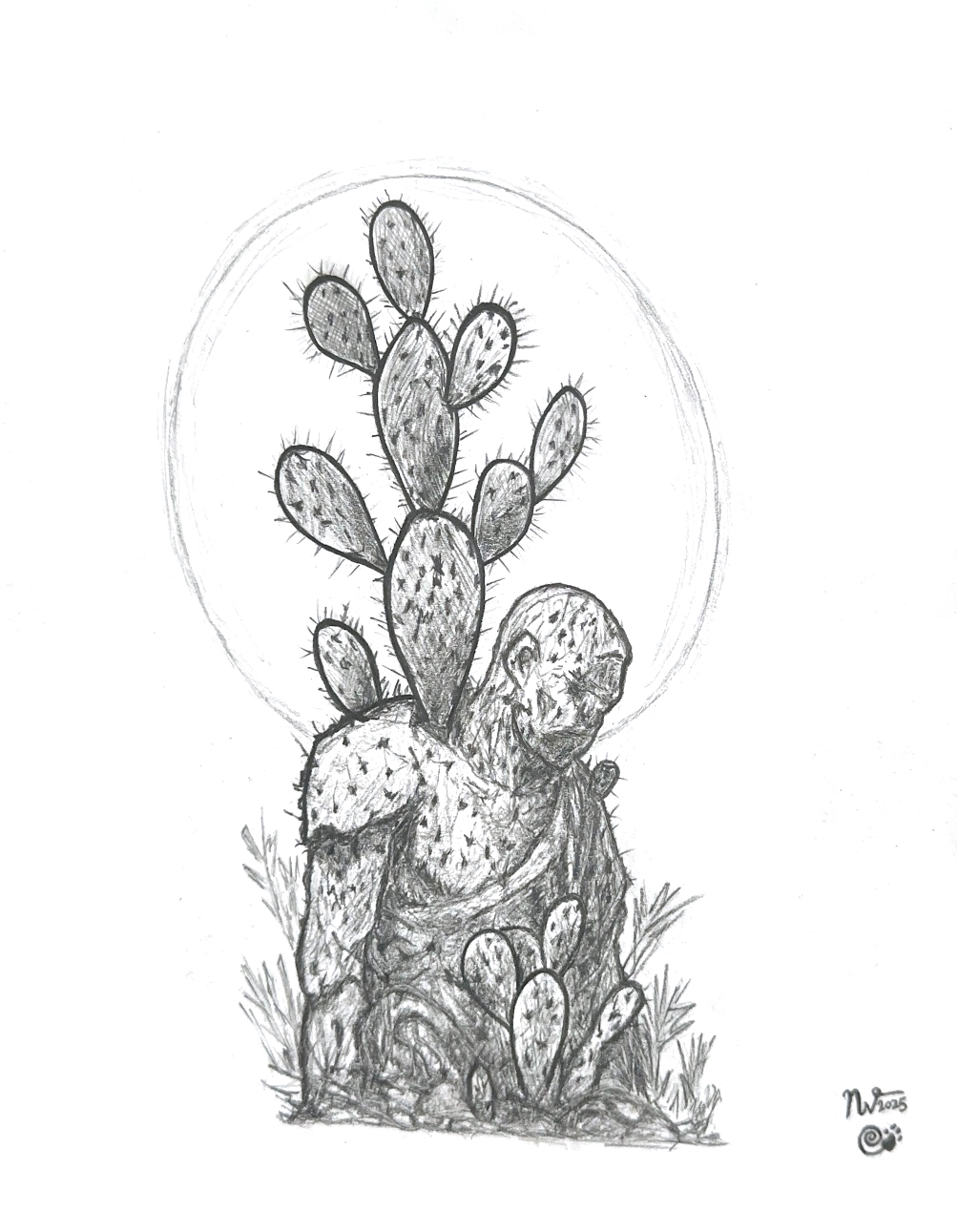
graphite drawing of a human figure intertwined with a cactus

Artist Statement

The desert knows how to remember – how to sustain life under pressure, how to make beauty from scarcity, how to bloom when no one expects it. I see my people in that terrain: the Black, Native, disabled, trans, and poor bodies who have always learned to root and rise through community, care, and imagination.

Becoming the Desert’s Memory reflects the endurance, wisdom, and adaptive beauty of disabled, Black, Native, and of color bodies – how we grow, re-member, and make meaning within conditions not meant for our thriving. This piece is both an offering and witness, a meditation on what it means to survive without erasing the tenderness that keeps us alive. The desert, often misread as empty, is a living archive. It holds memory in its bones, water in its depths, and resilience in its silence. The desert knows how to remember – how to sustain life under pressure, how to make beauty from scarcity, how to bloom when no one expects it. I see my people in that terrain: the Black, Native, disabled, trans, and poor bodies who have always learned to root and rise through community, care, and imagination.

The desert mirrors us. It holds our histories of persistence and possibility. 

In this piece, the figure is intertwined with cacti, embodying the paradox of tenderness and sharpness that survival requires. The cacti are both educator and kin. It shows that defense can be sacred, that softness and strength are not opposites. Its spines are not aggression; they are clarity, boundary, and truth. Its blooms arrive not in abundance but in rhythm, reminding us that flourishing does not depend on permission. 

As an AuDHD, deaf, Black, trans survivor, experiential archivist and access designer, I create from a place of embodied remembering. My art emerges from the archives my body carries – of grief and joy, silence and sound, rupture and repair. The desert’s landscape feels familiar: a space of contrast, restraint, and revelation. Like the cacti, I have learned to hold water in my own way – to preserve energy, to open only when safety and care allow. My work honors that rhythm. It insists that slowness is wisdom, that adaptation is not assimilation, and that survival itself is art. 

Becoming the Desert’s Memory is also a love letter to my kin – to disabled, Black, Native, and of color survivors, to trans and queer villages who have been told our lives are too much or not enough. It honors the ways we continue to cultivate, care, and connect despite systems designed to erase us. We are the desert’s proof that beauty and endurance are not separate, and that living, even in fragments, is an act of creation. When I make art, I am in conversation with survivors – the ones rebuilding after harm, after loss, after invisibility. We are living testimonies that story is medicine. Through our survival, we archive new ways of being. My work seeks to hold that continuum of becoming – to remember us not as broken, but as constantly re-forming, reshaping, returning. 

The desert teaches that every being has its own rhythm of reaching and retreating. Our disabled, queer, trans, and survivor bodies move that way, too, stretching toward possibility, resting when needed. Our rest is resistance. Our boundaries are devotion. Our joy is evidence of life beyond harm. 

Ultimately, Becoming the Desert’s Memory is both personal and collective. It is a mirror, a prayer, a record of what it means to inhabit a body that carries scar and bloom at once. It celebrates the brilliance of disabled survival, the wisdom of Black and Native endurance, the sacredness of trans and survivor becoming. It calls us to see our bodies not as aftermaths, but as living archives-alive, alert, and still blooming. 

The desert, in its quiet vastness, reminds me that memory is never lost. It lingers in roots, in shadows, in breath. It whispers that we, too, are landscapes of endurance and story. Even when the soil cracks and the light burns, something within us still reaches upward. We become the memory that refuses to fade-the proof that we have always been here, and will continue to bloom. 

Visual details: 

Title: Becoming the Desert’s Memory 

Medium: graphite on cardstock paper 

Alt text: graphite drawing of a human figure intertwined with a cactus, symbolizing survival, memory, and renewal.

nae vallejo

nae vallejo

nae vallejo (they/he) is a Black, Caddo, Mexican, queer, trans, disabled experiential archivist and access designer. their work moves through memory, rememory, and care, exploring how survivors leave trace across body, land, and story. as the founder of naeborhood projects, nae creates art that weaves disability justice, sensory attunement, and community connection into everyday practices of survival and tenderness. a hard of hearing, neurodivergent service dog guardian and lifelong educator, he centers interdependence, ritual, and storytelling as tools for collective care. follow their offerings on Instagram @naeborhoodprojects and support their labor via Venmo @nae-vallejo or Paypal @naevallejo.

How to apply the foundational yogic principles of Yama and Niyama to Fundraising

How to apply the foundational yogic principles of Yama and Niyama to Fundraising

By Unzila Chowdhury, a nonprofit strategist and development expert committed to helping BIPOC leaders build sustainable, values-aligned organizations

I found it helpful to draw parallels between [the Yamas and Niyamas] principles and various elements of my life to better understand them. They’ve provided a framework that has shaped my approach to both work and fundraising efforts.

Fresh out of college, naive with a fiery passion to create change, I eagerly joined a nonprofit organization 3,000 miles away from my friends and family as a volunteer in Southern California. I quickly came to understand firsthand a harsh and all-too-familiar reality in this sector: that nonprofit organizations are often complicit in upholding the very systems of oppression they claim to dismantle.

This became painfully clear when I reported a case of sexual harassment and was placed on paid leave. It wasn’t until another coworker who had also been harassed by the same person came forward that meaningful action was finally taken. It made me wonder whether a single person’s experience would have ever been taken seriously on its own. At the same time, I was earning just $12,000 a year while living in California, providing essential services with minimal training. This was a clear reflection of how the nonprofit sector often exploits those doing the most critical work. Overwhelmed and anxious, I began showing up to the only support I could afford, free meditation sessions at the neighborhood yoga studio.

The 5 a.m. meditation session turned into a 10-month journey through rigorous yoga teacher training. As a South Asian Muslim woman, I had always felt uneasy about mainstream yoga studios in the U.S. Their tendency to appropriate the practice, obscuring the violence inherent in the caste system and brushing over real-world issues with a shallow “namaste” ethos, made me especially skeptical (shout out to my teacher, Scott Miller, for speaking truth to power and creating a safe, affirming space for me throughout this journey).

Despite my reservations, I dove deep into yogic theory and discovered practices that I could apply to different aspects of my life.

The Yamas and Niyamas, foundational principles of yogic philosophy, have been particularly impactful. Somehow, I found it helpful to draw parallels between these principles and various elements of my life to better understand them. They’ve provided a framework that has shaped my approach to both work and fundraising efforts. While I don’t claim to have mastered these principles—and I’m unsure if perfection is even attainable—they continue to serve as a meaningful guide.

The nonprofit world and the yoga world, in many ways, share the same pitfalls: both often preach values of peace, equity, and justice, yet frequently fail to address issues head-on—such as the ongoing genocide in Palestine. The unwillingness of both spaces to engage meaningfully against such atrocities is disheartening, but not surprising. This, however, is a conversation for another day.

Years later, when I stumbled upon Community-Centric Fundraising (CCF) principles, it felt like finding a similar philosophy in a different form. 

The Yamas: Ethical Disciplines in Nonprofit Work

The Yamas, as described in The Yoga Sutras of Patanjali, are ethical principles that guide how we interact with the world and others. In the context of nonprofit fundraising, these values can provide a moral compass for how we engage with communities, donors, and colleagues.

Ahimsa (Non-violence): Compassion in Action

Ahimsa, or non-violence, means practicing compassion for all living beings—avoiding harm in thought, word, and deed. 

In the nonprofit sector, I believe this calls us to reflect on how, even with good intentions, we might inadvertently cause harm. Are we perpetuating trauma for those we claim to serve by exploiting their stories for donations? Are we overworking staff in the name of doing good? 

Ahimsa urges us to cultivate kindness and gentleness in our interactions and to recognize that, in trying to help, we must be careful not to harm.

Satya (Truthfulness): Honest Communication

Satya is the practice of truthfulness—not just in speaking the truth but in living it. 

Nonprofit organizations must be transparent with all stakeholders, from staff and partners to funders, donors, and the communities they serve. It’s essential to be honest about the challenges we face, the impact we have (or haven’t had), and where we need to grow. Too often, nonprofits are caught in a cycle of presenting inflated success stories to appease funders. 

Satya calls for integrity and authenticity, even when the truth is difficult to confront. The work that we do in the nonprofit world is far from perfect and does not always achieve the desired outcomes. Yet, embracing truthfulness fosters genuine growth and encourages others to follow suit.

Asteya (Non-stealing): Respect for Time and Resources

Asteya, or non-stealing, reminds us to respect what is not ours—including time, energy, and resources. 

In the nonprofit world, this principle can challenge the culture of overwork and burnout. How often do we steal time from our staff, asking them to sacrifice their well-being for the mission? And how often, in our relentless pursuit of making an impact, do we take time away from our loved ones or neglect ourselves? We must honor the time and energy of everyone involved in our work and our lives, ensuring we don’t deplete our most valuable resources, our people.

Brahmacharya (Moderation): The Right Use of Energy

While traditionally interpreted as celibacy, Brahmacharya, in the modern context, is about the wise use of energy. 

In fundraising, this can be seen as a call for balance, avoiding overindulgence or hoarding resources. Nonprofits sometimes fall into the trap of accumulating funds without a clear plan for their ethical use, or prioritizing fundraising over the actual work of serving communities. It’s crucial to be discerning about the grants pursued and the donors accepted, even choosing to decline funding if your values don’t align with the granting agency or if it would benefit other organizations more significantly than your own.  

Brahmacharya asks us to direct our energy thoughtfully and efficiently, ensuring we don’t exhaust ourselves or waste resources.

Aparigraha (Non-possessiveness): Letting Go of Attachments

Aparigraha teaches us to let go of attachment—to outcomes, material possessions, or even our professional identities. 

In nonprofit work, we often tie our sense of self-worth to our jobs, to the success of a campaign, or to the validation of funders. This attachment can cloud our judgment and fuel unhealthy competition for resources. 

Aparigraha reminds us to serve without clinging to results, and to work for the sake of the greater good without letting our ego drive the mission.

The Niyamas: Inner Observances and Personal Practices

While the Yamas focus on how we engage with the external world, the Niyamas turn our attention inward, guiding our personal discipline and self-care. In nonprofit fundraising, these principles help us maintain our integrity, build resilience, and foster a healthy relationship with our work.

Saucha (Purity): Keeping Things Clean

Saucha refers to cleanliness—of body, mind, and environment. 

In the workplace, this can mean maintaining a clear and organized space, but also cultivating mental and emotional purity. It’s about setting boundaries and wiping your feet at the door, so to speak, when moving between work and personal life. 

Purity in thought and intention helps us approach our work with clarity and focus, ensuring that we’re not carrying the weight of unresolved stress or negative emotions into our relationships with colleagues or the communities we serve.

Santosha (Contentment): Cultivating Gratitude

Santosha is the practice of contentment—being at peace with what we have and where we are. 

In the fast-paced, outcome-driven world of nonprofit fundraising, it’s easy to get caught in the cycle of constantly striving for more: more funds, more recognition, more impact. 

Santosha teaches us to find contentment in the present, and to appreciate the progress we’ve made without always seeking external validation or success. Gratitude for small victories fosters a sense of fulfillment, preventing burnout and helping us maintain perspective.

Tapas (Discipline): Enduring for Growth

Tapas is the inner discipline and resilience that comes from willingly enduring discomfort for the sake of growth. 

In nonprofit work, this can be seen as the grit required to stay the course, especially in challenging times. Fundraising is often difficult, filled with rejection, setbacks, and long hours. 

Tapas asks us to embrace these challenges as opportunities for personal and organizational growth, building the stamina needed to continue the work despite obstacles.

Svadhyaya (Self-study): Reflection for Growth

Svadhyaya, or self-study, is the practice of reflection and self-awareness. 

In our line of work, this means regularly reflecting on our personal actions, performance, and motivations. Are we truly serving our mission, or have we strayed? Do we understand the impact of our work on others, including unintended consequences? Is it time to step down from our position and let others lead? 

Svadhyaya encourages us to seek feedback, engage in self-inquiry, and continually evolve, ensuring that we’re operating from a place of integrity and alignment with our values.

Ishvara Pranidhana (Surrender): Letting Go of Control

Ishvara Pranidhana is the practice of surrendering, and letting go of ego-driven desires and outcomes. 

This is about recognizing that we cannot control everything—that sometimes, despite our best efforts, outcomes are beyond our grasp, especially as we sit in the belly of the beast fighting against different forms of systemic oppression. Surrendering to the process doesn’t mean giving up, but rather it’s about staying humble, remembering that we are part of something larger than ourselves. The issues we are trying to solve have existed before us and may not be solved in our lifetimes. It’s about allowing space for grace and being prepared for unexpected outcomes, all so that we can continue fighting for a better world.  

Both the nonprofit sector and the practice of yoga, despite their shortcomings, hold an encompassing and ubiquitous role in society. They are spaces where individuals strive to address challenges and growth, often with profound sincerity and effort. 

Yet, as with any system or philosophy, they are not immune to the contradictions and imperfections of the world they inhabit. 

Both have the potential to either perpetuate harm or be forces for deep transformation, depending on how their principles are understood and applied.

Unzila Chowdhury

Unzila Chowdhury

Unzila Chowdury (she/her) is a nonprofit development and workforce professional with over eight years of experience working with diverse populations, including formerly incarcerated individuals, Native American governments, and unhoused individuals. Her focus is on supporting BIPOC nonprofit leaders in growing their organizations sustainably and in alignment with their values. Unzila has also worked at the intersection of multi-family affordable housing and clean energy. Currently, Unzila serves as the Director of Development at Laal NYC, a Bronx-based nonprofit serving Bangladeshi immigrant women survivors of domestic violence. She holds a Bachelor of Arts in Economics and Environmental Science, with a Minor in Women, Gender and Sexuality from St. Mary’s College of Maryland and a Master’s in Nonprofit Management from Antioch University.