By nae vallejo, a Black, queer, trans, disabled experiential archivist and access designer
Artist Statement
The desert knows how to remember – how to sustain life under pressure, how to make beauty from scarcity, how to bloom when no one expects it. I see my people in that terrain: the Black, Native, disabled, trans, and poor bodies who have always learned to root and rise through community, care, and imagination.
Becoming the Desert’s Memory reflects the endurance, wisdom, and adaptive beauty of disabled, Black, Native, and of color bodies – how we grow, re-member, and make meaning within conditions not meant for our thriving. This piece is both an offering and witness, a meditation on what it means to survive without erasing the tenderness that keeps us alive. The desert, often misread as empty, is a living archive. It holds memory in its bones, water in its depths, and resilience in its silence. The desert knows how to remember – how to sustain life under pressure, how to make beauty from scarcity, how to bloom when no one expects it. I see my people in that terrain: the Black, Native, disabled, trans, and poor bodies who have always learned to root and rise through community, care, and imagination.
The desert mirrors us. It holds our histories of persistence and possibility.
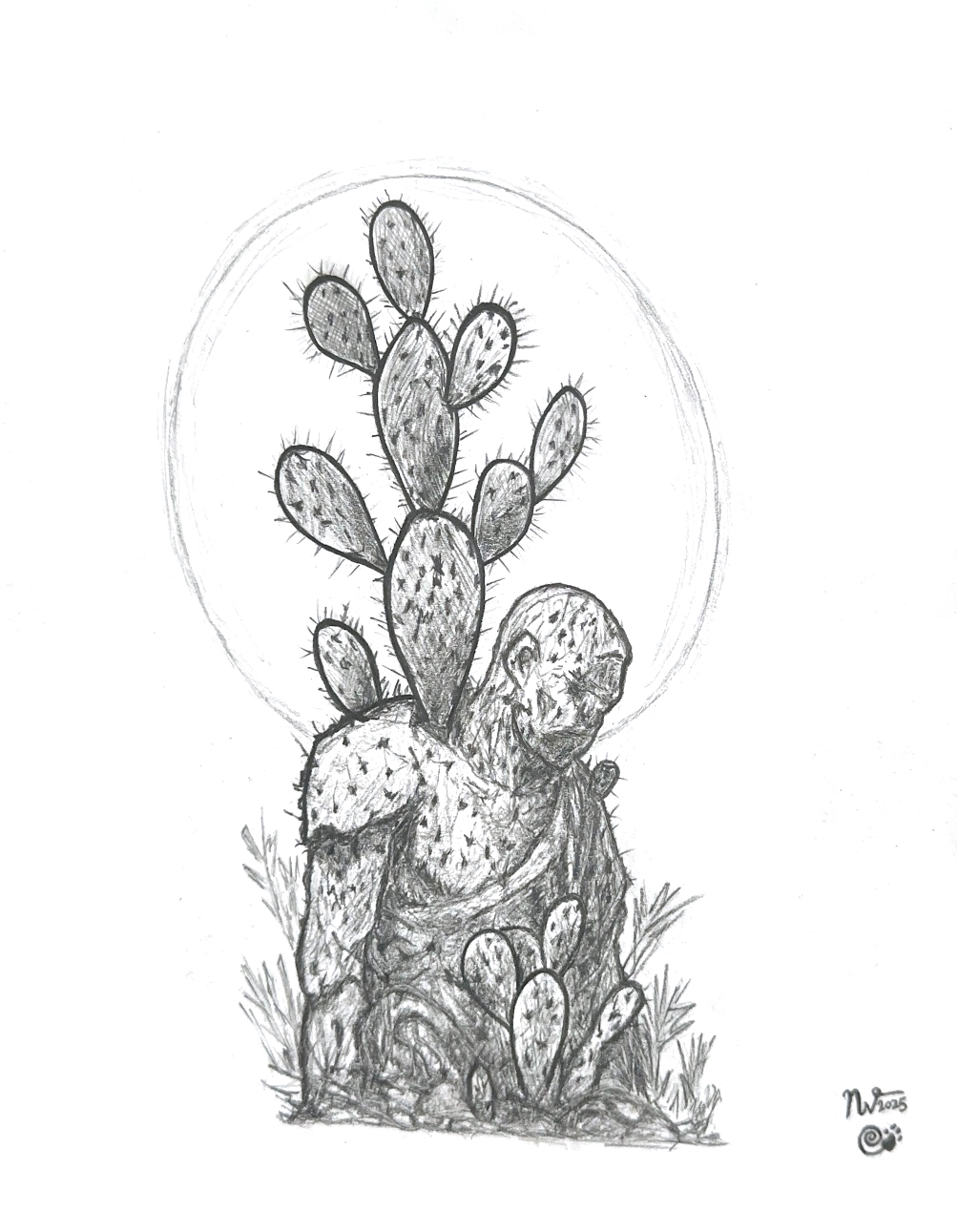
In this piece, the figure is intertwined with cacti, embodying the paradox of tenderness and sharpness that survival requires. The cacti are both educator and kin. It shows that defense can be sacred, that softness and strength are not opposites. Its spines are not aggression; they are clarity, boundary, and truth. Its blooms arrive not in abundance but in rhythm, reminding us that flourishing does not depend on permission.
As an AuDHD, deaf, Black, trans survivor, experiential archivist and access designer, I create from a place of embodied remembering. My art emerges from the archives my body carries – of grief and joy, silence and sound, rupture and repair. The desert’s landscape feels familiar: a space of contrast, restraint, and revelation. Like the cacti, I have learned to hold water in my own way – to preserve energy, to open only when safety and care allow. My work honors that rhythm. It insists that slowness is wisdom, that adaptation is not assimilation, and that survival itself is art.
Becoming the Desert’s Memory is also a love letter to my kin – to disabled, Black, Native, and of color survivors, to trans and queer villages who have been told our lives are too much or not enough. It honors the ways we continue to cultivate, care, and connect despite systems designed to erase us. We are the desert’s proof that beauty and endurance are not separate, and that living, even in fragments, is an act of creation. When I make art, I am in conversation with survivors – the ones rebuilding after harm, after loss, after invisibility. We are living testimonies that story is medicine. Through our survival, we archive new ways of being. My work seeks to hold that continuum of becoming – to remember us not as broken, but as constantly re-forming, reshaping, returning.
The desert teaches that every being has its own rhythm of reaching and retreating. Our disabled, queer, trans, and survivor bodies move that way, too, stretching toward possibility, resting when needed. Our rest is resistance. Our boundaries are devotion. Our joy is evidence of life beyond harm.
Ultimately, Becoming the Desert’s Memory is both personal and collective. It is a mirror, a prayer, a record of what it means to inhabit a body that carries scar and bloom at once. It celebrates the brilliance of disabled survival, the wisdom of Black and Native endurance, the sacredness of trans and survivor becoming. It calls us to see our bodies not as aftermaths, but as living archives-alive, alert, and still blooming.
The desert, in its quiet vastness, reminds me that memory is never lost. It lingers in roots, in shadows, in breath. It whispers that we, too, are landscapes of endurance and story. Even when the soil cracks and the light burns, something within us still reaches upward. We become the memory that refuses to fade-the proof that we have always been here, and will continue to bloom.
Visual details:
Title: Becoming the Desert’s Memory
Medium: graphite on cardstock paper
Alt text: graphite drawing of a human figure intertwined with a cactus, symbolizing survival, memory, and renewal.

nae vallejo
nae vallejo (they/he) is a Black, Caddo, Mexican, queer, trans, disabled experiential archivist and access designer. their work moves through memory, rememory, and care, exploring how survivors leave trace across body, land, and story. as the founder of naeborhood projects, nae creates art that weaves disability justice, sensory attunement, and community connection into everyday practices of survival and tenderness. a hard of hearing, neurodivergent service dog guardian and lifelong educator, he centers interdependence, ritual, and storytelling as tools for collective care. follow their offerings on Instagram @naeborhoodprojects and support their labor via Venmo @nae-vallejo or Paypal @naevallejo.
Discover more from CCF
Subscribe to get the latest posts sent to your email.
The drawing is exquisite and the storytelling is precise, giving you such detail that you can see it unfolding.