Defunding of the ECJ Communities Grants: The scale of what is being taken from communities nationwide

Defunding of the ECJ Communities Grants: The scale of what is being taken from communities nationwide

By Jenny Brandt, environmental justice advocate

The actions of the Federal Government have caused harm. For grantees, this has in some cases led to them laying off staff, spending limited resources without reimbursement, and may even result in threatening an organizations’ existence. It has certainly eroded relationships built with communities over years. And life-saving measures that were going to be implemented will not.

If you read our earlier blogs on The Hub, you’d have heard about Community-Centric Fundraising (CCF)´s participation as a thought partner and trainer for the Mountains & Plains Environmental Justice Grants Hub through the Thriving Communities Grantmaking Program (TCGM). We were among a group of organizations thrilled to be part of a new model in grantmaking. 

The new model designated 11 regional Environmental Justice Thriving Communities Grantmakers to handle the burdensome government reporting and allocate subgrants to organizations previously unable to access Federal funding to address environmental harm in their communities.

We are still processing the news that the Region 8 Grantmaker Hub has closed well before 2027 grant end date, and before the first round of grants were distributed to deserving communities.

The EPA Administrator Lee Zeldin and DOGE (Department of Government Efficiency) canceled the contract on the grounds that the award “no longer effectuates the program goals or agency priorities.” 

What happened to the program:

This program had been more than two years in the making. CCF was approached in April of 2023 to provide support for the program as a potential partner for the Mountains & Plains Environmental Justice Grants Hub (MAP EJ), JSI Research and Training Institute (JSI). In December of 2023, after spending months putting together their application, JSI was accepted as a Grantmaking Hub and began working with the EPA. 

They worked intentionally to build a new system for making sub-awards for Community-Based Organizations; they developed an ingenious grading system for scoring applications from communities; they built a special non-competitive grant award for organizations in most in need of investment. 

And just when this work was about to start having on-the-ground impact, the program was stopped cold. This sudden termination of grants happened after 96 projects were selected to receive $22.8 million dollars in the first round. 

The impacts on organizations and communities:

The funds were set to support community projects ranging from those that would help in accessing healthy local food; providing workforce and youth training; measuring and improving water quality; investing in infrastructure and energy efficient homes; monitoring and improving air quality; reducing exposure to lead, asbestos, pesticides, and toxins; cleaning up and managing waste; and much more.

A sample project that was unceremoniously defunded was a project that focused on replacing lead lines in low-income areas identified as “communities of focus” based on the Inflation Reduction Act’s disadvantaged communities map (which has been scrubbed of all information). 

Another defunded project would have focused on improving climate resilience and environmental health for small farmers in a rural county in Colorado, by promoting regenerative agricultural practices. The project involved providing training and technical assistance to participating farmers, along with developing a network of peer-educators. The project leveraged existing partnerships and expertise in rural community development.

Due to Administrator Lee Zeldin’s cancellation of the grant program, these projects did not receive the funds they had been promised. This is really difficult to witness. But it is part of an even greater scale of what has been attacked under this administration. 

In the second round of applications—which took place with the chaotic backdrop of the EPA sending stop work orders to some of the other grantmaking hubs and Thriving Communities Technical Assistance Centers (TCTACs, a $177 million program)—another 237 applications requested an additional $65 million dollars. The TCTACs came on board to build a pipeline to help small organizations build their capacity to receive funding for community-led solutions to environmental issues and climate impacts.

The actions of the Federal Government have caused harm. For grantees, this has in some cases led to them laying off staff, spending limited resources without reimbursement, and may even result in threatening an organizations’ existence. It has certainly eroded relationships built with communities over years. And life-saving measures that were going to be implemented will not. 

What is being done and what we can do:

There is demonstrated need for investments in Region 8 and nationally. But not only has Region 8’s Grantmaking Hub been closed, only three of the regional Grantmaking Hubs are currently operational, greatly reducing the impact of what $550 million in pass-through funding would have meant for communities in all 50 states and in 578 tribal nations. 

The three regions continuing the work sued the EPA and won the reinstatement of $180 million dollars in funding

Both the TCGM and TCTAC programs were part of the Environmental and Climate Justice (ECJ) Community Grant program, along with other grants, including the EJ Collaborative Problem Solving Grants (EJ-CPS,) $43.8 million), EJ Government- to- Government grants (EJ-G2G,  $84.2 million), Technical Assistance Grants (TA) for Inflation Reduction Act (IRA) Funded Grants ($200 million), and Community Change Grants ($2 billion).    

This whole suite of ECJ Communities Grants have been defunded.

There is a class action lawsuit brought by Lawyers for Good Governance to see if the defunding of the IRA Environmental and Climate Justice Program may be reversed.  

I just read an amicus brief signed by 20 states Attorneys General supporting the lawsuit. 

They think that separation of powers is a strong case for reversing the defunding as the Environmental and Climate Justice Program was created by Congress through the creation of the Inflation Reduction Act (IRA) under Clean Air Act. You can follow the court proceedings and find all the amicus briefs here

We must learn how to act in solidarity with those fighting this, and we as fundraisers must build stronger, more resilient funding streams that are a combination of federal funds, state funds, private philanthropy, settlement monies, etc. so that communities that relied on these funds are not suddenly left without support.  

We cannot make up the $3 billion dollars in funding that has been suspended, but our sector should be doing more to respond to the needs of these communities. We need to be more creative in getting funding to frontline communities without so much red tape and regulation. 

And most importantly, we need to not lose the years of work that went into creating a platform that sought out a radical change based on equitable and just investment in communities to weather and adapt to climate change. 

The need is there and we must not lose the political will to see it done.  

Additional Information:

It was very discouraging to go through each of the awardees of the programs’ websites and read their statements about closing down. I have provided those below for those of us who want to burn with righteous rage:

Region Grantmaker  Messages EJ TCTAC(s)
1 — Serving CT, ME, MA, NH, RI, and VT. Health Resources in Action (HRiA)  Grantmaking has been postponed until further notice. New England Thriving Communities Technical Assistance Center (NE TCTAC) Some University based programs appear to be continuing the work despite stoppages in funding.
2 — Serving NJ, NY, Puerto Rico, the U.S. Virgin Islands, and 8 federally recognized Indian Nations. Fordham University  EPA terminated the program on May 2.  West Harlem Environmental Action, Inc. (dba WE ACT for Environmental Justice) and Engage & Assist Grassroots organization for Environment/Energy Justice and Leadership capacity building (EAGLE) Despite Successfully Supporting Organizations and Municipalities in EPA Region 2, the WE ACT TCTAC Receives Official Termination Notice from the Trump Administration and EAGLE Project ends
3 — Serving DE, DC, MD, PA, VA, WV, and 7 federally recognized Tribes. Green & Healthy Homes Initiative Inc.  GHHI’s Thriving Communities Grantmaking Program resumed their work on June 17! And will be announcing the next group of awarded grants soon. National Wildlife Federation No update to the page
4 — Serving AL, FL, GA, KY, MS, NC, SC, and TN. Research Triangle Institute  Cultivating Healthy Environments TCGM Grantmaking Program has been terminated due to shifts in priorities by the federal administration. Research Triangle Institute (RTI International) and Deep South Center for Environmental Justice (DSCEJ) Webpage doesn’t exist or was moved and Deep South Center for Environmental Justice joined the class action lawsuit.
5 — Serving IL, IN, MI, MN, OH, and WI. The Minneapolis Foundation  To help our team catch up on submitted proposals, we have temporarily stopped accepting applications. Blacks in Green (BIG) and University of Minnesota No mention of it and Great Lakes Thriving Communities Technical Assistance Center Suspends Services Following EPA Cooperative Agreement Termination.
6 — Serving AR, LA, NM, OK, and TX. Texas Southern University  Webpage doesn’t exist or has been moved. Deep South Center for Environmental Justice (DSCEJ) and New Mexico State University While this federally funded initiative has come to a close, we remain committed to promoting equitable access to environmental and public health resources and will continue to seek new funding opportunities to serve our region to resume this important work.
7 — Serving IA, KS, MO, and NE. Research Triangle Institute (National Grantmaker)  Cultivating Healthy Environments TCGM Grantmaking Program has been terminated due to shifts in priorities by the federal administration. Wichita State University

Dear partners, collaborators, colleagues, and friends,

Unfortunately, due to changes in external funding, we must pause all activities associated with the HEJC, effective immediately.

8 — Serving CO, MT, ND, SD, UT, and WY. JSI Research and Training Institute  The MAP EJ Grants Hub is now closed. Montana State University Important Notice: Effective February 21, 2025, MaPTCC has ceased operations due to withdrawal of EPA funding.
9 — Serving AZ, CA, HI, and NV. Social and Environmental Entrepreneurs (SEE), Inc  Update: We regret to inform you that the Thriving Communities Grantmaking program for Region 9 was terminated by the Environmental Protection Agency (EPA) due to shifts in priorities by the administration. As a result, we are unable to make grantee selections and have made the difficult decision to close the application portal to all applicants at this time. University of Arizona and San Diego State University No update to the page and SDSU’s Center for Community Energy and Environmental Justice (CCEEJ) aims to strengthen community organizations’ capacity and effectiveness in applying to, managing, and implementing environmental and energy justice grants and programs.
10 — Serving AK, ID, OR, WA, and 271 Native Tribes. Philanthropy Northwest  All applications are closed for Types 1, 2, and 3 grants, but we will continue to accept non-compete requests Willamette Partnership and University of Washington   Due to changes in federal funding policies, our Center’s services are slowed down until further notice. While our request intake form remains open, please expect significant delays or disruptions in our response. And Funding from the EPA and DOE was abruptly and prematurely terminated for the Thriving Communities Technical Assistance Centers (TCTACs) program on May 2, 2025 due to changes in federal priorities.
NATIONAL Regions 1-3 Institute for Sustainable Communities (ISC) As a National Grantmaker, SCR focuses on supporting, coordinating, and providing oversight to Regional Grantmakers. Inter City/County Management Association As of Friday, March 21, ICMA’s TCTAC team will no longer provide support for programs, projects, or services previously offered through the Environmental Justice Thriving Communities Technical Assistance Centers Program (EJ TCTAC).
NATIONAL Regions 4-7 Research Triangle Institute No news since award announcement. Institute for Sustainable Communities Currently inactive.
NATIONAL Regions 8-10 Climate Justice Alliance* Climate Justice Alliance Sunsets UNITE-EJ, Its Thriving Communities Grantmaking Program, After Still Not Receiving Obligated EPA Funds. National Indian Health Board Webpage doesn’t exist or was moved.


*This example is particular because the blockage of funds occurred under former President Biden. 

Jenny Brandt

Jenny Brandt

Jenny Brandt (she/her) is a member of the Global Council at CCF. She is a co-lead of the Membership and Regional team and is building the network in Latin America.    

Her career in non-profit organizations has focused on building equitable access for Latino communities to health, economic justice, advocacy, jobs within the Federal government, environmental justice, resources and conservation.

She currently resides in Chetumal, Mexico where she loves taking photographs. You can find her on Linkedin here

Maybe it’s time to acknowledge scarcity… in order to cultivate collective abundance

Maybe it’s time to acknowledge scarcity… in order to cultivate collective abundance

By Nel Taylor, (Umatilla) they/them, he/him — queer, trans, fat, organizational equity strategist, ethical fundraising expert, and nonprofit systems fixer

Someone working from [a Collective Abundance] model doesn’t wait for big grants to trickle down. They find creative, hyper-local ways to resource others in the community by sharing donors ethically, co-hosting campaigns, exchanging labor, pooling sponsorships, and even trading non-cash resources that reduce expenses.

One of the huge shifts that the Community-Centric Fundraising movement ignited is the mindset shift from scarcity to abundance. At the core of the abundance mindset is the belief that there’s enough money out there, and more will come your way.

Does that strike anyone else as individualistic?

A great example of scarcity vs. abundance mindset, where the solution was in neither approach, can be found in the Great Toilet Paper Panic of 2020. Facing the threat of quarantine, apparently one of the first things on many Americans’ minds was, “how many times am I going to need to poop before this is over?” 

Those with a scarcity mindset loaded up on as much toilet paper as they could fit in their car, fearing that there wouldn’t be enough later on. And those with an abundance mindset bought only what they needed, trusting that more would be there for them when they were ready for it. 

But the reality was that stores did indeed run out of toilet paper, and if someone couldn’t travel to another store or order it online, there really wasn’t any left for them. That scarcity was real, and if you were one of those people, someone telling you “don’t worry, there will be enough” feels a lot like toxic positivity. 

What if, instead, our neighborhood acknowledged the scarcity and instead of hoarding or waiting for someone with resources to redistribute (*cough* foundations), we created alternate ways to meet the need together?

Maybe Riley down the street begins sewing washable cloths that can be used for #1. Maybe Zyair has a bidet, and we all take shifts– Ok, maybe this metaphor is circling the drain… 

The point is that we want to leave scarcity and competition in the past, but a fundraiser working from a traditional abundance mindset focuses on their own donor base, trusting that more will come in, which doesn’t really center the community either. 

The model I’m suggesting, and have been calling “Collective Abundance” (although I am under no impression that I’m “inventing” this model), acknowledges donor fatigue, economic downturns, and funding cuts do happen. Someone working from this model doesn’t wait for big grants to trickle down. They find creative, hyper-local ways to resource others in the community by sharing donors ethically, co-hosting campaigns, exchanging labor, pooling sponsorships, and even trading non-cash resources that reduce expenses. 

Ten ways to practice a Collective Abundance model:

1–Shared or guest authored newsletters

Are you working for one of two organizations running a fundraising campaign at the same time? You could trade off the responsibility of writing newsletters every week. On week 1, organization A writes up a newsletter with updates from their organization and organization B. Both organizations send the newsletter to their list featuring a link to encourage giving to the other. The following week, organization B takes on the task and the team on organization A can focus on another campaign task. 

2–”Give to both and win” incentive promotions

Promote an incentive prize that your audience can be entered to win if they make a gift to both your organization and your partner’s. At the end of the promotion, you cross-reference donor lists, and select a winner from the donors who appear on both. Be sure not to add other people to your donor list unless you receive explicit permission. 

I’ve done this with Portland Parks Foundation and People of Color Outdoors for a few years in a row, and it has always been successful. Check out this Instagram post!

3–Shared sponsorships or matches

If your organization secures a match or sponsor, bring in a partner organization and split the benefit. You might even find that sponsors will be more generous if they know it will be leveraged for two missions.

4–Combined appeals

Two organizations could run one campaign together and split responsibilities. Maybe your organization has a design team, and the other organization has more capacity for donation processing and tax receipts.

5–Share administrative staff

I haven’t seen this one in practice, but I’ve thought about it for a long time. Could two organizations split one full-time HR person or grant writer? Could you share an entire administrative team? I’m sure there are many legal considerations and compliance requirements, but I envision a sector where this could become a common practice among small organizations. 

6–Share office space or big ticket equipment

Organizations can go in on an office space, and maybe even split the days the office is used by each organization. You could have “hot desks” for staff who primarily work from home, and split the cost of utilities and cleaning service. This could work with equipment too! 

A Portland nonprofit found themselves stuck with a very expensive printer contract that they hardly utilized and couldn’t get out of. They were able to rent out shared use to another organization in their building to reduce the financial strain of printing on both organizations.

7–Offer back-end fundraising support

Share grant templates, donor tracking spreadsheet templates, swap campaign packets, sponsor connections, and share your debrief documents and lessons learned from events and campaigns. 

8–Host joint donor thank-you events

Host a small appreciation gathering for donors from multiple organizations, highlighting their missions. You can split the cost of catering, event space, and planning duties along with the benefit of introducing your donors to a new organization to support.

9–Skill-swap workshops

Do you have a Canva wizard on your team? Maybe your Development Manager is a grants pro. Consider trading mini-trainings or lunch-and-learns, rather than paying for outside help.

10–Resource matchmaking

Maintain a running “extras list” with your nonprofit neighbors tracking overflow event supplies, unopened merch, spare office chairs, or even supplies your neighbors can borrow for one-time events like linens or 6-ft tables.

The Core Principles

As I’ve been percolating on this idea, I’ve identified some critical core principles to keep the Collective Abundance model supportive and equitable: 

1. Transparency – Be honest about what you have, what you need, and what you can offer.

2. Reciprocity – While sometimes a well-resourced organization will have the flexibility to offer unconditional support, the spirit of this model is that both sides give and gain whether it’s resources, relationships, or trust.

3. Clarity – It’s going to be critical to clearly establish roles and responsibilities and outline formal agreements for some collaborations. Nothing breaks trust in a partnership like one person feeling like they’re doing all the work.

4. Efficiency – Reduce, do not add, to the workload. Partnerships shouldn’t mean more unnecessary meetings or longer hours.

5. Relationship First – This is about building relationships with other nonprofits, as well as staff, donors, sponsors, and community members. The stronger the trust, the easier the collaboration, and the more we benefit as a whole.

How to get started

Interested in starting to practice a Collective Abundance model? Pick a pilot idea to try:

  • Pick one low-stakes partnership (like a shared newsletter or giving day incentive).
  • Debrief afterward asking each organization: Did we save time? Did our donor base grow? Did the relationship feel stronger?
  • If it worked, share your framework with another organization! We spread new movements through communication and knowledge sharing.

I believe that adopting these practices will have benefits beyond dollars raised, including donor growth and connection, increased staff capacity and morale (ex: I was able to take a week off because you covered our newsletter!), deepened relationship depth, and collective momentum as a sector. 

When nonprofits lean into Collective Abundance, the whole sector gets stronger.

We’re not waiting for the “toilet paper distributor” to restock the shelves. We’re sewing cloths, sharing bidets, and figuring out together how to meet the need now, with what we have and what we can create and share.

It’s not just about survival. It’s about making sure that when one of us thrives, we all do. 

Nel Taylor

Nel Taylor

Nel Taylor (they/them and he/him) is an organizational development, Diversity, Equity, and Inclusion, Human Resources, and fundraising strategy consultant with 14 years of nonprofit experience. As the Founder and Steward of Now This Consulting, Nel guides organizations through operationalizing anti-racist principles into everyday operations and practices, moving their clients beyond DEI committees, into direct action and organizational change.

Their introduction to nonprofit work came out of their transition from houselessness when they were 18 years old. After experiencing exploitation at the hands of the nonprofit industrial complex, they set out to shift the traditional practices and systems that perpetuate harm throughout the nonprofit sector.

Download Now This Consulting’s Fundraising Equity Lens

Connect with him on Instagram @nowthisconsulting, LinkedIn, TikTok, or via their website nowthisconsulting.com. If you appreciated this article, consider sending some love via Venmo; it’s hard out here for a DEI consultant.

Capacity isn’t an excuse: How disabled people are excluded from nonprofit programs

Capacity isn’t an excuse: How disabled people are excluded from nonprofit programs

By Calion Winter, consultant building capacity and community for nonprofits with ethical tech

I’ll be the first to admit that I have a lot of disabilities, so after being excluded so many times, I started to question: “Is it just me? Am I too hard to accommodate?” But the requests I made were simple…

“We don’t have the capacity” is something disabled people hear all the time when trying to receive services from a nonprofit. 

It’s not direct exclusion; they say we’re plenty welcome on their website—but the program materials fall short. And, when we ask for accommodations, more often than not we face the dreaded “we don’t have the capacity.”

Every time I hear this, as a disabled person, it reads as “we don’t have the capacity to care for you.” It still shocks and disappoints me, especially when the nonprofits’ missions are about supporting populations with a high percentage of disabled people. If that’s true, then why are accommodations that are essential for us to participate the last thing built into their programs?

How this Unintentional Exclusion Manifests

Nonprofit programs can be incredibly impactful to communities. As a trafficking survivor, there are many I’ve joined in hopes of developing my career, healing trauma, and otherwise improving my life. I’ve also joined other programs in queer nonprofits, disability nonprofits, and immigrant nonprofits. 

Having interacted with dozens of programs, only one was ever truly accessible. 

I’ve sat with this realization for years with a hopeful longing that it really was “just capacity limits” holding them back from building in accessible practices. But as the months and years passed by, I realized “capacity” was just an excuse. 

Their exclusion looked like videos without captions or transcripts; documents without screen reader friendly layouts; a lack of trigger warnings; requirements for cameras to be on at all times; in-person event attendance requirements, without rest spaces, accommodations for lying down, or airborne infection control policies. 

The basics, like a wheelchair accessible venue, were a bit more common to see—but still not available all the time. 

Even many fully-online programs lacked accessibility, beyond missing captions and transcripts. Many times, a program’s level of engagement was stated to be small—perhaps around two hours a week. So I joined, knowing that this was within my capacity as someone with multiple energy-limiting disabilities. Then, on the first day, I learned there were five hours of work due that week, in addition to a live call. 

I wish I could say this only happened once, but it’s a pattern I’ve seen repeated over and over again. 

When asking for accommodations, the response was always “we don’t have the capacity” or “that’s now how our program is structured, we’re sorry it doesn’t work for you.”

“Is It Just Me?” 

I’ll be the first to admit that I have a lot of disabilities, so after being excluded so many times, I started to question: “Is it just me? Am I too hard to accommodate?”

But the requests I made were simple—captions on a single video (even auto-generated ones would work), ability to work at a slower pace, mask and testing encouragement for in-person events, or keeping my camera off so I could lie down while participating. I also met other people who were similarly excluded. It wasn’t just me. 

And yet, even if it had been just me—one member out of 25 in a program—was it wrong to ask for an accommodation anyway? 

Disability Justice in Our Programs and Our Movements

So how do we shift towards disability justice in our nonprofits? In the organizations that have been inclusive and accessible, here’s what I’ve noticed (or fought for):

Disabled leadership:

Without disabled leaders, ableism will always slip into organizational structures. Hiring disabled consultants, especially those unable to work full- or even part-time, helps ensure energy-sensitive programming. Hiring disabled leadership will instantly highlight what program elements aren’t accessible. If there’s no budget to hire, have an open dialogue with disabled program members—including those who have left the program—to ask what could have been better, and pay them for their time and expertise. 

Don’t use capacity as an excuse:

We live in an age where capacity strains on our organization can be radically transformed by using community resourcing, CRM technology, and many other innovative strategies. Even without strategies to increase capacity, building in accessibility only takes transparency, accountability, and a few minutes a week to add in some captions or reformat a document. 

Start with accessibility:

When designing a new program, think about various disabled communities. What might they struggle with? How will you navigate it? Consider things like mobility conditions, neurodivergence, sensory disabilities, and chronic illnesses that affect energy levels. If you have in-person events, also keep in mind high-risk communities during an era of frequent infectious disease. 

Building Accessible Programs is About Flexibility

Community-centered programming is all about building programs for the people they help, rather than only the whims and experiences of funders or organizational leadership. So, when developing nonprofit programs, consider flexibility and multiple points of access. 

One nonprofit I worked with had a great workbook of materials for a course they hosted, but when they misinformed the group of how many hours of live attendance were required, anyone who dropped out had their access to all course materials restricted. Even self-guided workbooks were denied to disabled applicants, simply because they couldn’t attend multiple hours of live sessions. 

Flexibility means offering partial course access. Examples could be evergreen (repeated, always available) eCourse versions; self-guided workbook access; making live coaching optional for some cohorts, whenever possible; pre-recording videos; or recording live sessions (edited to protect anonymity, if needed) to distribute afterward. 

The beautiful thing about this flexibility is that it helps everyone, not just disabled members. Single parents or busy students can watch recordings after work or school. Transcripts can be quickly auto-translated to increase language accessibility. Or, if someone otherwise totally healthy gets sick with COVID, they know they don’t lose program support while their body recovers. 

So, take some time and ask: How are we welcoming disabled people into our programs? How are we excluding them? How can we designate just a little time each week to improve accessibility? This way, capacity is never an excuse our organizations use for exclusion again.

Calion Winter

Calion Winter

As a multiply-marginalized trafficking survivor, Calion Winter (he/they) has been a passionate international activist for over ten years. His experience with severe disability has created a deep desire to innovate ways to expand movements in the midst of great limitations. He founded Taking Routes to do this and, through it, helps nonprofits expand capacity and revenue through CRMs and other technological solutions. Follow their work at Taking Routes or you can find them on LinkedIn here, too.

ChatGPT weakens our capacity to reimagine liberated futures; how not to relinquish your agency to Big Tech

ChatGPT weakens our capacity to reimagine liberated futures; how not to relinquish your agency to Big Tech

By Adrianne Yiu, inclusive leadership coach, accidental entrepreneur, and amateur climber

The conversation I want to have is about the internal cost of relying on capitalist tools built for profit, extraction, and domination. And how ChatGPT is weakening our capacity to reimagine liberated futures. 

The allure of ChatGPT is hard to ignore. 

The nonprofit sector is chronically underfunded, underresourced, leaders are burnt out, and staff are overworked. And then along comes a shiny new tool that promises to reduce workload with a click of a button. 

Despite tech activists sounding the alarm about the cost of GenAI on marginalized communities and the planet, it’s not surprising that many find it hard to ignore ChatGPT’s promise to free us from the vicious cycle of busy work. 

I don’t use ChatGPT, and I’m not here to shame people who use it because I don’t think the conversation is as binary as “to use or not to use.” 

The conversation I want to have is about the internal cost of relying on capitalist tools built for profit, extraction, and domination. And how ChatGPT is weakening our capacity to reimagine liberated futures. 

To reimagine liberated futures, movement activist Grace Lee Boggs emphasized the importance of growing our souls. In a conversation with Angela Davis in 2012 at the University of California, Grace Lee Boggs said: 

“I first used the concept of growing our souls about 10 years ago. Radicals don’t usually talk about souls—but I think we have to. What I mean by souls is the capacity to create the world anew, which each of us has. How do we talk about that with one another? It’s not only important to act, it’s important to talk because when you talk you begin to create new ideas and new languages. We’ve all been damaged by this system—it’s not only the capitalists who are the scoundrels, the villains; we are all part of it. And we all have to change what we say, what we do, what we think, what we imagine.”

I like to think of our capacity to create the world anew as a muscle. We build this muscle by learning about ourselves and how we’re connected with others. We strengthen this muscle by seeding new ways of knowing through curiosity, critical thinking and dialogue rooted in care. We rehab this muscle—especially when we’re feeling despair—by healing in community. 

And we weaken this muscle by relinquishing our agency to Big Tech.

Confronting who we are

Growing our souls starts with ourselves. It requires us to do the quiet but powerful work of knowing who we are. It also means interrogating things like who we should be vs. want to be.

When capitalism convinces us that our worth is defined by our productivity, this can keep us stuck in a busy spiral. In that anxious state, it’s easier to fall for false narratives like “rest is lazy.” 

So we keep going because it’s more uncomfortable (and sometimes too painful) to ask ourselves: Who am I without my labour?

So we turn to external sources like ChatGPT for immediate answers. Because it’s easier than sitting with the messy parts of ourselves.

In my leadership coaching and consulting work, I see more and more leaders using ChatGPT to get unstuck. And what I’ve noticed is that when we rely on Big Tech to resolve internal tension, it weakens the muscle that helps us learn about our values, gifts, stressors, and triggers.

We need to know ourselves so deeply so that we don’t lose ourselves in the oppressive systems we’re trying to dismantle. 

For leaders who are committed to Community-Centric Fundraising (CCF) principles, this means giving yourself permission to feel—without judgment and shame. It means recognizing your capacity to cause harm, no matter your intentions. 

We do this by sitting with discomfort and confronting the narratives we’ve unconsciously internalized. We do this by accepting the contradictions we carry. We do this by speaking our truth and having our community mirror it back to us. We do this by seeking out restorative community spaces for our big feels and lived experiences.

Confronting who we are is essential healing work that cannot be bypassed with ChatGPT prompts. And you don’t have to do it alone.

Seeding new ways of knowing

While ChatGPT normalizes binary and immediate solutions to complex topics, generative conversations can seed new ways of knowing through dialogue that centres agency. 

Growing our souls requires us to see the interconnectedness of our struggles and invite others to do the same. 

During a time when a 23-month live-streamed genocide has proven how morally bankrupt some of the world’s most powerful leaders are, we urgently need generative conversations that help us discern between the realities we’re witnessing and the propaganda we’re told to believe. 

For leaders who embody CCF values, this means engaging in intentional conversations that cultivate curiosity, reflection and clarity. It means turning thought into words—no matter how imperfect. It means facilitating nonjudgmental spaces that allow others to do the same. 

We do this by resisting the need to control the outcome of conversations. We do this by asking open-ended questions that help people to know themselves better. We do this by interrupting reactivity to create room for intentionality (when we can, since community work sometimes needs urgent, immediate responses). We do this by creating relational spaces that can co-create a world with new norms, narratives, and values. 

Oftentimes, we communicate to change people’s minds. But one thing I’ve learned as a leadership coach and facilitator is that it’s so much more powerful for somebody to arrive at something on their own terms rather than prescribing solutions. That’s because you’re centring the other person’s agency. And it’s honouring the fact that we carry different lived experiences, stories, and traumas that determine our capacity to receive new truths.

While ChatGPT normalizes binary and immediate solutions to complex topics, generative conversations can seed new ways of knowing through dialogue that centres agency. 

Resisting the urge to isolate

The inner work of liberation cannot be outsourced to ChatGPT because it cannot be done in isolation. 

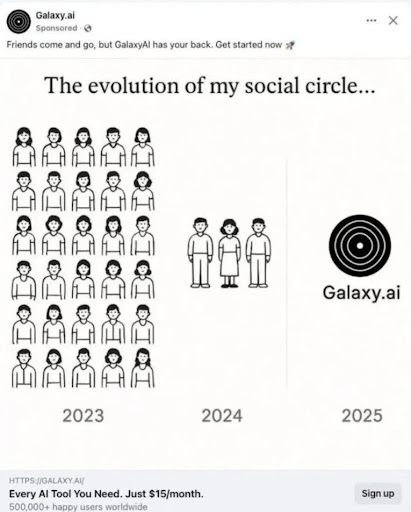
The reality is that we’ve never been more connected (through tech) and lonely at the same time. And Big Tech is on a mission to commodify emotional support 👇

Galaxy.ai advertisement showing how the evolution of a social circle goes from a group of people in 2023, to 3 people in 2024, and to zero in 2025 with the introduction of Galaxy.ai.

While ChatGPT pushes us to relinquish our agency—which is at the heart of liberation—it weakens our ability to think for ourselves, creates self-doubt in the wisdom we already have, and severs our connection with others.

So the next time you turn to ChatGPT to get unstuck, I invite you to pause and ask yourself these 3 questions: 

  • What might I be relinquishing in the process?
  • How can I move forward with more intention?
  • How can I turn to my community right now?

Don’t let ChatGPT convince you that you can and ought to do this alone. We need each other to create the world anew. 

Adrianne Yiu

Adrianne Yiu

Adrianne Yiu (she/her) is a second gen Chinese-Canadian immigrant and settler in Tkaronto on Treaty 13 territory. She is a leadership coach and change consultant who believes in a version of leadership that heals, liberates and disrupts. Prior to launching her practice in 2022, Adrianne spent over a decade facilitating systemic change across sectorsincluding curating award-winning inclusive leadership programming, leading people-centred digital transformations, and developing agile and compassionate teams in tech. She now partners with racialized women and non-binary folks to lead with more intention and less self-doubt. 

Adrianne is a mentor with Empower’em, an organizer for Climbers for Palestine, and co-creator of Dragon Centre Storiesa storytelling project honoring the untold histories of immigrant communities. Adrianne is also a 2022 Alum and 2026 Regional Co-Chair of the Governor General’s Canadian Leadership Conference. 

If you’d like to partner with Adrianne, book a discovery call here. If you’re interested in more musings like this, subscribe to her newsletter here. Follow her on LinkedIn here.

Dig in for the long game: Nonprofits and fundraisers must prepare for a role in an ecosystem of resistance

Dig in for the long game: Nonprofits and fundraisers must prepare for a role in an ecosystem of resistance

By Nate Levin-Aspenson, grant writer and student of movement organizing

This is institutionalizing the riot. Social benefit organizations can act as a ratchet. When smaller militant organizations push progress forward, larger more moderate ones hold and consolidate gains. The choice is simple: be divided and ruled, or act as part of an ecosystem and win.

I had to rewrite this several times because being a new parent is (unsurprisingly to everyone except me) very time-consuming and because our collective situation keeps getting worse. Every day I wake up like the proverbial frog in boiling water—except me and the other frogs all know the water is boiling and we all have Frog Bluesky so every day we’re posting about how hot the water is and how we should all get out of it. 

My first draft was Do Not Obey in Advance, which is no longer timely because A) we no longer have the luxury of being in advance of a fascist takeover and B) most organizations already did.

My second draft was Nonprofits Have to Fight if They Want to Survive, which I discarded not because the doom of our field is inevitable or because there has been no fight (not enough to my taste but not nothing), but because the stakes are no longer whether nonprofits will survive, but whether we will survive.

So here we are.

At time of writing, the GOP budget bill (the sycophantically trumpian-titled “One Big Beautiful Bill”) has just been signed into law. When implemented, 17 million Americans will be kicked off of their Medicaid insurance and the budget and $100 billion in new funding would be poured into the American Gestapo, further empowering them to kidnap and terrorize people.

All that is to admit that by the time you read this, the terrain of struggle under our feet will already have changed. Since I don’t want to scrap this again and start over, let’s pull back and look at the big view of what we need to do. 

I. Where we fit

In Full Spectrum Resistance, author Aric McBay describes the concepts of radical flanking and institutionalizing the riot

One of the many details lost to popular memory of the Civil Rights Movement is that Dr. Martin Luther King, Jr. once thought the Freedom Rides were too radical, and spent the night before the first ride trying to convince the organizers to call it off. But the riders went ahead, and the core of the movement moved with them. Radical Flanking describes the concept of radical or militant organizing moving the Overton Window of what is considered acceptable and sensible further towards a liberated society. 

Just like the Deacons for Defense and other militant self-defense groups made the Freedom Riders seem more acceptable and sensible to ordinary people, people revolting in LA and New York create room for organizations in the nonprofit sector to push successfully for protections of the rights of immigrants and queer people. 

As long as you don’t fall into the divide and rule trap of disavowing or condemning groups that are using more confrontational tactics.

In 1969, gay patrons of the Stonewall Inn in New York City, led by trans women and drag queens, spontaneously and violently fought back against the police repression that they had been suffering under for years. These police raids were routine, with people dressed in “women’s” clothing escorted to bathrooms to have their gender “confirmed” by police officers and those dressed more masculine were lined up to have their IDs checked. Being gay was illegal and criminalized. Arrests and beatings were commonplace. 

On June 27th of that year, the customers at Stonewall Inn spontaneously decided not to comply. Eventually, their defiance coalesced into a riot and participants attacked police vehicles and moved too quickly to be effectively countered by the lines of cops. Unlike previous riots in response to police raids on gay community hangouts, Stonewall led to the activation of a new generation of Gay Liberation movement organizations that were able to lock in the social gains made by the Stonewall Riots. They were using new and effective tactics like “zaps”—ambushing and heckling politicians, demanding they state their position on gay rights—to gain ground. Publications that previously wouldn’t publish the word ‘gay’ were now talking in detail about these organizations and their goals. 

This is institutionalizing the riot. Social benefit organizations can act as a ratchet. When smaller militant organizations push progress forward, larger more moderate ones hold and consolidate gains. (This is an incredibly brief overview of what McBay desribes, and I cannot recommend highly enough reading the book.)

The choice is simple: be divided and ruled, or act as part of an ecosystem and win.

II. Tactics

One of the sad things I had to recognize in writing this piece is that for many people who read it, your workplace has already hung you out to dry. Maybe they have already elected to find a place to hide in the new fascist landscape; maybe they have fully disavowed whatever values drew you to them in the first place. But maybe they have remained steadfast and are using their institutional power to fight fascism.

Whether you have the backing of your bosses or not, the core of my recommendation is the same: do not try to go it alone.

No one person or one organization is ever going to be enough to stymie or eventually overturn the fascist state, and they don’t have to be. Because they are not alone.

As a fundraiser, you are uniquely positioned within your organization to build and strengthen inter-organizational ties that can turn into networks and alliances of mutual support and protection. 

When I was working for a community mental health center during the pandemic lockdown, we found that building multilateral funding relationships to pursue emergency funding from governments and philanthropy was also having a knock-in effect of building inter-organizational relationships that helped us advocate as a bloc for the importance of our work during a time of emergency.

You can and should use that position to build multi-organizational networks. These can form defensive blocs when state or federal government entities target your funding or your constituents, as well as begin to throw around the economic power of your local third sector. Use the power that your bloc has to pressure state and local government officials for protections for your constituencies. 

Throw your weight around. Power that you or your organization have is worth nothing if it sits idle on the shelf. No time like the present. Smoke ‘em if you got ‘em. 

Now, if your organization is incapacitated by fear or apathy, there are still things you can do with just yourself and like-minded friends and colleagues. 

First, as others have advocated right here on The Hub, unionize your workplace. Join a union. The power of organized labor is one of the strongest tools we have right now to exert pressure on the regime and protect your community. 

If for some reason you can’t unionize your workplace (and you should try), there are still things you can do to be part of an ecosystem of resistance. No matter where you are, I guarantee that there are political projects near you that can use your particular set of skills as a fundraiser. That could mean raising money, sure—you would be surprised how little money some projects need to do their thing compared to a full organization—but communications, connection-building, and logistics are boons to local political projects. Hell, many of them are starved for simple admin: scheduling, keeping track of meetings, etc. It doesn’t sound like much, but adding capacity can nourish a local movement way more than money.

Find your niche. Find what you can support, and don’t neglect what supports you.

Because we are in this for the long haul.

III. The long haul

A lot of smart people have written about the MAGA tactic of flooding the zone to immobilize their enemies with indecision and anxiety and make their agenda seem powerful and inevitable. 

They do this because they’re not, and it isn’t. 

Don’t mistake me, the MAGA movement currently commands a tremendous and dangerous amount of power, but they are engaging in this tactic because they are fundamentally weak and fearful. They’re losers. And they are motivated by being losers who are afraid of everything. I say this not to hype up how easily our side will win (if the title didn’t give it away, I don’t think it will be easy or fast), but to better understand what we’re up against. 

The MAGA movement is an unstable and brittle coalition, and they fall apart quickly if they don’t get to be on the offensive. With a multilateral ecosystem of resistance pushing at them from all sides, using a variety of tactics, refusing to be divided and ruled, and leveraging the social and economic powers dormant within our sector, we can push them onto the defensive for as long as it takes for their movement to collapse.

We are not filling an annual campaign thermometer. Nothing magic will happen if 3.5% of the population engage in sustained nonviolent protest. We must grow a community of culture and practice to uproot, dismantle, and destroy fascism and trumpism in the United States. 

The nonprofit sector can be part of it. Fundraisers can be a part of it. 

You can be a part of it.

Nate Levin-Aspenson

Nate Levin-Aspenson

Nate Levin-Aspenson (he/him) is a writer, fundraiser, and container for dread based in North Texas. He has been writing things to ask people for money for over 10 years but is also learning to do more important things as part of his local ecosystem. You can find him posting through it on Bluesky or growing new things with the rest of The Equilibria Collective. If you appreciate his writing and want to give him money, don’t! Give to flood relief efforts in central TX and NC instead.