Focusing on fundraising goals is harmful — let’s measure love instead

And in a profession where money reigns supreme when we decenter money, a massive space opens up for something else. We’re filling that space with love.

In the beginning of 2020, before the pandemic, Oregon Food Bank (OFB) said goodbye to financial goals. (Not entirely, of course — resource development is still an important strategy for ending hunger and its root causes, after all.) To be more accurate, what we said goodbye to were financial goals as a driver of decision-making and as a measurement of staff performance.

We did this for many reasons, one of which is that we believe an orientation to financial outcomes creates the conditions for professional trauma and a consequent barrier to nonprofit organizations that aspire to resolve the most pressing moral and societal challenges we face.

This is evidenced by:

  • An exodus from the profession by nonprofit professionals, who only work in the field an average tenure of 16 months.
  • Nonprofit CEOs and EDs of color feeling at a disadvantage in contrast to their white counterparts in raising financial support for the nonprofits that they lead.
  • Less than 10% of those in our profession are people of color.
  • Rampant sexual harassment of women in the profession, particularly from donors.
  • Donors reporting being treated like financial targets by development staff, and fewer households (particularly middle-class households) are giving charitably.

For our team, the stress and pressure of raising funds to meet financial goals meant that we were not innovating, that we were relying on ‘tried and true’ practices developed over decades, ones that often replicated white supremecist, colonial, capitalist systems of extraction. Because we had been accountable to those kinds of goals, they were the yardstick by which we measured success.

But as the pandemic has demonstrated, environmental factors can have a disproportionate influence on whether you hit your numbers or fall short. And though we as fundraisers often move mountains, there’s still so much more beyond our control driving outcomes. To measure ourselves against something so unpredictable is an exercise in futility.

So then, to what do we hold ourselves accountable, and how do we measure our success? Decentering money is an inherent decentering of whiteness, colonialism, and greed. And in a profession where money reigns supreme when we decenter money, a massive space opens up for something else. We’re filling that space with love. For OFB, our new version of success meant recentering around the true meaning of philanthropy — a love of humankind.

How to measure love in philanthropy

Think about all the people in your life that you love. Most likely, love doesn’t feel and look the same for each person. There’s a richness of history and emotion that is unique to each relationship, and those relationships evolve and change over time. Distilling love down to visible, concrete metrics initially seems a fool’s errand. But the scope of our mission, the magnitude of what we are trying to solve for, made this a worthy and important problem for us to attempt to solve. Starting from somewhere was better than not trying at all.

Over the last year, our team has explored what it means to operate with love, equity and abundance and how the heck to measure it. With humility and vulnerability, we share our journey to the broader dialogue that’s shaping a new chapter for our profession, sector, and communities.

1. Define and scope

To put boundaries around love and better understand the scope in which we were working, we crowdsourced definitions from our team. We asked what love looks like for them in general, at OFB, and in their individual roles. From there, we created hallmarks to guide our path.

These hallmarks are the framework for creating an alternative moves management system that tracks our relationship with a donor within the many various facets of love alongside the solicitation cycle. Our Prospect Development Team hopes to evaluate portfolios through the lens of shared values, evidence by: taking action for the common good, care, centering clients, community, engagement, equity, growth, authentic partnerships, and respect.

2. Get stuck

The structure of our OFB database allows us to track and manage volume, velocity, and value — but it doesn’t allow much room for qualitative analysis at scale. So if you’ve decided you’re going to measure a marker like “respect,” what existing data will tell you if a donor has regard for the feelings, wishes, or rights of others? Is someone going to mine the contact reports for “authentic partnership”?

These questions broke our collective brains.

The complexity of this endeavor felt like a hurdle too great to tackle in the midst of a pandemic. We recognized how our capacity for creativity, energy, and enthusiasm had drained away from us. While being stuck can sometimes feel like defeat, being stuck was actually a chance for us to look beyond ourselves, it was a chance to find community with others who recognize that, in order to dismantle white supremacy, we must find a way to show value in the quality of relationships rather than the number of relationships our team holds.

3. Find your people

And then something wonderful happened. In the summer of 2020, we were introduced to Shiree Teng’s Measuring Love in the Journey to Justice: A Brown Paper. In her brown paper, Shiree explains how our missions — when not motivated by love — boil down to work plans focused on time-bound specificity with no mention of the emotional components of social progress and change. We too often forget those intangible pieces required for relationship and community building. It is the head speaking for the heart instead of speaking with it.

And this happens for a reason. Oftentimes, donors require us to report on the impact of our work in measurable, concrete and specific ways. Those measures are still important, but what can we add to our work plans and yearly goals to let the heart speak as well as the head? Shiree lays out a framework for recognizing transformative love and how to document it when we do.

Suddenly, we had a partner. With Shiree’s guidance and expertise, we developed survey assessments (more on this in the next sections) for ourselves and our supporters.

For our team, we wanted to learn more about how love shows up in our work as individuals, as a team, and as an organization, and how our experience with love changes over time. It brings a tangible yardstick to measure our performance against, while preserving and honoring the complexity of love.

For our supporters, we wanted to understand how this change to center love impacts them and their experience with OFB. Are they connecting more deeply with our mission through growing engagement in our team and partner organizations? Have they grown in their understanding of how systems of oppression can lead to food insecurity? And how much is this new messaging resonating with them in their own journey?

4. Measuring love with staff

Following the structure developed by Shiree, we created questions around the four core tenets for how love shows up:

Love for Oneself: How staff see themselves in integrity with their work to transform philanthropy

Love for Others: How staff see each other as well as supporters

Love in Community: How staff see OFB, and how OFB sees the staff

Love as Power: How OFB shows up in our state with love that’s fused with (advocacy and organizing) power, and how the community, including supporters and constituents loves OFB in return with its (advocacy and organizing and monetary) power.

Here are some sample questions included in the survey:

  • Is my work aligned with my purpose at this time in my life?
  • Am I able to hold supporters equitably — including those with great wealth, those who experienced or are experiencing food insecurity, those with less ability to give, young donors, and donors who are new to philanthropy?
  • Am I supported to find safety from power differential harms in donor relations?
  • Does OFB build power with our clients and donors for our collective liberation?

These questions are evaluated along three measures: dosage, authenticity, and duration. Dosage asks staff to consider how much they are doing something, authenticity asks how consciously, and duration asks for how long. All three rely on the inner wisdom of staff, and while this is a self-assessment meant to support interior reflection, we are collecting aggregate data to inform opportunities where larger systems and processes can facilitate growth across the team.

5. Measuring love with supporters

This spring we are launching the initial version of our assessment for supporters. Our goal this year is to create a baseline understanding of where they are in their own journey. This will be a starting line from which we will measure our progress in centering love and equity into our fundraising activities and the impacts, both attitudinal and behavioral it has with our donors.

We hope to learn if Oregon Food Bank has:

  • Expanded donors’ awareness of the systemic inequities that cause hunger
  • Introduced them to other organizations helping to end hunger
  • Helped them identify new ways to take action to end hunger
  • Helped shape what’s important to them when engaging civically or politically in our community
  • Encouraged their learning and growth

This was perhaps the harder of the two surveys to create. To better understand donor attitudes about the causes of hunger and poverty, we introduce mythological narratives in this survey that are pervasive and hurtful — these narratives do not resonate with OFB and with many of our supporters. Having data related to these narratives, however, allows us to increase the effectiveness of our communications and messaging initiatives over time. Borrowing from other progressive movements’ practices, we are mitigating harm by including corrective narratives in an auto-response email to survey responders.

By the time you read this, both surveys will have hopefully landed in the inboxes of our staff and supporters — and by the summer, we will have a better appreciation of all the ways love shows up for ourselves and for our supporters. Measuring love is just one of many initiatives OFB has undertaken in the pursuit to dismantle white supremacy in philanthropy and decolonize the profession.

However, it is our hope that, one day, we will not need metrics to demonstrate the value we bring to our communities. One day, we will not be accountable to results, but to the ushering in of transformational change. Until then, we can measure love.

Vivien Trinh

Vivien Trinh

Vivien Trinh (she/her) is a nonprofit professional with 11 years of philanthropy experience. Her career has taken her through the many aspects of philanthropy including direct mail, digital fundraising, donor relations, database management, and prospect development at nonprofits of all sizes. As the daughter of refugees, she is deeply committed to building inclusive communities that honor the dignity of each individual. You can reach Vivien by email.

The Ethical Rainmaker remix: white women as gatekeepers

By Michelle Shireen Muri, Freedom Conspiracy Principal and CCF co-chair

Episode Summary

“A lot of us, white women, are coming to our work with some deep martyrdom as the motivator. And this equation of ‘my worth is dependent on how helpful I am…’ well, helping is just the sunny-side of control.” With white women as the primary demographic of the nonprofit workforce, this episode begins addressing white women in their role as gatekeepers. In this episode, Fleur Larsen, a DEI consultant and a white woman, talks with Michelle to answer questions like: Why are there so many white DEI consultants making money off of racism? What does gatekeeping look like? How do you know you are gatekeeping and what should you do when you are called out? How do you call out a gatekeeper? Our attached bonus episode covers the elements of her life and history that have shaped her work.

About the Ethical Rainmaker podcast

In the United States alone, philanthropy is a $427 million dollar industry, of which 68% comes from individual donors. Yet the practices, theories, and foundation of modern philanthropy and fundraising often ignore the ways in which the industry perpetuates harm.

The Ethical Rainmaker, hosted by Michelle Shireen Muri, is a podcast that hosts authentic conversations grappling with the questions that we don’t often ask in the nonprofit world. Join us as we explore some of the practices that undermine our missions and navigate the way forward with today’s resisters, reimaginers, and the re-creators of the third sector. It’s time to think differently.

Michelle Shireen Muri

Michelle Shireen Muri

Michelle Shireen Muri (she/her) is the co-chair for Community-Centric Fundraising and the host of the new podcast, The Ethical Rainmaker, launching July 29. She is the founder of Freedom Conspiracy, a small collective of fundraising consultants focused on bringing values-aligned practices to clients in the nonprofit and philanthropy spaces. She can be reached at @freedomconspiracy on Instagram.

Are universities REALLY ready to take on antiracism? An Open Letter to UT Austin

By Marcus Cunningham and Michelle Flores Vryn, CFRE, from Community Centric Fundraising’s Texas chapter 

Some students and alumni love the song despite its racist origins. Until recently, the UT Austin band played it at the end of games and other school events.

Focusing on social justice and equity in philanthropy sounds like it should not be a new concept. Most people have dropped money into their church’s collection plate or bought a box (or three) of Girl Scout cookies. Philanthropy is all about charity and compassion, right?

In reality though, charity and compassion are actually contrary to the way many powerful institutions operate.

Take the recent example of The University of Texas at Austin’s response to open records requests on donor responses to changing the Eyes of Texas school song, a tradition that perpetuates racist origins.

“The Eyes” lyrics were written in 1902 by a white male student — the only demographic allowed to attend colleges at the time. The key song phrase,“The eyes of Texas are upon you,” was drawn from former UT Austin President William Prather. It has long been reported that Prather, who graduated from Washington and Lee University, borrowed the phrase from his own college president, Robert E. Lee, who was employed at the school following the Civil War.

As of March 2021, the University’s collective report, compiled by a 24-member committee, on the history and intent of the song lyrics found that while the content reflected racial aspects of its time, the group recommended that the song stay intact. The committee did not find a link showing that Robert E. Lee commonly used the “eyes of ____ are upon you” phrase.

It did, however, find evidence that the wording was inspired by Confederate brigadier general John Gregg (of Texas) who warned Confederate soldiers that “the eyes of General Lee are upon you!”

Some students and alumni love the song despite its racist origins. Until recently, the UT Austin band played it at the end of games and other school events.

Here’s a sampling of responses from angry, out-of-touch donors that were sent to the university:

UT needs rich donors who love ‘The Eyes of Texas’ more than they need one crop of irresponsible and uninformed students or faculty who won’t do what they are paid to do.”

“It’s time for you (UT) to put the foot down and make it perfectly clear that the heritage of Texas will not be lost … It is sad that it is offending the blacks (sic). As I said before, the blacks are free, and it’s time for them to move on to another state where everything is in their favor.”

Less than 6% of our current student body is black (sic) … The tail cannot be allowed to wag the dog … and the dog must instead stand up for what is right. Nothing forces those students to attend UT Austin. Encourage them to select an alternate school … NOW!”

If you couldn’t guess, we think these quotes are terrible and not reflective of us as Texans.

In terms of steps to move the UT community forward, the committee suggested the full history of the song be integrated into orientations and other university communications. The committee also recommended the formation of an initiative to encourage UT Longhorns to lean into racial conversations and work through different perspectives. We’ll see what progress those yield.

What does this mean for UT philanthropy … and university philanthropy in general?

Moreover, with a $30.1 billion endowment, second only in size to Harvard University, we believe that UT Austin is uniquely positioned to serve as a role model for others to stand by their institutional values and not sway to donor wishes.

While Black students may not be the majority at UT’s flagship campus, they deserve to attend a collegiate institution that owns and is working to rectify past and current institutionalized racism.

The Eyes of Texas History Committee report issued on March 9 provided a clear history of the song and a set of next steps for the university, but the urge to maintain the status quo is a risk to real healing and transformation.

Instead of bowing to the wishes of a few wealthy, similarly-privileged donors, the university should stand firm on fulfilling its core value of individual opportunity (many options, diverse people and ideas, one university).

The continuing donor-driven act of hostility and fear-mongering, as shown above, also speaks to a need for change within philanthropy. We need to draw attention to a new way of thinking and behaving: Community-Centric Fundraising (CCF) Principles, which was developed in response to practices commonly known as donor-centric fundraising. Instead of centering the feelings and desires of donors, the CCF Principles instead ask if the communities in which nonprofits serve are being valued through our actions.

The CCF Principles call for accountability as an act of love, leveraging a painful history to heal and transform into something better. It requires us to make a new table, one where the voices of those who are most affected by a decision sit at the head.

What UT is doing by retaining and cultivating relationships with donors whose beliefs and values directly contradict the existence, value, and needs of its Black students is contrary to several of CCF’s ten core principles:

Principle 1: Fundraising must be grounded in race, equity, and social justice.
Principle 6: We treat donors as partners, and this means that we are transparent, and occasionally have difficult conversations.

We, as a group of organizers in the Community-Centric Fundraising movement in Texas, reject the scarcity mindset that creates what CCF co-founder Vu Le calls the Nonprofit Hunger Games.

Instead, we embrace an abundance mindset, where the most powerful country in the world chooses to take care of its own. Instead of placing higher value on donor opinion based on their lifetime giving, we demand that UT Austin filter its decision-making through its own core values. Moreover, with a $30.1 billion endowment, second only in size to Harvard University, we believe that UT Austin is uniquely positioned to serve as a role model for others to stand by their institutional values and not sway to donor wishes. This is a crucible moment to show other institutions, most smaller than UT Austin, what justice-minded decision-making looks like.

And, for the record — we agree: What starts at UT Austin can change the world. UT, we invite you to a Community-Centric Fundraising-centered conversation and welcome the opportunity to share our thoughts on how UT Austin can stand up and truly serve its diverse set of talented students.

To connect with CCF’s Texas chapter, email ccfundraising.texas@gmail.com.

Marcus Cunningham and Michelle Flores Vryn

Marcus Cunningham and Michelle Flores Vryn

Marcus (he/his) and Michelle (she/her/ella) are from CCF’s Texas chapter.

Marcus Cunningham is a Black fundraiser determined to flip tables in the name of liberation. Born, raised, and currently residing in Dallas, Texas, he currently serves as Associate Director, National Development at New Leaders. He is passionate about creating a world where nonprofits are fulfilling and sustainable for those who make it their profession, and consistently useful for the communities that support them. You can find him enjoying the (extended) newlywed life, cheering on the Dallas Mavericks, or attending a local pro wrestling show when it’s safe to do so. He is a graduate of The University of Texas Rio Grande Valley. Find him on LinkedIn.

Michelle Flores Vryn, CFRE has worked in almost every area of development: institutional giving, major gifts, membership, capital campaigns, consulting, special events, and annual giving. She has a healthy obsession for equitable social impact and currently serves on the Association of Fundraising Professionals (AFP) Global’s Marketing, Awards & Communications Committee. Michelle lives in Austin, Texas and is always down for spontaneous outdoor adventures and dropping in on live music. She is a two-time graduate of the Hispanic Serving Institution (HSI) The University of Texas at San Antonio. Find her on LinkedIn to keep the CCF convos going!

So you think you’re a philanthropist, huh? Or maybe you’re a power hoarder? Let’s find out!

By Rebecca Paugh, Nonprofit Fundraiser

Dear Donor,

Hi! This is a message from your friendly, eager-to-please nonprofit fundraiser. All of us got together, and I drew the short straw … and I now have the task of telling you the whole truth and nothing but the truth. I have been summoned to pull back the curtain and reveal everything. Everything we want you to know — but are afraid to say — about philanthropy.

How can we help you understand when and how your donation helps — and also when your donation may, in fact, be unhelpful?

First and foremost, if you are currently giving money to a nonprofit organization, we want to genuinely thank you. Without funding, it is difficult, and — in most cases — impossible to do the work that needs doing. We understand that donors like you give for all kinds of reasons, and the choice to share your money is admirable. You could be spending all of your money on the latest iPhone, saving it all for your offspring, or buying a yacht. (I imagine that most of us fall within the first or second scenario, but still – we are all making a choice.)

Us fundraisers are not here to deny you your right to choose. You should get to call the shots and make decisions about what you are going to do with your money. As fundraisers, we can say with confidence that everyone has a complex relationship with money (especially us!) — and it gets trickier once we acknowledge that money is power.

Just sit with that. If you have the ability to make a donation — of any size — you are in a position of power. You have power!

And typically, more money = more power. Sometimes we use our money/power with good intentions. And sometimes there are unintended consequences to our good intentions — and that is what we want to talk to you about.

How can we help you understand when and how your donation helps — and also when your donation may, in fact, be unhelpful?

One thing you can do is ask yourself some questions before you make your next gift — and then repeat the process each and every time you make a donation going forward. These questions might make you squirm a little, maybe even feel uncomfortable — but we believe in you. We know your heart is in the right place. You’ve got this!

Question 1: “Is there a quid pro quo?”

Ask yourself how you benefit, if at all, from your donation? Are you asking to see your name or your company’s logo on a billboard or in the annual report? Do you expect front row tickets or other perks and favors? Do you understand that your donation allows you to benefit from an elevated social status and access to others of wealth and privilege?

Here is a dirty little secret: We know you have your self-interested reasons for giving, and we as fundraisers specifically try to find out what your reasons are — and then we capitalize on and exploit them by incentivizing you with rewards.

However, many of us have decided that we don’t really like doing this anymore. It feels manipulative and unsavory. We have created this problem, and we want it to stop. And we think once you really understand your giving motivations, you will want this dynamic to stop too.

Question 2: “How am I using my power?”

Are you asking to create new programs based on your personal passion and/or vision rather than supporting the work that is currently being done? How about: Are you leveraging your funds so that you can sit on a board or step in to provide direction and “expertise” — while also getting the added bonus of receiving accolades for doing so?

Do you ever assume that because you have resources, (or a PhD from Yale, or a Mensa membership) that your advice should carry more weight than those in the community who are doing the work?

Here’s a hot tip: If you are giving funds to a nonprofit, you clearly already have confidence in their quality of work and their commitment to their mission, right? Their lived experience and daily immersion in the work provides them with expertise that you likely do not have — so honor and respect that and maybe just save all your brilliant ideas for your own start-up.

Question 3: “Am I willing to share my power?”

Here’s another way to look at this question. Ask yourself: Do I trust the organization and its leadership to make good decisions with my dollars?

If your real answer is no, could it be because the organization is led by women, people of color, or someone with a less formal education? Are you continually ‘vetting them’ by demanding a return on your investment with labor-intensive data and impact reports?

Hot tip: While nonprofits do want to reassure donors that they are good stewards of their funds, all of the time spent documenting and justifying their very existence is time and energy spent away from doing the actual work. As a donor please adjust your expectations, as well as help change the norms by talking about this problem when you see it.

Question 4: “Is my giving plan really ‘philanthropy’ or is it a tax shelter?”

If you are putting your money into a Donor Advised Fund (DAF) or contributing to an endowment, who, precisely, are you helping?

For the record, a DAF is designed to allow you to avoid paying taxes. Typically, your money is not actually being distributed in a timely manner, but rather kept in a fund, earning revenue for you — your DAF, your Community Foundation, or the charitable fund who manages your DAF — while the nonprofits and communities who desperately need those funds are only getting the 5% skimmed off the top.

Are you throwing pennies at a problem with one hand while hanging onto your piggy bank for dear life with the other?

If you are, that’s okay. But it’s not really philanthropy, is it?

Question 5: “Am I engaging in charity or change?”

Do you expect to feel a warm glow as you reflect on how your money has rescued and lifted up others beneath you?

Let’s break it down: Charity implies that there are two categories of people — the givers (the superior, the ‘haves’) and the recipients (the inferior, the poor, the ‘have-nots’). As long as that is the lens through which we view money, there will always be people ‘in power’ and people ‘in need.’ The way we think informs the power dynamic.

If we want to stop engaging in ‘charity’ and acknowledge the toxic byproducts of this word, then all of us — donors and fundraisers — need to shift our thinking in the following directions:

  • We need to visualize the mission as a shared project.
  • We need to use words focused on partnerships that seek long-term change.
  • We need to acknowledge that we all have something to contribute — and money is only one part.
  • We need to talk more about our nonprofits doing community-based work, work that requires everyone working together, where each individual is valued as an equal partner.
  • We need to collectively reinvent our language to clarify what these new relationships will look like.

Question 6: “What do I want my legacy to be?”

Are you creating a fund that will ‘live in perpetuity’? What is the source of your motivation in wanting to leave behind a legacy?

Here’s another hot tip:

GIVE IT AWAY.

We all go out of our way to stretch our funds — to make them last in perpetuity (and our financial experts certainly advise us to do so, mostly because it actually benefits them.) But, if you want to make an impact, you need to give it away.

Why then do we do so with such reluctance?

Creating an endowment that ‘gives forever’ or putting your name on a building is actually not inherently about doing good. It’s about hanging on to your power. Again, that’s okay. It’s your power. Do with it what you will.

Let’s just remember — it’s not philanthropy.


Finally, dear donor, we want you to know that we believe in our hearts that you do not engage in giving merely for the accolades. We know you do it because you care. You care deeply.

And when you think of your family, your children, your community, what do you really want your lasting impact to be? Do you want your lasting impact to be one of change and partnership — or one of maintaining the status quo of a dysfunctional system, a system that perpetuates the lie that there are two kinds of people: Donors with a capital D and the recipients/less-than/have-nots.

Now is the time for all of us — donors, fundraisers, board members, and nonprofit communities — to move from transactional giving to genuine, equitable, and heartfelt partnerships for change.

Dear donor, we are holding out our hand to help you step down from the pedestal we put you on and asking you to walk with us side by side.


Author’s note: With deep appreciation to the Black, Indigenous, and People of Color who have led the way, I want to acknowledge that I am echoing ideas in this essay that many others have already articulated.

Rebecca Paugh

Rebecca Paugh

Rebecca (Becky) Paugh (she/her) has worn many hats in the nonprofit sector: co-artistic director/co-founder of a theatre company, stewardship/event planner for a private school, program developer for a refugee resettlement org, and director of development/chief recycler for a youth arts org. Becky lives in Connecticut with her complicated and beautiful blended family. She is passionate about bees, ranked-choice voting, and the NYTimes Spelling Bee.  Follow #disruptphilanthropy or find her on LinkedIn and Facebook.

It’s pronounced ‘zeen’! (How the world of zines inadvertently prepared me for a career in nonprofit fundraising)

By Yolanda Contreras, professional zinester and fledgling fundraiser

Without my zine experience, I’m not sure I would have been as prepared for the world of nonprofit fundraising.

Zines are usually categorized as ephemera, something that exists only briefly or for a short period of time.

Zines are pronounced zeen, short for magazine, and are self-published, not widely distributed, and cost very little. As small and temporary as they initially seem, zines have actually been around for decades and can have the power to provide a voice to those who are not normally heard.

A glimpse into zine’s beginnings

The history and origins of zines started in the 1930s and was bolstered by science fiction fans. Originally called Fanzines, a name that hearkened to the very people that created them, these tiny paper booklets allowed a whole group of people to express their love of science fiction without mainstream approval or need for ‘legitimacy’. Zine production grew with the invention of printers and copiers which meant that they were accessible and cheap to produce.

The real zine boom happened in the 1970s within the LA, London, and New York punk scenes. Fueled by an absence of “real” voices that were glaringly missing from mainstream publications. Further bolstered by the alternative music scene, there was yet another uptick in zines during the 1990s, when Riot Grrrls were in their prime.

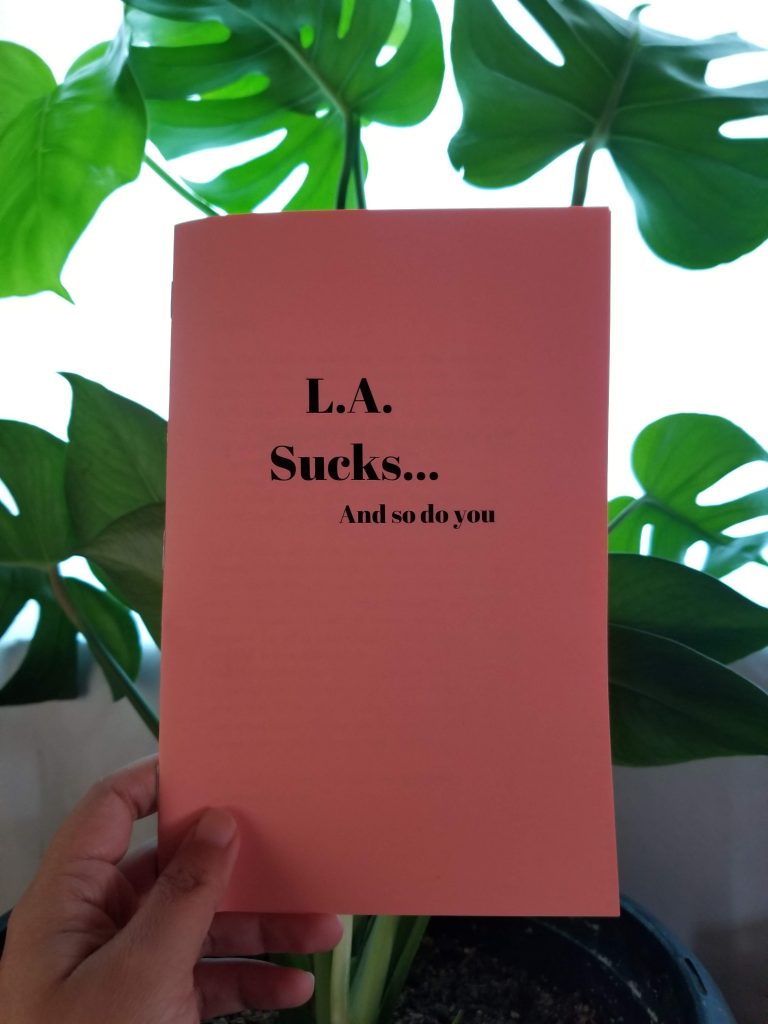
I released this zine in 2020 after moving from Arizona to California and then back to Arizona within the span of 14 months.

Today, zines are made in a variety of ways — photocopied, hand-drawn, or created completely digitally. Zines have popped up in so many ways because of the ease and simplicity of making them. They have also moved beyond music and art scenes. They have also crossed academic channels, where many colleges now have dedicated zine sections in their libraries and proper libguides, one of which I helped create for Arizona State University.

All of this is to say that I have years of experience making zines, talking about zines, and writing about zines. And I’m sure you’re wondering what this all has to do with fundraising for a nonprofit.

A lot actually. Without my zine experience, I’m not sure I would have been as prepared for the world of nonprofit fundraising. Creating zines is one of the most fulfilling ways I have been able to express myself and share my writing without the struggles of ‘getting published’ in the traditional sense. As a woman of color and in a world where white people constantly control the narrative, it’s especially freeing to have complete say in something.

My zine education begins

My introduction to zines started as a 90s child living in Southern California, during the heyday of Riot Grrrls and accessible printing options. I acutely remember purchasing a book about zines from my local thrift store. You may have seen it, with the cover containing a woman with burgundy hair, a leopard coat — holding several zines. This was my introduction to the world of zines, and I have never looked back.

The first-ever zine I created was about Kurt Cobain, a folded 2-pager that contained collages, fave lyrics, and a poem I had written. I distributed my zine freely to my high school classmates on Kurt’s birthday, all the way back in 2001 as a freshman.

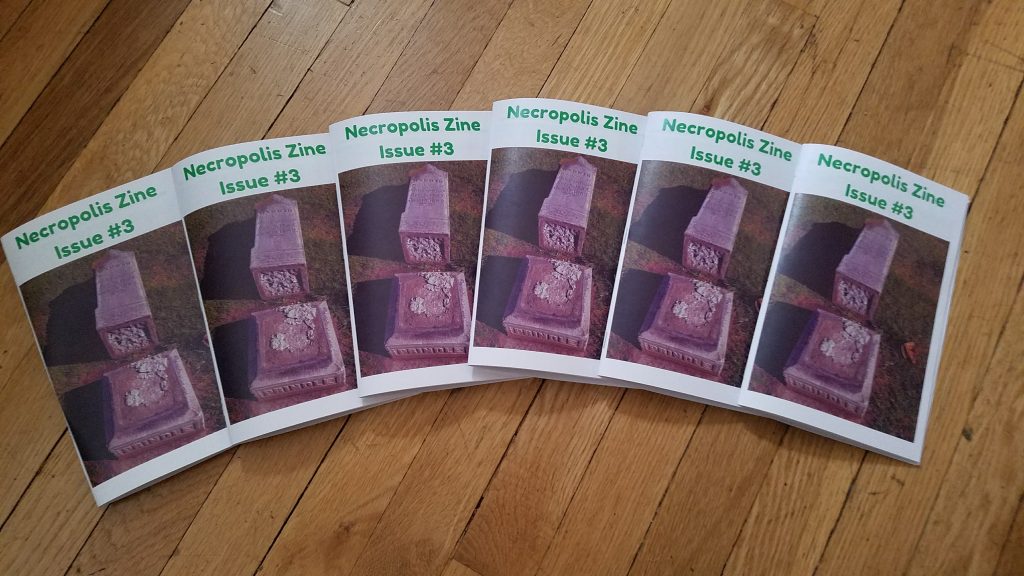
This was my first collaborative zine that included over 10 contributors. The zine focused on cemeteries and the concept of death and dying.

Given those glamorous beginnings, I continued to pursue my love and admiration for zines throughout the years. I was very fortunate to live in Southern California for the majority of my life, having access to resources and endless zine fairs. That community followed me when I moved to Arizona, where I found an ever-growing supply of like-minded zine makers who were more than willing to invite me into their world.

Carrying on with my zine love across state lines helped keep me connected to others as I grew older. That very type of connection led me to an internship while attending Arizona State University. The head of special collections needed an intern to help her with a zine collection that she wanted to start at ASU, based on existing literature and also from zines that had been recently collected or donated.

All of that culminated in one of my greatest achievements: the publication of a zine libguide that is still being used at Arizona State University to this day. I also still use the libguide today since it is always updated with current zine events and useful zine related information. It’s an incredible melding of zines and academics that I used as a basis for my fledgling nonprofit career.

What do nonprofits have to do with all of this?

Now, I know that creating zines seems to be in contrast to nonprofit fundraising, but hear me out. Much like fundraising, when you create a zine you need the drive and know-how to complete your project. Then once it’s complete, you then need to actually sell that idea and market your work.

Creating and maintaining relationships with potential stockists mirrors the relationships that need to be forged when obtaining nonprofit funding. Surprisingly, there are some cool similarities between the two such as creative writing, marketing your work and networking. For instance, when you create zines, it’s a way to purposely opt out of the traditional white-led world of publishing. Zines are about disrupting the ‘norm’ and reaching people through unconventional means.

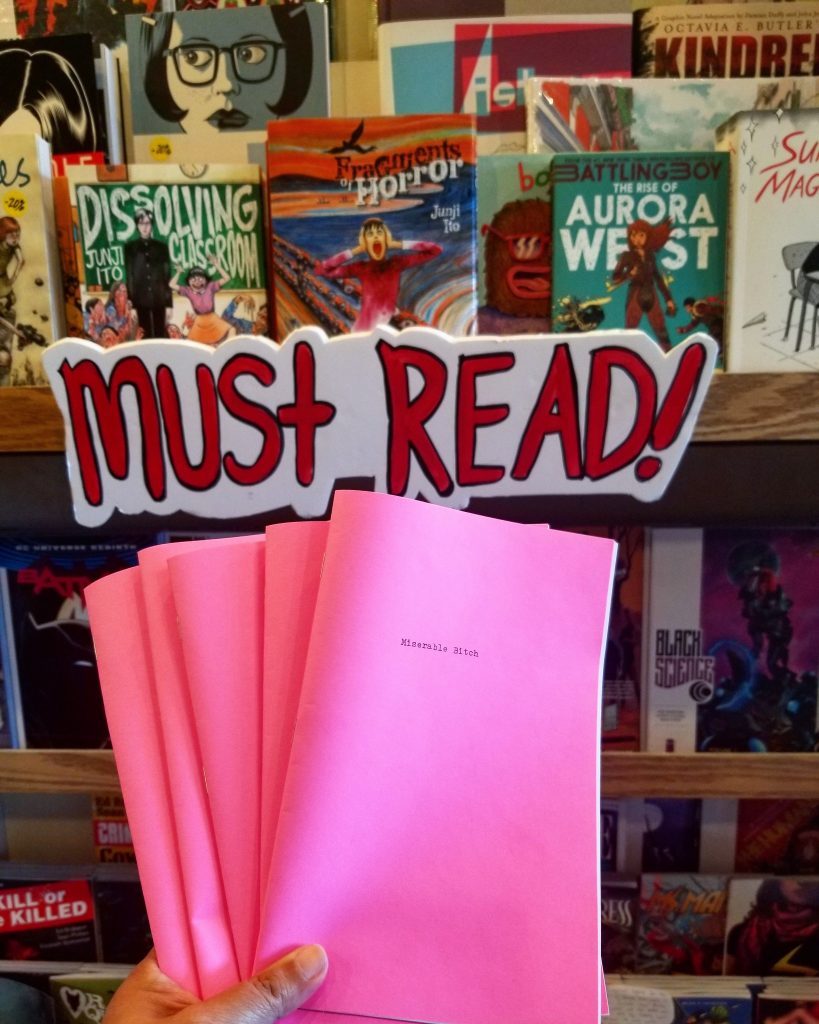
This is my bestseller and the culmination of years of pent-up anger. This zine has been sold at Skylight books, Wasted Ink Zine Distro, and so many others.

Similarly, when BIPOCs work within nonprofit fundraising, which is statistically white-led, our mere existence is already challenging the status quo.

Right now, while there are a lot of problems of inequity with the way nonprofits fundraise, I feel like we have a great opportunity to transform our work into something more equitable and inclusive. Applying the counterculture zine spirit to fundraising can lead to expansion beyond the old white standards of obtaining funding.

Social media has been an incredible tool for showcasing and amplifying artistic zine endeavors, and social media can also be used for fundraising by bypassing traditional means of outreach.

And I’m not just talking about slapping together a graphic and asking for money.

It’s like, why do people want to buy my zine? Why do people want to donate to our organization? Zines are already unconventional in and of themselves so I’ve learned to utilize that unconventional modes of outreach like social media, which in turn has helped me so much in fundraising.

The typical approach to fundraising is handwritten notes, phone calls, letters of appeals and newsletters to reach potential donors. Zines taught me that establishing connections, showing passion for your work and making it accessible to large groups of people can actually pay off.

For instance, using social media in development work is a way to make an organization’s work accessible to large groups. Through social media, we can show the faces behind the work, highlight allies, offer resources, display impact, create meaningful connections — and show folks from anywhere what their support would mean.

Zines also taught me to be community-centric. In the past and currently, I’ve highlighted and tried to amplify my love for other zines, not just my own, through my own social media accounts. I do this because I genuinely want these other zines to succeed, and I want people to know about them. There’s a similar opportunity within the world of nonprofits, even though too often, we become overly focused on our own organizations and forget that there are so many others out there that may be doing similar work to us. But by applying those zine values to fundraising, I see how we can all visibly show our support to other organizations to help foster relationships with them instead of competing for the same resources.

Lastly, zines have taught me how to embrace writing as a form of healing. Creating and writing zines means putting yourself out there in a very vulnerable way and hoping that someone connects to that. Isn’t that what we want to achieve with fundraising, to make those personal connections that will inspire people to give generously or simply empathize with the work that we do? Oftentimes, this means not asking directly for money but showing the humanity behind the organization. Weaving narratives and embracing your vulnerability — yes, even when you write a standard e-blast or newsletter — can go a long way towards a new form of openness with your organization’s supporters.

That’s what zines are all about. When someone wants to get their work out but everyone tells them no, we collectively found a way. In a similar way, when our small nonprofits need funding, we all just find a way to do it.

Also, little did I know that my years spent on zine-making would prove to be so fruitful in terms of communications around nonprofit fundraising. All of the hours I’ve spent sitting, writing, formatting, copying, laying out, and distributing zines are all activities I do in fundraising. We want our donors to connect with our words much in the same way we want our zines to connect with readers.

A bigger world is out there

Zines have also changed how I view the world. Zines have opened my eyes to ideas and things that I wouldn’t have found in ‘normal’ bookstores. Zines have provided me and others like me, a community that resides outside of the mainstream. And because of that experience, when I first started in fundraising I knew there had to be others like me, even though I didn’t see a lot of them. I sought a sense of community because I wanted to try and match what I got from my beloved zine community.

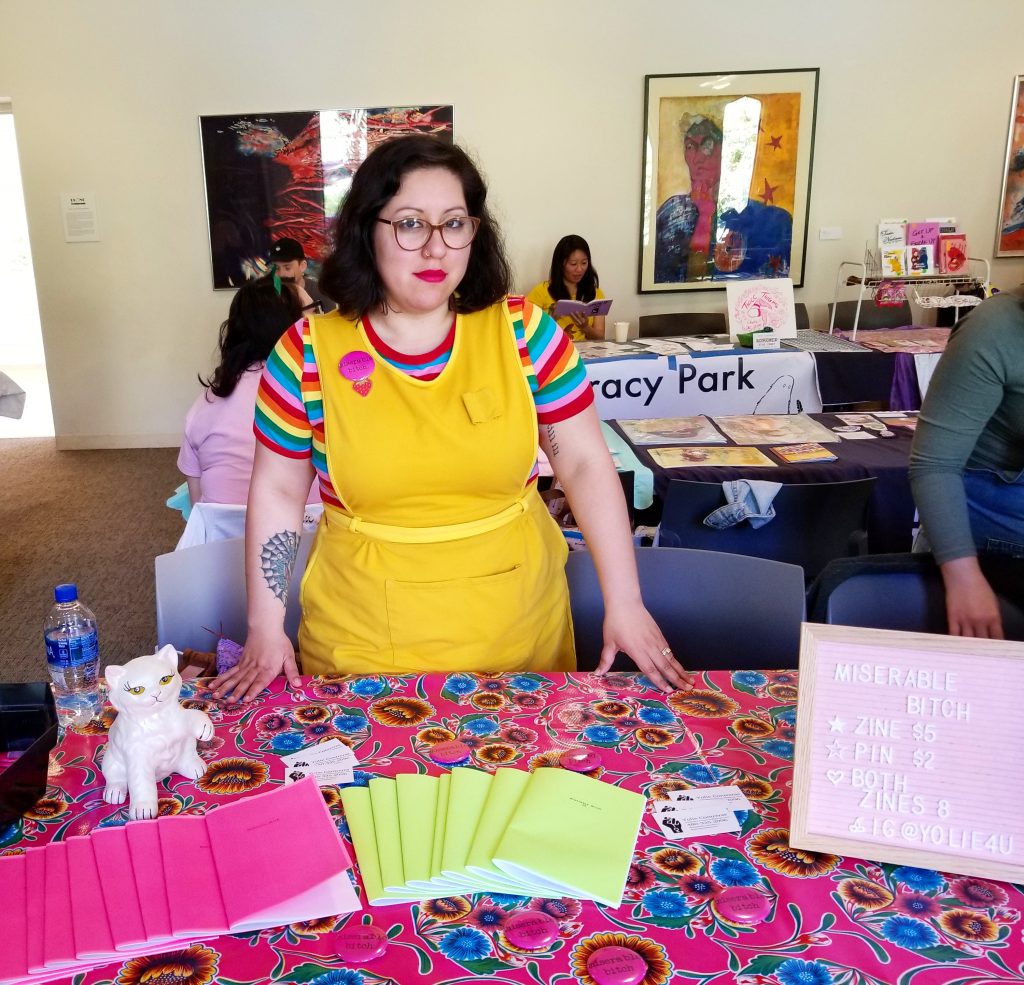
Here I am, slinging zines in Southern California at the Valley Girl Redefined Zine fest in 2018.

I’m so happy that there are more and more spaces that exist for us BIPOCs because we made it happen for ourselves. From zines humble beginnings as a way for science fiction fans to voice their love to growing into BIPOC-led distros, zines have proved to be so much more than some paper and staples.

Like, Brown Recluse Zine Distro is an extraordinary example of a QTBIPOC-led group who have disrupted zine culture. They embrace mutual aid and offer sliding scale pricing for BIPOC, even going so far as paying 50% of the cover price to non-Black POC creators and 100% to Black zine creators. They are also at a cross-section between being a nonprofit and working within the zine community. Further proving how zines and the nonprofit worlds can intersect and influence each other.

BTW, here are some more of my humble offering of zine makers and distros that are doing work that I greatly admire right now:

  • Julia Arredondo — an artist-entrepreneur that is taking zines to the next level by intersecting them with academia, brujería, and art.
  • Wasted Ink Zine Distro — a space for historically silenced voices that is run by a non-binary, queer multi-media artist in Phoenix, Ariz.
  • Long Arm Stapler — a podcast and online shop that focuses on queer zines.

So take a note from zines, if you can’t succeed the usual way, make your own path and create work that you will be proud of.

Yolie Contreras

Yolie Contreras

Yolie Contreras (she/her) is a Salvi-Chicanx writer, fundraiser and zinester. She is currently based in Tucson, Arizona, although she was born and raised in Southern California. She believes that words and actions matter, and as long as systems of oppression exist, it is our duty to dismantle them. When she’s not working, Yolie spends her time hanging with her husband and their cat, knitting, and perfecting her Animal Crossing island. She can be reached via email or on Instagram @Yolie4u.