The Ethical Rainmaker: “The truth about cancel culture (and an alternative approach),” featuring Kevin Baker

By Michelle Shireen Muri, Freedom Conspiracy Principal and CCF co-chair

Episode Summary

Cancel culture. Disbanded groups. Severed ties. Intent vs Impact. Most of us are shit at dealing with problematic behavior —  our own or others! Whether in our nonprofits, our neighborhood groups, activist communities or families —  our unresolved conflicts cause damage, chaos and separation —  in times where we need unity, repair and one-ness to best serve our communities. Enter Kevin Baker whose mission is to make sure people can bring their authentic cultural selves to the workplace, creating healthier, more open workspaces that better serve humans.

Kevin and I talk about how a whole bunch of us really need therapy, what it means to take a relationship-first approach to workplace conflict, and why we need to ditch our desire for quick fixes and allow ample time for repair work.

Find the episode notes and the podcast here.

About the Ethical Rainmaker podcast

In the United States alone, philanthropy is a $427 million dollar industry, of which 68% comes from individual donors. Yet the practices, theories, and foundation of modern philanthropy and fundraising often ignore the ways in which the industry perpetuates harm.

The Ethical Rainmaker, hosted by Michelle Shireen Muri, is a podcast that hosts authentic conversations grappling with the questions that we don’t often ask in the nonprofit world. Join us as we explore some of the practices that undermine our missions and navigate the way forward with today’s resisters, reimaginers, and the re-creators of the third sector. It’s time to think differently.

Michelle Shireen Muri

Michelle Shireen Muri

Michelle Shireen Muri (she/her) is the co-chair for Community-Centric Fundraising and the host of the new podcast, The Ethical Rainmaker, launching July 29. She is the founder of Freedom Conspiracy, a small collective of fundraising consultants focused on bringing values-aligned practices to clients in the nonprofit and philanthropy spaces. She can be reached at @freedomconspiracy on Instagram. You can send her a tip via Patreon.

OMG, stop giving us your old garbage: On creating a community-centered donation policy for your org

OMG, stop giving us your old garbage: On creating a community-centered donation policy for your org

By Melia Smith, Phoenix-based development professional

Have you ever wondered what would happen to you if you ate a 25-year-old can of soup? I have.

Here is what I imagine happens upon eating a quarter-century old “non-perishable” food:

First, it tastes terrible and is reminiscent of lightly seasoned Elmer’s glue.

So how do we minimize the inflow of literal trash and useless donations, while also respecting the recipients on the other end of the donation spectrum and honoring the time of staff — which ultimately makes more space for true mission work?

Shortly after consuming the few spoonfuls you’re able to slurp down, something akin to a volcanic eruption happens inside of your digestive tract. Food poisoning? Don’t know her. She has nothing on whatever this is. By the time the ambulance arrives to get you, your home has been transformed into a Superfund Site. You’re sent to the nearest emergency room where you then have to explain that you not only were in possession of but you consumed a can of soup so old that it could rent a car.

Maybe you’re reading this like, “Melia, this is sick. Why are you manifesting an imaginary scenario in which I shit myself inside out from eating a very old can of soup? Why would I even have a can of soup that old?”

The thing is, that 25-year-old can exists.

A 25-year-old can of soup was an honored relic at a food bank that I worked at — every food bank probably has one. Before each volunteer shift, the volunteer coordinator would go through the instructions for sorting through the industrial size cardboard boxes full of canned and dried donated goods. The shining star of this repetitive presentation was the quarter century year old can that sat on a special shelf next to her office.

“Anyone want to guess how old this can is?”

People would call out their answers. Two years. Five years. Ten years. No one ever guessed 25.

The volunteer coordinator would make the age reveal with all of the charisma of a birthday party magician. She would quickly follow up with, “We don’t want this. This goes in the trash — for obvious reasons.”

But it apparently wasn’t obvious to the person who donated it. It also wasn’t obvious to the multitudes of people who gave us long-expired dried goods.

The can anecdote was always funny to the volunteers (and somehow still to the volunteer coordinator after repeating it at least once a day, several times a week), but I started to wonder: Why were we telling the volunteers to screen for this can and not giving supporters the same explicit screening directive?

Sure, we were asking people not to give us expired food or sometimes contextualizing our asks with, “If you wouldn’t eat it, don’t donate it.”

But here we were, still talking about this 25-year-old can, because we continued to get grossly expired food. There was a canyon-sized gap in the perception of acceptability between us and our supporters. There was a glaring difference between what we found to be an acceptable donation and what our donors considered acceptable. The gap was just as much our fault as it was theirs.

Is actual community need and respect for community reflected in the donations your organization accepts?

If you’ve ever worked at an organization that collects in-kind donations, you’ve seen your fair share of straight up trash, things that are so beyond the realm of usefulness that it’s hard to imagine anyone donating them in seriousness. Those of us who’ve worked in the direct line of contact with those donations have not only seen some shit but have had to look the donors of the trash in the face and, without screaming, thank them for it.

After repeatedly receiving donations that aren’t on your wish list or are in such poor shape that they’re unusable, you start to question your reality. Is our in-kind list up to date? Is there something on our website that is confusing to the public? Is there a perception in the community that we’re just willing to accept any and everything, literally?

As you assess what comes in, it’s hard not to get upset at not only the things that you see, but that someone thought that another human being should be on the receiving end, not to mention the time wasted purging donations to get to the useful stuff.

So how do we minimize the inflow of literal trash and useless donations, while also respecting the recipients on the other end of the donation spectrum and honoring the time of staff — which ultimately makes more space for true mission work?

Have a clear donation list and an explicit policy around what you accept (and what you don’t).

Don’t want gently used items? Don’t accept them. Is there a specificity to certain items on your lists (sizes, types, brands, etc.)? Your donation list should be clear. And if reasonable and relevant, offer a FAQ about why you ask for the things you ask for.

In-kind lists are rarely ever static, so any significant changes to the list should be made clear and public. Your policy should be explicit about donation rejection. Contrary to popular belief, you don’t have to accept anything that you don’t want to and a donor is not entitled to force their donation on you. The policy should be on your website and shared as needed with donors (i.e. including it in donation drive materials, donation FAQs, etc.).

Know that when accepting gently used donations, “good condition” is subjective.

What you consider to be in “good condition” and what a donor considers “good condition” are two distinctly different perceptions. Supporters sometimes donate their things with the lens of “not good enough for me, but good enough for someone else.”

Be explicit about what you consider to be in good or bad condition and challenge donors to consider the condition with a lens of dignity. If a supporter would not use or wear the items that they’re donating, then why would they think someone else would? For example, how would someone else feel about receiving a pair of dirty stained tennis shoes, regardless of whether or not they had shoes? The threshold of “good enough” is not an appropriate threshold for giving. This examination of the donation is a critical and necessary part of the emotional labor piece that organization staff and clients often have to carry.

A friend of mine once asked me if I thought that people donated items that were in bad condition because they’d never experienced poverty and couldn’t themselves imagine what it would be like to be on the receiving end of charitable donations. I think this is a really important consideration — the inability to connect with who is on the receiving end may have to do with their lack of lived experience. If they’re in an echo chamber of like-minded people telling them what a good thing it is that they donate, who is going to tell them otherwise?

One of the kindest and most compassionate things you can do for supporters and the people on the receiving end of the donations is to spread out some of this emotional labor. And don’t limit this labor to in-the-moment interactions; use proactive opportunities to challenge your supporters to think critically about the way they extend their support through in-kind donation.

Be willing to reject the donation.

After you’ve established clarity around what you will and won’t accept, be consistent about maintaining your standards. This means sometimes following through on your policy and saying no to a donation. The hope is always that someone will check your website or social media or call in before bringing a donation to your org, but the reality is sometimes they don’t. If your donation list is publicly posted and regularly updated, and you’ve done your due diligence in making clear what you do and don’t accept, it’s okay to say no.

There is a balance to strike here though. So for example, if you’ve changed the list of items of what you’ve accepted recently, consider having a grace period for receiving items that have been removed from the list. On the other end of the spectrum, if a supporter is a repeat offender of ‘donating’ things that aren’t on your list, a larger conversation is likely needed and enforcement can be less gracious.

Another layer to donation rejection is to read the situation with compassion. If you get the sense that the the supporter is giving this donation in good faith because this is the only way they can afford to support your organization is through in-kind donation, then acceptance may be the kindest thing you can offer, knowing that what they’ve given is going to have to be pitched or given to another agency who could use it. But be careful about defaulting to this because in doing so, you are choosing to center the potential shame of someone whose proximity to power is closer than that of the people on the receiving end of the donations.

Educate your supporters.

Saying no to a donation is a confrontational act and it may shock and upset someone who genuinely thinks they’re doing something good. Use the opportunity to educate the supporter about why you can’t accept what they’ve brought in. In educating them, leverage your organizational values, mission, and vision to guide you and help bring them back into alignment with why they support you in the first place. The objective here isn’t to make the supporter feel bad, rather to bring awareness to unintentional harm they may be causing to the organization and to people on the receiving end of their donations.

Consider education as a way to transfer some of that labor. Again, keep in mind, this may be the first time a supporter has been confronted about a reality of lived experience that they themselves cannot relate to. Encouraging the supporter to stop and think about how they might feel to receive those items or to think about the time stolen from the organization in sorting through unhelpful donations will give them pause next time they are purging their things.

Think about it this way: What if people considered giving their things away as an examination of their hearts?

The central message of the Marie Kondo method is a good example of this. In purging items, she encourages people to ask if an item “sparks joy” for them. If it doesn’t, it’s time to let it go.

What if we asked supporters to take it a step further? “This item no longer sparks joy for me/serves me, but will it spark joy for someone else? Will someone feel good about receiving this? Will the organization I give it to find it useful?”

Outside of those sometimes tough on-the-spot conversations, be proactive about education. If you rely heavily on in-kind donations, spotlight some of the items you collect on your website and on your social platforms and talk about why you collect them. Host a town hall or webinar on thoughtful donating. Sometimes a message can come through softer if it’s coming from someone advocating for you, so leverage other supporters to amplify messaging about thoughtful giving.

For example where I work, a lot of our volunteers do the processing and sorting of our clothing donations and work in our clothing closet. Some of them have been doing this for years, and are really in tune with the needs of our clients. They can speak to the challenges of sorting through donations and leverage their experience as a supporter to get a message across in a way that may be more relatable to other supporters.

Center your community in your decisions.

Is actual community need and respect for community reflected in the donations your organization accepts? If you haven’t done a survey in a while (or ever!) of actual client need regarding in-kind donations, do this ASAP.

Take some time to think about what it would look like to have regular open feedback loops with the folks who are on the receiving end of your donations. Sometimes there is a disconnect between the entity managing the in-kind donation list (development/marketing) and the entity closest to people on the receiving end of donations (programs/operations). Close the communication gap.

Program staff are going to have some of the best day-to-day intel on need because of their proximity to your clients. They should not only be part of processes that collect client feedback but there should be a channel for them to give real-time feedback as need arises.

Support the front line staff on the receiving end of these donations.

Supporters who are committed to the willful ignorance of thoughtless giving will undoubtedly be loud in their ignorance when being guided on how to donate. Don’t let your front line staff be harassed by them. As you update your policies, be clear about your willingness to support and coach them through difficult conversations — and be willing to take on the labor of having those conversations yourself if you are in a position of power.

While donating should be easy and convenient, it’s fair to consider that ease and convenience should not be the sole nor primary drivers of charitable support. When you center ease and convenience, you put all of the labor of donating — from start to finish — on the organization and the people on the receiving end of donations, eliminating an important element of critical thought on the part of donors. When you rethink how donations are accepted at your organizations, you re-center the community they are intended for, and establish important boundaries to facilitate future thoughtful giving.

Melia Smith

Melia Smith

Melia Smith (she/her) is a development professional, specializing in start up and in-transition environments. She currently oversees development at a homeless services agency in Phoenix, Arizona. The coronavirus pandemic has forced her to have hobbies outside of TV; currently she enjoys calligraphy and watercolor art, reading, and scrolling through Instagram for pictures of dogs. She agrees with Dr. Tressie McMillan-Cottom about the absurdity of LinkedIn, but you can find her there anyway, as well as on Instagram @notesfrommelia. Read more essays from her on an irregular basis on TinyLetter. Tip her for her work via Venmo @melia-smith-1.

Zoinks! Like, is burnout at it again? Orrr is there a new villain in town?

By Carlos García León, Queer, non-binary, Mexican-Statesian, and fundraiser

… there is something more about burnout that we have been missing in this sector.

Throughout the week I have been hearing these mysterious stories of tiredness, crying fits under blankets, graying and thinning hairs, and general anxiety over work. All of it just sounds like there is a monster chasing us around. For example, have you ever wanted to take a nap during work hours but felt that you couldn’t because eyes were following you? It seems that this conundrum is an illusion because we are often quick to blame ourselves for not getting enough rest.

Well, what if I told you that you should be blaming your employer and the work culture that we’ve been systematically programmed to believe in — rather than yourself?

Not too long ago, my dear friend Selia wrote a phenomenal piece about burnout focusing on the notion that burnout culture is inherent to nonprofit work. As I was reading the piece, I felt this mix of joy for getting to see Selia’s first piece with this lovely community — and also so much frustration and anger about the fact that organizations are building burnout as part of the system.

There was also thought in my head that there is something more about burnout that we have been missing in this sector.

Grab your Scooby Snacks cause the Mystery Machine is moving.

What is ‘burnout’ really? Let’s take a journey into this systemic phenomenon

If we peek behind the curtain, the real culprit of our burnout woes is employer exploitation.

Once I found my glasses, the pieces of the puzzle started coming together. It is an error on our part as a sector to call what Selia describes as burnout “burnout.” We are allowing burnout to get the blame when in reality, it is something else altogether that we should be scrutinizing for these symptoms. If unmask this monster, the real culprit of our burnout woes is employer exploitation.

By calling employer exploitation “burnout,” we are giving organizations that exploit us the best PR that they could wish for. This switch in language — calling it employer exploitation — is critical because it no longer centers the feelings we have as workers, of our burnout, but rather it centers how it is the work culture and the policies in place that have not only allowed for us to experience burnout, but also makes it so we have to continue experiencing it in order to continue working at an organization.

Why do organizations allow for this? How come it is built in the workplace system?

And, is it only folks who are non-white or non-cismen the only ones experiencing and expressing burnout?

As I pondered these questions, scrolling through Twitter, this lovely tweet came on my page, as if the stars were listening to my queries.

The kids are meddling again

Thinking about how we still are doing the same work hours and work practices as we did in the past is truly wild to me. As Amy demonstrates, it is no wonder that we are feeling exploited. While we are no longer assimilating to the same norms of the past, with heteronormative and sexists actions against women, who had to stay at home not working outside the home (by that, I mean not being paid for the huge amount of work that they actually did).

How ridiculous it is that we haven’t changed the rules to fit the new societal norms of living, the dangers of Capitalism working us to the bone, and how the pandemic continues to proliferate the erroneous belief that Capitalism will save the economy? If we are to solve these systemic designs, we need to start meddling with ways to stop being exploited.

Amy’s provocative question led me to another thought: Are our white cis male colleagues and supervisors feeling any of this?

Jeepers, looks like we have another mystery on our hands!

Jinkies, exploitation among different races

I may not be a researcher, but I am adept at using Google, so I asked dear Google: “Burnout differences among races?”

This led me to articles describing and sharing the ways work exploits activists and mothers the most, particularly Black activists and mothers, respectively. The articles demonstrate the additional mental and physical labor that BIPOC individuals are going through daily that impact them that our white colleagues will never experience.

It also showcased the fact that because of the dangers of not allowing ourselves to rest due to the fear of not having enough money for healthcare, or even our own livesakes, that we are diminishing the chances for change to continue in the long term.

As I kept reading, it seems that some studies even show that BIPOC individuals tend to even recover from burnout faster than their white counterparts. That to me means that us BIPOC folks have been forced to experience burnout for so long now that we are generationally adept at overcoming it. We still experience it, no doubt — we just no longer crumble at it ‘cause Capitalism and the hustle and grind culture do not allow us to.

If I may add my own catchphrase to the mix of Scooby Doo references, this level of exploitation among everyone, but particularly Black women and Black activists, is a “yikea,” which is an IKEA full of yikes.

We may have been napping on employer exploitation — but when’s the real nap happening?

This past year (and for the foreseeable future), I have been taking a 15-30 minute nap every day during work hours. I take much of my inspiration from the Nap Ministry where resting is a form of resistance from Capitalism.

I have been so indebted to this mentality that I have brought it to my cubicle where I wrote that napping is a part of my agenda for the day.
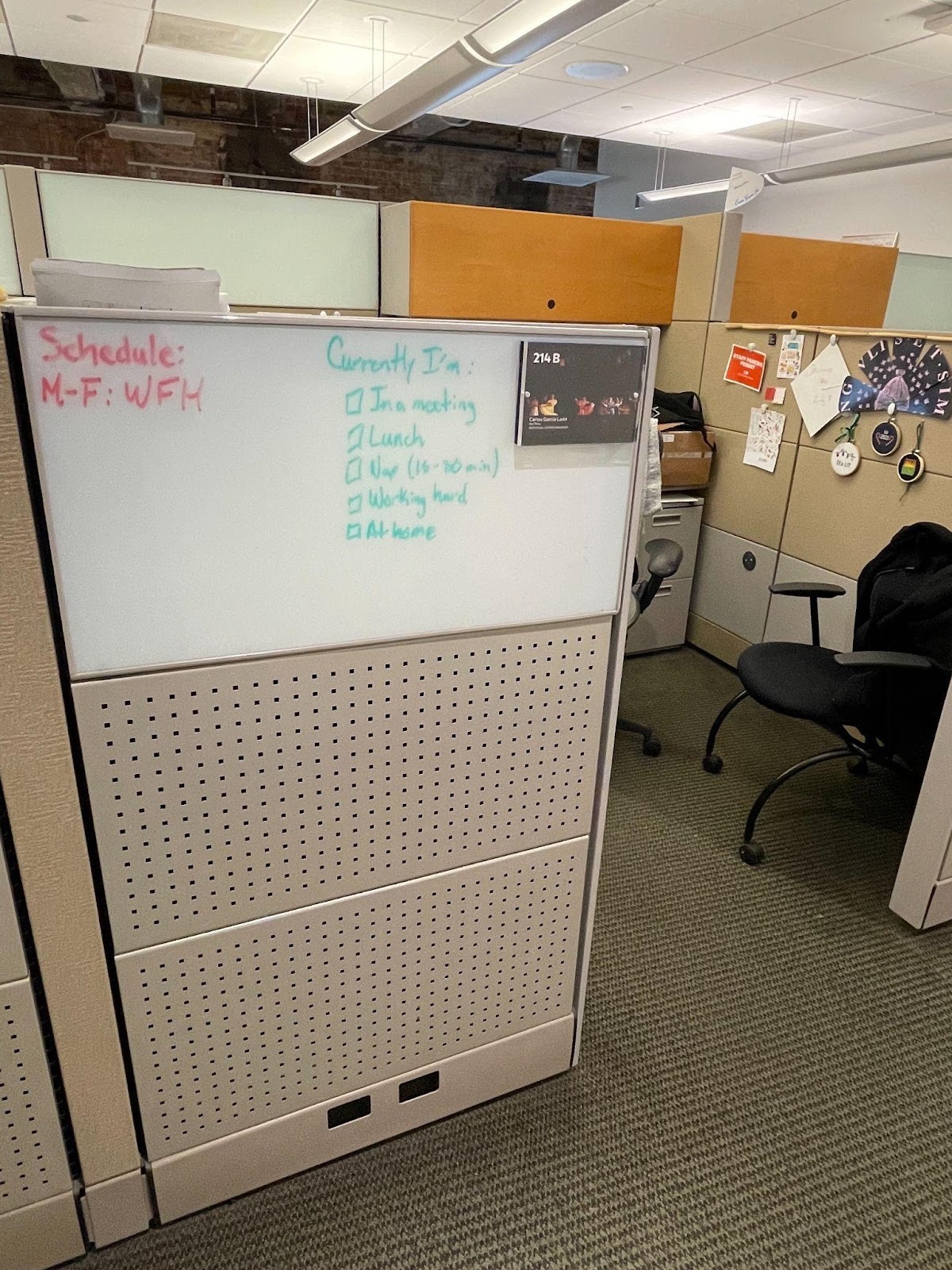
Carlos’ cubicle, with a whiteboard on it that shows their schedule. Napping happens after lunch!

I tie this notion often to the much laissez faire attitudes I saw during my travels in both Europe and Latin America, where many workers often take the time to really enjoy their mid-day meal, whether or not they had company around them. They removed themselves from having a work-work-work mentality.

On top of that, I also take rest as an act of defiance, in combating the work I am asked to do compared to the amount of money that I am paid — which is too much work for very little pay. If an organization starts crumbling because you aren’t present, it says more about the organization and its inequitable structures and less so about the work you are doing.

Do you see how this small shift in articulating this as employer exploitation unpacks burnout culture for its true design?

In my experience within my company, my team is aware of my stance on resting. My supervisor has never woken me up from an office nap, nor have they told me it is a problem. However, even if they did, my response would be that because of the circumstances that we find ourselves in the work culture, due to employer exploitation, I cannot do my work as well unless I take a nap.

(Also, I do not get paid enough to buy or make coffee everyday to continue working while also feeding myself and ensuring that my plants don’t die.)

Ruh-roh, I think coffee is the worst.

For as we have known, society tells us that if we aren’t making money, we are losing value.

Now, coffee drinkers, take a seat on a comfy chair and grab a blanket.

There is a reason why I hate coffee. Beyond its bitter taste, there’s also the notion that coffee is a device for us to use in order to continue working. Coffee doesn’t allow us to rest because our society has always held shame around taking breaks and resting. Capitalism has used caffeine as a tool — a drug really — to keep us in this cycle of productivity. For as we have known, society tells us that if we aren’t making money, we are losing value.

We have been drinking ourselves into being overworked and underrested. The hustle/grind culture that we have applauded ourselves and others for is creating high levels of exploitation that if we do not fix now, will be much harder to solve in the future. I see this often in my colleagues and others in the field, who have had at least one side hustle to make ends meet on top of their already demanding job.

How this hasn’t been classified as exploitation is truly beyond me.

Solved the mystery, onto the next!

Now, we have solved the mystery of burnout, and who the villain really is — there’s probably a bigger villain around the bend, right? (I mean, that’s the trajectory of any mystery show.)

Capitalism is that bigger villain.

Much like how the Scooby Gang found themselves as they grew up, we are also finding ways to continue working while keeping our mental and physical health intact. Experiencing burnout, even just once a year, is impeding our overall and long-term possibilities of success and is completely antithetical to the idealized notion of Capitalism that gets spun — the idea that we can work constantly for the long haul.

If anything, just think how incredibly proud your ancestors would be of seeing you take a nap, for even allowing yourself to think you can take a nap.

Even having an hour for lunch is seldom enough time to make and cook lunch. It’s not enough time to rest and heal from the many things that keep us up at night, whether it be handling care of children and/or elders, the mental health toll of the pandemic, the ongoing ways that the government has not taken care of its citizens, the racism that is prevalent in Capitalism, and the financial stresses of our world.

Shaggy and Scooby may be able to indulge and eat everything on the menu of the food venue they are in all the time, but in reality, we as people generally do not. I wish that we were given the chance to rest more so that we could do our work better.

Normalizing exploitation in the workplace is a violent act of harm to the body, mind, and the spirits of our workers, coworkers, and colleagues in the field.

If anything, just think how incredibly proud your ancestors would be of seeing you take a nap, for even allowing yourself to think you can take a nap. I often envision my ancestors looking with pride as I fight Capitalism via rest, something of a privilege that they were never given or even could think of, for the sake of providing for the family due to the lack of opportunities they had as immigrants and non-English speakers.

The Mystery Machine needs a tune-up, but let us continue fighting against normalizing burnout and more exploitation in workplaces by centering our health and deconstructing the harms of Capitalism. After a Scooby Snack and a nap, of course.


Carlos García León

Carlos García León

Carlos García León (he/they ; el/elle) is a queer, non-binary, Latine, Mexican-Statesian, and fundraiser. They were born in Atlixco, Puebla, Mexico, but currently reside in the stolen land of the Shawnee and Miami tribes, also known as Cincinnati, Ohio and work as the individual giving manager of Cincinnati Opera. Their work, both in the arts and through writing, is driven by a fight for cultural equity, decolonizing the arts, and social justice. Outside of working and writing, Carlos likes to stream TV and movies, read a good book, learn German, take naps under their weighted blanket, drink milkshakes, and look for the next poncho to add to their collection. They can be reached via email or on InstagramTwitter, and other social media platforms @cgarcia_leon. Tip them for their work via Venmo @cgarcia_leon or via PayPal using their email, cgarcia.leon@yahoo.com.

The Ethical Rainmaker: “The truth about unhoused folks (and harm reduction!) ft. The Sidewalk Project”

By Michelle Shireen Muri, Freedom Conspiracy Principal and CCF co-chair

Episode Summary

Medical violence. Stigmatization. Criminalization. These are just a portion of the harms we, as nonprofits, cause the people we are supposed to serve. That’s why Soma Snakeoil and Stacey Dee created The Sidewalk Project, an organization that advocates for the dignity and rights of people living on the streets. Everyone deserves to be treated with respect, have their needs met, and receive medical care, but our unhoused neighbors are often denied even the most basic compassion and dignity. 

In this latest episode of the Ethical Rainmaker, learn about some of the shitty practices we perpetuate and how we can instead empower communities that have been systematically harmed and erased.

Find the episode notes and the podcast transcript here.

About the Ethical Rainmaker podcast

In the United States alone, philanthropy is a $427 billion dollar industry, of which 68% comes from individual donors. Yet the practices, theories, and foundation of modern philanthropy and fundraising often ignore the ways in which the industry perpetuates harm.

The Ethical Rainmaker, hosted by Michelle Shireen Muri, is a podcast that hosts authentic conversations grappling with the questions that we don’t often ask in the nonprofit world. Join us as we explore some of the practices that undermine our missions and navigate the way forward with today’s resisters, reimaginers, and the re-creators of the third sector. It’s time to think differently.

Michelle Shireen Muri

Michelle Shireen Muri

Michelle Shireen Muri (she/her) is the co-founder for Community-Centric Fundraising and the host of the podcast, The Ethical Rainmaker. She is the founder of Freedom Conspiracy, a small collective of fundraising consultants focused on bringing values-aligned practices to clients in the nonprofit and philanthropy spaces. She can be reached at @freedomconspiracy on Instagram. You can send her a tip via Patreon.

3 learnings from BIPOC communities that have made me a better nonprofit leader

By Kristin Cheung, arts administrator/fundraiser
As first generation Asian Canadians, my parents always worked blue collar jobs — from housekeeper, warehouse worker, health care worker, and everything in between. Because of this, growing up, I never had role models in fields like “the nonprofit sector” and certainly not jobs like “executive director.” The nonprofit sector — the idea of working in a sector that doesn’t aim to generate large profits — was so foreign to my parents, Especially since they grew up poor in their home country and then came to Canada for the dream to thrive and be successful.

So seeing their only daughter work in a sector that didn’t fulfil their dream was a bit unexpected for them.

I joined my current organisation, an arts nonprofit, as its executive director last summer. I’ve always thought, in the back of my mind, that my parents wanted me to move into a more lucrative career, like the ones my other relatives are in (business, banking, tech, etc.) My career move was also a bit unexpected for me because I didn’t see myself as the director-type, since the typical executive director is a white woman in her late 40s.

Growing up on the Canadian prairies, in a white-dominant part of Canada, I never saw folks who looked like me — an Asian Canadian — represented in a senior leadership position, especially not one who was at the director level.

In my 20s though, I relocated to the West coast for an unpaid internship and suddenly found myself among many Asian Canadians. Vancouver’s population is 49% visible minority with Chinese, South Asian, and Filipino as the top groups. There were lots of niches of Asian Canadians working in the arts and nonprofit sector. Everything from folks running Asian Canadian Heritage Month, Vancouver Asian Canadian Theatre, Ricepaper Magazine (an Asian Canadian literary publication that also produces an Asian Canadian literary festival), and Centre A: Vancouver International Centre for Contemporary Asian Art (which I’m now board director of) — I saw that there was such a wide range of BIPOC folks in the nonprofit field — in all roles — and strong community leaders in positions of power. There were even BIPOC folks my parents’ age, who had been doing this type of work for decades.

But I always go back to my roots — as an Asian Canadian — and also from the BIPOC community that helped raise me and my career throughout my 20s. In them, I finally found some of the answers I had been looking for.

Seeing folks that looked like me — being represented — gave me a bit of push to follow the path of a job in the nonprofit sector, and after 15-years eventually led to an executive director role.

I thought working as an Executive Director was the most natural progression for my career path, but I quickly realised that the role was much more than the job description.

Financial auditing confusion, personality conflicts, human resources issues (the reality of hiring and firing people), and the never-ending workload were all things that made this role seem like not the right fit for me.

I struggled (and perhaps am still struggling) to find my place in a role like this.

In my struggles, I sought out support from white collar resources, like Linkedin, online Zoom workshops, audiobooks on Robert’s Rules of Order, and also just about every other conventional place on the internet to find ways to support myself in this new leadership role.

But I always go back to my roots — as an Asian Canadian — and also from the BIPOC community that helped raise me and my career throughout my 20s. In them, I finally found some of the answers I had been looking for. There’s a lot of guidance and leadership from these roots that I’ve probably long ignored for much of my younger years. I felt a lot of resistance to uphold the traditional Asian values as I’ve attempted to exist and assimilate to a Western way of life. But now in my 30s and maturing a little bit more, I can now really see the value of these learnings from my community.

These are three learnings from my community that have helped me become a better executive director, which in turn helped transform my organisation.

1. Accessibility, especially language accessibility, is so important.

In the past, I was always the individual in my community who was the ‘translator.’ Because I grew up with English as my main language, folks like me (second generation Asian Canadians) would always have to translate paperwork for our parents.

Language barriers contribute to disparities between many BIPOC communities and non-BIPOC communities — especially income inequality. From my experience with working within communities of colour — where English is often not their first language — I’ve had to shift my ways of working to suit their needs.

For instance, I’ve switched to speaking in plain language when discussing complicated bureaucracy. I use shorter, simpler sentences, use more common everyday words, and been more reader- and audience-centred in communications.

Also, speaking in plain language is a strength, especially in grant-writing. Like, you want to convey your message more clearly to the grant assessor. You want to explain, in simple terms, what you’re asking for, why you want your project funded, and for how much.

Working with communities of colour taught me that accessibility comes in all forms, not just language accessibility. There’s visual, cognitive, learning, neurological, auditory, physical, and speech accessibility, too. As nonprofit leaders, our goal is not just to manage our organisations, but to learn to make our programs more accessible to all — in all forms.

2. Be transparent and honest in knowledge-sharing.

My family is large, and I grew up with lots of cousins, aunties, and uncles. In order for our folks to survive in a new country, they relied on transparency and knowledge-sharing. Spreading news of new job opportunities in our community, as well as telling each other how much we were getting paid in our jobs was a vital way to not only survive, but thrive. My relatives needed to know all the information, like which jobs were paying well, so they could advance further in their jobs and careers.

In the early stages of my role, I found it difficult to understand what information to share and what not to share with staff and board members. My previous bosses only shared a portion of information to the staff, so I was inclined to inherit those same practices.

But I soon realised that sharing more information — providing greater transparency with everyone actually made the workload easier. With more information, folks were able to understand the gaps that needed to be filled, and thus they were more able to step up and support. Sharing drafts of documents, work plans, ideas of project plans and budget — with both board and staff alleviated much of my anxiety because the stress didn’t feel like it was just on my shoulders. Since I was able to share my ideas with everyone, I felt more supported and less alone.

Knowledge-sharing and transparency were vital for my Asian community to advance further in their jobs and careers. Now, in managing an organisation, knowing-sharing and transparency is also vital so that folks accurately know what’s happening — so we are better poised to move forward as a team.

3. Go with collectivism, and let go of individualism.

Collectivism is the idea that folks should work together for the greater good of the group. This is often in opposition to the ideal of individualism, where folks value one person’s goals and personal ideas above all else.

Collectivism is rooted in my family’s history and dates back to when my grandparents were rice farmers in Southeast Asia. As a community, they and other farmers all worked together because that was the only way to get a good harvest season for all. Similar values of collectivism are common throughout Asia, Africa, South America, and more.

In our field, the nonprofit and the charitable-giving sector, we should be applying more values of collectivism. We should be working together for the greater good for the community, rather than pushing personal agenda. In my role, my job is to facilitate the ideas from our community members — not use my job as a platform to execute my personal projects.

As I pass my six-month mark in my new job as an executive director, I will constantly keep on learning new ways of working and unlearning old ones. I’ll constantly test new ideas out and see what works and what doesn’t work. But so far the values of collectivism, transparency, and accessibility are strong key themes that I carry with myself as someone raised up in BIPOC communities. And now, these are values that I will carry with me in my professional life to help lead organisations forward.

KRISTIN CHEUNG

KRISTIN CHEUNG

Kristin Cheung | 冮雪莉 (she/her) is an arts administrator and fundraiser. She is originally from Treaty 6 territory (Edmonton) and now currently residing in the Unceded territories of the xʷməθkʷəy̓əm (Musqueam), Skwxwú7mesh (Squamish), and səl̓ílwətaʔɬ (Tsleil-Waututh) Nations (also known as Vancouver), Turtle Island. Passionate about working with and supporting the work of underrepresented communities, she has volunteered and fundraised for numerous culturally diverse nonprofits in Vancouver and Edmonton. In 2016, she co-founded The Future is you and me, a free community mentorship program for young women of colour and Indigenous women in the arts. This intersectional feminist program aims to build a future with strong, diverse women in leadership positions, reflective of the current cultural landscape. Kristin has a Masters in Arts Administration & Cultural Policy from Goldsmiths University of London and spends her free time as a board member of Centre A and Room magazine.

She can be reached at @cheung_kristin on Twitter and Instagram. To send her a tip for this essay, PayPal her at @kristincheung.

Photo credit – Elise Miccolis