My legacy as a descendant of the Taíno and African peoples who withstood Cristoforo Colombo and his ilk

My legacy as a descendant of the Taíno and African peoples who withstood Cristoforo Colombo and his ilk

By Chantelle Ohrling, a cultivator of reciprocal legacies in the face of extraction

This is the story of one holiday of many that keeps the room’s colonial mythology alive. In telling it, I hope to help reconstruct the room in truth, so that its warmth no longer depends on exclusion.

Somos un agujero
En medio del mar y el cielo
Quinientos años después
Una raza encendida
Negra, blanca y taína
¿Pero quién descubrió a quién?

We are a hole 
In between the sea and the sky 
Five hundred years later
A race ignited 
Black, white and Taíno 
But who discovered whom?

Juan Luis Guerra, El Costa de la Vida

If we picture the modern holiday season as a room built to protect an alternate history within the colonial memory, then Columbus Day in the U.S. and Canadian Thanksgiving in October would be the metaphorical threshold. This “room” was a constructed space designed to enshrine false memories that legitimize settler belonging. Its walls are carefully papered with constructed imagery of settlers and Indigenous Peoples in harmony sharing harvests, of “untouched wilderness”—terra nullius—waiting to be bravely conquered, and the ceremonies of violent religions which depict themselves as saviours. 

Within this room is also the “season of giving,” which teaches that charity is the highest form of love and that mercy can replace justice. The giver is redeemed, and the power structure remains intact. But this room, the spirit of the holiday season, was built on stolen land with stolen labour from stolen people. For those excluded from this alternate history—unless playing the role of gratitude that was scripted by whiteness—we are left in the cold outside of this “room.” This is the story of one holiday of many that keeps the room’s colonial mythology alive. In telling it, I hope to help reconstruct the room in truth, so that its warmth no longer depends on exclusion.

I trace my maternal ancestry to the Taíno and African peoples, who withstood the earliest European incursions upon Quisqueya and Ayiti. This heritage grounds my understanding of 1492 not as discovery but as the onset of racial capitalism and genocide. And while we’re rightfully critical of Colombo, it’s important to remember that he was only one man. 

Many colonizers came to our shores with a greed akin to starvation and careless violence in their hearts. 

In the process of said tracing, I have parted the illusionary curtains of history’s victors and learned to recognize the violent and extractive face of settler-colonialism continuities across modern contexts. Including those of Canada, the United States, and Israel. 

But too many of my colleagues are still unaware of what happened in 1492 and the true legacy of Cristoforo Colombo…

There are three main actors in this story of Caribbean land, yet history only remembers two: the colonizers colonizing on “paradise’s” shores (Colombo and his men, followed by the Portuguese and Spanish slavers) and those colonizing from their own shores (the European royals). 

What about the people who were already on the islands? 

Do you know their name? 

You eat their fruit: guava, banana, papaya. Most of the world uses their name (canoa) for canoes. Some of their food items have even become crucial aspects of European and Western nation cultural identities: potatoes (batata), corn (maiz), and barbeque (barbacoa). Castles all over Europe are adorned with furniture and doors carved out of the bodies of their sacred caoba (mahogany) trees. We all covet laying in one of their hamaka’s (hammock) on their shores. 

Despite the impact they continue to have, they’re continuously wiped from history. 

So who rescued Colombo in 1492? 

Take my hand and walk with me alongside a Caribbean shore. Warm, crystal clear blue waters roll and crash against white sand beaches. Palm trees thicken into mountains covered with rainforests made up of fruit trees and mahogany. A myriad of endemic birds are singing into the sweetly scented breeze. 

There are no internationally-owned resorts in the distance using tourists to separate the locals from their shoreline. It’s 1491, and you can still see a monk seal, and the ocean is heavy with life. 

Taíno Peoples are busy trading tobacco with other Nations and incorporating pineapple on the islands from the mainland of Turtle Island. 

What happened during First Contact?

Contrary to the education we receive, Columbo found himself among “… a highly populated and culturally sophisticated web of islands whose inhabitants were connected to one another through ties of kinship, political alliances, and trade networks. In many ways, the Caribbean Sea acted as a highway tying various indigenous cultures and peoples to one another. Some maintained ties as far afield as the South American and Mesoamerican mainlands.” 

These inhabitants governed themselves in complex, matrilineal, practices connected to land and ritual. Inheritances were passed down matrilineally. The sacred cemi figures and myths of Atabey (mother of the Taíno’s major deities) reflected reverence for deeply communal and reciprocal relationships with kin and land. These values are reflected in the many unique cultures across Turtle Island, and were exalted and held up by Abraham Maslow centuries later after he spent time with the Blackfoot Nation as seen in his Hierarchy of Needs. (It is important to note that although Maslow observed the Blackfoot philosophy on needs, he appropriated and misrepresented it, focusing on a hierarchy rather than interdependency and built his hierarchy entirely on the individual needs, removing the community actualization and cultural perpetuity aspects from the Blackfoot perspective.)

In spite of the 533 years of violent extraction, Indigenous Peoples still embody these values across the continent, to the point of sacrificing their lives to protect water and land. 

“This island, like all the others, is most extensive. It has many ports along the seacoast excelling any in Christendom — and many fine, large, flowing rivers. The land there is elevated, with many mountains and peaks incomparably higher than in the centre isle. They are most beautiful, of a thousand varied forms, accessible, and full of trees of endless varieties, so high that they seem to touch the sky… The nightingale and other small birds of a thousand kinds were singing… There were palm trees of six or eight varieties, the graceful peculiarities of each one of them being worthy of admiration as are the other trees, fruits and grasses… There is honey, and there are many kinds of birds, and a great variety of fruits… Hispaniola is a marvel… as also the magnificent rivers, most of which bear gold… This is worth having, and must on no account be given up.”

In December 1492, a European voyager, later mythologized as an explorer, accidentally grounded his fleet upon the reefs of a Caribbean island. The Taíno inhabitants, acting on their principles of communal reciprocity, extended aid and sustenance to the survivors. Colombo and his men depended entirely on the Taíno, whose humanitarian ethos inherently led them to aid the strangers and share their resources freely. 

This generosity, born from a worldview rooted in kinship and care, was immediately weaponized against them in the machinery of empire.

From his journals: “Inside, they were well swept and clean, and their furnishing very well arranged; all were made of very beautiful palm branches.” He said there were “wild birds, tamed, in their houses; there were wonderful outfits of nets and hooks and fishing-tackle.” Colombo wrote that it was a “delight” to see Taíno canoas (canoes) that were “very beautiful and carved … it was a pleasure to see its workmanship and beauty … the best people in the world, and beyond all the mildest … a people so full of love and without greed … They love their neighbors as themselves, and they have the softest and gentlest voices in the world, and they are always smiling. 

“…they are very guileless and honest, and very liberal of all they have. No one refuses the asker anything that he possesses; on the contrary, they themselves invite us to ask for it. They manifest the greatest affection towards all of us … content with the very least thing or nothing at all…” He wrote in his letter of discovery,  “… they should be good servants… and I believe that they would easily be made Christians … will take hence, at the time of my departure, six natives for your Highnesses.”

In these early colonial texts, we see the first examples of a predictable violence: colonial praise for generosity and beauty immediately giving way to claims that Peoples are property. Colombo claimed the Taíno lacked governance and religion, believed himself god-sent, and renamed landscapes to suit his delusional entitlement. 

While there isn’t space or time for it within this piece, the mention of forced religious conversion to Catholicism is another main force of colonialism which continues to this day. Colombo and his men were the first missionaries in the western hemisphere. And we can’t forget that the Doctrine of Discovery and Terra Nullius were created by Pope Alexander VI to enable Colombo’s “right to claim land that was deemed vacant for their nation.” Land was considered Terra Nullius (vacant land) if it had not yet been occupied by Christians. Such vacant lands could be defined as “discovered” and as a result sovereignty, title, and jurisdiction could be claimed. In doing so, the Doctrine of Discovery invalidated the sovereignty of Indigenous nations and gave Christians the right to subjugate and confiscate the lands of Indigenous Peoples.” This enforcement of religion also violently restricted gender rights.

This event “first contact”welcomed the genocidal and ecocidal machinery of imperialism that spread across Turtle Island against Indigenous Peoples and Africans with the Trans-Atlantic Slave Trade. 

Walter Rodney writes that “the transportation of millions of Africans was a drain of human skills and energies which could have been used inside Africa.” He names this a culture of extraction, defined as a system that “destroyed the capacity of the African economy to grow.” The genocide was not only in the deaths during the middle passage fifteen to twenty million gone but in the deliberate stripping of Africa’s ability to sustain itself.

And what you do to the people, you do to the land. Genocides almost always coincide with ecocide. Not only did our numbers diminish so quickly and sharply that we were declared extinct on paper as early as 1533, but half of the island lost 98% of mahogany (caoba) trees sacred to Taíno culture. According to the John Brown House Museum, “With growing demand for mahogany, deforestation spread steadily through the West Indies and Central America during the 18th century and contributed to the alienation of Indigenous peoples from their native lands.” 

Not to mention the zealous overhunting and destruction of animals. There used to be seals in the Caribbean seas; they were declared extinct in 1962. 

We see the continuing effects of this treatment of Indigenous Peoples today in Canadian apartheid enacted through the Indian Act, and American immigration detention and theft of Indigenous People of Central and South America. In the extensive for-profit prison system, continuing the chattel slavery of African descendants through the 13th Amendment. In the violent extraction of resources and capital in Africa and South America committed by international companies.

How we resisted and continue to resist.

My mother’s ancestors resisted colonization fiercely. 

My Taíno ancestors burnt down the first colonizer settlement in 1493, leaving Colombo to return to no survivors apart from the children to be born from his men’s assaults, no settlement except for charred remains. 

We refused to grow food for them. 

We organized mass rebellions, and this spirit lives on. 

We escaped to the mountains and survived in marronage, as described in Freedom as Marronage by Neil Roberts. 

We offered our knowledge and sacred caves to our indigenous African cousins fleeing slavery. 

Our deep kinship ties are depicted in ceramics possessing both African and Indian characteristics, which are fairly commonly discovered in the Caribbean. As well as in the bachata and merengue born of Afro-Indigenous beats. 

Despite this, very rarely are we mentioned by name — even in very progressive publications. 

Colonization has done a wonderful job of almost erasing us from the history books. 

I regularly scan the index of many books on colonization and decolonization. Almost all of them mention Colombo by name, but never the Taíno or Arawak Peoples. For example, this article in The Guardian manages to write of our destruction without mentioning the Taíno or Arawak Peoples by name once, and only references the island by the colonial name. Even the source that I used as a definition for Terra Nullius — an organization created to amplify Indigenous voices — participates in our erasure by not naming the Taíno and centering Colombo in the story of 1492. 

In recent years, activists across Turtle Island have been calling to replace the holiday on October 13th with Indigenous People’s Day. While an improvement upon the holiday, most retellings of this history are still participating in the erasure of my Taíno ancestors. 

“Indigenous Peoples’ Day is an official city and state holiday in various localities in the United States that celebrates and honors Indigenous American peoples (Native Americans) and commemorates their histories and cultures. It is celebrated on the second Monday in October. It began as a counter-celebration held on the same day as the U.S. federal holiday of Columbus Day, which honors Italian explorer Christopher Columbus  genocidal Cristoforo Colombo. It is celebrated as an alternative to Columbus Day, citing the lasting harm Indigenous Tribes suffered because of Columbus’s all colonizers’ contributions to the European colonization of the Americas.” (Wikipedia)

Many publications question our existence at all. 

As recently as 2023, The Smithsonian was questioning our existence and bemoaning our lack of racial purity, with only a quick note that blood quantum was a Nazi invention. But many people are direct descendants of and have inherited our culture of marronage. My family and many other families have been on the same land they have always been on, still call plants and lands their Taíno names, still have Indigenous reciprocal relationships with all living relations.  

While I will not describe the atrocities that my ancestors survived in detail, I do want to stress the scale of the horrors. The Spanish royalty, who were responsible for the creation of the Spanish Inquisition, had Columbo arrested and removed from his post as Governor due to his cruelty. Many other writers choose to focus on the gory details, like Aura Bogado in this article here. These resources are how I’ve learned of my ancestry. If I want to find my ancestors, I have to look in Colombo’s and other colonizers’ journals and read the atrocities of what they did in their own words. I have to go searching for the legacies of resistance and reciprocity I’ve inherited in books called The Conquest of Paradise: Christopher Columbus and the Columbian Legacy, Conquest of Eden 1493-1515, and Paradise Destroyed: Catastrophe and Citizenship in the French Caribbean

What these books fail to include is the resistance that continues to this day and the beauty of Afro-Taíno culture which illuminates the islands. 

My African ancestors — likely also Afro-Taíno descendants of marronage — freed themselves and the entire island from slavery. Haiti was the first nation to outlaw the barbaric practice that was brought to us first by Portuguese slave traders. 

My family is from a part of the Dominican Republic still called by its Taíno name and known for its dedication to rebelling and protesting injustices. We have resisted American imperialism in the form of US-placed and backed dictators who committed genocidal acts against our Haitian siblings. We have built a beautiful blended African Indigenous culture which dances bachata and laughs in the face of our supposed extinction. I even have friends who are reviving the Arawak language and writing poetry in Taíno. 

The journals of Colombo describe my Taíno ancestors as “liberal of all they have,” people who gave without hesitation, who welcomed strangers with open hands and open hearts. Colonial greed tried to twist that generosity into servitude, but what my ancestors embodied was not weakness. Their legacy is one of ethics of abundance, reciprocity, and care. 

That same ethic flows in my blood and lives in my marrow. It is why I do the work I do: to resist systems of extraction and to cultivate relationships rooted in reciprocity and justice. Their resistance was more than burning settlements and refusing subjugation; it was also in their insistence that generosity is strength, that community is wealth, that survival is an inheritance we must continue to defend. I carry that forward, knowing that to honour them is to build a future where giving restores balance instead of taking it away.

Colombo’s colonialism also continues on — on our island, in evolved forms of capitalism, and in the same violent settler-colonialism we see in the genocide committed against Palestine. 

International hotel chains owned by American and Spanish capitalists profit off of destroying our environment whilst creating a dependency on tourism. Canadian mining companies revel in extractivism, polluting our land and water as they exploit gold — maintaining Colombo’s destructive hunger for resources. Megalithic cruise ships destroy sensitive reefs in two major ways: dumping toxic waste in the ocean and, just as Colombo did in 1492, physically striking them

Subvert “Columbus Day” and all the anti-Indigenous holidays of this season.  

Center the Taíno, the Africans, the Afro-Taíno. 

We’re still here. We survived. Say our names. Refuse the erasure. 

It was not the “Columbian” Exchange, it was the Taíno Exchange. 

Don’t mention his name or 1492 without also naming those who continue to survive and thrive. 

Celebrate our survival not by celebrating Colombo and his extractive, violent values, but by aligning yourself with the values of generosity and respect for the land he sought to destroy.
Chantelle Ohrling

Chantelle Ohrling

Chantelle Ohrling (she/her), comes from a long line of rebellious Afro-Taíno women. When she isn’t nerding out about planned giving at Ecojustice or with her nose in a book, she’s honouring her responsibilities to her communities by tracing histories, listening to stories, and building connections for liberation. She believes we can alchemize oppressive systems (much like fungi decompose dead matter) into fertile ground for new societies rooted in reciprocal relationships based on deep care and respect for all living relations. You can find her on LinkedIn.
When my life is no longer a priority funding issue: A love letter and a thank you note to resource organizers

When my life is no longer a priority funding issue: A love letter and a thank you note to resource organizers

By Aileen “AJ” Joy, Director of Resource Organizing and Organizational Development, Tenants Together

My story is not an unfamiliar story right now, and I still want to send out my little story with love and gratitude and resistance to all my comrade resource organizers living through this. Triggers in this article include: intimate partner violence, housing insecurity, addiction, untimely death.

Like resource organizers have always known, the interest of those with money and class privilege comes and goes, but the work continues. I know the work we do matters, and I am grateful that I get to do it with you.

Dear resource organizers,

I have worked, paid and unpaid, for over a dozen years in tenant rights, anti-displacement, and housing in California. 

Way before that, I was a kid in San Francisco whose family got displaced to the suburbs when our home was sold to a large landlord and a fire damaged part of it. 

That move cost us a lot as a family. 

Like many people the world over (and definitely many of us from my beloved Bay Area), our family was made by lots of ties, both chosen and blood. A stable home and proximity to each other strengthened our connections and capacity to care. 

Being displaced from our neighborhood in the late nineties and early naughties, as a teen, caused a ripple effect in my family of those “poor health outcomes” the nonprofit industrial complex claims to want to prevent: addiction, toxic levels of stress and all kinds of mental health crises, loneliness, and shortened lifespans. 

Again, as an adult, the cost of housing in the Bay Area kept me in violent or toxic relationships, but community-controlled and created social housing solutions enabled me to get free from the cycle of domestic violence. 

I say a big thank you, with my words and my actions, to the legacy of organizers—largely BIPOC, queer, working class, and femme—who created the dynamics and structural capacity—like rent control, harm reduction, community land trusts, and complex webs of care among organizers—for me to be free. 

And now? Now…sigh. 

Among all the values and communities and beloveds being attacked, I am also hearing from some funders that housing is no longer a priority issue in their portfolios. Housing is not a part of their future public health grantmaking; they did a brief experiment in race equity and housing funding, but now they are moving on. 

These responses break my heart, and they will cause real harm. 

Very few funders to begin with funded the kind of BIPOC-led, scalable, cost-effective, and proven solution to housing insecurity tenant organizing that organizations like Tenants Together, where I work, have done for decades. 

De-resourcing and de-staffing anti-displacement work will create conditions for more evictions, more homelessness, more harassment of community members in the home (as landlords and others increasingly seek to use ICE to intimidate community members where we live), and therefore more illness and death. 

Don’t believe me? As LeVar Burton told me as a tiny millennial, “You don’t have to take my word for it.” Check out this peer-reviewed study published in the National Bureau of Economic Research that found that lives are cut short from evictions—whether they’re connected to the ongoing COVID pandemic or not—far too often. 

In the past six months, Tenants Together—California’s statewide organization for renter rights—lost a significant portion of our budget due to “anti-DEI” (pro-segregation) funder sentiment, funders defunding housing as a public health strategy, and more symptoms of this moment. I have never written more grants or asked for more in my life, all while I was on partial furlough and my stepparent was dying. 

I know so many of you are facing this and more, and are hearing everyday funding and policy decisions that seek to tell us that we, our stories, and our lived experiences do not matter. 

For me, as a survivor, this opens up old, deep wounds of gaslighting, dismissal, and profound unsafety.  

If you feel this too, resource organizers, I just want to say that I love you, I believe you, and I thank you for how you have showed up as a community for me, throughout my career and in this current funding environment. 

When the funder or policy gaslighting gets to be too much for me (like right now, when another budget cut hits, or when I hear another organization I love dearly is facing lay-offs, furloughs, or closure), I cry, I despair, and I also try to do some of these things for myself:

  1. Rightsizing my assessment of the threat to us and acting where I can. I hold so much fear and heartache now, but I learned from my survival how to live with some of these big feelings. First, I find spaces where I do not have to live my fear or sadness alone. I find comrades (more below) and trusted healers to navigate the defunding and other attacks with me.I then investigate where I have privilege (as a white person who has always been in the more “middle” side of working class) and where I have risk (as a queer nonbinary and disabled survivor). In so many spaces, I am less at risk than colleagues, and I can use this to step up or step back as the situation needs.


    I use my position of leadership in movement (and my fundraising skill set) to ensure we continue to have access to growing amounts of paid PTO and better than industry standard benefits (including flex funds for culturally meaningful care or otherwise uncovered therapy). As funding continues to be threatened, the fight to protect our well-being as organizers will deepen; I am here for it with you.

  2. Taking time away from screens and the hustle to rest and recharge. The work of Tricia Hersey has been very inspiring to me and many colleagues in the trenches out here. By resting, small periods each day and also for days or a week at a time (after longer sprints for funding), I am more able to respond to a landscape that changes quickly.

    Survivorship has taken real tolls on my body, which I will not detail here, but rest has made it possible for me to continue this work, skillfully and with creativity and care for comrades.
  3. Deepening my listening to mentors. I am seeking this information from deep conversation with partners, other community members, and national coalition partners tracking the trends right now.

    As a movement, we know a lot about resistance, in this time and in all the times before.

    Not a comprehensive list, but I never want to waste an opportunity to thank Steve Lew of Compass Point, Lisa Schottenfeld of Seed the Vote (where I volunteer as a resource organizer), Mario Lugay of Justice Funders, my colleagues at Tenants Together, and so many of the staff and members of our national partners at Right to the City for leading with your combined decades of deep wisdom, kindness, love, dedication, and humor. Spending time with you all the last few years has really grounded this work for me. 

    Like resource organizers have always known, the interest of those with money and class privilege comes and goes, but the work continues. I know the work we do matters, and I am grateful that I get to do it with you.

    In solidarity,

    Aileen “AJ” Joy

    Aileen “AJ” Joy

    Aileen “AJ” Joy

    Aileen “AJ” Joy (they/he/she) is Director of Resource Organizing and Org Development at Tenants Together, California’s statewide organization for tenant rights and a coalition hub for over 60 member and partner orgs statewide. They have worked in the tenant rights field for almost 15 years. To tip AJ for their efforts, you can donate to Tenants Together here.

    Rethinking stewardship: Who deserves our time (and why)

    Rethinking stewardship: Who deserves our time (and why)

    By Maria Rio, well-known pot-stirrer

    How my lived experience as both charity recipient and fundraiser taught me that true stewardship should center community, not cash:

    I remember the first time I walked into a gala a former employer was hosting. It felt fancy beyond belief for someone who grew up in poverty. I felt out of place.

    While I was trying to find my footing, I noticed something: senior leadership spoke differently to the guests with expensive coats versus the volunteers doing registration. Their behaviour modeled that monetary support mattered more than any other gift an organization could receive. 

    In fundraising, we are trained to identify “prospects” by their clothing, their postal codes, and their networks. We segment our donor lists by giving capacity and reserving our warmth, handwritten notes, and genuine gratitude for those who can write the largest checks. 

    But here’s what donor-centric stewardship doesn’t acknowledge: the person who gives $5 monthly from their disability income is making a proportionally larger sacrifice than the wealthy philanthropist writing a $10,000 check. The volunteer who shows up every week despite working two jobs to make ends meet is giving something more precious than money. They’re giving their very limited free leisure time. 

    Let’s be clear about what donor-centric stewardship actually does: it reproduces the same systems of oppression that our nonprofits claim to fight against. When we center wealthy donors’ comfort over community voices or we prioritize those with disposable income over those with lived experience, we perpetuate the very inequities our missions seek to address.  

    I’ve been guilty of catering to the wealthy as a donor-centric fundraiser, but with Community-Centric Fundraising, I know we can–and must–do better to steward our entire community.  

    Many of us are already trying. The data says that over 90% of nonprofits are now familiar with the CCF movement, and 76% have changed practices in response to CCF or broader equity initiatives, according to a 2025 Johnson Center study. This widespread adoption is happening as more people acknowledge that the traditional donor-centric model without the infusion of CCF values and practices has failed our communities and our missions. 

    Redefining Value: Beyond the Dollar Sign 

    When I fundraised for an anti-poverty organization, service users couldn’t give money to our organization. But they could, and often did, translate for other Spanish-speaking families. They shared their stories to help secure funding. They advocated fiercely for program improvements. They gave time, expertise, and emotional labor. 

    However, none of that showed up in a donor database. 

    Community-Centric Fundraising asks us to expand our definition of investment. 

    At the heart of CCF are ten guiding principles, and several directly challenge how we think about stewardship: 

    • All who strengthen the community are equally valued: volunteers, staff, donors, board members. This means recognizing that the volunteer who coordinates your food bank is as vital as the donor who funds it. The formerly unhoused person who speaks at your gala is contributing as much value as the table sponsor.
    • Time is valued equally as money. When someone gives you 20 hours of their time, they’re giving you something they can never get back. That deserves the same gratitude and care as a financial contribution.
    • We foster belonging, not othering. Donor-centric stewardship without a CCF lens creates an us-versus-them mentality. CCF stewardship builds community by recognizing that we all have something to contribute. 

    This shift in perspective changes everything about how we approach relationship-building in the nonprofit sector. 

    So, Who Deserves Our Time? 

    Organizations and fundraisers need to take the time to identify who they’re currently stewarding versus who they should be stewarding to be in alignment with CCF Principles. The gap is often shocking. 

    • Volunteers: I worked with an organization where a volunteer had been helping with an annual fundraiser for multiple years. She managed about a dozen other volunteers, secured sponsorships from her employer, and personally posted about it on social media. Yet she received the same mass thank-you email as someone who helped for two hours.

      Reflecting on the value of her contribution (both in hours and fundraising outcomes) I’d estimate it to exceed $100,000. But because she wasn’t writing the checks herself, she was stewarded as an afterthought.

      Not only are volunteer contributions incredibly valuable in their own right, volunteers often become your most loyal monthly donors when treated with genuine care. They’re your biggest advocates when they feel valued. They’re also your most likely planned gift prospects because they’ve seen the impact of your cause firsthand. You can easily start stewarding your volunteers toward other ways of giving by adding them into your donor database, sending them the same communications other donors get, and tracking the number of volunteer hours.

      The worst way overt devaluing of volunteers shows up is when a donor is also a volunteer, and you only call to acknowledge their monetary gifts without mentioning their donated time. By stewarding volunteers alongside donors, you avoid those awkward missteps in your relationship building and show true appreciation for the whole of what that person gives your organization. 

    • Board Members: Board service is a significant commitment, especially for people who are juggling multiple responsibilities. Yet many organizations ignore board stewardship. By doing so, we contribute to the lack of understanding board members often have about the work. Education is a key part of stewardship, and so is relationship building. Often, the ED will attempt to gatekeep the board from staff, but this only harms the organization. Fundraising staff should be encouraged to steward the board directly, telling them about the stories, programmatic impacts, and internal workings that make your organization special. This will bring the board along in understanding the sector, systemic issues, and the staff’s actual experience of the organization. It will also keep them engaged and inspired.

      I encourage organizations to acknowledge both the time and any financial contributions board members make. Send them updates between meetings. Celebrate their professional milestones. Recognize that they’re leaders choosing to stake their reputations on your work, and that–just like donors of money–they are looking to learn more about the issues. 

    • Your Staff: In a Small Nonprofit Podcast episode I did with Vu Le, we talked about this: “We are the biggest donor to the nonprofit sector… And if we’re donor-centered, then why aren’t we donor centered that way? Why don’t we focus – and we’re going to be focused on major donors – why don’t we focus on the biggest donors of all, which is nonprofit staff?” Every person working for below-market wages is essentially contributing the difference to your mission. That’s a form of giving. And it’s often invisible in our stewardship strategies and CRMs.

      Do you celebrate work anniversaries with the same enthusiasm you show major gift milestones? Do you invest in professional development as intentionally as you cultivate major donors? Do you acknowledge the financial sacrifice they’re making to serve your mission? Do you even say thank you? These are all critical considerations for nonprofit leaders looking to move towards CCF Practices. 

    • Monthly Donors: Monthly donors are the backbone of sustainable fundraising. They give smaller amounts but demonstrate consistent commitment. They’re more likely to increase their giving over time, respond to additional appeals, and stay connected to your mission for decades. Like volunteers, monthly donors are also your best planned giving prospects.

      Yet many organizations treat them as “set it and forget it” revenue streams rather than valued community members.

      Fundraisers should have specific stewardship tracks for monthly donors that recognize their consistency and commitment. This might include quarterly phone calls, special impact reports, or invitations to traditionally Major Donor events. 

    • Your Champions and Amplifiers: Some of your most valuable supporters never write checks, but consistently show up in other ways. They attend every event, share every social media post, and tell their friends about your work. They bring energy and enthusiasm that’s worth far more than money.

      The most powerful advocacy often comes from people who haven’t been asked or paid to promote your work; they do it because they genuinely care. Cultivating and stewarding these champions shows that you invest in those who support you as deeply as they invest in your work. 

    Practical Steps Toward Justice-Based Stewardship 

    Shifting from donor-centric to Community-Centric stewardship requires intentional changes in how we see and value our community members. 

    Instead of segmenting solely by giving capacity, try these approaches: 

    • Segment by longevity: Who has been with you for years, regardless of the size of their contribution? Loyalty and consistency deserve recognition.
    • Segment by engagement: Track more than financial gifts in your CRM. Note volunteer hours, event attendance, social media engagement, and advocacy efforts. 
    • Segment by role: Create distinct stewardship tracks for volunteers, board members, staff, and community advocates that acknowledge their unique contributions. 
    • Segment by values alignment: Some people demonstrate deep commitment to your mission through multiple forms of engagement. These are your champions, and they deserve champion-level care. 

    And if you are looking for even more ways to steward in ways aligned with CCF, try these: 

    • Practice cultural humility: Not everyone expresses gratitude or engagement in the same way. Be mindful of cultural differences in communication styles and relationship-building. 
    • Remove barriers to engagement: Ensure your stewardship activities are accessible. This means considering language, location, timing, childcare needs, and transportation barriers. 
    • Center lived experience: When planning recognition events or creating thank-you materials, ensure you dignify the perspectives of people with direct experience of the issues you’re addressing. 
    • Address power dynamics: Acknowledge when there are power imbalances in your stewardship relationships and work actively to minimize harm. 

    When we steward with justice in mind, several things happen: 

    • We build stronger communities. People stay engaged longer when they feel genuinely valued, not just cultivated for their wealth. 
    • We create authentic advocates. People who feel genuinely cared for become passionate ambassadors for your work. 
    • We model our values. If we’re fighting inequality, our fundraising practices should reflect that commitment. 
    • And we may identify hidden capacity. That volunteer you’ve been thanking with mass emails might have significant planned gift potential you’ve never explored. 

    Community-Centric Fundraising ultimately asks us this question: What kind of world are we trying to build

    If we want a world where everyone’s contributions are valued, community matters more than cash, and dignity isn’t determined by bank account balances, then our stewardship practices must reflect those values. 

    The 2025 Johnson Center data shows that organizations implementing CCF principles aren’t just feeling better about their work; they’re also achieving better results. We’re seeing a sector-wide transformation toward justice-based philanthropy. By jumping on the justice-based stewardship bandwagon, you’re ensuring your organization thrives through the many challenges ahead. 

    As someone who has been served by nonprofits and now serves them, I know that transformation is possible. But it requires all of us (fundraisers, executive directors, board members, volunteers) to examine our practices and choose courage over comfort. 

    The communities we serve deserve nothing less. And frankly, so do we. 

    Maria Rio

    Maria Rio

    Maria Rio is the founder and CEO of Further Together, a fundraising consulting firm dedicated to driving systemic change through Community-Centric Fundraising. A refugee who arrived in Canada at an early age, Maria uses her lived experience to help justice-driven nonprofits double their fundraising revenue while centering community voices. She serves on the Board of Living Wage Canada and hosts The Small Nonprofit podcast.

    From assumptions to integration: Examining your positionality throughout your community-engaged partnerships

    From assumptions to integration: Examining your positionality throughout your community-engaged partnerships

    By Charisse Iglesias, PhD, Training and Resource Director, Community-Campus Partnerships for Health

    Examining your positionality before, during, and after engaging with historically marginalized communities is so important to the work and allows you to reflect deeply on who you are working with, and why you are working with them. I argue that this reflection can be extremely helpful to be a better researcher, funder, and community-engaged practitioner.

    A lot of community programs and initiatives operate by going into historically marginalized communities to conduct “community-engaged” practice, which can be extracting and limiting by positioning the community as the default space to receive knowledge.

    The institutions see themselves as the experts who are most qualified to create and implement solutions. As Rudayna Bahubeshi explains in her CCF article, “What Community-Based Research Can Look Like Through a Community-Centric Lens,” “communities are the experts in their realities.” 

    There are many reasons why institutions and funders may fail to build trust with communities, and forgetting that communities are the experts in their realities may be one of them. Instead of pushing agendas, these institutions should reflect on why they chose to engage with certain communities: Are we the experts in our own reality regarding our power and privilege? If the answer is no, these institutions should critically examine how they show up and position themselves in these communities.

    There is power in exploring how your intentions, background, and lived experiences inform the person or institution you are today, and this is why I’m passionate about positionality. 

    Tyson Holloway-Clarke defines positionality as “our relationships between each other, the origins and formations of our ideas and knowledge, and the actions we credit to ourselves and others.” 

    Positionality is the consideration of the social and political factors that make us who we are. The practice of examining our positionality is undervalued and overlooked, but it does provide an opportunity to reflect on who we are, what has influenced us, and how we choose to influence others.

    Examining your positionality before, during, and after engaging with historically marginalized communities is so important to the work and allows you to reflect deeply on who you are working with, and why you are working with them. I argue that this reflection can be extremely helpful to be a better researcher, funder, and community-engaged practitioner.

    Reflect: Is Your Partnership Forcing a Cultural Fit?

    As a community-engaged scholar, I am mindful of the way that community-engaged research inherently disrupts traditional, hierarchical notions about scholarship where the researcher or university partner is considered the expert and research is essentially done to the community. 

    I am also a novice practitioner and teacher of drawing comics as a way to reflect, inspired by Scott McCloud’s Understanding Comics: The Invisible Art. I believe that composing comics can enhance the reflection practice because it encourages composers—as Gabriel Sealey-Morris argues—“to slow down, to consider the power of their rhetorical productions, and to own their authorship in a more palpable way than typing glowing dots onto a screen.” 

    Over time, I’ve noticed that I was revealing more about my experiences through drawing than I revealed through writing or thinking. Each panel serves as an intentional point in the comic’s narrative because you have to think strategically about what will fit into the panel and how it’ll be understood by the reader. Composing comics can be an effective way to communicate abstract thinking to support revealing the truths of your reality.

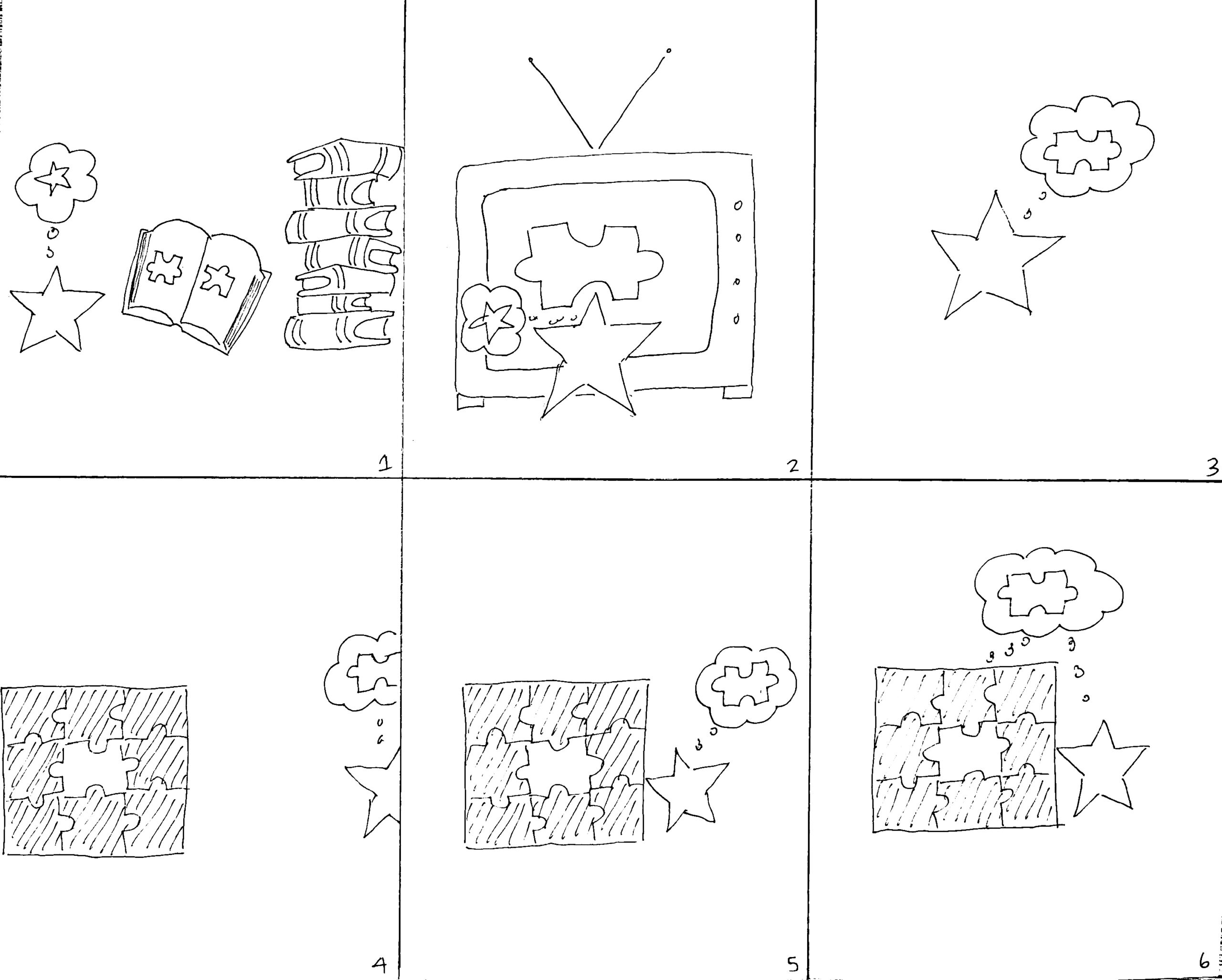
    I offer the following comics to describe my journey in discovering, acknowledging, and recognizing how positionalities affect the work done in community-engaged spaces: 

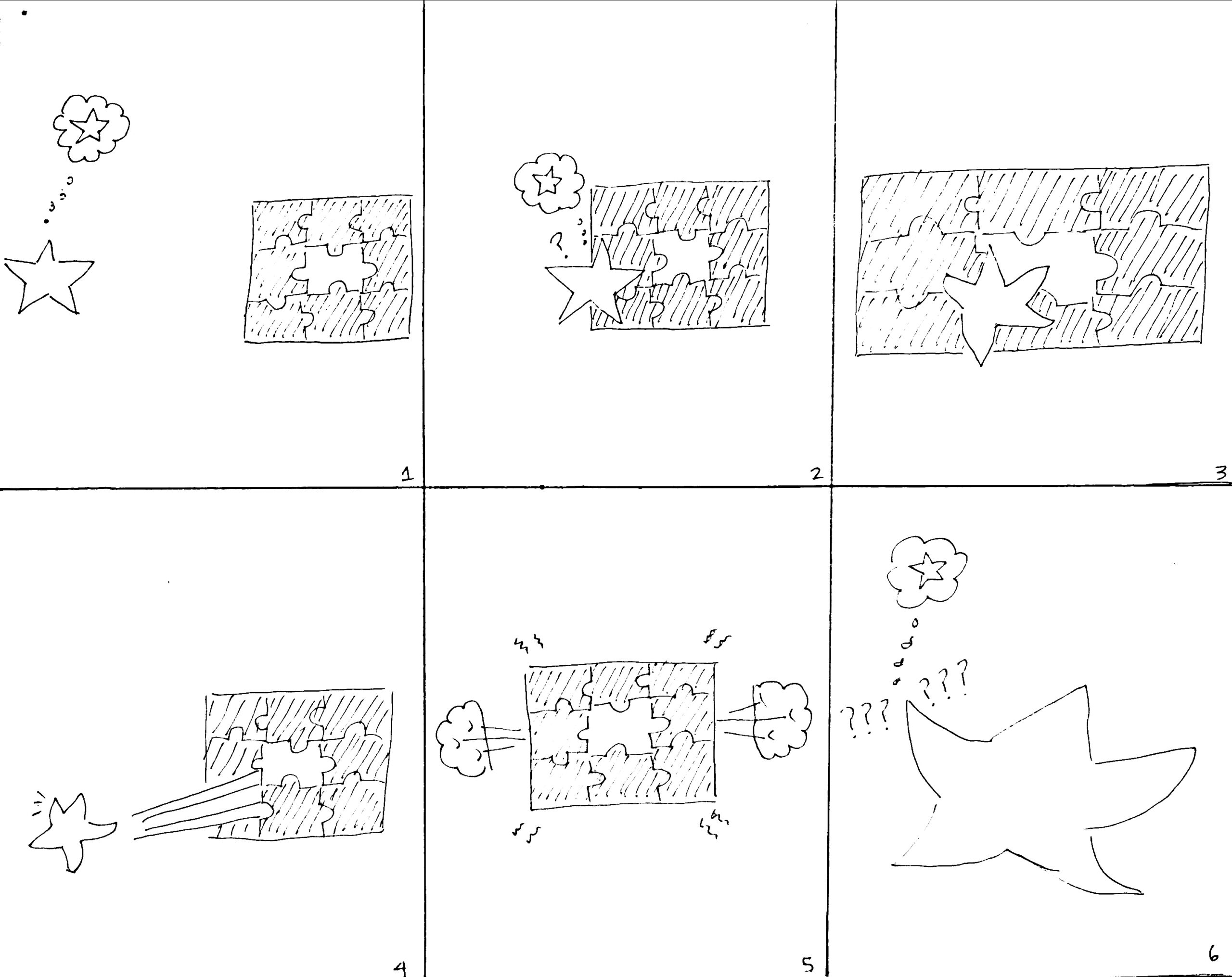
    Comic 1: Forcing a Cultural Fit

    A handdrawn comic. Panel 1: Star heads to a puzzle, while thinking of star
Panel 2: Star questions how it can fit into the puzzle, while thinking of star
Panel 3: Star forces itself into puzzle hole
Panel 4: Puzzle pushes away the star
Panel 5: Puzzle is upset at the star
Panel 6: Star is confused, while thinking of star

    Panel 1: Star heads to a puzzle, while thinking of star
    Panel 2: Star questions how it can fit into the puzzle, while thinking of star
    Panel 3: Star forces itself into puzzle hole
    Panel 4: Puzzle pushes away the star
    Panel 5: Puzzle is upset at the star
    Panel 6: Star is confused, while thinking of star

    In this comic, the star thinks they know best, and considers their perspective to be the default. This can create harmful power dynamics that could lead to irreparable effects later on in the partnership. 

    Thankfully, the puzzle clearly asserts that it’s the wrong fit. As a young community-engaged practitioner in the Peace Corps, I was in projects where I did not sense—or rather, I didn’t listen—to the signs of a mismatch. There were instances where I rushed to create content for a program to meet a self-imposed due date without securing additional feedback and that contributed to low attendance to the program.  

    It’s difficult to be in a community-engaged partnership where there is no real indication if the community embraces the intervention despite agreeing to fund and lead it. Community groups may say yes because they don’t want to be left out, or they want to be considered for future partnerships, especially when there is significant funding, and they don’t want to be seen as exclusive. There are so many reasons. It’s important to note that it is not necessarily the community’s labor or responsibility to communicate the mismatch. It’s the practitioner’s responsibility to reflect on the connection, on the partnership, and a big part of that is reflecting on why you came and stayed. 

    Reflect: Have You Prepared to Learn and Observe with Care?

    As you explore community-engaged projects and come into new communities, you might want to pursue a type of level-setting conversation to figure out each partner’s assets and self-identified needs. Any collaborative project would benefit from going back to basics by asking: Why are we here? What is the goal? Do terms connote the same for me as they do for you? If they don’t, what does that mean, and how can we move forward? What roles do we play? How do we hold each other accountable? These questions are essential to ensuring everyone understands important aspects of the project, shifting the power dynamics toward shared leadership. 

    A conversation like this could result in a formal partnership agreement or a brainstorming session about developing a common language about each other’s needs. However this conversation looks, it must be culturally-responsive, transparent, and built on trust. 

    Step back and reflect: 

    • How might your position as a researcher, funder, practitioner affect the power dynamics of the partnership? 
    • How could you show that your intentions to partner are based on respect and mutual growth?

    This is why community-engaged research cannot be taken lightly. It requires a profound commitment to learn about each other, respect differences, and find a path forward that is reciprocal and sustainable.

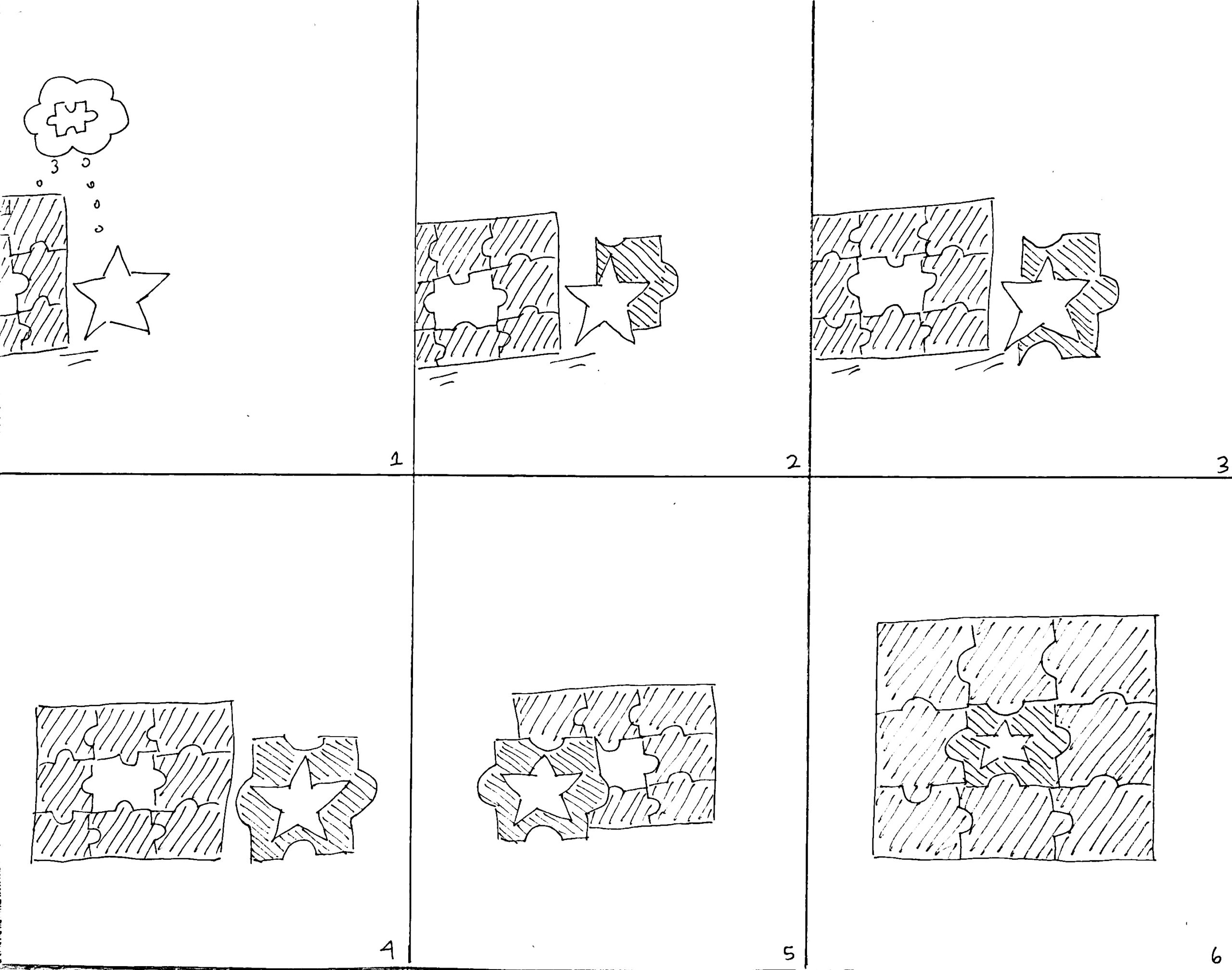
    Comic 2: Learning and Observing with Care

    A hand drawn comic. Panel 1: Star reads a book about the puzzle, while thinking of star
Panel 2: Star watches a video about the puzzle, while thinking of star
Panel 3: Star thinks of the missing puzzle piece
Panel 4: Star comes back to the puzzle, while thinking of a puzzle piece
Panel 5: Star starts interacting with the puzzle, while thinking of a puzzle piece
Panel 6: Star and puzzle are thinking of the puzzle piece together

    Panel 1: Star reads a book about the puzzle, while thinking of star
    Panel 2: Star watches a video about the puzzle, while thinking of star
    Panel 3: Star thinks of the missing puzzle piece
    Panel 4: Star comes back to the puzzle, while thinking of a puzzle piece
    Panel 5: Star starts interacting with the puzzle, while thinking of a puzzle piece
    Panel 6: Star and puzzle are thinking of the puzzle piece together

    In response to being scolded, the star does some homework on the puzzle. There is only so much you can learn in school, from books, and in the library, so the star tries to practice what they’ve learned out in the field. 

    Practitioners and researchers often bring (sub)conscious racist, elitist, and limiting assumptions into their community-engaged projects that presume communities are the ones that need to build capacity or increase their readiness to be able to partner with them. However, in authentic community partnerships, it’s often the opposite. Communities are ready, but there are systems and policies in place to prevent their success, and practitioners and researchers must take the lessons they’ve learned from the community-engaged projects to change institutional policies so that future collaborations between practitioners, researchers, and communities are improved for the sake of the community’s well-being, not exclusively the institution’s. 

    Reflect: What Assumptions Are You Bringing to The Partnership?

    Recognize when you make assumptions because, again, they could lead to irreparable effects later on in the partnership. When I arrived in my Peace Corps country, Indonesia, I assumed I’d have an easy time adjusting to the culture because I’d been told that the Indonesian culture had many similarities to my Filipino culture. The Indonesian teachers I worked with also assumed this because I looked exactly like them. But after many instances of miscommunication, we both realized that we needed to learn a lot more from each other and to not assume the other would understand what was going on. Even though my ethnic background had much in common with Indonesian culture, my US upbringing was a dominant part of my identity. This seems like a simple realization, but recognizing and accepting the differences we have with others to create a shared language is an overlooked practice.

    Step back and reflect:

    • What preconceived notions are you bringing into the community space? 
    • How can you approach your interactions with the intent to build trustworthy relationships?

    What you choose to create, research, and conduct matters, and how you choose to approach that practice matters just as much. 

    Comic 3: Integrating and Maintaining Self-Identity

    A hand drawn comic. Panel 1: Star walks with puzzle, while they both think of the puzzle piece
Panel 2: Star grows a piece to become the missing puzzle piece
Panel 3: Star grows another piece to become the missing puzzle piece
Panel 4: Star grows the final piece to become the missing puzzle piece
Panel 5: Star, as the missing puzzle piece, stands in front of puzzle 
Panel 6: The puzzle is completed with the star, as the missing puzzle piece, fitting in the middle of the puzzle

    Panel 1: Star walks with puzzle, while they both think of the puzzle piece
    Panel 2: Star grows a piece to become the missing puzzle piece
    Panel 3: Star grows another piece to become the missing puzzle piece
    Panel 4: Star grows the final piece to become the missing puzzle piece
    Panel 5: Star, as the missing puzzle piece, stands in front of puzzle 
    Panel 6: The puzzle is completed with the star, as the missing puzzle piece, fitting in the middle of the puzzle

    Countless communities—specifically Black/African American and Indigenous communities—have a deep, justified distrust of institutions, researchers, etc. because of historical and contemporary harms done to them. In this idealized comic, the puzzle provides a second chance to the star. 

    The star learns more about the puzzle community, has conversations about strengths and assets, actively puts into practice shared decision-making and open communication, and learns to adapt to what the community ultimately says it needs. 

    While community interventions should be community-funded (as much as possible) and community-led for sustainability purposes, there should also be space for a community-based evaluation plan to ensure that the intervention meaningfully addresses community-identified needs, not practitioner-imposed agendas. 

    The star does not try to change the mind of the puzzle for a star-shaped hole in the puzzle. Rather, the star builds themselves to fit the needs of the community.

    Reflect: Are You Balancing Your Identity and Mission With the Community Needs?

    There is a balance. You don’t want to lose yourself in the process of engaging and integrating into the community. You also don’t want to force your way in. You are still who you are. You are still a star. But you are adding bits and pieces to your knowledge and experiences and adapting to a new way of thinking and being for the purpose of achieving shared goals with a community partner.

    Step back and reflect:

    • How are you respecting your needs as well as the needs of your community partner?
    • How can you bring the positive relationship building you’ve practiced with your community partner back to your institution or organization to update policies regarding future community-engaged projects and partnerships? 

    Note your privilege in these partnerships and the potential to improve outdated policies that continue to position communities as the receiver of knowledge and laboratory of oppressive assumptions.

    From the misadventures of making assumptions to the process of culturally integrating, examining your positionality throughout your community-engaged practice strengthens your role as a practitioner, enhances the connection you have with community partners, and when shared, improves the training processes of researchers, funders, and practitioners to work equitably with all kinds of community partners. 

    Charisse Iglesias, PhD

    Charisse Iglesias, PhD

    Charisse Iglesias, PhD (she/her) creates shared educational spaces to expand the depths and intersections of our lived experiences, and she enjoys writing about the processes for creating those spaces with and for other education-minded practitioners. Find Charisse on LinkedIn!

    The case for unrestricted funding: Why true equity in philanthropy starts with autonomy

    The case for unrestricted funding: Why true equity in philanthropy starts with autonomy

    By Ena Taguiam, a London-based outreach and engagement coordinator and sexual health practitioner

    But what is unrestricted funding, and what room is there for it in the philanthropic sector? More importantly, how will it change the way we manage programs, and how will it contribute to building more equitable and anti-colonial practices within a still-colonial system?

    In the wake of what appears to be a major unravelling of the philanthropic sector following massive USAID cuts, experts and practitioners alike are urging the reimagining of the funding landscape. Most—if not all—of those affected are BIPOC-led and Global South organizations that work with communities in dire need of social support. 

    At the same time, anyone who is immersed in the funding landscape within the development sector would notice a significant shift in the language used in anti-colonial discussions. While donor-advised funding (DAF) is pretty much still the standard, there seems to be a significant rise in unrestricted, core, or flexible funding where grantees have more autonomy to decide where funding goes in the organization. 

    The growing support for unrestricted funding amid rising right-wing rhetoric is no coincidence. It is a heavy pushback by progressives on this emerging political climate. But what is unrestricted funding, and what room is there for it in the philanthropic sector? 

    More importantly, how will it change the way we manage programs, and how will it contribute to building more equitable and anti-colonial practices within a still-colonial system?

    Traditional colonial grantmaking

    Before getting into the case for unrestricted funding, it’s important that we talk about the status quo in grantmaking today. Traditional grantmaking approaches are driven by heavy oversight and planning from donors, thus are restrictive in nature. If lucky, grassroots and community-based organizations are consulted beforehand. But often, donors work with strategic advisors or consultants to “review and ensure proper reporting at each stage, so gifts are used most effectively.” Accountability is used as a proxy for trust-building. 

    But the truth is, it is more so for funders to maintain control. Restricted funding relies on a top-down approach where funders hold reins and dictate how resources are used, despite being the furthest from the problem. For organizations serving BIPOC communities, the situation is much more dire, as institutional racism manifests as challenges in our work and our funding. 

    Several studies looked at how biases and unconscious prejudices remain barriers for Black-led organizations in seeking funding. Despite the crucial role of BIPOC-led organizations in addressing disparities and helping those most in need, funding remains a significant barrier to doing our work effectively. 

    This is the result of historical under-representation in funding decisions – funders don’t understand the nuances and complexities at play in populations they want to help, but determine how impact is measured, completely removed from input from the communities. In most cases, the impact reflected in reports doesn’t manifest in communities (at least, not in the way communities would want to experience). The onus of accountability is on grantees, but not on the funders. True accountability goes both ways – while grantees are held accountable on how funding is spent, funders also have the responsibility to have an informed and participatory funding process.

    Colonial systems are so deeply ingrained with mainstream funding processes that we don’t notice how they affect funding decisions. In the process, funders forget that communities of color have agency over their own fate. Despite being the closest to the problem, communities of color are the furthest from holding power in deciding how they are funded and which programs get funding in traditional colonial grantmaking processes.

    This is the reality of prevailing colonial systems – where those in power continue to benefit, unless actively challenged through anti-colonial practices like trust-based and equitable funding.

    Unrestricted trust-based philanthropy

    Unrestricted funding is built on the idea of shifting this power imbalance within the development sector. Whereas traditional grantmaking is based on a unidirectional trust, unrestricted funding creates space on both sides for dialogue and mutual learning, ultimately building trust in the process.

    In projects where unrestricted funding is in place, grantees are treated as partners, and they have de facto control over how they spend the funds received. Such fundings are transformative for organizations, particularly when they are multi-year, as they give them room to breathe and flourish, rather than just keeping afloat. 

    Unrestricted funding often comes in the form of core grants, or general operating support. Funding entities like the Oak Foundation and MacKenzie Scott’s Yield Giving stress the importance of general operating support or core grants in building organizational capacity and scaling impact. Ideally, core grants cover the overall operational costs, rather than funding tied to projects. They cover the organization’s nuts and bolts—salaries, rent, utilities— which allows us to dedicate more resources to achieve our mission. 

    BIPOC-led nonprofits in the health sector, for example, need heavy human resource support to be able to deliver satisfactory health outcomes, particularly in vulnerable populations. Having a fully developed strategy is necessary in such interventions, and having multiple coordinators and field workers to execute said strategy is an even more important feat. But how can nonprofits thrive when securing grants becomes a full-time function of our management and there is a lack of human resources in the field? 

    The transformational nature of unrestricted grants

    The report on MacKenzie Scott’s Yield Giving showed the transformational nature of unrestricted grants as leaders talked about how the grant gave them breathing room to pause, strategize, and scale up their impact. The Oak Foundation talked about their lessons from core funding, how working with grassroots organizations helped them challenge traditional ideas of grantmaking, and emphasized how having core funding as the default helped their team to fully invest in the missions of their partners. 

    When the basics are covered, organizations can allocate more resources to think up more creative, community-driven solutions. When the basics are covered, there is open dialogue with the grantmakers and grantees, and more resources are allocated to activities and programs that the community needs – it transforms into the purest meaning of partnership.

    I would argue the most significant impact of unrestricted funding is the trust it builds between partners and within community-based organizations. Grassroots organizations are often the most trusted and rooted in the community. We spend most of our time immersed in the communities we work with in order to understand deep-seated issues better and to converse with the population on what they need the most. And yet, we’re chronically underfunded, or the funding that we do have is project specific. There is very little room for us to reimagine our programs, never mind the room to make mistakes in the process. 

    In today’s funding landscape, we are treated as beneficiaries, rather than the vanguards of justice.

    The ability to spend on overhead costs also helps grassroots foundations get additional funding. The Yield Giving report shows that getting unrestricted funding has emboldened grantees to be more strategic in funding opportunities they apply for. Unrestricted funding inevitably gives grassroots organizations a cushion or fallback to be more purposive in the grants we get, which in turn strengthens our mission. 

    Perhaps as we look to a new funding future, we envision an anti-colonial and equitable system in place – one where funding is reparative, not extractive; where relationships between donor and grantee are reciprocal, not transactional; and one where our metrics for success are defined by the communities we work with and aligned with lived realities. 

    While we recognize that the work towards building anti-colonial systems is long, arduous, and seemingly endless, we must strive for practices that centre autonomy, reciprocity, and justice. Unrestricted funding alone won’t undo systemic inequity, but it is a critical starting point in reshaping how power moves within philanthropy. After all, community-based organizations and the communities we work with already know how we can build our future. We only need trust to do so.

    Ena Taguiam

    Ena Taguiam

    Ena Taguiam (she/her) is a London-based outreach and engagement coordinator and sexual health practitioner, managing community health projects that address disparities among marginalised groups. She also supports a creativity-driven consulting firm in Atlanta, Georgia as a research and communication assistant. You can connect with Ena through LinkedIn or read through her Substack.