By Charisse Iglesias, PhD, Training and Resource Director, Community-Campus Partnerships for Health
Examining your positionality before, during, and after engaging with historically marginalized communities is so important to the work and allows you to reflect deeply on who you are working with, and why you are working with them. I argue that this reflection can be extremely helpful to be a better researcher, funder, and community-engaged practitioner.
A lot of community programs and initiatives operate by going into historically marginalized communities to conduct “community-engaged” practice, which can be extracting and limiting by positioning the community as the default space to receive knowledge.
The institutions see themselves as the experts who are most qualified to create and implement solutions. As Rudayna Bahubeshi explains in her CCF article, “What Community-Based Research Can Look Like Through a Community-Centric Lens,” “communities are the experts in their realities.”
There are many reasons why institutions and funders may fail to build trust with communities, and forgetting that communities are the experts in their realities may be one of them. Instead of pushing agendas, these institutions should reflect on why they chose to engage with certain communities: Are we the experts in our own reality regarding our power and privilege? If the answer is no, these institutions should critically examine how they show up and position themselves in these communities.
There is power in exploring how your intentions, background, and lived experiences inform the person or institution you are today, and this is why I’m passionate about positionality.
Tyson Holloway-Clarke defines positionality as “our relationships between each other, the origins and formations of our ideas and knowledge, and the actions we credit to ourselves and others.”
Positionality is the consideration of the social and political factors that make us who we are. The practice of examining our positionality is undervalued and overlooked, but it does provide an opportunity to reflect on who we are, what has influenced us, and how we choose to influence others.
Examining your positionality before, during, and after engaging with historically marginalized communities is so important to the work and allows you to reflect deeply on who you are working with, and why you are working with them. I argue that this reflection can be extremely helpful to be a better researcher, funder, and community-engaged practitioner.
Reflect: Is Your Partnership Forcing a Cultural Fit?
As a community-engaged scholar, I am mindful of the way that community-engaged research inherently disrupts traditional, hierarchical notions about scholarship where the researcher or university partner is considered the expert and research is essentially done to the community.
I am also a novice practitioner and teacher of drawing comics as a way to reflect, inspired by Scott McCloud’s Understanding Comics: The Invisible Art. I believe that composing comics can enhance the reflection practice because it encourages composers—as Gabriel Sealey-Morris argues—“to slow down, to consider the power of their rhetorical productions, and to own their authorship in a more palpable way than typing glowing dots onto a screen.”
Over time, I’ve noticed that I was revealing more about my experiences through drawing than I revealed through writing or thinking. Each panel serves as an intentional point in the comic’s narrative because you have to think strategically about what will fit into the panel and how it’ll be understood by the reader. Composing comics can be an effective way to communicate abstract thinking to support revealing the truths of your reality.
I offer the following comics to describe my journey in discovering, acknowledging, and recognizing how positionalities affect the work done in community-engaged spaces:
Comic 1: Forcing a Cultural Fit
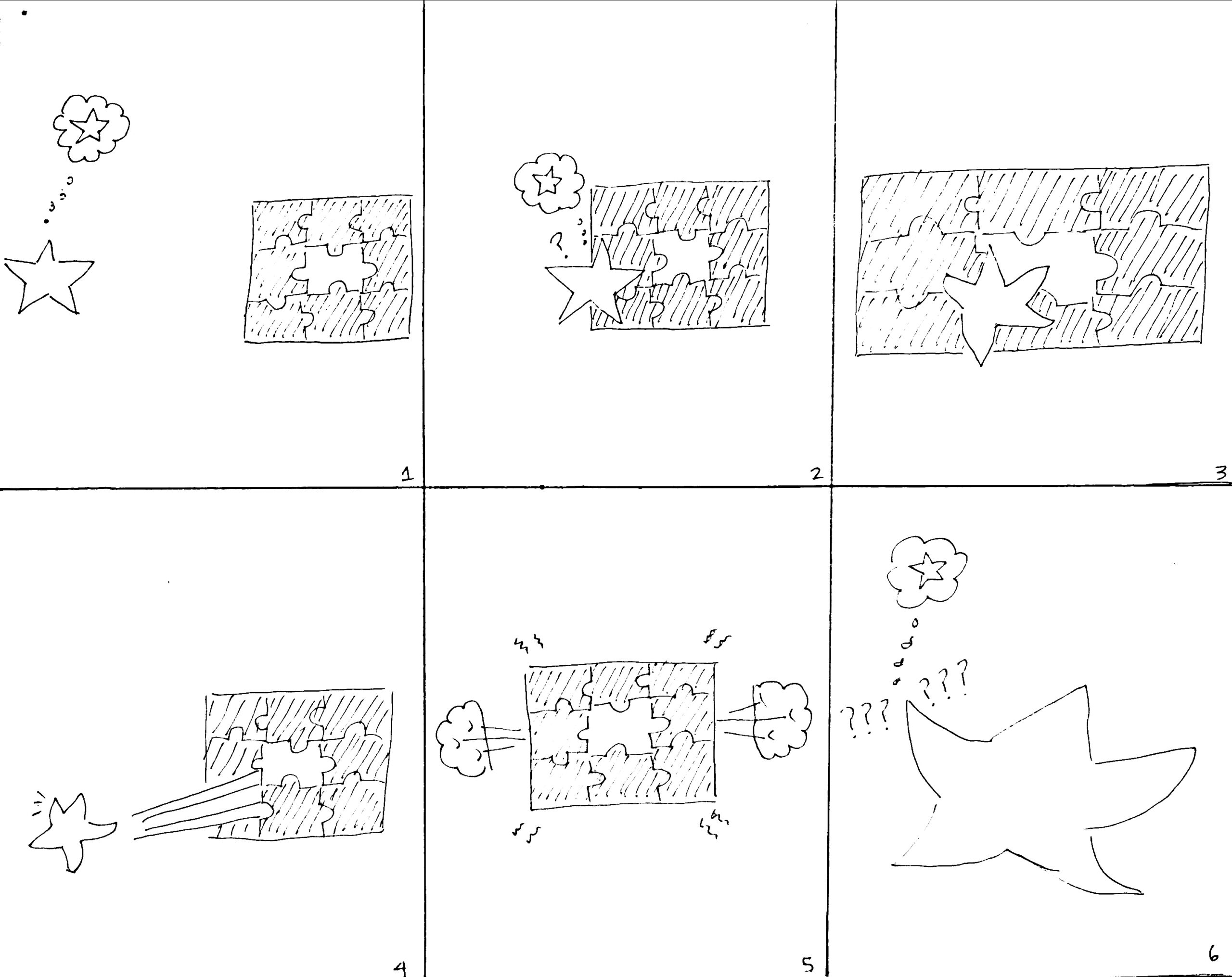
Panel 1: Star heads to a puzzle, while thinking of star
Panel 2: Star questions how it can fit into the puzzle, while thinking of star
Panel 3: Star forces itself into puzzle hole
Panel 4: Puzzle pushes away the star
Panel 5: Puzzle is upset at the star
Panel 6: Star is confused, while thinking of star
In this comic, the star thinks they know best, and considers their perspective to be the default. This can create harmful power dynamics that could lead to irreparable effects later on in the partnership.
Thankfully, the puzzle clearly asserts that it’s the wrong fit. As a young community-engaged practitioner in the Peace Corps, I was in projects where I did not sense—or rather, I didn’t listen—to the signs of a mismatch. There were instances where I rushed to create content for a program to meet a self-imposed due date without securing additional feedback and that contributed to low attendance to the program.
It’s difficult to be in a community-engaged partnership where there is no real indication if the community embraces the intervention despite agreeing to fund and lead it. Community groups may say yes because they don’t want to be left out, or they want to be considered for future partnerships, especially when there is significant funding, and they don’t want to be seen as exclusive. There are so many reasons. It’s important to note that it is not necessarily the community’s labor or responsibility to communicate the mismatch. It’s the practitioner’s responsibility to reflect on the connection, on the partnership, and a big part of that is reflecting on why you came and stayed.
Reflect: Have You Prepared to Learn and Observe with Care?
As you explore community-engaged projects and come into new communities, you might want to pursue a type of level-setting conversation to figure out each partner’s assets and self-identified needs. Any collaborative project would benefit from going back to basics by asking: Why are we here? What is the goal? Do terms connote the same for me as they do for you? If they don’t, what does that mean, and how can we move forward? What roles do we play? How do we hold each other accountable? These questions are essential to ensuring everyone understands important aspects of the project, shifting the power dynamics toward shared leadership.
A conversation like this could result in a formal partnership agreement or a brainstorming session about developing a common language about each other’s needs. However this conversation looks, it must be culturally-responsive, transparent, and built on trust.
Step back and reflect:
- How might your position as a researcher, funder, practitioner affect the power dynamics of the partnership?
- How could you show that your intentions to partner are based on respect and mutual growth?
This is why community-engaged research cannot be taken lightly. It requires a profound commitment to learn about each other, respect differences, and find a path forward that is reciprocal and sustainable.
Comic 2: Learning and Observing with Care
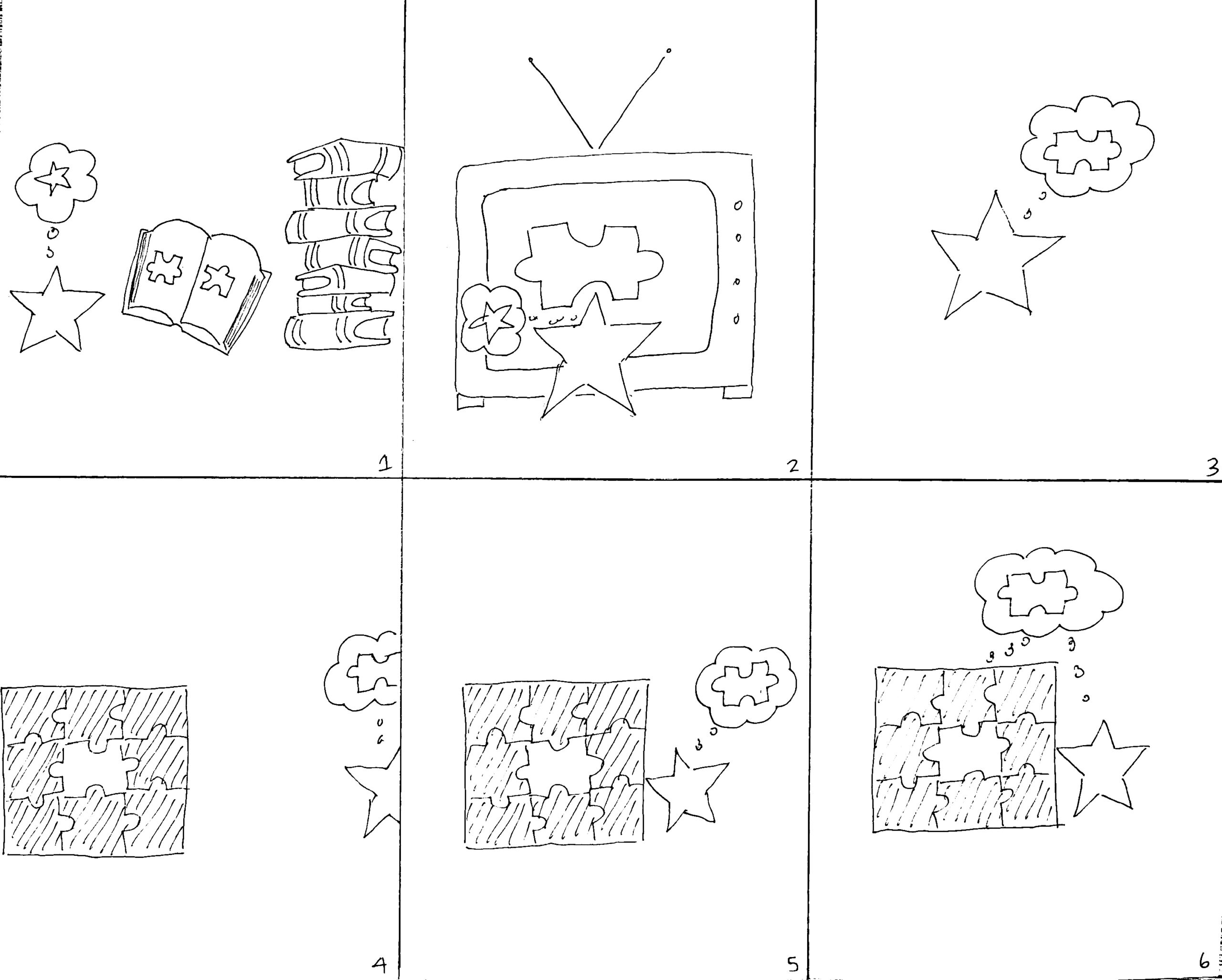
Panel 1: Star reads a book about the puzzle, while thinking of star
Panel 2: Star watches a video about the puzzle, while thinking of star
Panel 3: Star thinks of the missing puzzle piece
Panel 4: Star comes back to the puzzle, while thinking of a puzzle piece
Panel 5: Star starts interacting with the puzzle, while thinking of a puzzle piece
Panel 6: Star and puzzle are thinking of the puzzle piece together
In response to being scolded, the star does some homework on the puzzle. There is only so much you can learn in school, from books, and in the library, so the star tries to practice what they’ve learned out in the field.
Practitioners and researchers often bring (sub)conscious racist, elitist, and limiting assumptions into their community-engaged projects that presume communities are the ones that need to build capacity or increase their readiness to be able to partner with them. However, in authentic community partnerships, it’s often the opposite. Communities are ready, but there are systems and policies in place to prevent their success, and practitioners and researchers must take the lessons they’ve learned from the community-engaged projects to change institutional policies so that future collaborations between practitioners, researchers, and communities are improved for the sake of the community’s well-being, not exclusively the institution’s.
Reflect: What Assumptions Are You Bringing to The Partnership?
Recognize when you make assumptions because, again, they could lead to irreparable effects later on in the partnership. When I arrived in my Peace Corps country, Indonesia, I assumed I’d have an easy time adjusting to the culture because I’d been told that the Indonesian culture had many similarities to my Filipino culture. The Indonesian teachers I worked with also assumed this because I looked exactly like them. But after many instances of miscommunication, we both realized that we needed to learn a lot more from each other and to not assume the other would understand what was going on. Even though my ethnic background had much in common with Indonesian culture, my US upbringing was a dominant part of my identity. This seems like a simple realization, but recognizing and accepting the differences we have with others to create a shared language is an overlooked practice.
Step back and reflect:
- What preconceived notions are you bringing into the community space?
- How can you approach your interactions with the intent to build trustworthy relationships?
What you choose to create, research, and conduct matters, and how you choose to approach that practice matters just as much.
Comic 3: Integrating and Maintaining Self-Identity
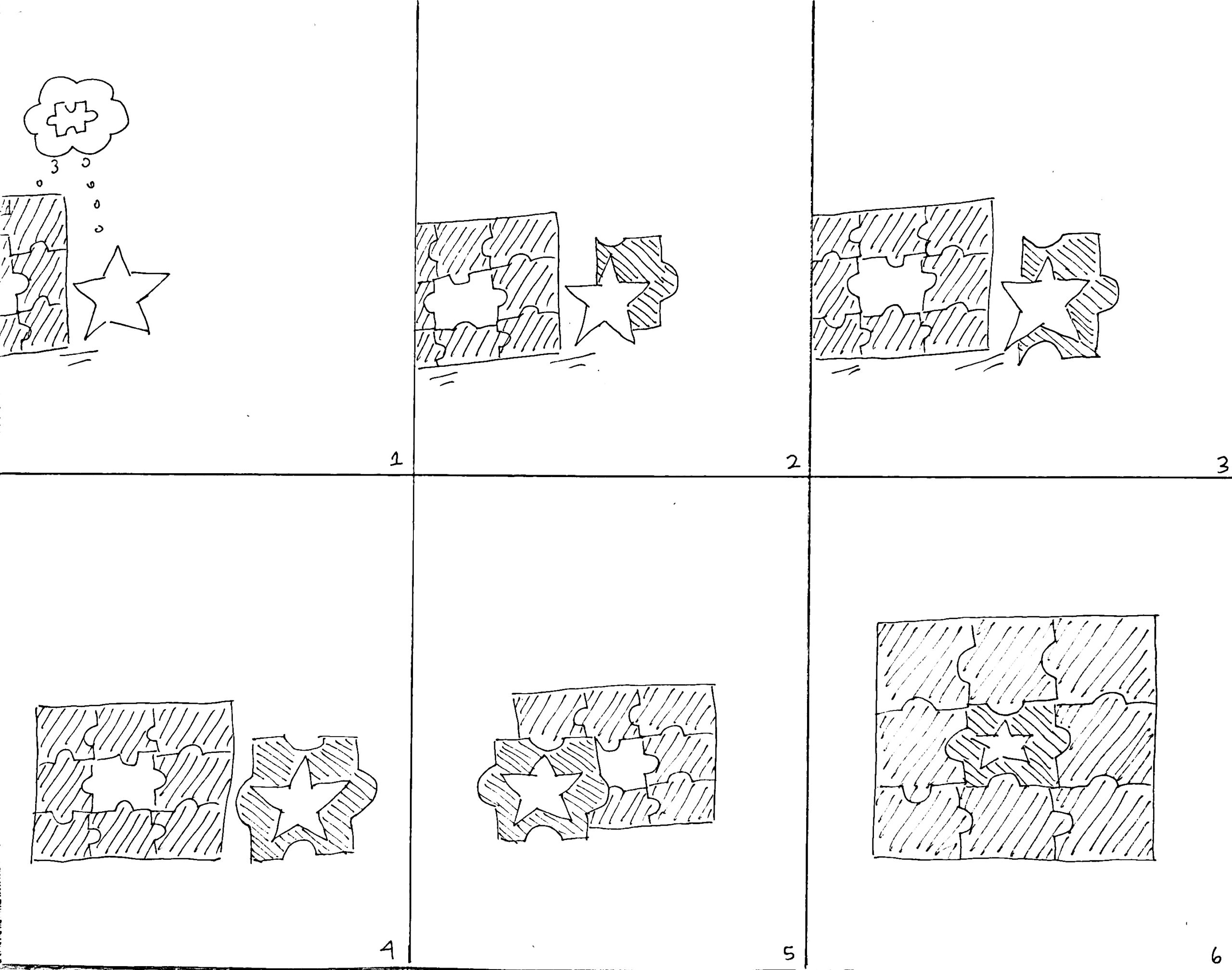
Panel 1: Star walks with puzzle, while they both think of the puzzle piece
Panel 2: Star grows a piece to become the missing puzzle piece
Panel 3: Star grows another piece to become the missing puzzle piece
Panel 4: Star grows the final piece to become the missing puzzle piece
Panel 5: Star, as the missing puzzle piece, stands in front of puzzle
Panel 6: The puzzle is completed with the star, as the missing puzzle piece, fitting in the middle of the puzzle
Countless communities—specifically Black/African American and Indigenous communities—have a deep, justified distrust of institutions, researchers, etc. because of historical and contemporary harms done to them. In this idealized comic, the puzzle provides a second chance to the star.
The star learns more about the puzzle community, has conversations about strengths and assets, actively puts into practice shared decision-making and open communication, and learns to adapt to what the community ultimately says it needs.
While community interventions should be community-funded (as much as possible) and community-led for sustainability purposes, there should also be space for a community-based evaluation plan to ensure that the intervention meaningfully addresses community-identified needs, not practitioner-imposed agendas.
The star does not try to change the mind of the puzzle for a star-shaped hole in the puzzle. Rather, the star builds themselves to fit the needs of the community.
Reflect: Are You Balancing Your Identity and Mission With the Community Needs?
There is a balance. You don’t want to lose yourself in the process of engaging and integrating into the community. You also don’t want to force your way in. You are still who you are. You are still a star. But you are adding bits and pieces to your knowledge and experiences and adapting to a new way of thinking and being for the purpose of achieving shared goals with a community partner.
Step back and reflect:
- How are you respecting your needs as well as the needs of your community partner?
- How can you bring the positive relationship building you’ve practiced with your community partner back to your institution or organization to update policies regarding future community-engaged projects and partnerships?
Note your privilege in these partnerships and the potential to improve outdated policies that continue to position communities as the receiver of knowledge and laboratory of oppressive assumptions.
From the misadventures of making assumptions to the process of culturally integrating, examining your positionality throughout your community-engaged practice strengthens your role as a practitioner, enhances the connection you have with community partners, and when shared, improves the training processes of researchers, funders, and practitioners to work equitably with all kinds of community partners.

Charisse Iglesias, PhD
Charisse Iglesias, PhD (she/her) creates shared educational spaces to expand the depths and intersections of our lived experiences, and she enjoys writing about the processes for creating those spaces with and for other education-minded practitioners. Find Charisse on LinkedIn!
Discover more from CCF
Subscribe to get the latest posts sent to your email.