For those who work in the arts and culture sector…

For those who work in the arts and culture sector…

By Carlos García León, Queer, non-binary, Mexican-Statesian, and anti-capitalist fundraiser

Opening Monologue

Bienvenidos, willkommen, bienvenue, welcome, etc, etc. (A little homage to Cabaret) Please take a seat. Ladies, gentlemen, and all my gender rebels, this show is about to begin. 

Unlike many other productions, you are welcome to take pictures, record, leave, and enter in the discourse at your leisure. But like many productions, please share with your friends, and let us know what you think of the show. We love the engagement. 

And now, let the show begin! *imaginary curtains rise* 

We, of course, begin with a soliloquy, because what else do you expect from a one-person show? *audience laughs* 

I am not sure if you have felt this way or not. This might just be me battling my inner demons and hoping that if I speak on them, maybe someone else who may also feel the same gets some solace that you aren’t the only one in the world. 

As the title suggests, the target audience is those who work in the arts and culture sector. Yet, as any marketer can tell you, there are lessons that can be learned from even those outside of the target audience. I would even argue that sometimes learning from someone outside of your sector is even more valuable. 

For example, the invisible barriers of my upbringing in orchestra education were made crystal clear by colleagues in the museum world. Questions like, what does make a good orchestra if you don’t have an ear for being “in-tune”? How come there isn’t much engagement from anyone on stage about the program? 

I have been a fundraiser exclusively for arts organizations for a few years now. It wasn’t my first choice. I had a dream of being a bassoon rockstar when I graduated high school. However, as you Google what a bassoon is, there is also the realization that even if I did become one, I would have no significant power in changing the field as one. Thus, to stay close to my appreciation of arts, and for some job stability, I applied for jobs in the administrative side of the arts and culture sector, which led me to fundraising. 

However, it is not all jazz hands, kick lines, belters, and razzle-dazzle in this part of the fundraising pie. 

Act 1: Why the arts?

Finding CCF has been a great weight off my shoulders, a source of inspiration, and the hope and push to continue working in the fundraising field. 

Working in the arts as a community-centric fundraiser has been a pleasant joy. And by pleasant joy, I mean that every few weeks, I go into an existential crisis at the state of the world, the state of funding for the arts, the idea does any of this really matter?!, and the crushing doom of capitalism. You know, typical stuff. 

I am occasionally grounded by some performances that I get to watch that remind me of the reason I stayed in the arts field in the first place. A couple of examples in the past months have been Breaking the Binary Theatre Festival’s Play Maid, Goodman Theatre’s Lucha Teotl, National Museum of Mexican Art’s Dia de Muertos annual exhibit, Chicago Symphony Orchestra’s Blacknificent 7 concert, Museo de Carnaval in Barranquilla, Colombia, and of course, I have to toot my own company’s production of Twelfth Night

If we want to be political – even though I believe all art to be sociopolitical even when it’s not engaging in social or political commentary because choosing not to engage in socio-politics is a privilege that is chosen when deciding in programming – here is this lovely video of a girl from Gaza dancing a traditional Palestinian dance

The ability to create hope and joy even amidst tragedy, especially during tragedy, through a dance brings a little smile, knowing that while history is being actively erased and destroyed, people celebrate the culture through a medium of art. 

Act 2: Who is the community? 

The main crux of working in the arts as a community-centric fundraiser is that finding the community is half the battle. In other nonprofits, the community is clear. It’s the reason the nonprofit exists: volunteers, children, voting rights, local lack of food accessibility, queer safety, homelessness, etc. These are the stated missions of the organizations. Meanwhile, in the arts, the mission is often for the arts’ sake. Hence why, when thinking of who to center when thinking of community-centrism this becomes a source of confusion. 

As someone whose work involves interacting with individual donors, what I’ve attempted to do is change the way the organization and myself interact with donors through CCF principles. 

The community I am centering are the communities that should have access to the art that is being presented. This, of course, means communities that may have never seen a production or have been off-put by the stigma created by elitism in art organizations and the spaces they take. This has been a pain point for me as I have only worked in predominantly white institutions. 

That is no shade to them. Each of them, including my current organization, makes progress actively to engage with a diverse audience (although sometimes the motivation is capitalistic rather than because of any DEI values) – whether by premiering new works by creatives of the global majority or by changing the setting of a classic tale. There is pride and merit in hoping to move the needle forward, and as a fundraiser, it is great to see the arts be the motivator for that.

There have been times, however, when donors talked to me as a fundraiser as if I had any power in making decisions in the programming of the organization. Donors would off-handendly, or directly, say that if x organization programs y thing, they’ll give z money, which, in my opinion, is a hindrance to the art.

Part of my role is to communicate with donors that maybe this upcoming production is not their usual Carmen, or that the Beethoven 9 symphony will sound a bit different than what they have listened to in the past 250+ years. Most importantly, part of my job is explaining the why. What is the organization hoping to achieve with these changes? and also letting them know that our efforts are to bring in new audience members and tell different stories and different perspectives. 

This is particularly frustrating when donors claim to want younger audiences to come see the show and experience the organization or to engage more with the culture that we have brought on stage (like Caribbean folks for a production set in the Caribbean, or veterans with PTSD for a new work with a story focused on that community). Only to be met by these donors afterward, saying they didn’t like it, didn’t connect with the story, or the story we’ve shared is not the reason why I began supporting the organization

I’ve been calling this the dichotomy of well-intended donors. 

So not only do I have to be a fundraiser, but also an educator, a therapist, a mini-historian of the art form, and manage white fragility and guilt while also minimizing any harm that may come my way. 

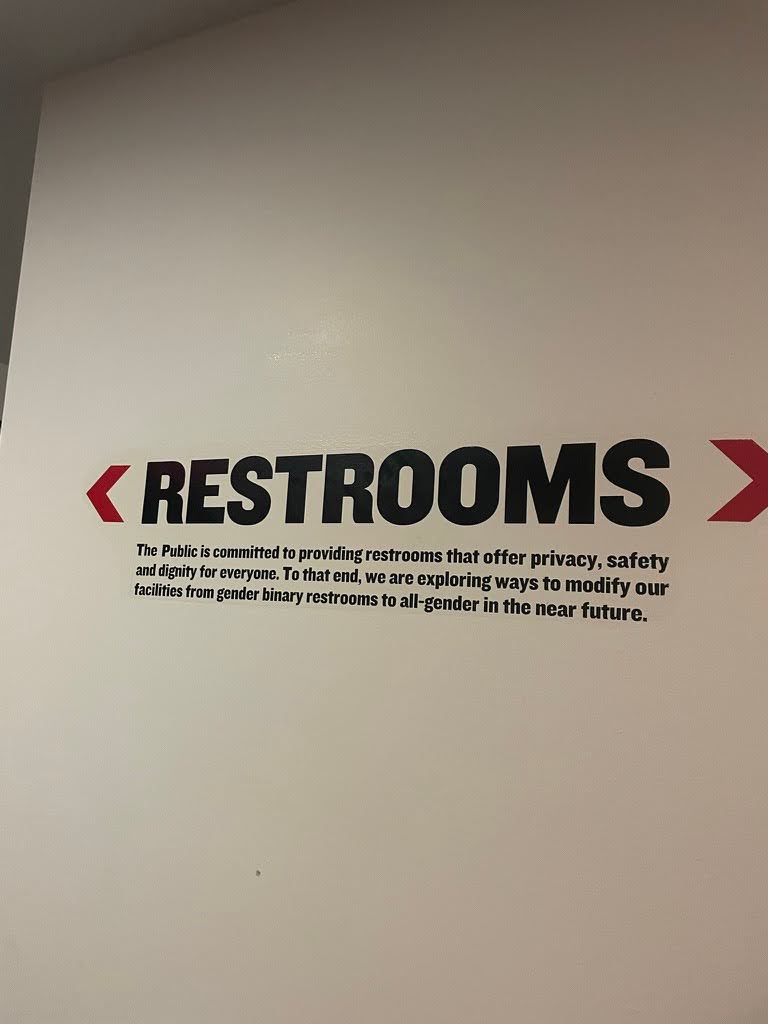
Entry way to the restrooms with writing that says The Public is committed to providing restrooms that offer privacy, safety, and dignity for everyone. To that end, we are exploring ways to modify our facilities rom gender binary restrooms to all-gender in the near future.
It is exhausting work, but this is the way I have interpreted being community-centric and what I can do within my role. There are also ways that an organization can move to be more community-centric. My favorite example of this, from an institutional perspective, was The Public in New York City and their change to all-gender bathrooms. Here, they have a public statement expressing that they affirm and welcome gender diversity.

It is a bit sad that there has to be an explanation of the why, as if caring for folks outside of the heteronormative experience isn’t reason enough, but in this work, figuring out who the community is and passing that along to the rest of the organization is pivotal. 

Ultimately, a lot of this work is battling capitalism and our role in this industrial complex. It does feel odd that the arts and culture sector are a part of it, too, but recognizing that we are emblematic of the problem is crucial and finding some solutions, like The Public has, continues moving us forward. To me, it is particularly tiring that I am convincing folks that the arts matter enough to contribute to, but alas, here I am sharing with you all that the arts are important for our humanity.

Curtains 

As we begin to dim the lights on this piece, I do have to give some gratitude to this community of other CCF-minded professionals who, in a virtual town hall, gave me some words of encouragement. 

Working in the arts and culture sector can be a bit disheartening because we aren’t raising funds to solve hunger, poverty, homelessness, cancer, mistreatment of children, voting injustices, labor rights, and so on. We are just putting on a show, or a couple of paintings on a wall, or a concert, and sometimes, sometimes, we do reach the audience that may benefit the most from this story. 

We open perspectives and minds into the lives of other people. As the community told me, the performances can and do bring joy, heart, and hopefully, sometimes, a moment of the vision we have for the future or an idea that challenges the way we have been living in the present. After seeing the injustices of the world and finding funds for those, being able to see a production is the grounding others need. 

My mission, not as a nonprofit, but as an individual, is to fight for equity and justice in the arts sector through the philanthropic space. This is a mission that I hope is accomplished in my lifetime, and while I don’t envision that happening (solely because there is not enough action being taken toward preventing the dangers of global warming), I do hope that I can make the fight easier for the next generation of warriors. 

*curtains drop*

*standing ovation and applause* 

Thank you everyone for coming! Feel free to take your program with you. If you liked what you read, please consider making a donation, and share with your family and friends to come see this show. Enjoy the rest of your day, and please make plans to attend and/or volunteer at your local arts organizations. 

Carlos García León

Carlos García León

Carlos García León (he/they; el/elle) is a queer, non-binary, Latine, Mexican-Statesian, and fundraiser. They were born in Atlixco, Puebla, Mexico, but currently reside in the stolen land of the Peoria, Potawatomi, Kickapoo, and Kaskaskia tribes, also known as Chicago, Illinois and work as the individual giving manager of Chicago Shakespeare Theater. Their work, both in the arts and through writing, is driven by a fight for cultural equity, decolonizing the arts, and social justice. Outside of working and writing, Carlos likes to stream TV and movies, read a good book, learn German, take naps under their weighted blanket, drink milkshakes, and look for the next poncho to add to their collection. They can be reached via email or on InstagramTwitter, and other social media platforms @cgarcia_leon. Tip them for their work via Venmo @cgarcia_leon or via PayPal using their email, cgarcia.leon@yahoo.com.

Why “decolonizing” is the wrong word for changes we make inside oppressive systems, and how we can strive to be anti-colonial instead

Why “decolonizing” is the wrong word for changes we make inside oppressive systems, and how we can strive to be anti-colonial instead

ByMaria Rio, Founder of Further Together Fundraising

I have visited this topic with many colleagues over the past few years. We see “decolonize education,” “decolonize the workplace,” decolonize this and that – but what does that really mean?  

Is it ridiculous to think you can decolonize a harmful system? For example, can you decolonize policing? Can you decolonize real estate? If those sound absurd, then why do we not have the same reaction to “decolonize nonprofits”?

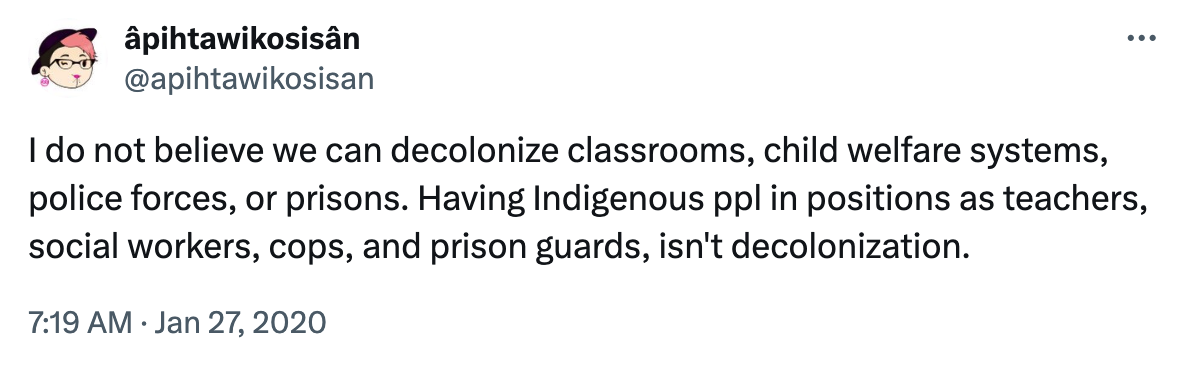
A tweet by Twitter user Âpihtawikosisân which says I do not believe we can decolonize classrooms, child welfare systems, police forces, or prisons. Having Indigenous ppl in positions as teachers, social workers, cops, and prison guards, isn't decolonization

The original Tweet can be found here.

There is no way to undo centuries of harm caused by white supremacy. Oppressive systems are designed to maintain power imbalances and marginalize certain groups. They’re not neutral settings where bad things occur; they’re designed to perpetuate inequality. Nonprofits, by design, play into the non-profit industrial complex. 

By working toward equitable practices in the areas you as a leader have control over, does that really mean you are decolonizing any extremely harmful and oppressive system capitalism depends on? Does trying to work within these systems reinforce them? 

In the past, reflecting on this topic has left me with more questions than answers, but today, I want to put some thought to paper.

Let’s talk about the word “decolonize” 

By using the word “decolonize” to replace “how can we take the white supremacy out of this,” we are co-opting and diluting the word itself. By using it as a metaphor for change, we move away from the real meaning of decolonization.

“Decolonization brings about the repatriation of Indigenous land and life; it is not a metaphor for other things we want to do to improve our societies and schools. The easy adoption of decolonizing discourse by educational advocacy and scholarship, evidenced by the increasing number of calls to “decolonize our schools,” or use “decolonizing methods,” or, “decolonize student thinking,” turns decolonization into a metaphor.“ — Decolonization is not a metaphor 

By using the word “decolonize” to replace “how can we take the white supremacy out of this,” we are co-opting and diluting the word itself. By using it as a metaphor for change, we move away from the real meaning of decolonization. 

To illustrate, let’s compare our use of the word decolonize with colonization. American sociologist Robert Blauner identified the four components of colonization as: “(1) forced entry into a territory and its population; (2) alteration or destruction of the Indigenous culture and patterns of social organization; (3) domination of the Indigenous population by representatives of the invading society; and (4) justification of such activities with highly prejudicial, racist beliefs and stereotypes.” With this definition in mind, I don’t believe there is a true way to decolonize systems. The eradication of Indigenous cultures and Peoples cannot be undone. Instead of leaning towards the sentiments currently associated with “decolonize” – sentiments of undoing the harm that has been done – we should move toward words like “anti-colonial,” which acknowledges that the harm is irreparable.

In their piece “Do Not ‘Decolonize’…If You Are Not Decolonizing: Progressive Language and Planning Beyond a Hollow Academic Rebranding,” Critical Ethnic Studies Journal provides six alternative words one can use instead of decolonizing: 

  • Diversify your syllabus and curriculum 
  • Digress from the cannon 
  • Decentre knowledge and knowledge production 
  • Devalue hierarchies 
  • Disinvest from citational power structures 
  • Diminish some voices and opinions in meetings, while magnifying others 

Can spaces free from white supremacy (“decolonized” spaces) exist in oppressive systems? 

In short, nope, they can’t.  

When we talk about creating “safe spaces,” we think of pockets of safety within a larger framework of oppression. That is not enough; they must be part of a much broader effort to dismantle the oppressive system itself. Otherwise, they’re just “safe for now” spaces. 

Think of placing a plant in bad soil. It may survive, but it will certainly not thrive, and the soil will always limit its growth or worse. Unfortunately, even when creating your own safe organization or safe fundraising team or strategy, we have to acknowledge that we don’t exist in a bubble.  

White supremacy is not a shark; it is the water…The water might be more dangerous than the individual shark, but it’s still a concrete force that can be resisted. The first step is seeing it, acknowledging it. That just can’t be the last step” — Kyle “Guante” Tran Myhre 

How does this relate to equitable fundraising?  

To truly remove white supremacy from fundraising, we need to destroy it in its current form. We need to create a social support system that, by design, is equitable and transformative.

Traditional fundraising perpetuates systemic inequalities. It’s transactional; it focuses on what the donor can get—be it a tax break, recognition, or a sense of superiority—rather than on the needs and agency of the communities. In addition, remember the role nonprofits play in the nonprofit industrial complex: by design, we uphold the status quo. 

To truly remove white supremacy from fundraising, we need to destroy it in its current form. We need to create a social support system that, by design, is equitable and transformative. This means moving from “how much can we raise?” to “how can the act of fundraising itself be a form of social justice?” 

This doesn’t mean we will have decolonized anything. It means that we are taking steps toward a less harmful and oppressive way to work in the current systems. In actionable terms, fundraising as a tool for social justice could mean participatory budgeting processes where the community decides how funds are used, or who even runs the organization.  

But it could also mean: 

  • Decentralized Power: Explore models that distribute power more equitably among staff, volunteers, and community members. This could mean a co-operative model or a consensus-based decision-making process. An organization I greatly admire does this well; if one person at Foster Advocates doesn’t agree with the proposed budget, they all work together until everyone is in agreement. 
  • Financial Reparations: The current philanthropic landscape is skewed, with a disproportionate amount of resources going to organizations that are white-led and already well-funded, often perpetuating the status quo. By redistributing wealth to smaller, BIPOC-led groups and non-qualified donees, you’re giving power and agency back to the communities. 
  • Community-led Boards: We need boards that have people with real lived experience in the issues we are addressing. The more recent, the better. This ensures that the community’s needs and perspectives are not just passively considered. Instead, they would be integral. 
  • Radical Listening: Implementing “listening sessions” where leadership is silent and employees or community members speak. 

The above is definitely not for the faint of heart. It demands that we become accomplices in the fight for justice, not just allies or spectators. It requires us to scrutinize and dismantle the very systems we operate within, even when those systems benefit us. It’s not about creating pockets of less harm; it’s about transforming the soil so that every plant can thrive. Remember that the goal is not to make oppressive systems less oppressive but to completely replace them with systems that are equitable and just.  

Maria Rio

Maria Rio

Maria Rio (she/her) is a fundraising consultant with Further Together with 10+ years of non-profit experience. She is regularly asked to speak on issues related to fundraising and her op-eds have been featured in national publications. She was a finalist for the national 2022 Charity Village Best Individual Fundraiser Award and has a deep passion for non-profit work. Maria also sits on the Board of Living Wage Canada.

You can connect with Maria through Further Together or through LinkedIn.

Africa Rising Virtual Meetup

Africa Rising Virtual Meetup

What the arts and culture field can teach us about CCF, Part I: Fundraising as a narrative change strategy

What the arts and culture field can teach us about CCF, Part I: Fundraising as a narrative change strategy

By Erika Pettersen, independent researcher, strategist, resource builder, and creative writer

I want to begin by sharing my own personal and professional journey, which led me to author a report titled Narrative Change for Racial Equity in Nonprofit Funding: An Exploratory Report on Community-Centric Fundraising in the Arts and Culture Sector.

As fundraisers, many of us can relate to being drawn in by a cause near and dear to our hearts—and tripping into development work as a result. 

Because someone tells us we’d be good at it. Because it pays a little better than other nonprofit roles. Because we see the need. 

Then, somewhere along the line, we reach a state of cognitive dissonance. 

On the one hand, we believe we can change the world for the better through the organizations we work for. On the other, our development responsibilities often compel us to perpetuate the very power dynamics that undergird the economic and racial inequities we seek to overturn. 

Before the Community-Centric Fundraising (CCF) movement took root, it was hard, if not impossible, for many of us to even articulate this phenomenon, let alone address it. We grew cynical. We lost faith. We burnt out. 

Now, through CCF, we’re learning how to boldly name the ways in which traditional fundraising upholds oppressive white supremacist hierarchies and devising strategies for evolving fundraising into a praxis that more fully aligns with our values and goals. 

Taking root within a nonprofit sector addressing a diversity of societal issues, CCF builds on a variety of histories and lived experiences. Each and every one of us brings unique and special insight into the past, present, and future of this movement. Drawing on both my lived experiences and my action-oriented research, this three-part series of essays will dive into some of the particular challenges, opportunities, and questions for CCF brewing within the arts and culture field. 

In this first essay, I want to begin by sharing my own personal and professional journey, which led me to author a report titled Narrative Change for Racial Equity in Nonprofit Funding: An Exploratory Report on Community-Centric Fundraising in the Arts and Culture Sector. 

The Personal is Political

Growing up in Jackson Heights, Queens, where over 150 languages are spoken, and half the population are immigrants, I’d assert my multi-ethnic identity with pride—and mathematical precision: “I am ¼ Ecuadorian, 3/8 Irish, 1/8 Norwegian, and ¼ Puerto Rican.” Slowly, though, the fractions started to work on me. Although my mixed background felt like a perfect match to my neighborhood, I was unsure what my identity actually added up to. 

I also came to understand that the diversity of Jackson Heights was an anomaly, even within New York City. First, through stories from my mother about her childhood in the South Bronx, and later, when I worked in similarly segregated areas of the city, the socio-economic consequences created by these divisions became apparent to me. Working with a national nonprofit as an AmeriCorps volunteer in Harlem, I grew impatient with our efforts to connect residents with public benefits and low-paying jobs. Simply managing the repercussions of redlining and disinvestment felt myopic in the face of enduring structures that maintain racial inequities in the U.S. 

Subsequently, I sought to follow the lead of geographic and cultural communities most impacted by the literal and figurative lines drawn by white supremacist systems of power. Working with Black-led nonprofits serving Brooklyn communities subject to damaging mainstream narratives, I became passionate about supporting their efforts to amplify arts and culture in ways that laid claim over their collective stories. 

As fundraising became more central to my job responsibilities, a familiar frustration crept up on me. The fact that funding depended on meeting standards set by wealthy and largely white decision-makers, far removed from the lived experiences of the communities these organizations served, seemed to undermine the paradigm-shifting nature of this work. By 2018, after nearly a decade in the nonprofit sector, I was exhausted by the nonprofit development hamster wheel and disillusioned by the larger political environment wherein white supremacy was on unabashed display. It felt urgent to pause and reflect. 

So, I went back to school. 

Entering the Latin American Studies Master’s program at Tulane University, a particular Trumpian tautology haunted me: “We either have a country or we don’t have a country.” I pondered the deliberate divides—physical, social, and ideological—drawn by this statement, along with its foregone conclusion that our world depends on the policing of borders between lands, communities, and ways of life. 

Considering Latin America—the region this statement called to wall off—I also looked inward at the unreconciled map of my own mixed European and Latina heritage. These disquietudes guided my studies on the politics of identity, belonging, and representation at the intersections of culture, race, and gender. My thesis centered on how women in Oaxaca, Mexico access opportunities to destabilize hegemonic constructions of Indian womanhood, counter marginalizing discourses, and create visibility for Indigenous and Afro-descendent Mexicans to assert, validate, and advocate for their own values and ways of life. 

Through this research, I graduated with a deeper understanding of the transnational white supremacy culture that oppresses Black, Indigenous, and other People of Color (POC), along with how it produces its power and compels our complicity through systems designed to perpetuate marginalization and exploitation. 

Bridging Theory and Practice

I came out of graduate school during the height of the COVID-19 pandemic. Racial inequities in the United States had become even more transparent and undeniable, but I felt more fully equipped to wrestle with them. 

In 2021, a friend and former colleague from my time as Development and Communications Director at Haiti Cultural Exchange recruited me to join her on the research team at Arts Business Collaborative (ABC). While the research department at ABC was short-lived, officially phasing out in September 2023, my brief time there offered an exceptional window of opportunity to connect my graduate studies to my professional history as a fundraiser. 

The CCF movement had gained incredible momentum during my hiatus from the nonprofit sector. I was blown away by the boldness and thoroughness with which the founders of CCF took aim at donor-centric fundraising practices. They had translated the tensions and misgivings so many of us fundraisers and nonprofit staff have felt over the years into dynamic critiques of and actionable responses to the racial and economic inequities created by power imbalances in philanthropy’s white supremacist systems and structures. 

I was eager to dig into the impact of CCF on the nonprofit sector and pitched an exploratory study on CCF in the arts and culture sector. ABC leadership gave me the green light to design and execute an exploratory study on CCF in the arts. 

I centered this project on interviews with twenty arts and culture resource builders1, most of whom identified as POC and/or as working for a POC-led arts organization in the U.S. Our conversations were provocative and unbelievably awe-inspiring, exploring countless facets of CCF and the larger arts and culture philanthropy landscape. 

Amidst these diverse discussions, two core themes emerged. Firstly, research participants offered insights and questions exploring the “why” of CCF, or the movement’s overarching vision for systemic change. Secondly, they shed light on and sought greater clarity on the “how” of CCF, or what the movement’s work looks like in practice. I also engaged in a supplemental literature review prior to, during, and following interviews. As participants’ interest in the “why” and “how” of CCF became clear, these themes guided my exploration of relevant media and text. 

Racial Inequities in Arts & Culture Funding

By analyzing the funding landscape for arts and culture organizations, I found that the nonprofit sector largely perpetuates the arts labor exploitation, financial insecurity, and racial inequities created by capitalism. 

A survey conducted by Arts Funders Forum in 2019 reports that 78% of respondents indicated that they were “somewhat concerned” or “very concerned” about the future of arts funding.2 These concerns are supported by reports from Grantmakers in the Arts (GIA) that demonstrate declines in institutional funding for arts and culture when accounting for inflation.3 Dwindling support erodes at an already meager share of philanthropic dollars, with arts, culture and humanities only receiving 5% of overall US giving.4

Above and beyond the sector-wide economic insecurity, POC nonprofits are subject to a phenomenon called “philanthropic redlining,” which the Memphis Music Initiative (MMI) defines as:

A set of funding practices in which an organization’s size, racial or ethnic constitution, demographic served, artistic designation (e.g., “high art” or “community art”), and/or location results in: (a) exclusion from funding altogether, (b) grants that are substantially lower than comparable organizations; and/ or (c) forms of funding that discourage capacity building.5

The extension of redlining into philanthropic practices causes astounding racial inequities in arts and culture funding. 

Of 925 US cultural organizations with budgets over $5 million, fewer than 50 are dedicated to POC artistic traditions and/or communities. Moreover, in 2017, when POC constituted 37% of the US population, only 4% of private philanthropy going to arts and culture went to POC-serving organizations. Even where POC-serving nonprofits made up 25% of local cultural groups, these organizations received a mere 10% of local cultural funding. 6

During the COVID-19 pandemic, the tide appeared to be turning in response to a racial reckoning in the US catalyzed by the oversized toll on public health faced by POC communities as well as the murders of George Floyd and Breonna Taylor by law enforcement officers. In fact, GIA reported that 51% of grantmakers they surveyed in 2020 indicated that they’d increased giving to POC-led organizations.7 Still, only $3.4 billion of a total $11.9 billion that was pledged to racial equity work in 2020 was confirmed to have been actually awarded by October 2021.8

The “Crisis of Relevancy” and the Nonprofit Industrial Complex

Contextualizing racial equity issues in nonprofit funding within the arts and culture field’s wider struggles to secure an adequate share of philanthropic dollars guided my research on CCF to address philanthropic dialogue regarding the social impact of the arts. 

In her conversation series “The Path Forward,” cultural philanthropy advisor Melissa Cowley Wolf perennially returns to what she calls a “crisis of relevancy.” She describes this “crisis” as the failure of arts and culture nonprofits to effectively explain their societal import to donors and funders, which in turn leads to underfunding of the sector. During an episode with nico wheadon, founder and principal of bldg fund, llc, Wolf shares this conclusion and asks, “How do we correct this—what stories should we be telling?” 

wheadon flips this question on its head: “From where I sit, the question is less what stories we should be telling and more who should be telling them. I’m an advocate for ‘for us, by us institutions’ and think the priority within the sector should be empowering and resourcing communities to tell their own stories.”9

In recent years, various leaders in arts philanthropy have acknowledged the power that POC artists and culture bearers hold to transform the harmful dominant narratives that fuel systemic racism. As such, they have made the case for funding “narrative change” as a core arts and culture strategy for achieving social justice. This call to fund the work of POC cultures and creative communities signals a step toward greater racial equity in support for arts nonprofits. 

However, this framing continues to leave the POC arts and culture community vulnerable to donor-centric paradigms, like the aforementioned “crisis of relevancy.” wheadon’s reflection challenges members of arts philanthropy to acknowledge and reconsider the metanarrative at play in their giving practices. Her assertion that POC-led arts organizations should be funded for the purpose of expressing their underrepresented narratives problematizes the notion that these narratives must be evaluated by donors and funders in order to earn support.

Additional POC guests on “The Path Forward” respond similarly to the “crisis of relevancy” by decentering donor expectations. Evolv founder Eboné M. Bishop asserts that instead of charging POC-led arts and culture nonprofits with the task of making a better case for their relevance, philanthropic institutions need to become more relevant by disprivileging Western standards of artistic merit.10 

Co-founder of Peoplmovr, Geoffrey Jackson Scott, expands on Edgar Villanueva’s calls to decolonize wealth, offering, “To my mind, the landscapes of arts funding and overall philanthropy would do well to come together in service of repair and follow the leadership of Black and Indigenous folks in doing so. What I’d like to see is nothing short of transformation.”11 

Both Bishop and Scott invert the “crisis of relevancy,” shifting discourse from a preoccupation with how to persuade donors and funders to increase support for arts and culture to an acknowledgment for the need to reshape arts philanthropy in service of racial justice.

These critiques echo larger calls for racial justice in philanthropy by individuals and groups seeking support for POC communities. Many engaged in this work, including members of the CCF movement, point to INCITE’s 2007 anthology “The Revolution Will Not Be Funded: Beyond The Non-Profit Industrial Complex (NPIC)” as a seminal influence. Essays from activists and academics interrogate the power imbalances within funding structures that shape and manage the NPIC, which this text defines as “a system of relationships between the State (or local and federal governments), the owning classes, foundations, and non-profit/NGO social service and social justice organizations.”12 

In response to oppressive power dynamics, many community organizers and leaders have chosen to exit the NPIC. Art.Coop has documented how artists and culture bearers have also turned to alternative structures outside of the 501c3 model, such as worker-owned cooperatives, mutual aid groups, community land trusts, and other entities rooted in solidarity economics.13

Still, there are more than 120,000 US arts and culture nonprofits that continue to rely on the 501c3 tax-exempt status to secure funds for their work.14 While fundraising mechanisms within the NPIC can perpetuate the harms of systemic racism, an increasing number of nonprofit development professionals are crafting and implementing tactics and strategies that aim to confront and eradicate philanthropic redlining. In its commitment to disrupting donor-centric dynamics toward achieving economic and racial justice in fundraising and philanthropy, the CCF movement is a prominent example of this subversive approach to transforming how the nonprofit sector works.

Amplifying POC Narratives to Change the Donor-Centric Fundraising Paradigm

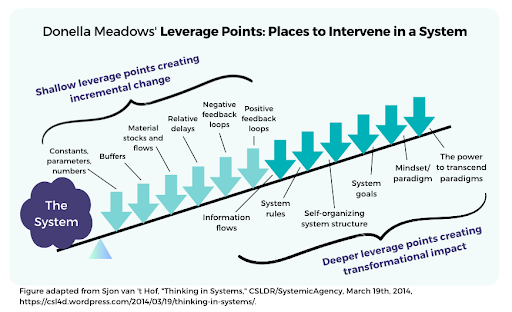
The CCF Principles are the bedrock of the movement and a natural starting point for delving further into the “why” and “how” of CCF. Understanding CCF as a systems change approach, we can interpret these principles as new community-centric rules for fundraising designed to replace the existing donor-centric rules that uphold racial inequities within the NPIC. As such, the CCF Principles correspond with number four in scholar Donella Meadows’ “Leverage Points: Places to Intervene in a System.”15 Meadows describes this fourth most influential leverage, out of a total of twelve that she speaks on, as “the power to add, change, evolve, or self-organize system structure.”16 As such, CCF engages with the NPIC as a broken system with the purpose of fixing its oppressive dynamics. Its vision for how to achieve this goal is to amplify and harness the power that fundraisers hold by cultivating community guidelines and resources that nonprofits can organize around and experiment with in their efforts to transform the NPIC into a more racially equitable system.

Exploring CCF within the arts and culture field, in particular, reveals the movement’s even deeper leverage within the NPIC. Scanning CCF literature and media, I found that POC cultural influences are a potent undercurrent within the movement. From the Afro-futurism at the core of adrienne marie brown’s Emergent Strategy: Shaping Change, Changing Worlds, to the gamut of POC traditions cited in essays on the CCF Hub—such as susus and ukub17 as well as mano cambiada18—POC arts and culture serves as a clear inspiration to many in the CCF movement. 

Moreover, research participants whom I interviewed spoke on the affinities between CCF and their own cultural backgrounds. Madalena Salazar, Executive Director of Working Classroom, noted that she saw a reflection of Chicano power-building practices—such as “mutual aid, giving circles, and intentional relationship building”—within CCF. Explaining further, she stated:

I was raised with the sense that we give back to our community. And it’s not just my family. Folks in my community were also raised with that understanding. And I see that in the writings of CCF. I’ve seen that, particularly, like in the writings of Nonprofit AF, these are our values. These are our cultural values.19

Although Jeremy Dennis, President of Ma’s House, was new to CCF at the start of our conversation, he told me that he instantly saw the CCF Principles’ embodiment of Native community building values, especially the tenet of keeping capitalist exchange to a minimum. 

Sentiments regarding CCF’s correspondence with POC cultures were echoed by additional POC research participants. The perspectives and reference points reflected within research participant interviews and broader conversations within the CCF community suggest that CCF walks in step with a wide range of POC cultures. 
Graph is labeled 20

Moreover, within this context, culture—inclusive of traditions, values, and norms—emerges as a central node of CCF’s work. Understanding CCF through the lens of culture brings forth the movement’s impact at yet a deeper leverage point, the second highest within Meadows’ construction of systems-level interventions: The mindset or paradigm out of which the system—its goals, structure, rules, delays, parameters—arises.”21

Research participants and other CCF practitioners have demonstrated that narrative change is an implicit praxis within the movement. Replacing donor-centrism, a paradigm supported by white supremacy culture, requires building new narratives of community-centrism, a paradigm rooted in values and histories of POC communities that CCF aims to uplift and amplify. 

This approach corresponds with the above-mentioned visions for revolutionizing arts philanthropy in the face of the donor-centric trope of a “crisis of relevancy.” wheadon’s insistence on supporting the autonomy of POC communities to tell their own stories alongside Bishop and Scott’s calls for arts funders to become more accountable to POC communities point to the power that self-determined, POC-led narratives hold to transform philanthropy in the arts—and throughout the nonprofit sector—towards achieving greater racial equity.

Meadows’ highest leverage point for systems change is “The power to transcend paradigms.”22 Accepting that no paradigms are universally “true” offers the flexibility to create and use paradigms in service of a larger purpose. This understanding converges with social change praxes developed and deployed by POC scholars and activists in the US and throughout the world. Inspired by the work of Barbara Christian, Audre Lorde, bell hooks, Gloria Anzaldua, Merle Woo, and many other POC feminist scholars, Chela Sandoval’s theory of “oppositional consciousness” prioritizes the act of resistance over loyalty to ideologies. 

She explains, “The differential mode of oppositional consciousness depends upon the ability to read the current situation of power and of self-consciously choosing and adopting the ideological form best suited to push against its configurations, a survival skill well known to oppressed peoples.”23 This praxis requires adaptability over attachment in order to stay responsive to evolving power dynamics. Engaging with fundraising as a mode of narrative change embodies Meadows’ recommendation to transcend paradigms and Sandoval’s invitation to participate in oppositional consciousness. 

CCF strategies and tactics are not fixed practices. Rather, they are responsive to the ongoing challenges presented by white supremacy culture in philanthropy. CCF does not celebrate nonprofit fundraising as the best and only way to build resources for POC communities. Instead, it leverages fundraising as a tool for changing the white supremacist mindsets, paradigms, and narratives that philanthropy often upholds.

You can see core findings from both the landscape analysis and interviews in the following five-page summary: “Key Takeaways for Nonprofit Leaders and Fundraisers.” You can also dive deeper into the full report here: Narrative Change for Racial Equity in Nonprofit Funding: An Exploratory Report on Community-Centric Fundraising in the Arts and Culture Sector.

Footnotes

  1. For the purposes of this report, the term resource builder refers to individuals working to grow capital, capacity, and other forms of support for their organizations. As such, this term expands beyond the traditional notion of fundraising to include non-monetary modes of sustaining a nonprofit’s work.
  2. “Arts Funders Forum’s Research: A Look at What We Learned,” Art Funders Forum, September, 24, 2019, https://www.artsfundersforum.com/news/our-findings-2019.
  3. Reina Mukai, Nakyung Rhee, Mohja Rhoads, and Ryan Stubbs, Grantmakers in the Arts: Annual Arts Funding Snapshot, (New York: Grantmakers in the Arts, 2022), https://www.giarts.org/sites/default/files/2022-arts-funding-snapshot.pdf.
  4. Snapshot of Today’s Philanthropic Landscape, 11th Edition, (New York: CCS Fundraising, 2022), https://go2.ccsfundraising.com/rs/559-ALP-184/images/CCS_2022_Philanthropic_Landscape.pdf?aliId=eyJpIjoiRDRxM0taNmJqdTZ3QThXMSIsInQiOiJvXC9McGVIRVI1dFArd0UwUUc5Z2F1QT09In0%253D
  5. Charisse Burden-Stelley, Jarvis Givens, and Elizabeth Burden, Toward the Future of Arts Philanthropy: The Disruptive Vision of the Memphis Music Initiative, (Memphis, TN: Memphis Music Initiative, 2018), 66, https://assets.speakcdn.com/assets/2777/mmi-disruptive-philanthropy-study.pdf?1620831779161.
  6. Not Just Money: Equity Issues in Cultural Philanthropy, (New York: Helicon Collaborative, 2017), 5 -8, http://notjustmoney.us/.
  7. Eddie Torres, “Arts Grantmakers’ Changes in Practice: Present and Future,” Grantmakers in the Arts, November 5th, 2020, https://www.giarts.org/blog/eddie/arts-grantmakers-changes-practice-present-and-future.
  8. “2020 estimates of racial equity funding off by as much as two-thirds,” Alliance Magazine, October 6th, 2021, https://www.alliancemagazine.org/blog/2020-estimates-of-racial-equity-funding-off-by-as-much-as-two-thirds-actual-figure-far-less-finds-research/.
  9. nico wheadon, “The Cultural Strategist: nico wheadon,” interview by Melissa Cowley Wolf, The Path Forward, MCW Projects, April 3rd, 2021, transcript, https://www.mcw-projects.com/thepathforward/2021/3/30/nico-wheadon.
  10. Eboné M. Bishop, “The Cultural Change Agent: Eboné M. Bishop,” interview by Melissa Cowley Wolf, The Path Forward, MCW Projects, January 1st, 2022, transcript, https://www.mcw-projects.com/thepathforward/2022/1/4/the-x-ebon-m-bishop.
  11. Geoffrey Jackson Scott, “The Involvement Strategist: Geoffrey Jackson Scott,” interview by Melissa Cowley Wolf, The Path Forward, MCW Projects, August 22nd, 2020, transcript, https://www.mcw-projects.com/thepathforward/2020/8/16/gsj.
  12. INCITE! Women of Color Against Violence Staff, The Revolution Will Not Be Funded: Beyond the Non-Profit Industrial Complex (Durham, NC: Duke University Press, 2017), xiii.
  13. Nati Linares and Caroline Woolard, Solidarity Not Charity: Arts and Culture Grantmaking in the Solidarity Economy, (New York: Grantmakers in the Arts, 2021), https://art.coop/#report.
  14. “Arts, culture, and humanities organizations,” Cause IQ, accessed March 2023, https://www.causeiq.com/directory/arts-culture-and-humanities-nonprofits-list/.
  15. Donella Meadows, “Leverage Points: Places to Intervene in a System,” (Hartland, VT: The Sustainability Institute, 1999), https://donellameadows.org/archives/leverage-points-places-to-intervene-in-a-system/.
  16. Meadows, “Leverage Points: Places to Intervene in a System.”
  17. Samra Ghermay, “Collaborative Philanthropy is Rooted in African Communal Practice. Let’s Reclaim It,” Community-Centric Fundraising (CCF), June 14th, 2021, https://communitycentricfundraising.org/2021/06/14/collaborative-philanthropy-is-rooted-in-african-communal-practice-lets-reclaim-it/.
  18. Yura Sapi, “4 Antidotes for Scarcity Mindset,” Community-Centric Fundraising (CCF), July 11th, 2022, https://communitycentricfundraising.org/2022/07/11/4-antidotes-for-scarcity-mindset/.
  19. Erika Pettersen, Narrative Change for Racial Equity in Nonprofit Funding: An Exploratory Report on Community-Centric Fundraising in the Arts and Culture Sector. New York: Arts Business Collaborative, 2023. DOI: 10.13140/RG.2.2.35756.23681
  20. Figure from Pettersen, Narrative Change for Racial Equity in Nonprofit Funding: An Exploratory Report on Community-Centric Fundraising in the Arts and Culture Sector.
  21. Meadows, “Leverage Points: Places to Intervene in a System.”
  22. Meadows, “Leverage Points: Places to Intervene in a System.”
  23. Chela Sandoval, “U.S. Third World Feminism: The Theory and Method of Oppositional Consciousness in the Postmodern World,” Genders 18 (Winter 1993), 15.

Erika Pettersen

Erika Pettersen

Erika Pettersen (she/her) roots her work as an independent researcher, strategist, and resource builder in a commitment to challenging marginalizing discourses and systems. With over a decade of experience in the nonprofit sector, the majority of her roles as a fundraiser and capacity builder have been situated at the intersection of arts, culture, and community. She has prioritized supporting Black-led, community-rooted organizations in Brooklyn, NY, such as the Youth Design Center, Haiti Cultural Exchange, and Brooklyn Queens Land Trust. Her work is guided by a wide range of educational experiences alongside her lived experiences as a woman of mixed white and Latina heritage from Queens, NY. She holds a B.A. in Philosophy from Amherst College, an M.A. in Latin American Studies from Tulane University, and a certificate in Arts & Culture Strategy from the University of  Pennsylvania. She has also completed post baccalaureate coursework in Studio Art & Art History at Brooklyn College. Building on her work history and academic credentials, she published the report “Narrative Change for Racial Equity in Nonprofit Funding: An Exploratory Report on Community-Centric Fundraising in the Arts and Culture Sector” during her time as Senior Research Scientist at Arts Business Collaborative. Erika also engages in a variety of creative practices, including fiction and poetry writing, photography, collaging, and curating.

Erika welcomes you to connect with her on Instagram (@erika_pettersen), LinkedIn, and ResearchGate. If you’re interested in chatting or collaborating, feel free to send her an email. If you’d like to support her work as an independent researcher, you can send her a tip on Venmo.

What Loki can teach us about dealing with organizational change

What Loki can teach us about dealing with organizational change

By Abigail Oduola planned gift fundraiser and self-proclaimed Marvel enthusiast

With your work universe imploding, how might you respond and take part in creating a plan that leads to collective flourishing?

Note: This piece has spoilers about Disney+ Loki season two

The Time Variance Authority (TVA) is an organization in disrepair. He Who Remains, master strategist and TVA’s authoritarian leader, has been assassinated. The board was composed of literal puppets, the founding story an intentional lie, the building physically falling apart, and employees battling for power. It turns out the mission they thought was good and altruistic is actively destroying communities, worlds, and even galaxies. 

Oh, and reality is collapsing in on itself. 

Welcome to Loki season two by Disney+. If you didn’t watch season one or need a primer, here’s Collider’s detailed recap. Caught up? Okay, let’s ride.

Maybe you haven’t experienced anything as dramatic as this. After all, the characters in this series navigate both a collapsing organization and multiverse. However, swap out a few minor details, and the scenarios sound like difficult moments in a nonprofit. 

A leader unexpectedly leaves, and there is a power vacuum. Organizational stories or experiences that rattle the institutional core get uncovered. An organizational mission is revealed to have caused more harm than good. 

With your work universe imploding, how might you respond and take part in creating a plan that leads to collective flourishing?

We’ll focus on Episode 4, which weaves a narrative of a broken organization coming back together and having a chance to grow in a fresh way. Using this framing, we can draw our own conclusions about how to deal with organizational change.

Coalition Building is Scary

Coalition building is a great space for an incrementalist.

B-15 is optimistic about the organization’s fate. She’s both accused of treating the lives on the timeline as theoretical and has an idealistic solution to reform the TVA broadly and its policing branch specifically. We can call her an incrementalist, as she goes person by person to inspire change. Notice on the timeline she’s a doctor, a role that produces value by improving people’s lives over extended periods of time (incrementalist).

B-15 and Judge Gamble have a conversation that focuses on the difficulty of making changes to an organization when you are still defining improvement and success. B-15 is reminded that this is not all on one person’s shoulders, or like Esther Saehyun Lee says, “We do it in community, or it doesn’t get done.” 

Everyone has a role to play, and one is gathering others to make change happen – coalition building. B-15 is encouraged to bring others into the cause, especially those who are ideologically different but deeply care about the organization, like General Dox, to “convince her that this new version is worth protecting, too.”

When she uses her power to encourage others to join the cause, it’s more than just her passion; her integrity gives the most persuasive argument. B-15’s ideals and consistency are key to her success as a bridge to others.

Within nonprofits, people know which coworkers walk the talk and care deeply about others. We may hire for skills and talent, but character matters. The way that you have engaged others in the past, even when in disagreement, is crucial when things are shaky. This pattern of behavior will encourage others to join you in the struggle to protect something they also value in the workspace. People tend to follow other steady, dependable people into the unknown. And coalition building is a great space for an incrementalist.

Reform or Revolution?

Loki’s reformist perspective needs Sylvie’s revolutionary vision to aspire for a better future. Her perspective guides him into “glorious purpose.”

Our resident reformer, Loki, said,Sure, burn it down. Easy. Annihilating is easy. Razing things to the ground is easy. Trying to fix what’s broken is hard. Hope is hard.

Within institutions, changing the direction of a large, crumbling structure and all the people taking part in it is hard. Fixing everything that is broken is also hard. Maintaining hope while engaging in all these projects is a discipline. Also, a revolution involving tearing down rotten systems and building something in their place is not easier than reform. It takes dedication and creativity to imagine something that doesn’t yet exist and bring it into existence. It takes bravery to acknowledge when something is not salvageable.

We can get trapped in the sunken cost fallacy when reforming our organizations. This leads to further investment in something that isn’t working because we’ve already spent so many resources. 

We become convinced that revolution is impossible because fighting for reform has been so tedious. We’ve lost bits of ourselves along the way, as well as the larger vision. 

The foil to this viewpoint is the Loki variant and revolutionary, Sylvie, who prompts Loki’s statement. Sylvie is painted as negative and generally disliked by everyone except Loki because of her uncompromising dedication to living and speaking her truth (and a lack of finesse).

Sylvie is the most ethically inflexible of the characters, pointing out how casually others (and the audience) rush past the ongoing harm, making several statements like, everything is turning to s*** while we leave them and go have some pie…Does it matter that the branches are dying?

She also worries that the system may be beyond reform because of how it was created and why. 

She has experienced the TVA’s mission as a community member and is there to make substantial changes. Most of what she has to say is overshadowed or exists as a contrast with the show running Loki, but that doesn’t stop her or prevent her from joining the ideologically diverse coalition of characters.

Loki’s reformist perspective needs Sylvie’s revolutionary vision to aspire for a better future. Her perspective guides him into “glorious purpose.” Sylvie’s focus on consensus-based decision-making and saving as many timelines as possible as non-negotiables become a part of the group’s goals.

What do we do about it?

The glimpse of life at the TVA as the series concludes depicts what we wish for in our institutions…

Just because it isn’t you doesn’t mean it’s necessarily me…it just doesn’t mean it’s me,Loki argues with Mobius on whose turn it is to operationalize the group’s loom solution and save the timelines.

The loom they were trying to fix for the entire season does need to be destroyed. And there’s recognition that a part of having privilege is sacrificing it so that the larger community can receive the redistribution of power in the form of opportunity for flourishing and living full lives.

Loki leaves it all to become Yggdrasil, the Tree of Life that sustains the multiverse and takes on the burden of purpose. It’s a beautiful story arc for Loki, but that’s where our elaborate analogy teeters to its natural end.

People with privilege sacrificing it all for a larger purpose and collective flourishing is part of the story, but not the whole story in the real world of institutional collapse.

Co-creating a future together, and not just with the people you like, is more of the story. 

The glimpse of life at the TVA as the series concludes depicts what we wish for in our institutions: participation in meaningful, collaborative work, time off to understand what our lives mean outside of our workspaces, democratization of access to power, and diversity of voices in decision-making forums. 

This is also a part of how broken institutions come back together again.

This process of moving forward includes reframing Sylvie’s concerns in our own contexts. Who is sitting in seats of power is important, but also, how are they operating from that power? What does that power mean for everyone else? Are we, like Sylvie, concerned about abuse of power? Sylvie is thinking about how the choices that the people in the room make affect everyone – not just the employees of the TVA. As we create new futures for our institutions, are we thinking about how things affect not just our place in the nonprofit ecosystem, but other staff, and the community we work alongside? Are we considering these things when creating strategic plans and keeping them as a focal point?

When it still doesn’t work

You may have to reckon with the possibility that, like the infrastructure the series characters are fighting to preserve, the system may have been designed to fail.

Sometimes, in a collapsing department or organization, like Casey and Ouroboros, you might get to the point of, I don’t understand; we’ve adjusted everything we can adjust.  They even did everything a consultant would suggest. They created a plan, tried to figure out the scaffolding issues and figured out people’s strengths and used them to support their aims.

You may have to reckon with the possibility that, like the infrastructure the series characters are fighting to preserve, the system may have been designed to fail.

At times, these flaws are interpersonal, likeOnly the one who designed it can open it.  Ouroboros discovered that although the person who designed the damaging system was dead, he continued to wield control over the TVA, still gatekeeping access and forcing the organization to make someone like him a successor.

Like the fictional loom, some of our systems weren’t designed to take on the weight of our expectations and desires for an equitable organization. Structures in your organization may exist only to support one person’s “sacred timeline” to the detriment of all others.

Seminaries accepting women and Black students but not including us meaningfully in the syllabus. Inviting fundraisers of color to work for you but not having policies to protect them against microaggressions at organizational events or during donor visits. Situations like the University of Pennsylvania having DEI (Diversity, Equity, and Inclusion) efforts but also refusing to give back the remains of Indigenous people in any meaningfully, speedy way, putting them in comfortable noncompliance with a several decades-old year Federal law.

If that’s the case, your solution might be to be like Sylvie and advocate for radical change rather than incremental adjustments or reform.

Despite how the other characters initially engage with her, Sylvie still chooses to be a part of a coalition, and her presence makes a difference. They need a revolutionary to push their boundaries on what is possible. She has the choice of walking away but chooses to be where the decisions are made because she is a survivor and wants to see futures that don’t include an apocalypse and where no special powers are necessary to enjoy life.

Sylvie shares her controversial opinions repeatedly to mainstream them. She comes to deeply want the TVA to live its values. She wants the mission to mean something beautiful rather than tragic for all the communities who have no idea the institution exists but are changed by its work, nonetheless. Ultimately, the other characters understand her better, and she succeeds by helping the incrementalists and reformers reimagine the possibilities.

We have many different motivations, but building coalitions across differences and finding ways to help people invest in change, like B-15 did, is worth it. Sacrificing individual agendas for the greater good and looking for practical solutions, like Loki, is worth it. Deciding which vision of the organization gives people the best chance to thrive is worth it. Speaking the truth and living your values, like Sylvie, is worth it.

In the moment, navigating through organizational upheaval can feel hopeless, but you, too, are a character in a larger story, and your story is worth telling.


Abigail Oduol

Abigail Oduol

Abigail Oduol’s (she/hers) surname is not Irish or Pennsylvania Dutch. It’s Kenyan. She keeps her escape pod in Kenya ready, and checks on it regularly with her young kids and husband. Abigail serves on the CCF Global Council, NACGP D&I committee and with her local PTA.  Follow her musings on threads @abby_oduol and longer thoughts on LinkedIn. You can send tips and micro reparations to her Cashapp $AbbyOduol.