How green bell peppers will end anti-Blackness. Seriously.

By Nina Yarbrough, Business Development Manager & Consultant

I was born a poor Black child and, according to my mama, “a picky eater.”

I told my mom that I would no longer eat the devil’s pasta because she had put “onions” in it. She calmly explained that the recipe had always been made this way and the taste was the same. I refused to believe this lying sinner …

I loved sweets though, anything with the right amount of high fructose corn syrup really. I was also highly suspicious of any food that even vaguely resembled a vegetable. If it wasn’t smothered in ranch, why would I eat it? Being born and raised in Cincinnati, Ohio did not help me on the nutrition front either. Home of Major League Baseball (go Reds!), riverboat races, flying pig marathons, racism, one of the lowest-valued NFL teams in the industry, more racism, an incredible public library system, and Skyline Chili, the Queen City truly had it all.

(Skyline Chili is one of the very few ride-or-die Nasty Nati things I will fight you over. You ain’t gotta like it, but you will respect the game or I will diss yo mama and ya grandmama.)

If you take away the corrupt policing — which has improved over the years (or so I’ve heard from someone’s cousin), the racism and the Bengals (who’ve also improved, or so I’ve heard from someone who cares), Cincinnati was as good a place as any to grow up, even if it was in Ohio.

(As a native Ohioan I was given express permission to diss my home state. It’s part of the holographic watermarks on our birth certificates. You, if you are a non-native Ohioan cannot disrespect my beautifully complicated pork chop. It was the first state forged out of the Northwest Territories, meaning it was the first one in which slavery was outlawed by the state’s constitution in 1802. I also worked as a costume interpreter at one of the state’s largest history museums.)

At least it wasn’t Cleveland.

The youngest of a big Midwestern family, I am the daughter of tenacious, industrious, creative, formidable people, primarily from the south by way of Athens, Alabama. That meant most vegetables I encountered were either smothered and covered, canned — or boiled to within an inch of their lives. May they rest in peace. As an adult who moved away to see the wide world and experience how green things are supposed to be prepared and eaten. I have since had my tastes broadened. I mean, why did it take me until my late twenties to realize that minced garlic should go on almost everything you put in a skillet? Since I was a picky eater, I would often balk at new recipes my mother put in front me if they even hinted that veggies were lurking in the mix.

So, imagine the betrayal I felt when I learned that my mother, my mama, meine Mutti would have the audacity to put green bell peppers in her spaghetti recipe!

There were few things I loved more than my mama’s spaghetti. I don’t know why I had never paid attention to how she prepared the dish before, but on the fateful day that I learned the truth? Disgust, devastation, and dare I say — grief — all warred within my chubby little adolescent heart.

After witnessing this crime, I told my mom that I would no longer eat the devil’s pasta because she had put “onions” in it. She calmly explained that the recipe had always been made this way and the taste was the same. I refused to believe this lying sinner and genuinely didn’t eat the spaghetti the next time she made it.

… if I — as someone who has been accused of being intelligent, forward-thinking, smart, and a leader — can acknowledge that my own bias and unfounded skewed reasoning can be overturned when better more accurate information is supplied — then so, too, can you.

Now truth be told? We didn’t exactly have a lot of money when I was growing up. We never wanted for much but my siblings and I all knew what was up. My mama was not a woman to prepare separate meals for the delicate palates of her precious children.

Like every Black mother who ever existed, and every mother who has had to feed five mouths while performing the alchemical magic of making a $1 out of $0.75, my mother’s motto was and still is: “Eat what I fix or don’t eat at all.”

As an adult human that must now fend for myself and bravely chop my own ingredients and meal prep, I understand and respect this principle. Also, my mother has a ninth-degree black belt in ass-whooping and her pimp hand was way strong. So, I was at least smart enough as a kid to keep my mouth shut and learn to chew the spaghetti while breathing through my mouth after I learned the truth about it.

The funny thing is, I never quite lost the sting of this particular cut and so I never ate what I always thought of as “gross onions,” which in reality were green bell peppers.

Now what I am about to tell you is the heart of why you — a nonprofit professional likely engaged in some level of fundraising and concerned about justice and abolishing racist systems — are reading this right now.

Until this year, until last month, having seen 33 winters, worn stirrup pants unironically, lived through two Bush administrations, survived no child left behind — until this year of our lord (all hail Beyoncé) in September 2020, I had not eaten a single green bell pepper because I thought it was a gross, bitter, slightly spicy onion.

But you want to know something funny? Green bell peppers? Are categorically fruits, sweeter than their viridescent skin would have you believe, and culinarily a vegetable. I apparently really like green bell peppers, as it turns out.

The world is a beautiful place and life is here to teach you every day, if you’ll just open your big dumb mind to receive these dazzling lessons.

What’s the moral of our story?

The moral of our story is that I am categorically a smart person who is really dumb sometimes.

The world, culinarily speaking, is a turd sandwich wrapped in a gluten-free dumpster fire being run by a bunch of “really smart people.” They, like me, are the products of a corrupt education system that’s very adept at producing incredibly intelligent idiots.

No one had ever told me, in my whole life, that green peppers, despite being called a “pepper,” are actually sweet, juicy, great sources of vitamin C, and low in sodium. I also never actively sought out this information either. I just let my own prejudice guide my thinking until I reached a point where I was ready to try something new. I truly am brave.

What does any of this mean?

It does not take much effort or skill to understand that at a bare minimum, my life as a Black-bodied human being FUCKING MATTERS.

Well, it means that if I — as someone who has been accused of being intelligent, forward-thinking, smart, and a leader — can acknowledge that my own bias and unfounded skewed reasoning can be overturned when better more accurate information is supplied — then so, too, can you.

Or at least, that’s what it should mean!

Look, building nonprofits (and ideally a country) rooted to a foundation composed of equity, love and justice with liberation as our north star? Not that difficult.

Stupid people make it seem difficult.

It is challenging to be sure, because revolution and change are complex, but it is not difficult.

And I am not merely playing leftist Scrabble with my wordsmithing. A difficulty, by its definition, is an adjective that means “needing much effort or skill to accomplish, deal with, or understand.”

It does not take much effort or skill to understand that at a bare minimum my life as a Black bodied human being FUCKING MATTERS.

It does not take much effort or skill to understand that power structures erected over centuries of murder, displacement, rape, denigration, and debasement of non-white people will not be toppled or transformed quietly.

There is nothing quiet about change or revolution, but they are simple to comprehend.

Change is constant and no empire is perennial. Especially an empire founded on the stolen land of the massacred, tilled and cultivated under the aching hands and broken backs of stolen souls.

As I am learning from the titans upon whose shoulders I stand, who have given me a view that holds more perspective and sunshine than those that came before me:

I am here to tell you that you, too, can surmount this seemingly great hardship all for the low, low price of putting aside your ego and pride.

Those in power will not yield that which they believe is theirs and theirs alone. They will overcomplicate and muddy the waters so that we all claw each other to death, just hoping for the crumbs that fall from the banquet table that we built for them.

Author and pleasure activist adrienne marie brown elegantly writes in her book “Emergent Strategies” that new ways of being emerge from the interconnectedness of simple systems that compound on one another. This stacking results in the complex web of relationships and systems that make up our societies. Complexity is not difficult to understand, but there is a beauty in the challenges that arise from working with it.

A challenge by its definition is a noun that means “a call to take part in a contest or competition, especially a duel.” It can also mean “an objection or query as to the truth of something, often with an implicit demand for proof.”

This nuance presents us with fluidity and movement and acknowledges that the dismantling of anti-Black systems and institutions cannot be stopped just because the work may sometimes appear incomprehensible.

We must advance forward because it is through this movement work, through query and the proliferation of new complexities that brown says a just society can manifest from this compilation of many “inch wide mile deep relationships.”

In building just institutions, and by extension, a just and loving society that is liberated and centers the most marginalized of us, we must learn to accept that the way we have been operating is stupid — even as smart, capable adults that have survived our own traumas, trials, and tribulations — even as college-educated, award-winning, emotionally motile millennials — we, too, can be dumb and operate from a place of deep ignorance.

I am here to tell you that you, too, can surmount this seemingly great hardship all for the low, low price of putting aside your ego and pride.

And I promise it ain’t that difficult.
Nina Yarbrough

Nina Yarbrough

Nina Yarbrough (she/her) has a background in theatre performance, spoken word, and playwriting. She has had a multi-faceted career, which has spanned 14 years both in the arts and the broader nonprofit sector. An Ohio transplant, Nina moved to Seattle in 2014 and obtained her MFA in Arts Leadership from Seattle University two years later. She began her work in fundraising as a member of Seattle Opera’s capital campaign team and currently works for The Central District Forum for Arts & Ideas as the Business Development Manager. A theatre kid at heart, Nina is an avid crafter, owning more books than she’ll ever have time to actually read, and trolls her roommate at least three times a day. This year, she hopes to publish her first collection of poetry, and you can learn more about her artwork by visiting her very cool website, ninayarbrough.com(Photo cred: Jonathan Vanderweit)

The Ethical Rainmaker: Disrupting your community foundation with Heather Infantry

By Michelle Shireen Muri, Freedom Conspiracy Principal and CCF co-chair

Episode Summary

“…while we know that systemic racism is real and we know that funders aren’t really supporting and investing in brown and black communities, when you see the data, it’s staggering. And it’s amazing to me how complacent we can get sometimes, even in our advocacy.” Community foundations are supposed to serve their communities! But many community foundations use the same donor-centrism philosophies that our nonprofits do, centering white communities and wealth. In this episode, Heather Infantry, a fundraiser, executive director and organizer, tells us the story of how she called out her local community foundation and started a huge transformational shift in her community of Atlanta, Georgia. ​

Find episode notes and the podcast transcript here.

About the Ethical Rainmaker podcast

In the United States alone, philanthropy is a $427 million dollar industry, of which 68% comes from individual donors. Yet the practices, theories, and foundation of modern philanthropy and fundraising often ignore the ways in which the industry perpetuates harm.

The Ethical Rainmaker, hosted by Michelle Shireen Muri, is a podcast that hosts authentic conversations grappling with the questions that we don’t often ask in the nonprofit world. Join us as we explore some of the practices that undermine our missions and navigate the way forward with today’s resisters, reimaginers, and the re-creators of the third sector. It’s time to think differently.

Michelle Shireen Muri

Michelle Shireen Muri

Michelle Shireen Muri (she/her) is the co-chair for Community-Centric Fundraising and the host of the new podcast, The Ethical Rainmaker, launching July 29. She is the founder of Freedom Conspiracy, a small collective of fundraising consultants focused on bringing values-aligned practices to clients in the nonprofit and philanthropy spaces. She can be reached at @freedomconspiracy on Instagram.

#NonprofitKarens: What they look like and how you can spot one!

By Dominique Calixte, Associate Director of Annual Giving and Special Events, YW Boston

By now, most, if not all of us, are aware of the many Karens of the world. If you are unsure about your neighborhood Karen she is the lady who is the first person to insert herself in a situation that has nothing to do with her. She can be seen calling the manager — (cue the infamous Karen meme). We have seen Karens show up in many spaces and continue to be problematic.

For those unclear as to who exactly a Karen is, let’s break it down further.

So, who exactly is Karen?

Scores of white women were taught that they had the responsibility to ensure that folx of color did not step one foot out of line.

The rise of Karen is more than just an internet meme and trend. Karen is the appointed term for white women who demonstrate their entitlement and privilege in public spaces. Karens embody a kind of assertion of white women’s superiority, typically over BIPOC folx. Karens will see a gathering of BIPOC and find some way to assert herself and try to break up the gathering. Karens can also be found at your local grocery stores and Targets complaining about policies that don’t really exist and thus aren’t being enforced, but stuff is inconveniencing her, so she’s reporting it.

There is a long history of this kind of behavior dating back to the Jim Crow era, where you could find white women keeping Black folx ‘in their place’ to create an advantage and assume power. It was an era that solidified respectability politics and maintained and reinforced strict racial segregation.

Public school teachers, midwives, and mothers, white women were not afforded power to affect laws and legislation, but with their ears to the ground and their proximity to everyday domestic life, they served as really effective enforcers of what is ‘right.’ (In those days, white was right.)

During this era, scores of white women were taught that they had the responsibility to ensure that folx of color did not step one foot out of line. If BIPOCs were perceived to make one wrong move, these early-day Karens would take it upon themselves to make sure things were dealt with. This brought upon many instances of Karens tattling and thus putting BIPOC folx in harm’s way. Some of the more notable early Karens include Carolyn Bryant, Lola Cannady, and Trisha Meili.

White women’s belief in themselves as rule-abiding whistle-blowers of righteousness continues to this day. It is now more present in society because Karens have the power of social media to help in their crusade in ensuring that white dominant culture continues to reign supreme.

Recently, there have been several Karen incidents that have come to light. One of the more well-known instances being the time Amy Cooper called the police on a Black man who was bird-watching, Christian Cooper (no relation), when the two ended up disagreeing in Central Park while she was walking her dog.

In reports, this disagreement apparently escalated very quickly, and Amy Cooper made claims to the police that she was being threatened by an “African American man” who was doing a lot of nothing to her. Video clips of this incident went viral, and there was instant outrage over the incident. BIPOC folx and our conspirators were tired of Karens wielding the power and putting folx in danger. It is a clear cut example of the privilege that Karens will continue to deny exists.

#NonprofitKarens, we see and know you exist

I’ve found myself sitting in rooms with women who were well-intended and well-to-do, providing me ‘constructive criticism,’ which are just loaded, back-handed compliments

At the peak of the Amy Cooper incident, outrage from BIPOCs was being expressed and shared widely all over social media. The sheer number of participants having these conversations led to folx sharing of the various ways that Karens are showing up in places or sectors that haven’t been highlighted as often.

It was clear that Amy Cooper is far from the exception.

And BIPOC folx are sick of it. We stated that we refuse to continue letting Karens show up in spaces without comment. We refuse to allow for Karens to continue perpetuating a culture that harms Black and Brown people.

Folx began to point out the lack of awareness of how these antics mirror so many workplace practices and policies. Black and Brown folx continue not to be shocked by incidents like these because many are dealing with their own professional spaces.

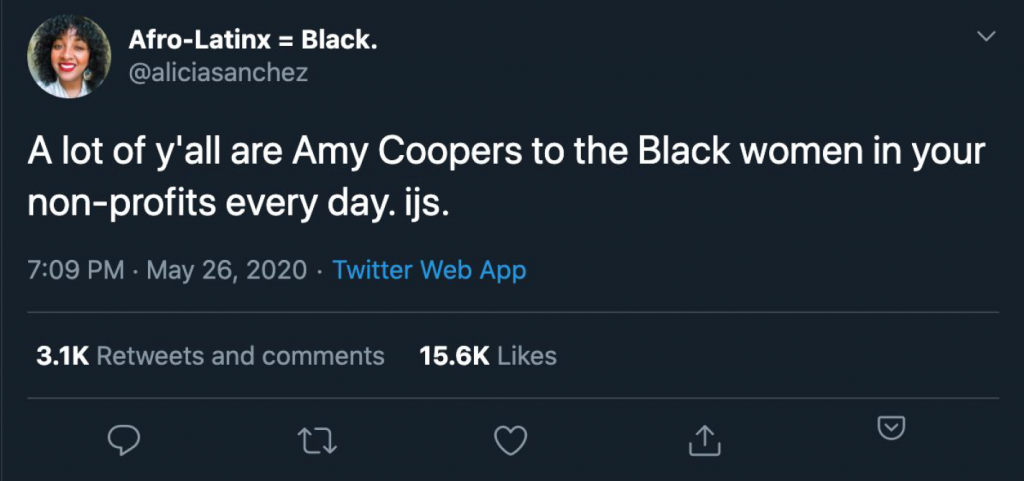
The nonprofit sector is especially not exempt from this, as demonstrated by @aliciasanchez’s tweet,

Tweet reads:  a lot of yall are amy coopers to the Black women in your non-profits everyday. ijs.

Folx with marginalized identities in the nonprofit sector witness and are subjected to Karen behavior far too many times. I, too, have been victim to the nonprofit Karen archetype — you know, your suburban white women coming into the city to do the ‘good work.’ I’ve found myself sitting in rooms with women who were well-intended and well-to-do, providing me “constructive criticism,” which are just loaded, back-handed compliments wrapped in coded language like, “Maybe you should be less passionate about this issue.” Sometimes it is the constant micromanagement from these women, feeling their lack of trust in me.

I am not alone in this. Many BIPOC nonprofit professionals are experiencing the same from their own #NonprofitKarens.

So you may be wondering the ways #NonprofitKaren shows up in our space … or more bluntly, you may be wondering how you, too, can you spot a #NonprofitKaren.

Here are some of the most common qualities of a #NonprofitKaren:

1. They have a disguised (or sometimes pretty overt!) savior complex

Have you seen your white female colleague jump into action, often without evaluating the whole situation or identifying the needs of anyone?

Yeah, me too. That is a #NonprofitKaren fulfilling her perceived call to heroism. She feels the urgency and responsibility to jump into action. And actions within nonprofit leadership tend to be informed by the dominant culture and the good intentions of white folx instead of actual needs and call to-actions from the community served.

When looking at our white counterparts in the sector, urgency and social responsibility can and often blur with white saviorism. Simply put, #NonprofitKarens and their leadership fail to listen to marginalized communities and focus mostly on their own good intentions.

So when you see your colleague (or you, yourself) focusing on intentions and not the community, you just may have a #NonprofitKaren on your hands. Take a moment to remind your Karen to listen to community needs first.

And maybe break this to them: “Your intentions don’t always align with the work, Karen.”

 2. They will use strategic use of words and phrases to center white fragility

Do your white female colleagues use words and phrase like, “Your passion is showing a bit too much,”or, “You are so well-spoken and poised,” or, “You are bit too lax for the situation”? These are among some of the key phrase will help identify a #NonprofitKaren.

They are often seen strategically using words and phrases that call out and differentiate their BIPOC counterparts. The words they use can also come in the form of descriptors like “aggressive” and “threatening.” They apply these words almost exclusively to those who identify as BIPOC.

A #NonprofitKaren will also be the first person to point out when all the BIPOC employees are sitting together, and she will express feelings of exclusion (while in the same breath, continue with her own exclusionary practices.) Behaviors like this create an unsafe and hostile work environment.

So no, Karen, I won’t lower or correct my tone.

3. They will undermine BIPOC leadership

BIPOCs in leadership positions often find themselves in situations where their decisions are questioned and not accepted. Additionally, BIPOC folx also receives lots of back-channel feedback and finds themselves in a constant battle to prove themselves and their decisions.

If you have experienced this with your white female colleague, you may have yet again another #NonprofitKaren on your hands. #NonprofitKarens find workarounds that undermine BIPOC leadership and harm their professional careers, both presently and in the future.

So if your #NonprofitKaren colleague has found ways to undermine BIPOC folx, you should be sure to tell her, “Karen, in response to your complaints regarding what is probably a really reasonable request — cancel it!

4. They are super avoidant

Finally, white folx in the sector assert privilege in spaces by avoiding uncomfortable conversations. Often, when difficult conversations arise, our white counterparts will retreat from the conversation because they are nervous.

In comparison, BIPOC folx are forced to sit in uncomfortable situations all the time, without opportunities to retreat from said situations.

FYI Karen, we BIPOC folx want to run, too, when you ask to touch our hair or ask how you would look in the same hairstyle, but we can’t. The fact that you can run is a privilege — period.

How to NOPE a #NonprofitKaren

Now that we have identified four ways that #NonprofitKarens show up in the sector, what can and should we be doing?

A. Push the conversation and ask a question.

My favorite question to ask a #NonprofitKaren is, “Why do you think/feel that way?” My favorite thing to do is to relentlessly push this conversation — the way Karens relentlessly push to assert their power.

We are going to talk today, Karen.

B. Don’t just call the behavior in, also call behavior out.

Calling out the behavior doesn’t give Karen the opportunity to center her white guilt and white fragility. We are dealing with harm right here and we should only accept changed behavior moving forward. Awareness and apologies do not advance us.

So not today, Karen. Not today.

C. Support membership groups aimed at helping BIPOC folx in the space.

Karens often ask what they can be doing better and what they can do to put action with the intention. Well, once you are aware of the problem, it’s good to openly support groups that are aimed at supporting BIPOC folx. It’s important to learn from those groups when appropriate. Groups like The Rooted Collaborative offer a safe space for BIPOCs, but also offer opportunities for allies to become co-conspirators.

Karen, we want to see you keep that same energy. And if you are unsure what I mean by that we want you to show up.

Dominique Calixte

Dominique Calixte

Dominique Calixte (she/her) is a fundraising professional and has worked in the nonprofit fundraising space for six years. In her career, she has supported nonprofits in building revenue streams, implementing systems, and inclusive fundraising practices. She also focuses on activating millennials as change-makers through philanthropy, donor engagement strategies, and effective DEI practices in the fundraising space. Dominique currently serves as the Associate Director of Annual Giving and Special Events at the YW Boston. Outside of her work commitments, she runs a nonprofit Instagram blog called DomProfit. DomProfit aims to be your plug to the nonprofit sector — be sure to give the page a follow for more.

5 reasons your development planning sucks

By Nikkia Johnson, development and operations professional

While I have been involved in grassroots fundraising for years, in 2018 I officially entered the fundraising field with my promotion as a development manager.

It felt unnatural to talk about my communities in a way that was digestible to donors who had more wealth than I could dream of.

Before then, I still had my hand in quite a few fundraising activities at the organization. I worked closely with the board ensuring up to date policies and documents. I was the data entry queen, mastering the intricacies of our database. I came from various nonprofit organizations where I managed programs, volunteered to run events, or assisted in drafting communications. I was even national vice president of my sorority. All of this experience put me in a unique position of understanding how the organization ran and how fundraising and relationship-building are integral parts of that.

I thought my promotion would be a great time to implement all the new ideas I gathered over the years and shift thought processes of what fundraising is. (Because so many times in the past, I was swiftly told, “That’s not how we do things.”)

So I ramped up on my training, professional development, and education in the field. As I was doing so, however, I noticed that so many trainings and mentors focused heavily on donor-centric practices. As a woman of color who has been heavily involved in the community — none of it felt right. It felt unnatural to talk about my communities in a way that was digestible to donors who had more wealth than I could dream of. It felt eerie to uphold stereotypes through data bias and storytelling so that we pulled on donors heart strings for a gift.

When I first read about community-centric fundraising via Vu Le’s Nonprofit AF blog, a lightbulb went off in my head. Everything that felt icky to me about donor-centric practices was articulated. Once I started seeing more articles like this, I knew I was on the right track with shifting the narrative at my own organizations.

So, why does your development planning suck?

1. You’re not clear on your board-giving policies

Most board policies are focused on how much money we can get. In doing so, we are ignoring other factors members can bring — time and talent.

And while yes, give/get policies are popular, remember that not every person has connections to wealth. Utilize people’s time and talent.

At organizations I have been involved with, I have heard the argument for and against a robust giving policy. Those for it think we need high worth donors to sit on our board to reach fundraising goals. The issue with this is: How many of those types of members do you retain long-term when they roll off the board? How many people does that lock out of ever joining your board?

Really what we’re saying here is — if a person cannot make a gift within your board-giving policy, there is no place for them on your board.

Those against it think that focusing too much on board-giving minimums will hinder diversity efforts. This way of thinking signifies the belief that people/communities of color are not high worth donors. In fact, this 2018 study by the Lilly Family School of Philanthropy found that there is no significant link to fundraising and board diversity.

So both of these are horrible viewpoints.

Listen — it’s all about how we communicate. How are we communicating fundraising goals to our boards? How do we work with board members to craft individual engagement plans to maximize their time and talent? Are we providing them with the tools needed to be successful?

While a board-giving policy is needed to institute a culture of philanthropy for a variety of reasons — it needs to be intentional. And while yes, give/get policies are popular, remember that not every person has connections to wealth. Utilize people’s time and talent. If you have a potential member who is an employment lawyer and is willing to do pro bono work on your personnel policies, that’s probably a fair trade off from a member who donates $5,000 but is never seen or heard from when needed.

Stop prioritizing board contributions over board time and talent.

2. Your donor relations tactics suck

A member of one organization I worked with said, “Well, we don’t have the time to get to know all our donors.” If we don’t have the time to get to know them — why should they take the time to give to us?

First off, donor relations is not the same as stewardship. If you are only reaching out to a donor when they give a gift, you’re doing it wrong.

Why are we still so obsessed and focused on major donors, to the point that we neglect other donors?

A member of one organization I worked with said, “Well, we don’t have the time to get to know all our donors.”

If we don’t have the time to get to know them — why should they take the time to give to us?

Good donor relation tactics start with tackling these kinds of questions:

Are we educating our donors on what’s happening at our organization? Are we okay having uncomfortable conversations with them? Do they understand that the mission is about uplifting the communities we work in and not about what they feel is urgent?

As fundraisers, building relationships is at the forefront of our work. But we need to also be able to do that in a trusting way that lifts up our communities. This brings me to the next point …

3. Your donor communications plan is trash

Does your development plan even include a communications plan? (No, I don’t mean just thank you notes and solicitation letters.) Do you have an actual, laid out plan of what is going out, when, and what the messaging themes are? Most importantly — do you know who is at the center of your storytelling?

We exist because there are problems of inequity (and that’s what our organizational missions attempt to fix) — yet our communications still say, “Look what your $20 gift helped us do.”

Like many others, I was drilled that donor-centric fundraising was the only way to go, that centering solicitations and thank you notes around the ever important “YOU” should be the focus of all communications.

During The Rooted Retreat (hosted by The Rooted Collaborative) that I attended in July 2020, Michelle Edgerton hosted a session called “How to (not) White Savior Your Donor Communications.” This led to a robust discussion about how donor-centered communications perpetuates saviorism and the “othering” of the communities we exist to uplift.

Let me say that again — we exist because there are problems of inequity (and that’s what our organizational missions attempt to fix) — yet our communications still say, “Look what your $20 gift helped us do.”

If you are telling a good story (which you should be), the person it highlights should direct the narrative. Not only will this cut down on saviorism, it will build a sense of community that we are all in this together.

We know communication is a big piece of donor relations, so make sure to be strategic and plan them out. When we shift to community-centric communications practices, we acknowledge we are not the gatekeepers of communities, but instead are working in partnership with them.

4. You’re not facilitating program engagement

As development professionals, we should be working with our program staff on a regular basis to really understand what is happening on the ground in order to be able to speak to it comprehensively, accurately, and compellingly.

Personally, I am all up in the programming world. At my current organization, I constantly help program staff execute their events and trainings.

As a community volunteer, I serve on numerous programming committees to effect change on a local level. As a donor, I’m interested in knowing how the on-the-ground work happens. I’m not so much interested in a contrived story about little Fulanita and how she’s better off with this new program or policy that took effect only last month.

Now, I understand different people want different things — but this is a part of relationship-building — finding out what works for each person and implementing those things to the best of our ability.

And this should be replicated on a bigger scale even though it’s often not.

COMMUNITIES ARE THE EXPERTS ON THEMSELVES!

As development professionals, we should be working with our program staff on a regular basis to really understand what is happening on the ground in order to be able to speak to it comprehensively, accurately, and compellingly. And, if possible, have program staff members be the impact speakers during donor visits. At the end of the day, your program staff members are doing the direct impact work that you are fundraising for and telling stories about.

5. You focus too much on only special events

I remember the first time I was given a huge chunk of responsibility for an organizational event. My first thought was: Whoa, these prices are high! How will we ever get young professionals involved here?

It’s so easy for fundraisers’ first line of defense to be a special event like a golf tournament, a benefit event, or our favorite — a gala. … After all the work staff and volunteers put into an event, was the ROI worth it?

I knew that had I not worked at the organization, there was no way I could afford to attend the organization’s event. The articulation of this realization started an important conversation about who our target audience is made up of and how we get them involved. While it had long been on our list to launch a young professionals board, including the addition of a YP price for this event, having the conversation enabled us to garner enough interest to start it.

It’s so easy for fundraisers’ first line of defense to be a special event like a golf tournament, a benefit event, or our favorite — a gala. This appeals to corporations for sponsorship. It’s a quick way to earn money while showing tangible benefits with flashy marketing and a good meal. I won’t vent on all of the issues there, but Phuong Pham tells you six reasons why tiered event sponsorship needs to go.

After all the work staff and volunteers put into an event, was the ROI worth it? While special events are great when done sparingly, we should be using most of our time building our communities and creating long lasting relationships with those interested in our organization.

When planning something, the first questions asked should be: What kind of event are we hosting? Do they make sense for the community we serve? How are we creating opportunities for the involvement of our target audiences? Are we only asking community members to participate so they can tell their story to high worth donors so that those high worth donors can gawk and shell out money?

After answering these questions, check out CCF’s aligned action list.


It is moral and just to center our work around the communities that we advocate for. When we look at equity, diversity, justice, fostering a sense of belonging in communities of color — and when we look at dismantling white supremacy and white-centric norms — we must take a holistic approach. We must look at all our programs and operations.

That especially includes fundraising.

While there is intentionality and conversation needed around how you can apply the principles in your organization — there is no option but to do the work.

Nikkia Johnson

Nikkia Johnson

Nikkia Johnson (she/her) is a nonprofit development and operations professional. She was born and raised in Queens, NY and currently lives in Richmond, VA — which greatly informed her career choice in nonprofits and fundraising. Nikkia is passionate about mentoring the next generation of leaders, and hopes more people will choose a development career instead of falling into the work. She serves on various organization committees in Virginia and is very involved with her sorority Sigma Lambda Upsilon/Señoritas Latinas Unidas, Inc. Nikkia’s biggest hobbies are dancing, cooking, and (in non-pandemic times) traveling. She can be reached via LinkedIn, or via email.

The Ethical Rainmaker: Kink, consent, & centering community with Lateef “L.T.” Taylor

By Michelle Shireen Muri, Freedom Conspiracy Principal and CCF co-chair

Episode Summary

In this episode, we’re dipping into the world of kink, and BDSM – and specifically consent. With so much awful news, subjugation, disaster, political oppression and disempowerment, it is easy to brush past some of the day-to-day tools we can use to regain power. In this episode, we explore the framework of consent, applied beyond the kink world, with kink-trainer and activist L.T. We’ll talk about boundary setting, renegotiation, clear communication, power dynamics in npos and more. So buckle up and get ready for juicy, beautiful content. “..we know we have a culture that is at best, murky around consent. None of us has ever lived in a consent culture, so we don’t know what to model it after, so we are all building this together.” Find episode notes and the podcast transcript here.

About the Ethical Rainmaker podcast

In the United States alone, philanthropy is a $427 million dollar industry, of which 68% comes from individual donors. Yet the practices, theories, and foundation of modern philanthropy and fundraising often ignore the ways in which the industry perpetuates harm. The Ethical Rainmaker, hosted by Michelle Shireen Muri, is a podcast that hosts authentic conversations grappling with the questions that we don’t often ask in the nonprofit world. Join us as we explore some of the practices that undermine our missions and navigate the way forward with today’s resisters, reimaginers, and the re-creators of the third sector. It’s time to think differently.  
Michelle Shireen Muri

Michelle Shireen Muri

Michelle Shireen Muri (she/her) is the co-chair for Community-Centric Fundraising and the host of the new podcast, The Ethical Rainmaker. She is the founder of Freedom Conspiracy, a small collective of fundraising consultants focused on bringing values-aligned practices to clients in the nonprofit and philanthropy spaces. She can be reached at @freedomconspiracy on Instagram.