6 lessons for broadening your mental horizons, from the perspective of a Gen Z student

By Isabella Lock, freelance journalist and student at University of Manchester studying Spanish and Japanese.

As young adults, we do not always have much money and time — but we know that there are many ways in which we can bring about change.

Despite the never-ending deadlines and the new and glorious challenges of adult life, Gen Z are some of the most political and active members of our society. The police brutality that resulted in the death of George Floyd sparked mass protests across the world for the Black Lives Matter movement with Gen Z at the forefront. Similarly, around a month ago, university students across the UK took to the streets demanding for improved student well-being.

Young people are undeniably at the core of many progressive movements today. As a university student myself, I would like to share some lessons for what all of us can do to continue staying involved and pushing for radical changes.

1. Diversify your feed by following informative, intersectional, and international accounts.

Thanks to social media, we can listen to millions of stories from all over the world. By listening to each other and learning from other experiences, we can become more aware about issues that affect people from all walks of life.

For this reason, I push myself to follow a range of accounts that share information and experiences that I otherwise would not have been exposed to. For example, I’m British and I follow several accounts on Instagram of Native American/Indigenous American people, such as @tiamiscihk and @wapahkesis, who often share their heritage, which we know have been oppressed for hundreds of years in the U.S.

It is easy to only follow accounts that discuss topics that you are already familiar with, but that will only narrow your perspective rather than widen it. By following a range of accounts from all over the world that explore a variety of topics, I allow my mind to be exposed to new cultures, beliefs, and movements.

Another example is the University of Manchester Feminist Collective (UoM Feminist Collective), which utilises social media to educate its followers about intersectional issues. Penny, co-deputy chair of the society, shares that “social media, especially Instagram, has allowed us [the UoM Feminist Collective] to reach people all over the world with infographics on important issues in an easy to understand and accessible way. We’ve raised awareness for issues such as Polish women fighting for their reproductive rights, debunking harmful myths about transgender people, and the severity of racism in the UK, to educate our followers using facts and statistics that they may otherwise not have learnt about from the mainstream media.”

2. Read an article every day.

Spending 10 minutes or so a day reading one article has exposed me to new issues that I otherwise would not have known about. (And I always ensure that I get my news from reliable sources with an intersectional lens to broaden my perspective on the world.)

My favourite media outlet is Gal-Dem, due to its diverse set of writers that explore perspectives and experiences typically underrepresented in mainstream media. For example, one Gal-Dem article exposed me to the situation in India, in which millions peacefully protesting against new farm laws were met with tear gas and water cannons by the security forces. Since there has been little to no mainstream media coverage of these events, my article a day rule has enabled me to educate myself on an issue I otherwise would not have known about.

3. Educate others using your own online accounts.

If you want to go one further, if you want to get even more involved in a global way, a good place to start is using our voices and sharing our own stories on social media. Whether it’s starting a blog to share your culture or creating infographics on Canva about an experience you have had, sharing personal stories will almost always make an impact.

For example, I wrote an article about my experience with anorexia in 2017. The article resulted in me getting several messages from strangers who shared how much my article had helped them in their own journey to recovery. (By the way, I want to emphasise that it is never your responsibility to educate others on your experiences, whether it be racial microaggressions or abuse trauma. It is always the responsibility of others to research these experiences themselves using the limitless resources that are already out there.) However, if you do want to and are able to share your experience, I’m here to tell you that you should!

The most impactful power that we all hold is our voices, so don’t be ashamed to use it.

4. Listen and learn.

Thanks to the pandemic, we have become more reliant and creative with technology than ever. There are hundreds of Q&As, discussions, speeches, and more being held across various media platforms, which are usually recorded and thus available to watch as many times as you want.

During the first lockdown of the UK, I spent hours watching YouTube documentaries about the animal cruelty carried out by SeaWorld and other marine parks. I also signed up to Zoom Q&As about how we can protect our suffering planet, discovered new podcasts about how colonialism is the root to most of our problems, and broadened my perspective watching TED Talks on just about anything.

Thanks to the wonders of technology, we can listen to and/or watch wherever and whenever. (Like usually, I’ll put on an online discussion whilst cooking or doing laundry or going for a walk.) Listening to others’ experiences is the most important way that we can make an impact and today, we have access to millions of experiences from anywhere and anyone.

5. Get creative with your research.

In between studying and navigating adulthood, I dedicate time to educating myself on topics underreported in the media. Right now, I’m learning about the rise of anti-Semitism and the movement against fatphobia. I aim to make an effort to research something new at least once a month, as a rule of thumb, to stay aware and educated.

Sometimes, a topic will spark an idea in my head, which I will write about in my blog or pitch to a media outlet.

There is also an infinite number of ways in which we can get creative as we educate ourselves. I’ve seen artists produce pieces that build on what they have learned and researched. I’ve also seen poets who rearticulate what they have learned in their poetry. I think by getting creative, research and learning will be less like a dull, never-ending university assignment and more like an interesting hobby.

6. Conversation equals change.

The most important and accessible way in which we can make an impact is talking to others. It is easy to get stuck on our views thanks to social media’s algorithm and the mainstream that only shows us what we want to see and keeps us ignorant and unaware of issues around the world. Talking with another and engaging in healthy discourse can evolve our mindsets, since we all have different experiences that play a role in how we were shaped by our society.

By evolving our mindsets through conversations, we therefore also have the power to evolve our society, which, as evident by the ongoing police brutality in the U.S. and the protests in India, amongst other issues, still has a long way to go. We must challenge our current beliefs and that of others through conversation if we really want to see a change.


As young adults, we do not always have much money and time — but we know that there are many ways in which we can bring about change. I think it is important that you find what works for you and keep a check on your own well-being. It has certainly been a difficult year for everyone, but we must not let that discourage us from making an impact.

Every little bit of research, conversation, artwork (and more) counts in the movement to make this world a better place for both us and future generations.
Isabella Lock

Isabella Lock

Isabella Lock (she/her) is a freelance journalist and student at the University of Manchester studying Spanish and Japanese. She regularly writes for her blog and The Mancunion. All of Isabella’s published work can be found in her portfolio. She can be reached on Twitter at @isabellalock_, on Instagram at @isabellalock_, or via email at isabella174@btinternet.com.
Why throwing professionalism out the window was my best career move

By Kelly Phipps, digital fundraising and philanthropy communications

It’s easy to think that professionalism is mostly good, that it is synonymous with having a good work ethic and providing good customer service. But since professionalism also causes BIPOC employees to make sacrifices, both small and large, I question it.

I used to wear the title of ‘working professional’ with pride.

It’s because I have an inescapable type A personality. It was also because I was fed the message of maximizing career pursuits ever since middle school, when my aptitude for organizing became clear in extracurricular activities.

Once I reached college, I worked between two to three jobs at a time out of necessity to pay my bills, but also to quell my raging fixation on ensuring my resume was impressive when I graduated. I even started wearing blazers to class, while others wore sweatshirts, to push myself further into the epitome of professionalism. And no one around me ever stopped to wonder if I truly was developing my future outside of the context of career.

However, now that I’m 30, I can finally admit that I’m constantly having an internal battle against who capitalism fashioned me to be. When people ask what my career goals are, my blank and anxious mind wanders into some obscure philosophical state, pondering the meaning of life while I mumble that as long as I’m making a difference, my job title doesn’t matter.

It’s easy to think that professionalism is mostly good, that it is synonymous with having a good work ethic and providing good customer service. But since professionalism also causes BIPOC employees to make sacrifices, both small and large, I question it.

Shifting away from professionalism

Today I feel weighed down by professionalism’s problematic roots, specifically how the structures of power dictate the culture of professionalism and how capitalism pollutes our definition of destiny.

There isn’t a single moment that created the shift from type-A go-getter to my current state in my mind. Each day is a new step in analyzing and understanding what societal messaging I’ve internalized. While I’ve always had a dream of helping to empower a new generation of BIPOC women moving into leadership positions within nonprofit spaces, I’ve realized that unless I am fully authentic in the office and have done the hard work with myself internally, I am just perpetuating toxic professionalism.

… the decisions I made to meet the definitions of professionalism brought me one step closer to emulating the norms of my white peers and leaders.

According to the Cambridge Dictionary, a definition of professionalism is “the combination of all the qualities that are connected with trained and skilled people.” It sounds benign, but the toxicity creeps in when societal views of training and skills start to encompass traits that deal more with a person’s identity and aesthetic than their talents.

When I started down my career path, I couldn’t help but notice that the decisions I made to meet the definitions of professionalism brought me one step closer to emulating the norms of my white peers and leaders.

For most BIPOCs, these decisions often result in adhering to Eurocentric beauty standards like straightening hair to fit in or choosing to wear blazers and suits at work over styles closer to an authentic identity. We may filter our ideas and feedback through corporate jargon and code-switching. Or navigate tokenism and microaggressions while maintaining poise and politeness.

The more I peel back the layers covering my unease with professionalism, the more I see our society’s obsession with wealth and status peering through, tangling itself up with the racism that our nation has yet to fully reckon with.

Here are ways capitalism and racism negatively impact the culture of professionalism.

Capitalism

Think about how much of our lives revolve around trying to obtain wealth and materials, including within our school systems and its curriculum, the prestige of certain university degrees, and how we define success. In the default societal context, our identity and value to society is rooted in how productive we are.

Capitalism is an economic system that hinges around private or corporate ownership of capital goods, the value of which are determined by competition in a free market. While capitalism is often framed as sparking innovation and progress, it also has a darker reality of exploitation. The byproducts of capitalism create many of the very disparities that nonprofits seek to alleviate.

The consequences of capitalism are ever-present in the workplace, from the hierarchies of leadership to who holds decision-making power to the constant struggles of employee burnout and overtime. There is the constant pressure to do more, to be better than those around us, and to secure that next promotion or raise.

And for many women and people of color, that definition of success is disproportionately harder to achieve.

Racism, sexism, and professionalism

I used to pride myself on meeting all deadlines and thought I was demonstrating sought-after talent by completing complex tasks sooner than expected. But one day, I realized I was trapped in a never-ending cycle that left me burnt out and frustrated.

So what is perpetuating the entanglement of professionalism and racism?

According to the 2020 Women in the Workplace report by McKinsey & Company and Lean In, white men hold 66% of c-suite jobs while women of color hold just 3%. Since leadership plays a pivotal role in defining corporate culture, that means a majority of corporate culture is overwhelmingly influenced by one demographic. And since the demographic holding the majority of power for decades has racial and gender prejudices and biases, racist and sexist practices seep into the fabric of professionalism.

The Society for Human Resource Management revealed a study that only 13% of white HR professionals surveyed believed that discrimination based on race and ethnicity existed in their workplace. And while arguably some of these leaders are not setting out to create a work environment that perpetuates the barriers to a more diverse c-suite, at a base level, there is often a lack of awareness about how their social location influences the corporate culture around them.

The gaps within leadership and workplace discrimination aren’t surprising. What was truly my epiphany, however, was to learn how the value structure born from this environment molded my daily attitudes towards work and success.

I used to pride myself on meeting all deadlines and thought I was demonstrating sought-after talent by completing complex tasks sooner than expected. But one day, I realized I was trapped in a never-ending cycle that left me burnt out and frustrated.

Then I stumbled across a webinar “Black, Indigenous, People of Color Surviving Predominantly White Institutions” by artEquity and had this truly mind-blowing experience. Through artEquity, I learned that how I approach the concept of time and deadlines was rooted in a cycle that contributes to barriers for women and people of color.

A dRworks resource by Tema Okun, in particular, helped define, for me, what a white supremacy culture looks like in organizations. One of the pillar definitions is a sense of urgency. When an organization persists in a rushed state where everything is on an emergency timeline, it results in staff members forgoing planning and process. It can create an environment where those with power and influence maintain prominence and those whose voices and skills are actually needed get left behind. The process becomes more about fulfilling orders and less about brainstorming and inclusion. Okun details that in a results-driven world, the very act of slowing down to ask the important questions and ensure the right voices are present is counter-culture and disruptive.

For me, this was a huge pill to swallow — to realize that each late night I worked to rush the completion of a task was actually a missed opportunity to build collaboration — and it harmed my mental wellbeing.

Resistance can be the simple act of slowing down, taking a step back, and asking why.

Respectability Politics

… the fact that I presented myself in a certain way and believed elements of professionalism meant that I was a tool of respectability politics.

Oof, this is another hard one. According to Dictionary.com, respectability politics is “a set of beliefs holding that conformity to prescribed mainstream standards of appearance and behavior will protect a person who is part of a marginalized group, especially a Black person, from prejudices and systemic injustices.”

Simply put, if we act a certain way we can fit in just a little bit more and avoid consequences of being perceived as a stereotype.

While I was still in college, I took a summer internship at a large organization. The hiring manager was a Black woman who went over the top to ensure I was excited about my internship.

A few weeks before the internship started, she sent me an email with some final details and, as a P.S., prompted me to look at some hairstyles and consider straightening my hair.

I was thrown off and conflicted.

While I knew it was a friendly gesture of trying to help me thrive in an internship at a predominately white organization, it also made me feel uncomfortable.

And on the first day of my internship, I showed up in my dark navy business suit — with my hair pressed.

While respectability politics was birthed from a place of survival and desire for safety, it falls short. Way short. Not only does the approach of respectability politics fail to get to the root of the problem, it plays into classism and the very stereotypes we seek to avoid resulting in division, hierarchies, and victim-blaming. While I did not typically go around preaching the ideals of respectability politics, the fact that I presented myself in a certain way and believed elements of professionalism meant that I was a tool of respectability politics.

Unlearning

Unlearning these parts of me are uncomfortable. It makes me want to forget moments of my past, yet I resist because I know unlearning is necessary. I am a better employee, manager, friend, aunt, and community member when I am authentic.

There’s a lot of unlearning to do. After a lifetime of navigating the world a certain way, there are parts of me I am currently untangling to see what is my true personality and what was altered. I learned early on in my childhood that Black girls (especially outgoing ones) are often disciplined more and stereotyped. And it does not stop at childhood.

The story of a group of Black women being kicked off a train for being ‘too loud’ is a constant reminder that my voice and laughter are only welcome in public spaces in small doses. This societal dampening of Black Joy slowly molded me to have a reserved and pensive temperament in public.

The moments I’m with my best friends or in my off-the-wall group chats, I feel the burden lift and the boisterous laughter explode from my shell. While it’s natural to be more free with one’s friends than at work, I feel an acute tension between my two selves. Those two versions of me are too different. And my soul feels it with each and every switch.

Unlearning these parts of me are uncomfortable. It makes me want to forget moments of my past, yet I resist because I know unlearning is necessary. I am a better employee, manager, friend, aunt, and community member when I am authentic.

So what does that mean for our career pursuits? How can we navigate a career while internalizing an awareness of the constant systems at play?

While critiques of capitalism and professionalism are relevant and vital, until the system changes, it will remain part of our daily lives.

So, what are the daily steps we can take to safeguard our mental health, embrace our authenticity, and inspire those around us? Here are some thoughts to consider.

1. You are more than your job title.

When people asked me, “What do you do?” I used to default into my career, job title, and where I work.

Now, I frame my identity in a new way. I’m an Auntie, rage cookie baker, a daydreamer obsessed with breaking down inequalities within Christian spaces and nonprofit organizations, and thanks to the pandemic I play Tetris! Lots of Tetris.

2. Reframe conversations.

The questions we ask also communicate what we value. A simple way to decentralize capitalism and professionalism is through how we connect with those around us.

When meeting someone new, avoid inquiring about someone’s profession unless they bring it up. Consider asking about someone’s passions, their hopes, their hobbies, their family, and the story of where they’re from. Not only will you get to know people on a deeper level, you are finding value in their life outside of a job.

3. Don’t get caught up in the grind.

You are more than your productivity — So much more. Sometimes life is busy and rushed. There may be a day you are stressed about a deadline. It happens. But when you can, slow down. And in the moments that slowing down is not possible, forgive yourself. And don’t give into the guilt when you don’t live up to societal expectations of productivity. You deserve rest. Period.

4. Question professionalism standards.

There may be hard moments when you witness others question or critique a colleague’s professionalism. Before passing judgement, ask yourself, is this critique rooted in a toxic understanding of professionalism? Does the individual being criticized come from a group that is historically marginalized? If the answer to either of those questions is yes, you have an opportunity to educate others on how their understanding of professionalism is harmful.

Depending on where you work, this might seem like an impossible task. But offices around the country need courageous voices willing to call out problematic beliefs and behaviors.

5. Expand your definition of professional networking.

Reflect on who your professional connections are. If you are only pursuing relationships with those in power and name drop around those who are not in power, if you shy away from befriending coworkers who don’t fit company culture, then you have some internalized systemic issues to work through.

Your professional network is enriched when you get to know those from all walks of life, backgrounds, job titles, and personalities. When we only pursue rich and powerful connections and place them on a pedestal, we are reinforcing unhelpful systems of hierarchy.


While there is a myriad of collective societal unlearning that needs to happen, I hope that my personal journey of understanding what’s contributed to my career experiences can be a catalyst. Let’s boldly throw out work habits that aren’t contributing to our wellbeing. Let’s call out practices that leave others behind. And let’s never stop questioning tradition.

Kelly Phipps

Kelly Phipps

Kelly Phipps (she/her) is a Minnesota transplant on the West Coast who is passionate about closing the disparity gap of women of color moving into nonprofit leadership roles. The title she is most proud of is being auntie for her three siblings. Kelly enjoys podcasts, amateur baking and gardening, and daydreaming about the future while taking walks on sunny days. While on the clock, Kelly dives into the world of digital fundraising and philanthropy communications. She can be reached on LinkedIn, on Twitter at @KP_PR or via email.

Fundraisers, your community needs your talents beyond your 9-to-5 office job

By Taylor Gibson, Portland fundraiser

As a development director who loathes capitalism, I often feel very conflicted about my job. When I was young, I had big visions of making a positive impact on the communities I loved, and they certainly didn’t include asking those who hoard wealth to give back (what is often) an insignificant amount to marginalized communities in exchange for a tax deduction and a sense of superiority and white saviorism.

… if we want to create real change in our communities, nonprofit fundraisers should extend their talents to their communities and volunteer their time outside of their jobs to help fundraise for candidates and ballot measures.

Between fighting with board members to include the words “dismantling white supremacy” in emails, pushing for more than surface-level DEI, and trying to explain to people why the little nonprofit I work at stopped distributing Dr. Seuss books, I feel as though I’m maintaining the status quo in the Nonprofit Industrial Complex, facing constant setbacks when trying to push forward.

This began to change in the spring of 2019 when a friend asked me if I would be interested in doing a fundraising training for a scrappy group in Portland, Oregon’s chapter of the Democratic Socialists of America (DSA). (Full disclosure: I am a member of the chapter and am currently serving a one-year term on its steering committee.)

This group was working on an ambitious goal — getting universal preschool on the ballot in Multnomah County, where Portland is located. Their plan was to provide preschool for every 3- and 4-year-old in the county, and they were going to do it by taxing the rich.

When this campaign started, I was skeptical as to how a group of small but determined volunteers was going to ensure that every single child in the county was going to get preschool.

When it was over, I left inspired, and absolutely convinced that if we want to create real change in our communities, nonprofit fundraisers should extend their talents to their communities and volunteer their time outside of their jobs to help fundraise for candidates and ballot measures.

Let’s talk about preschool

Many people are unaware that preschool is not part of the K-12 system. Unless a child is enrolled in Head Start (which is deeply underfunded and only covers 42% of children who are eligible to enroll), families usually end up shouldering the burden of preschool tuition. In the state of Oregon, childcare costs, for a 4-year-old, averages to $9,396 a year, resulting in Oregon being one of the top 10 most unaffordable places for preschool in the country.

There is insurmountable evidence of the benefits of preschool, especially for children from low-income families, children from dual-language homes, and BIPOC children. And when it comes to universal versus targeted programs, evidence shows that low-income children’s reading and math scores improve when they’re in class with children from a range of income backgrounds. The fact of the matter is that universal preschool is just good policy.

I agreed to help teach the DSA fundraising training, with the caveat that I had only ever fundraised for nonprofits and didn’t know the fundraising rules for campaigns, candidates, or ballot measures. And so, with my friend, we taught the basics of fundraising — how to talk to potential donors about your cause, how to do an ask, how to host a house party, and how to do basic event planning. I told myself I wouldn’t get involved much further than that — because I tend to overcommit.

Then I did a second training and found myself volunteering to do a few small things, like putting together a packet for hosting fundraising house parties and writing some appeals for emails. Before I knew it though, I was attending weekly meetings for the Universal Preschool NOW campaign.

It was the real deal — an initiative that was going to level the education playing field for every preschool-age child in the county, with a massive redistribution of wealth to make it happen.

How could I say no?

More than a band-aid

And although I had concerns about the differences between political and nonprofit fundraising, people’s desires and concerns transcend those categorical boxes.

Isn’t this the type of change we hope to help make happen when we go into nonprofit work? So much of nonprofit work can feel like a band-aid — treating the symptoms rather than the sickness. We raise funds to buy books for children, to host beach cleanups, for afterschool programming, for healthcare — but we’re not creating the structural change that is so necessary in a society dominated by capitalism, racism, ableism, sexism, xenophobia, transphobia, and so much more. Nonprofits simply don’t have the resources and oftentimes the will to create radical change.

Knowing that working on the Universal Preschool NOW campaign was an opportunity to create real change by redistributing wealth, I jumped in. And although I had concerns about the differences between political and nonprofit fundraising, people’s desires and concerns transcend those categorical boxes. If you write a compelling appeal explaining how a certain program/initiative/insert-magical-thing-here has the opportunity to create substantive change in your community, they will come.

We started out writing email appeals, and then began hosting small fundraising events in community spaces. We headed into 2020 with a lot of optimism that universal preschool for Multnomah County was on the horizon.

A year of drama and hot lava

What happened next was a year full of made-for-TV drama. Obviously, COVID-19 happened. Universal Preschool NOW found itself facing a parallel preschool ballot measure, spearheaded by a county commissioner with support from venture philanthropists. This separate initiative initially sought a more modest, means-tested program supported by local nonprofit leaders. (Nonprofits, listen to me: Stop fighting for crumbs from politicians even if you get funding from them. Get the whole pie.) The cherry on top was The Portland Business Alliance suing our campaign in an apparent attempt to limit the time available to gather the 22,686 signatures we needed to get on the ballot.

And of course, by the end of May, like much of the rest of the country, Portland was enmeshed in protests against our violent police force and, eventually, the federal government. (The same moms in yellow t-shirts and others who collected signatures during the day for the campaign were out at night fighting for Black lives and racial justice, being tear gassed, beaten, and arrested by cops.) By a feat of community strength and resilience, we collected over 32,000 signatures (almost 10,000 more than we needed to qualify) in 34 days and qualified for the ballot, and we successfully merged with the other preschool campaign.

In order to raise the money necessary to pay for the campaign, we utilized a diversity of fundraising tactics. We launched an email appeal campaign with a matching gift. We asked for donations in every Zoom meeting we attended. The campaign even got our own special Universal Preschool Cookie, a delicious confection from an incredible bakery in Portland who gave us a percentage of the proceeds. We even nosted a no-rules 5k for Pre-K, where nearly 400 people ran, rolled, swam, paddle-boarded, and did yoga poses to raise awareness for the ballot measure.

On Nov. 3, campaign volunteers met up in a park (masks on) to eat snacks and be together when the election results came in — we won with 64% of the vote!

In total, Universal Preschool NOW raised $78,355.42. Believe it or not, this relatively nominal amount carried us through the anticipated legal challenges, covered basic expenses (for example, a website), and also allowed us to make substantial contributions to the joint ballot measure campaign. I find this to be incredibly inspiring — and a call to action.

More work to do

You have a tremendous set of skills and gifts that can create a better world and build solidarity, and we owe it to our communities to do more to create lasting change.

As our friend Vu Le has written about extensively, we’re being outfunded and out-organized. Conservative philanthropy moves quickly without micromanagement and has done so for the past 30 years, while progressive philanthropy moves at a glacial pace, over-intellectualizing everything and is risk-averse. We cannot wait for our foundations and executive leadership at our nonprofits to create change; we have to lead by example. Sometimes that means logging off at your paid job at 5:00 and getting on a zoom call at 6:00 for a local candidate running for school board or a grassroots PAC trying to push through legislation to provide more services to our houseless neighbors.

Fundraisers, I know how much work you do. I know the hoops you jump through, the long hours you put in, and how burned out you are.

And yet, we’ve got more work to do — especially those of us who are white, and hold other privileges. There are so many grassroots candidates, ballot initiatives, and other electoral projects that need your abilities. They need you to run a fundraising event, to write an email appeal, to make an ask in-person (or these days, on Zoom) for a gift, to put together a gift calculator chart, and so much more. A few extra hundred dollars can pay for more phone calls to voters, postage for mailers, snacks for volunteers, or for gas for canvassers, which can make all of the difference in local elections.

Many of you work at nonprofits, so I don’t need to tell you that there is an abundance of organizations out there that are training folks to run for office, from grassroots organizations like Portland’s East County Rising to more nationally-recognized groups like Emerge, as well as local grassroot PACs like UP NOW and organizations like local chapters of the Democratic Socialists in America that are working on developing legislation to go to the ballot to pass Green New Deal reforms, a $15 minimum wage, ending houselessness, defunding police, and labor laws to ensure worker protections. Reach out to these groups and individuals to offer your many talents!

If we want to see truly substantial change in society, we’ve got to put the work in, both inside and outside the office. Even if you only have an hour to spare (and I recognize that free time is a privilege), your skills can help a grassroots ballot initiative raise enough money to hire a lawyer to write a ballot measure, or write an email appeal for a candidate not backed by capitalist special interests, or even show a grassroots PAC how to optimize their giving page so they can receive more donations.

You have a tremendous set of skills and gifts that can create a better world and build solidarity, and we owe it to our communities to do more to create lasting change. We may work during the day to fund programs that give children’s books to kids enrolled in Head Start, or write grants to increase the capacity of our local food bank. But let’s also consider using our talents to help fund candidates who will increase the SNAP budget (which provides more food than food banks ever could), or help fund grassroots initiatives that ensure every child can go to a publicly funded preschool, where every child will have access to books.

This is the solidarity we owe our communities, and each other.

Taylor Gibson

Taylor Gibson

Taylor Gibson (she/they) is a resident of Portland, Ore. who earned her Bachelor of Arts from Alma College and a Master of Arts from the University of Denver. She has over six years of nonprofit fundraising experience and would like to take this opportunity to tell you to start a union at your workplace if you haven’t already. You can connect with Taylor via email or Twitter. She enjoys telling people to wear at least SPF 30 even on cloudy days and being a dog mom.

I wrote a CCF essay about racial gaslighting — and then white fragility blew up in my face!

By Melia Smith, Phoenix-based development professional

In the throes of the holiday season last December, the careful balance between read and unread emails in my inbox was starting to take a turn. As I conducted my daily reckoning of my inbox, one message jumped out at me, demanding my immediate attention. It didn’t have a subject.

I recognized the handle right away though; I knew who it was. A riff on her name, she always used the same version of that handle for her social media accounts.

I took a deep breath and rolled my eyes.

Out loud, to no one, I said, “I literally do not think about you ever. You just don’t know when to quit do you?”

I opened the message, and it was exactly what I expected. It had a Trump-losing-the-election flavor to it. The ALL CAPS. The double spacing after the end of each sentence. It was full of half-sentences and grammar errors so egregious that I started to grind my teeth. It was an outright assault on any and all punctuation standards. It was full of empty threats of taking me to court. It was the digital equivalent of a ransom note made out of magazine clippings.

And there, buried within the word salad of accusations, was an unhinged: “I’m not a racist, YOU ARE!”

I bark-laughed at my screen before taking screenshots and filing it in a folder of correspondence I’ve been gathering, should I need to file a protective order.

A protective order. How did we get here?


Thinking reverse racism is real isn’t just a fundamental misunderstanding of racism — it’s the willfully ignorant belief that racism is nothing more than prejudice or bias.

Back in September, CCF published an essay I wrote about my experience with racial gaslighting at a former organization. Writing that essay was cathartic and ended up being a critical part of healing from the experience. The response I got from friends, colleagues, and family was overwhelmingly positive. I was simultaneously affirmed and crushed by the number of people who reached out to thank me and tell me that they’d had a similar experience, tell me that reading my essay helped them feel less alone or less crazy.

A few days after it was published, my neighbor (who is white) and someone I had considered a friend, reached out to congratulate me — or so I thought.

She started off by saying, “You should be very proud of the article and your achievements in spite of your gaslighters and ignorant road blocks.”

I started to type a response of thanks — when another message, a different kind of message, quickly appeared.

I hope you’re not racist against all white people now?!” she quipped.

I frowned at the text and wondered how, at this point in time, after the year that we’ve had and with all of the antiracism resources available to us, how after reading my essay this person still thought that reverse racism is real.

(Thinking reverse racism is real isn’t just a fundamental misunderstanding of racism — it’s the willfully ignorant belief that racism is nothing more than prejudice or bias. It’s the willfully ignorant belief that racism is only overt, like through lynching and saying the n-word. It’s the willfully ignorant belief that racism against white people is an actual documented occurrence perpetrated at the local, county, state, and federal level.)

(Believing reverse racism is real legitimizes the objective falsehood that the same discrimination that is exercised against BIPOC communities is also excercised in the exact manner against white communities.)

I groaned and texted the thing that felt safest: “LOL of course not.” I added laughing emojis.

(BIPOC folx need to be skilled in the art of choosing battles when it comes to engaging with unintended or willful ignorance. We make important calculations, sometimes without even thinking about it, asking ourselves: Is this a battle worth fighting right now? Do I have the energy to sustain its violence? Will I be safe in the aftermath? This neighbor was my friend, and I decided that there would be another time to unpack this. I didn’t have to do it right away.)


The next morning my neighbor texted to tell me she’d read some other essays that I wrote and … she had some thoughts.

Things deteriorated from there.

I gave up 45 minutes of my life to a stream-of-consciousness attack and accusation Blitzkrieg that jumped from topic to topic. She kept telling me about — and then deflecting — every time she was confronted with something that conflicted with her reality or that didn’t align with her sense of victimhood.

She went as far as pulling screenshots of excerpts from two specific essays and accused me of talking about heras if I’d written essays about the death of two Black men with her specifically in mind.

Those essays were actually written from a place of me trying to process my own grief. And while she didn’t deserve that explanation, I explained it to her anyway.

She didn’t want to hear it. The story she’d already sold to herself was that all of this was ultimately about her.

By the time she ineptly tried to argue that she, in fact, doesn’t experience white privilege because she doesn’t come from money, I knew what I was doing wrong. I hadn’t removed myself from what was from the start, a futile and one-sided conversation about the impact of the truth of my experiences on her (the audacity).


For BIPOCs like me, building a plane while flying it isn’t just unsafe, it’s just not possible. This conversation was impossible.

One of my former CEOs used to describe overseeing the chaotic state of our organization as “building the plane while flying it.” I thought of this as my neighbor’s texts came through, one after the other, each more bewildering than the one before.

She was trying to have what she thought was an honest and authentic conversation about race and was unknowingly saying ignorant and hurtful things. She not only didn’t have the basic language to talk about race in a way that doesn’t perpetrate violence, she didn’t actually care to have that language, because she didn’t approach this discussion with humility. She approached it with outrage.

I couldn’t have a stable and safe conversation with her because I couldn’t do all of the work for the both of us — the work of having the authentic conversation she so desired and the work of protecting myself from her ignorance by correcting her ignorance.

She didn’t want dialogue, she wanted absolution.

She wanted me to know just how wrong I was about her, maybe even apologize to her — which is unbelievable because none of the personal words that I shared were about her at all.

For BIPOCs like me, building a plane while flying it isn’t just unsafe, it’s just not possible. This conversation was impossible.

My neighbor’s reaction was a masterclass in how violent white fragility can be. One of the (many) problems with white fragility is that when it comes to telling the truth, white fragility makes space for one truth: the truth of white feelings.


I had to move.

My neighbor’s texts became increasingly hostile and unstable, ending with an unprovoked five-inch-long scorched-earth monologue, bereft of sense or compassion, a dialogue so wild, I am still actually afraid of what she is capable of.

I think a lot about what might have happened if this had happened to me in the workplace, if a coworker had responded to me with such violence. The thing is, it does happen. This kind of thing happens all the time.

So I packed up the apartment I’d lived in for the last four years and moved, unable to sustain the threat of spiritual, emotional and psychological violence from someone who is now basically a stranger to me.

Last June, Ja’han Jones wrote on Instagram: “White people are trained to express rage through ignorance. The ability to ignore racist horrors committed before your very eyes is not a passive trait, but a carefully honed skill. All the things you don’t know — all the things you’ve claimed not to know but which have persisted for centuries — demonstrate you are heirs to a violent tradition of white ignorance.”

My experience was a reflection of toxic white fragility and white supremacy and the willful ignorance that accompanies them, and they were expressed through verbal, emotional, and psychological violence.

And this is not uncommon.

I think a lot about what might have happened if this had happened to me in the workplace, if a coworker had responded to me with such violence.

The thing is, it does happen. This kind of thing happens all the time.

Every day, BIPOC folx are navigating situations in the workplace where the fragility of white people is weaponized against them. And as a result of our workplace cultures being built through the systems that promote this fragility, the outcomes of these situations favor the perpetrators of the violence.

My first essay was public and loud, but the quiet and simple act of saying to a white colleague “Hey, that was racist,” presents the same opportunity for the kind of harassment I experienced. The mix of willful ignorance and white fragility insulates perpetrators from their acts of racism — the perpetrator’s individuality is valued over rectifying the actual hurt they cause. The hurt they cause is justified through yes they did/said something racist, but they’re a good person, they didn’t mean it.

At one point in the breakdown of our relationship, my neighbor had actually messaged me, “I’m sorry I’m not holding a Black Lives Matter sign.”

It wasn’t the open hostility of the fake apology that was the most annoying. It was the fact that it lacked self-awareness. The apology was disingenuous, not only because I know she didn’t mean it, but because it was a botched attempt to absolve herself from participating in work she was making every attempt to not understand. She offered it up as a slight. but instead it reinforced her commitment to her own ignorance. Even her apology, in all its counterfeit glory, was violent.


As I wrote this piece, I had to dredge up our texts for the receipts and was surprised by how raw the hurt still was …

That experience is a real life example of how dangerous it is for BIPOCs to be on the receiving end of white people’s misguided belief in the extent of their personal accountability for racism.

(They were not there in the time of slavery, their parents raised them right, they don’t see color, they are not biased, but I’m not a racist, forever and ever amen.)

All of this, however, is a demonstration of how accountable they actually are — their unwillingness to see racial oppression and then openly acting like not seeing it makes them innocent is proof of their racism in itself.

As I wrote this piece, I had to dredge up our texts for the receipts and was surprised by how raw the hurt still was as I read them even though I had processed this so many times with friends, in therapy, and with colleagues (who I felt embarrassed telling, but who I felt should know, in case something happens to me.)

I am reminded of the time I heard someone describe systemic racism as death by a thousand papercuts. Imagine getting a papercut every few minutes and being acutely aware of each and every painful slice to the skin. It would consume you. It would be all you could ever think about.

And eventually you’d find a way to numb yourself so that the papercuts are bearable, so that maybe you wouldn’t even notice them — because you might even get used to them.

This is the existence of BIPOC folx within a system that refuses to deal with the ignorance of white people. We’re able to get by, only by numbing ourselves to the cuts — until someone throws salt on all of those wounds and reminds us that yes, they are there and they fucking hurt.

Melia Smith

Melia Smith

Melia Smith (she/her) is a development professional, specializing in start up and in-transition environments. She currently oversees development at a homeless services agency in Phoenix, Arizona. The coronavirus pandemic has forced her to have hobbies outside of TV; currently she enjoys calligraphy and watercolor art, reading, and scrolling through Instagram for pictures of dogs. She agrees with Dr. Tressie McMillan-Cottom about the absurdity of LinkedIn, but you can find her there anyway, as well as on Instagram @notesfrommelia. Read more essays from her on an irregular basis on TinyLetter.

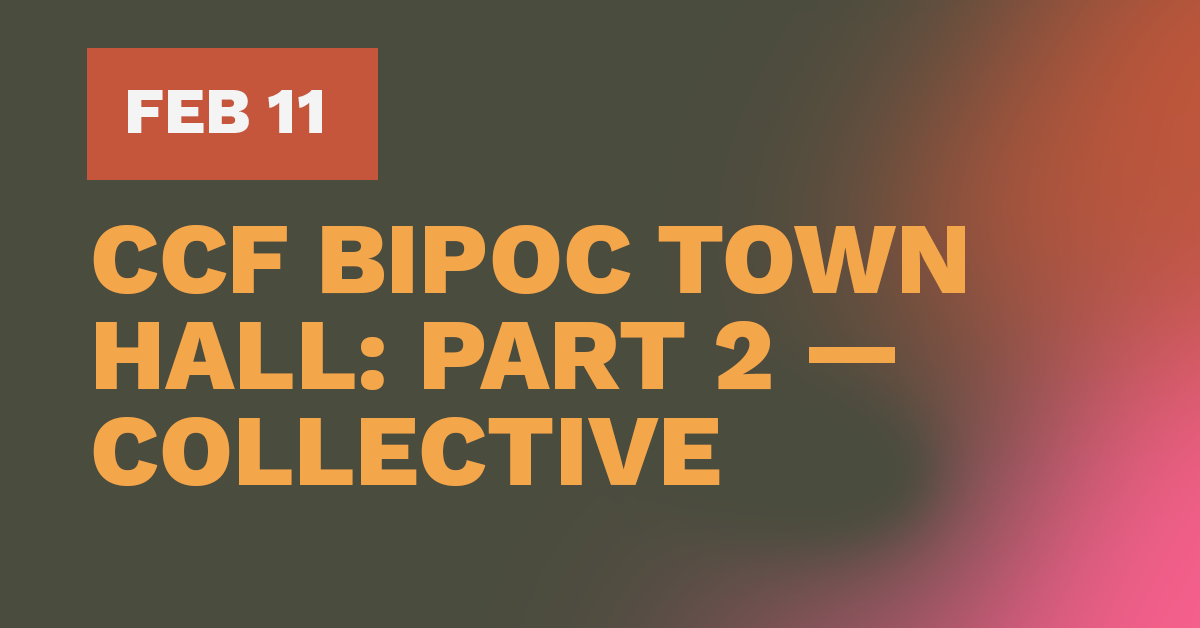
Feb 11, 2021: CCF BIPOC Town Hall: Part 2 — COLLECTIVE

When: Thursday, Feb. 11, 2021, 2 p.m. PT, 4 p.m. CT, 5 p.m. ET

Where: Online

Details:

Join us on Thursday, February 11, 2021 for CCF’s ongoing BIPOC Town Hall series. Our theme will be Collective and we will share ideas and explore how to center community and racial equity into our fundraising practices. Spoiler alert: It’s not easy and there are no quick answers. That’s why we’re focused on building collective movement toward this vision.

This will be the second of a three-part monthly series by BIPOC fundraisers, for BIPOC fundraisers in the CCF movement.

January 14, 2020: Part 1 — SELF
February 11, 2020: Part 2 — COLLECTIVE
March 11, 2020: Part 3 — MOVEMENT

This event series is EXCLUSIVELY for Black, Indigenous, and persons of color. Hosted by Community-Centric Fundraising.

Live captioning will be provided.