Three times trying a community-centric approach paid off

By Chris Talbot, communications (plus additional duties as needed) professional

It’s never easy to change the tire while the car is still in motion, but if we want to build our organizations to truly uphold JEDI principles, it’s something we need to do.

In mid-February, I sat in a development committee meeting. Like most meetings I attend, I was the only non-white, non-cis person in the room, sitting on mute, listening to an all-white, all-cis group share their ideas for how we could monetize an educational week of events.

The event they want to use as a fundraiser is one I have put on my recent slate of  cover letters (thank you to the folx who reached out after my first article and encouraged me to look for new work) as an example of one of my proudest accomplishments. Its last incarnation was a week-long virtual series of events, which happened in the third month of the pandemic, and was entirely free to attend.

During this February meeting, when the others mentioned VIP-style pay-to-play schemes to monetize it, I was not happy. And I voiced it. 

“That’s not an equitable practice,” I said. 

I also elaborated and tried to relay the injustices in wealth accumulation between the races and explain how our science-based research is better circulated to everyone who wants to learn than saved for the wealthy who can afford to pay. 

Honestly though, I’m not sure how much I was able to say or if I even whipped out any stats — like the fact that it would take the average Black family 228 years and the average Latinx family 84 years to accumulate as much wealth as the average white family — because a white cis woman on the Zoom call interrupted me to laugh in my face and tell me, “That’s just how fundraising is.”

This wasn’t the first time I’d been laughed at by a white cis colleague while voicing an equity concern in a nonprofit. I’ve worked and volunteered in predominantly white institutions my entire adult career. I’m pretty much used to it. 

But it was the first time it happened after the people involved expressed a “commitment” to justice, equity, diversity, and inclusion (JEDI) work, and so it hit differently.

Regardless, I tried one more time: “It may be common, but it’s not the only way. And it’s rooted in white supremacy culture.” 

This elicited shocked stares from the all-white, all-cis wall of Zoom rectangles on my screen before someone did the whole, “I can see both sides, but I think this is a larger conversation that can happen off this call.” 

That was over two months ago. There’s been no attempt to have that larger conversation.

Shaken by this exchange, I went to process the experience with one of my accomplices. She brought up that there may not be many examples of community-centric practices on paper — and there’s also no evidence that white-donor-centered (as Vu Le refers to it) is the only or supreme form of fundraising either. 

There simply isn’t enough data to claim either side of the argument the victor.

(In my purview, if organizations are committed to justice and equity, that needs to be at the forefront, regardless of what works best to bring in cash. But, I take the point.)

I’m sure the thousands of us following Community-Centric Fundraising want to be the change, but how are we sharing our successes and learning opportunities to make sure that the data will eventually be there?

With that goal in mind, I want to share three things I’ve tried that worked beautifully.

1. The time I organized a week-long, virtual education event and gave it away for free


We had our week-long annual educational event scheduled for May 10-16, 2020. Typically, this week would have a significant event every day, along with a couple of fundraisers, to educate the public on at-risk animal species and help fund our work to protect them. 

Denver reported its first coronavirus case on March 5 and started its incremental lockdown around March 16. 

Being a triracial, queer, trans nonbinary person in an all-white, all-cis, all-het organization meant that I almost immediately realized I would need a little extra help getting through the pandemic without rage-quitting my job. I had already begun attending support groups and webinars to help me navigate and process my feelings when my team scheduled the “what are we going to do?” meeting. 

Inspired by the BIPOC Surviving Predominantly White Institutions series and Native Wellness Institute Power Hours I loved, I proposed doing free lunch-and-learns to share the community’s knowledge regarding different species. While there was some skepticism, there was also a lack of other great ideas and the energy to deal with the programming, so I was given free rein to do whatever. Power! LOL.

Instead of seeking monetary sponsorships from our partners as we had in years past, I asked nonprofits to share a resource, an action, or have one of their experts appear on a lunch-and-learn for the day. I also provided them with a media kit and asked them to advertise the week and events. Content, experts, and advertising — check! Community — double check!

With their contributions, I made a webpage for each day featuring things to read, direct actions to take, videos to watch, and kids’ activities. For Monday through Friday, I scheduled a different lunch-and-learn, each with a panel of experts.

It was completely free. Anyone with an internet connection could attend. We recorded the lunch-and-learn sessions for those who couldn’t participate on the day and hosted them on our YouTube account.

One partner who wasn’t ready for community-centrism insisted on doing their own thing, going as far as taking credit for my work, sending fundraising asks about the event with no mention that my organization (or more accurately, I) created it. But I ain’t mad. At the end of the day, the information was disseminated, people learned and took action, and the movement inched forward.

The result is that we created the most educational experience I think our group has ever hosted! We had over 70 attendees register for each lunch-and-learn. Attendees got direct access to experts and were able to ask questions in real-time. 

I don’t know if anyone felt what I did as the moderator, but it felt like we were building a real community! It was beautiful!

What about the bottom line? Well, with the whole week being online, removing the need for rented locations, signage, programs, and other in-person staples, and all the experts donating their time in exchange for sponsorship benefits, the costs were entirely staff time. And if you’ve read my previous article, you know I am not paid well. A few enthusiastic donors probably covered my salary without us even having to do any formal ask (I didn’t track it, but I’m fairly confident this is a true statement).

This is the series of events the development committee wanted to monetize with VIP-level access, pay-to-play scheme, concentrating access to the information and science to the “largest” donors. (I put “largest” in quotes because “largest” in this case would be determined by the number of dollars donated rather than respecting that “large” is subjective — people give at a level meaningful to them. It also does not account for donated time, which, arguably, community scientists who acquire the scientific data we rely on make a “larger” donation to the cause than any monetary donation could).

2. The time I divested from AmazonSmile and immediately received donations equalling six years worth of disbursements


During the last Amazon boycott, nonprofit Facebook groups were abuzz about what to do. Should organizations continue to advertise AmazonSmile or should they respect the boycott? Most of the responses indicated that almost universally, nonprofit fundraisers hated the whole AmazonSmile grift but reluctantly participated.

I was the same way. For years I wanted to divest our organization from AmazonSmile. I would send an email to my boss every time we received our quarterly disbursement asking that we find time to talk about the possibility.

When my organization started claiming they cared about JEDI principles, I stopped asking and started telling. I said we couldn’t make that claim while our fundraising processes proved otherwise. I made a list of things that we wouldn’t be doing anymore — with sending personalized thank yous only to people giving $100 and above (yes, for real) and AmazonSmile at the top. 

After I finished the divesting process, I let our supporters know. I sent an email. Here’s a truncated version of my email:

We’ve committed to more ethical fundraising

We have recently divested from Amazon due to their ongoing history of warehouse abuses, sub-standard pay, Rekognition software that contributes to racist profiling, and inadequate or spotty adherence in warehouses to social distancing guidelines during COVID. 

Our organization has decided to cut ties with Amazon and the nonprofit fundraising arm, AmazonSmile. In doing so, we are not making a statement against individuals, businesses, or organizations who continue to use Amazon for their needs. We recognize that for a lot of people, Amazon is the most accessible option and a safe alternative to shopping in person, but we have decided not to support the business ourselves.

AmazonSmile donated 0.5% of our registered supporters’ qualifying purchases on their platform, or $5 for every $1,000 spent. In the last year, we received $224.28 from AmazonSmile. We hope that we can recover this amount without encouraging spending at an organization with a history of unethical practices.

If you are looking for alternatives to Amazon, here’s threshold, a website with a list of ethical alternatives. You can also shop at businesses that are 1% for the Planet members. These businesses donate one percent of annual sales directly to approved environmental and sustainability nonprofit organizations.

The immediate result of this action was that we received an outpouring of support in our inbox, along with enough donations to cover six years of lost disbursements! 

And more than that, we stopped providing a tax shelter and encouraging nearly $45k a year in spending “on our behalf” on Amazon.

3. The time I changed our sponsorship levels from dollar levels to a percentage of income


Spurred on by these two successes, I decided to try something new for our end-of-the-year celebration and fundraiser. Already, it was going to be different. Typically, our annual celebration event costs $35 to $65 just to get in the door. The ticket price grants you direct access to our staff and board for presentations of our work, vegan and vegetarian tapas, wine, and the opportunity to bid on an environmentally-themed silent auction. 

With the lockdown and the pandemic, we decided to host one of our annual environmental film festivals virtually.

The film festival is always my favorite event of the year — a film festival made by activists, for activists. We always pair the festival with a reception where local nonprofits can feature a direct action for attendees to take.

The festival’s entry fee was $15 per household rather than $35 to $65 per ticket. Still, I ensured all of our advertising was clear that we would happily waive the fee if anyone were experiencing financial insecurity. 

For our sponsorship levels, I decided to try and create suggested ranges based on gross income. Our previous sponsorship levels had two price points: $250 and $500. We had one partner organization with a gross income under $100,000 who struggled with this each year, and I always felt guilty turning them away.

Our new ranges based on gross income operated on my theory that people give at a level meaningful to them.

We based the high-end of the range on 0.05% of gross income. So, for organizations with a gross income below $100,000, we asked them to donate between $20 to $50. Our levels went up to “Over $1,000,000” for $750 to $1,000. 

After making the levels, I ended up looking at a few of our partners’ 990s and realized some had gross incomes over $50,000,000! How unfair was it that we previously expected the same sponsorship amount from the first partner as we did the other two partners!

Additionally, I added a “choose your own adventure (name your price)” sponsorship level, where partners could let us know what they could give and decide their benefits — either the ones listed for the traditional sponsorship level or something else that could be mutually beneficial.

Smaller organizations were able to get in at a reasonable rate relative to their income. Larger organizations stayed at sponsorship levels similar to the previous years through the choose-your-own-adventure option.

While the resulting sponsorship is hard to compare to our normal business operations because we were essentially combining two events (our end-of-the-year party and a film festival we usually host in January) — we still ended up bringing in twice as much as we typically do for the end-of-the-year party and significantly more than the last year’s two events’ sponsorship combined. 

More importantly, the change made it so that our close, smaller partners could participate. In fact, 25% of our sponsors were new sponsors! 

It’s never easy to change the tire while the car is still in motion, but if we want to build our organizations to truly uphold JEDI principles, it’s something we need to do. As Vivien Trinh pointed out in her essay (which I absolutely suggest everyone read), “relying on ‘tried and true’ practices…often [replicate] white supremacist, colonial, capitalist systems of extraction.” We can do better.

While the following three things are “tried and true” …  

  1. Creating exclusivity that hinges around a haves and have-nots dynamic in order to encourage large donations is not based on equity and doesn’t help the larger mission. If only those who can afford to learn about species and the obstacles they face, how will you build critical mass to remove those obstacles?
  2. Reluctantly participating in funding schemes with horrible equity for partial pennies on the dollar isn’t worth the harm it puts out into the world. 
  3. Creating sponsorship levels that shut out essential members of your community while chasing members outside of your community for what they can afford doesn’t build a strong community. Being malleable, meeting your community where they are, and building relationships rather than transactions do.

There are big and small ways we can try to change the white-donor-centered transactional method of fundraising we’ve been told is “just how fundraising is,” if we’re creative and we’re open to learning, trying, and, yes, failing. 

And maybe that needs to start with diverting from a planned meeting agenda to have a much-needed conversation about equity when a white woman fundraiser laughs in the face of the person suggesting it. Making small changes to your programs and events that make them more equitable and community-centric is an exciting opportunity with benefits infinitely more important than the monetary ones. And in my experience, sometimes financial boons come with those changes, too.

Chris Talbot

Chris Talbot

Chris Talbot (they/them) is a queer, trans nonbinary, mixed-race artist, activist, and nonprofit employee. When they aren’t working the day job, they spend their free time editing art and literature magazines, writing and illustrating educomics to help folks affirm their nonbinary pals, creating a graphic novel to describe what it’s like to be nonbinary in a gender binary world, cuddling their cat, and quad skating in the park. 

You can find Chris at talbot-heindl.com, on LinkedIn, Instagram, Bluesky, and Twitter — and tip them on Venmo or PayPal or join as a patron on their Patreon

I’m an executive director who has worked for free for nearly 10 years. Is it still even worth it?

By Nicholas Steven George, founding executive director

All the blood, sweat and tears  —  I told myself it would be worth it. Soon though, there comes a point when all the blood and all the sweat and all the tears begin to take their toll.

Eight years ago, I had an idea. The idea was inspired by what I had seen at other organizations around the country, but for where I resided, in Central Virginia, it was a new thing. After about a year of testing this idea out and playing with it in a real-world sense, I decided to commit to seeing it come to fruition. I would end up spending so much of my time — without compensation, mind you — working relentlessly, because I believed in it.

This was my foray into the messy world of nonprofit work.

In retrospect, there were a number of people who prompted me to reconsider starting a nonprofit. Friends who were business owners or those who had their own experiences in the nonprofit field implored me to really assess why I thought my goals had to come to fruition as a charitable business.

It was because I was convinced that I wanted this endeavor to belong to the people. I had observed many successful NPOs, from Kids Across America to Big Brothers Big Sisters, and I wanted to join the ranks of organizations that existed for the common good instead of the bottom line. There was also a part of me that was concerned about the threat of capitalism infecting the heart of any altruistic mission. Declaring a position as “not-for-profit” seemed to be a way to avoid that.

There is also a sense of romanticism about it. Visions of “fighting the good fight” and “sticking it to the man” and “doing it for the people” danced in my head like a John Hughes montage. This was my chance to do something that could really make a difference in the world. In a world where visibility matters for Black youth, I’m a part of a bigger system than I initially thought. I’m a part of a small fraternity, a conclave of ambitious nonprofit founders — Philanthropy’s Broke Phi Broke, if you will. I can’t just quit, right? All the blood, sweat and tears  —  I told myself it would be worth it.

Soon though, there comes a point when all the blood and all the sweat and all the tears begin to take their toll.

It’s a still a business

One thing I learned in the time since The Listening became incorporated and tax-exempt is that while there are many different ways to apply the rules, the fact remains that it is a business. The road towards sustainability may look different than the road an LLC or a sole proprietorship takes, but it still exists — and if the plan is to stick around for a while, the road has to live on more than good intentions and passion, and beyond the personality of its founder. All that stuff is great, but it doesn’t amount to a hill of beans without a plan. Nonprofits are still a business, bottom line.

It is, in that fact, that also showed me that the rules of engagement change as the organization grows. What started as a community-based platform for friends and like-minded individuals has evolved into a machine that calls on a lot more accountability. Someone has to be responsible. You and all your buddies may have started this thing over a late night pizza run, but when it all goes down and someone has to answer for collective decisions, best intentions and friendships go out the window.

Bodie, pictured here, shortly after we adopted him. Likely preparing to pounce on some unsuspecting toes. (photo cred: me)

There are legal implications now. There are consequences now. There is money involved, money that donors and sponsors entrusted you with to complete your mission in a certain manner.

To add to that, consider that life continues to move on. When I started The Listening, my wife and I were still relatively newlywed. Eight years later, our little duo is now a family of five (minus one cat  —  we miss you, Bodie!*).

We’ve both transitioned in and out of different employment positions and navigated through different levels in our professional journeys. We are not who we were, and (most of) the people who were around when it all started are not around now.

It’s real in (and out of) the field

My (physical and mental) health has been impacted, I’m sure. I’ve left my wife and kids at home more often than I care to admit, all for the sake of networking and exposure opportunities. For better or worse, many of my relationships exist now because of this organization that I’ve started.

I was recently on the phone with a friend of mine who also started a nonprofit, and we lamented the fact that, in layman’s terms: It’s real out here. We are both parents, but as a single mother, the game is totally different for her and her daughter.

We shared stories of our shared stresses, and both processed how we have considered walking away from it all and just focusing on raising our respective families.

Add to the fact that philanthropy has an awkward history of racism. In an interview with Vox, Edgar Villenueva points out that, “We have a major diversity issue. Ninety-two percent of CEOs of foundations, 89 percent of executives on foundation boards, 81 percent of management for financial services and 86 percent of venture capital investors are white. We often give to people in our network, and to people that we know and look like us. And so because of that major diversity issue in philanthropy, resources are not going to communities of color.

I’ve learned a lot on-the-fly, but there remains much to be said about scaling these towers with skin like mine.

To add a bit of transparency: Not a month goes by where I don’t sit for a second and fantasize about leaving it all behind. How simpler life would become if I just focused on “the important things.” No one asked me to take on this mantle. I literally asked for it. For all the thanks-for-all-you-do-for-our-community, it takes monumentally more from me and my family than it gives.

(To be fair, if I got a nickle for each “thank you,” my tone would probably be different.)

My (physical and mental) health has been impacted, I’m sure. I’ve left my wife and kids at home more often than I care to admit, all for the sake of networking and exposure opportunities. For better or worse, many of my relationships exist now because of this organization that I’ve started.

The thing is, I would love to continue to do it “for the love” or “for the culture.” These phrases suggest that a labor of love is a labor worth persisting, and that it would be enough gratification to continue, no matter the stress or heartache.

And I may have only been working at this thing for a little less than a decade, but I’m here to call bull.

(Maybe this is the part where I remind you that I’ve been doing this for free.)

If you haven’t gathered by now, I’ll state it plainly: This stuff is hard.

The hours of stressing over a strategic plan, the relationships built and lost and questioned, the stress over developing and sticking to a budget, grant-writing and applications and FUNDRAISING, research on best practices, meetings on top of meetings on top of meetings, assessing the competition, appealing to the community, pouring over models and templates and guides and how-tos most of which say the same thing, understanding marketing and SEO, website development, recruiting personnel for board service and volunteerism and then managing and working with people — and on top of that, remembering the mission and the vision and the point and the purpose for it all.

“Nothing worth having…”

L to R – Nora, Britt, Noah, me and Naomi, putting on our best faces. photo credit: Amanda Martin Portraits

Then (for those of us who live this life), to go home and make sure there’s clean underwear for the four-year old who’s 98 percent potty trained and that the trash is taken out so the house doesn’t smell like the rough side of a taco truck.

It is hard.

It is scary.

It is lonely.

There’s an angle where it’s all worth it. It does exist  —  I’ve seen it. It’s happening. I still feel it in an undeniable part of me that the work I’m engaging in will lead to changed lives and evolved perspectives. It’s like I’m seeing the future of it in vivid 3D. I am choosing to believe that this is a part of the organizational foundation that allows for lives to be changed, a refining fire, if you will. “Nothing worth having…” and all that jazz, I suppose.

I do think, and this is an idea that’s been with me all year, that this is the point where the cost gets counted. I wrote recently about my experience with imposter syndrome. Truthfully, is it worth it, or am I fooling myself?

If you’re a nonprofit professional, I’d love to hear from you. What did it look like when you finally counted the cost? How did you make it over? What does it look like doing it “for the love,” and was/is it worth it?

*Don’t worry, Bodie is perfectly fine  —  he’s staying with some friends of ours. As far as he’s concerned, he’s on a really long sleep over. Unfortunately, the ‘pet-owner’s fee’ for where we’re renting was too much, and asthma is a reality for our family. Sad face.

Nicholas Steven George

Nicholas Steven George

Nicholas Steven George (he/him) is the founding executive director of The Listening, Inc, an organization in Central Virginia, with the mission to engage, change and save lives with the performing arts through community engagement and youth programming. Developing his creative and performance style of writing since his teenage years, Nick is continuously growing as a poet, author, public speaker and facilitator. With a strong background in performance poetry (also referred to as “spoken word poetry”), Nick pulls from his own life experiences and personal challenges as inspiration for his work. Through advocating for mental health and recognizing the utility of the performing arts, Nicholas uses his voice and skills to ignite social impact, challenge stigmas, and develop deep community. When he’s not living vicariously through Amanda Gorman or fantasizing about the Marvel Cinematic Universe, he’s living his best Black life with his wife and three children. You can see more of Nick’s work on his website, follow Nick on Instagram at @nickgeorgethepoet, and tip him for his work via Cash App, $nsteveng.

The Ethical Rainmaker: Billionaires, DAFs, and the Changing Face of Philanthropy with Teddy Schleifer of Vox’s Recode

By Michelle Shireen Muri, Freedom Conspiracy Principal and CCF co-chair

Episode Summary

Billionaires in America are changing the landscape of philanthropy. Journalist Teddy Schleifer of Vox’s Recode Daily podcast, joins Michelle to talk about what billionaires are doing with their money, the debate about Donor Advised Funds, and large scale philanthropy. “One thing society might not appreciate is how much those entities [large East Coast Foundations] are going to seem like small potatoes. The amount of money being made in Silicon Valley and is theoretically going to be deployed to the charitable sector…is enormous.” 

Find episode notes and the podcast transcript here.

About the Ethical Rainmaker podcast

In the United States alone, philanthropy is a $427 million dollar industry, of which 68% comes from individual donors. Yet the practices, theories, and foundation of modern philanthropy and fundraising often ignore the ways in which the industry perpetuates harm. The Ethical Rainmaker, hosted by Michelle Shireen Muri, is a podcast that hosts authentic conversations grappling with the questions that we don’t often ask in the nonprofit world. Join us as we explore some of the practices that undermine our missions and navigate the way forward with today’s resisters, reimaginers, and the re-creators of the third sector. It’s time to think differently.
Michelle Shireen Muri

Michelle Shireen Muri

Michelle Shireen Muri (she/her) is the co-chair for Community-Centric Fundraising and the host of the new podcast, The Ethical Rainmaker. She is the founder of Freedom Conspiracy, a small collective of fundraising consultants focused on bringing values-aligned practices to clients in the nonprofit and philanthropy spaces. She can be reached at @freedomconspiracy on Instagram.

The fact-based fallacy of accountability to donors

There are so many reasons the notion of accountability to donors is not only misplaced but factually illogical.

One of my favorite questions to ask board members is this one: “To whom is your organization primarily accountable?” With rare exception, a sizable portion respond almost reflexively: “Our funders/donors.” 

When I ask the follow-up question, “What about the community you serve? Are you not primarily accountable to them?” they generally think for a moment. They discuss. And they invariably come up with, “Well yes, the community. So I guess it’s both – the community and our funders.”

There are so many reasons the notion of accountability to donors is not only misplaced but factually illogical. I’m not talking about the significant ethical reasons that have been covered so well in racial equity and social justice forums. I’m talking about logic-based, fact-based arguments. Because once we begin down the logic trail, the entire donor-centric model of accountability begins to crumble on its own.


Some simple fact-based metrics

Let’s start with some simple logistical questions.

  • If organizations are primarily accountable to donors, consider a fully endowed organization. With no donors to be accountable to, does that mean the organization is not accountable to anyone?
  • If organizations are primarily accountable to donors, and a donor dies, is the organization still accountable to that person? What if it’s been 30 years since they died, and the world has changed dramatically — are you still accountable to that person’s wishes? Or are you accountable to their heirs? What if the heirs don’t care about your mission — perhaps their mother was an animal lover, and they could never understand that part of her. Maybe they even hate your organization. Are you accountable to the second and third generations of a donor who loved you, even if her heirs do not?
  • If organizations are primarily accountable to donors, are they more accountable to the person who writes a $1 million check than to the person who gives $10? What if the $1 million came from Jeff Bezos, representing a fraction of his wealth, and the $10 came from a person who has little more than that $10 to their name? Are we talking about an accountability sliding scale?
  • If organizations are primarily accountable to donors, are they only accountable to those donors who give cash? What if someone provides $1 million in free rent every year, or someone volunteers full time (40-hour weeks) for free? Are organizations equally accountable to those in-kind donors who don’t appear on the P&L?
  • If an organization is receiving government funds, is the organization accountable to the official who approved the grant? The whole government? Or just that division of the government? And what exactly does “government” mean? Is it the individual employees who work there, or the elected officials? Or is the organization accountable to every taxpayer? Is your organization therefore accountable to me?

It’s about your mission

Moving beyond simple logic, let’s consider the effect of “primary accountability to donors” on the reason our organizations exist in the first place — to make a difference. It may go without saying, but when it comes to the topic of accountability, it is important to state explicitly: Our organizations exist — and our fundraising exists — to make a difference in our communities.

The reason this is important to say out loud is because accountability is not a nebulous, theoretical construct.

Accountability determines what will get done, for whom, and why.

The IRS understands this. Granting tax exemption for the sole purpose of providing benefit to our communities, the IRS is clear about where our legal accountability lies. It’s why the IRS can (and does) revoke tax exemption from organizations who provide no benefit, but they do not revoke that status if you fail to send a thank you note to a donor.

WHAT you are accountable FOR is the basis for determining WHO you are primarily accountable TO.  If organizations are legally accountable for providing benefit to the community, then by logic, the people to whom you are accountable are those community members who will receive that benefit.

Let’s take that mission-focused argument out a few more steps. We all know groups with very little money, who create dramatic impact. Let’s therefore look at what actually leads to mission success vs. accepting at face value the notion that the key to mission success is money.

ONE: Are we holding ourselves accountable?

First, successfully accomplishing one’s mission requires that we hold ourselves accountable for accomplishing those results. That seems obvious, but even just that simple statement puts a hole in the argument of accountability to donors. Because we accomplish what we hold ourselves accountable for.

What we’re saying when we focus our accountability on donors is that our primary accountability is for the money — the means to do our work — and only secondarily, if at all, for the end results those means are intended to create. 

The money. That’s how we talk about it, right? It’s not just “money” but THE money
How many conversations have we all been in, where it feels like mission is taking a back seat to money? Accountability for the money leads business-oriented board members to disparage programs that “don’t pay for themselves,” as if those programs are failed profit centers vs. avenues for creating healthy, equitable communities. That money-as-our-primary-accountability mantra may make sense in a business, but in an organization that receives a tax exemption in exchange for its focus on community benefit, this money-over-mission accountability is a dangerous red herring.

A second critical key to mission success is that our means be aligned with our desired ends. This is about walking the talk of our core values and our vision, being the future we want to see. And when it comes to alignment of means and ends, donor-centric accountability fails at every turn.

Here is just one example: 

Nonprofits routinely underpay staff, based on the inequitable compensation systems of the market, because paying more than market wages would supposedly compromise “wise stewardship of the money.” 

That “wise stewardship” leads, for example, to paying market wages to employees whose job is to physically care for people with disabilities, who can’t care for themselves. Often those employees could earn more working at McDonald’s, with a lot less stress. Factoring in the direct financial implications of burnout, turnover, and retraining, the result is not only more financially costly; it is harming the reason that organization exists — to provide compassionate care to people who need that assistance. (And yes, this is a real story. The group in question asked me what to do about “morale,” because their annual turnover was 250%. That is not a typo.) 

Focusing their primary accountability on the money, we see board members spend a huge percentage of their time discussing financial matters, and often zero time discussing what success would look like in their community. And of course, that focus on the money is the impetus for wanting to fill boards with business people in the first place.

TWO: Are our means aligned with our desired ends?

A second critical key to mission success is that our means be aligned with our desired ends. This is about walking the talk of our core values and our vision, being the future we want to see. And when it comes to alignment of means and ends, donor-centric accountability fails at every turn.

If we want a community that values every person, that shares power regardless of financial means, that values democratic principles, then we will walk that talk in the way we do our work. 

In reality, though, values are often tossed out the window when money is on the table. Suddenly, our primary values become, “But we need the money!”

I once found myself in conversation with board members from a federally funded health center, who all listed patient health as their highest priority. However, one board member kept insisting, “We can only prioritize patient care to the extent we have the money to do so.” 

So I took a sheet of paper and wrote “Values Statement’ at the top. Then I wrote, “Our primary focus will always be the health of our patients, as long as we have the money to do so.” I asked if that is what they would like to post in their lobby. 

Suddenly their sense of accountability shifted.

THREE: Are we building relationships?

A third key to mission success is building relationships. Not only does the scarcity-driven focus of donor-centric accountability skew which relationships we prioritize, it actually devalues the relationships we have with people who donate! 

While fundraisers are taught that fundraising is about relationship building, the reality is that those are not real relationships — they are transactional relationships, and donors and funders know that. Here is what “fundraising is about relationships” really tells a donor:

  • If you give us money, we will be your friend. 
  • If we think you will give us money, we will court you as our friend. 
  • The more money you give us, the more friendly we will be.
  • If you fail to give us money, we will eventually stop calling you. 

If we truly valued donors as people, we would stop categorizing them as LYBUNTs and SYBUNTs. We would stop seeing people as walking wallets. Having spent time working at a foundation, I can share the degree to which foundation officers stay always on their guard, mistrusting relationship motivations they know are rooted in the hope of eventually getting funded. 

This current system makes everyone involved feel uncomfortable at best, manipulated at worst. 

That leads to the fourth key to mission success:

FOUR: Do no harm

Would you believe me if I told you the only way to accomplish your mission is to lobby legislators, asking them to benefit the rich and powerful? Of course not.

But that is what we are doing when we focus our primary accountability towards those who provide funds for our work. We are reinforcing and actively perpetuating the very power and privilege that our work is attempting to remedy, from poverty and healthcare to education and the arts. 

To paraphrase Audre Lorde, we have convinced ourselves that using the tools of the master’s house will somehow convert that house into a home for all of us.

What we can do instead

We will stop seeing relationships as a means to the ends of financial success. We will instead see funding as one of many possible on-ramps to the kinds of real relationships that create change — action relationships, trust relationships, true friendships.

The only way social change groups will accomplish our goals is to walk the talk of the future we want to see. If we want to see healthy, equitable communities, we will walk that talk in everything we do. We will value donors just as we value all other community members who care, not because they are community members with money. 

If we want to see communities that value people over money, we will not work counter to our values because “we need the money.” We will encourage funders and donors to have a different relationship with our work. WE will invite THEM to the table, because THEY need US. After all, without organizations who do actual work in community, all donors and funders have is money. We have what they need.

We will stop seeing relationships as a means to the ends of financial success. We will instead see funding as one of many possible on-ramps to the kinds of real relationships that create change — action relationships, trust relationships, true friendships.

We will learn to share non-cash resources like buildings and vehicles and volunteers and knowledge, because sharing builds trust, and trust is required if we are to link arms to create change. 

And the first change we will create is to re-imagine funding systems that perpetuate the world of power and privilege. Many funders want that change as well. As for the others, well, that is where the work is. 

And that’s the final reason it is important to focus our primary accountability on the community: You will be teaching donors and funders how to BE in a world without money-focused power and privilege. You will be teaching them that they are members of the community, just like everyone else. Focusing accountability on community results is one way to help them see a different path. 

And when it comes to social justice work, that focus on community is where the real work begins.


Hildy Gottlieb

Hildy Gottlieb

Hildy Gottlieb (she/her) is a social scientist and asker of powerful questions. She is co-founder of Creating the Future, a global nonprofit that teaches people how to create systems change via the questions they ask. Hildy’s current work focuses on re-imagining nonprofit organizations, to align their inner workings with the world they want to see. Sign up for Creating the Future’s systems change newsletter here.

That time an ‘equity office’ made me grasp how mandatory DEI training harms the most oppressed

While I may not have joined the university with high expectations of the department in my counseling role, I am ashamed to say that I fell hook, line, and sinker for their propaganda when I was offered a different role in an equity office …

Some know my employer as “a globally top-ranked public research university in Toronto” but having survived employment there since 2018, I know it as Jordan Peterson’s stomping grounds. 

I joined the institution well aware of its fuckery. I knew that I had only infiltrated that space thanks to a model minority clinician who mistakenly believed she had found another one of her, but in me. With that clear understanding on my end, I did my best to code switch until I completed my six-month probation. 

While I may not have joined the university with high expectations of the department in my counseling role, I am ashamed to say that I fell hook, line, and sinker for their propaganda when I was offered a different role in an equity office. (I have since come to refer to this office as “an equity office in name only.”)

That time I got my ‘equity office’ hopes dashed

Even though it’s been two years, I can still easily remember my excitement at the beginning of that first day of work for that new position supporting students with disabilities through accommodations. 

Of course, it would only be a matter of hours into that first day, before a white woman insisted that one Black colleague bore the name of another, and then she had the audacity to tell me that she hoped I was not taking this interaction to mean something negative about her. 

Four days after that, she would begin our equity training session by letting us know that she often later regrets statements that she makes, which is why she wanted us to just kindly accept that her heart is always in the right place, even when something she says may come across wrong. 

In some ways, these early experiences should have told me what to expect, but I did not listen.

That time I tried to teach a white woman about equity — and failed

In our time together, this white woman would eventually describe me as “angry.” 

I learned this from a BIPOC colleague and felt infuriated because, I mean, I had painstakingly toned shit down for this white woman — from stopping myself from constantly asking, “What the fuck?” to calmly explain, as if to a child, the equity lens of impact over intent. 

Why was I even surprised that this was my experience at my latest job though? Why was I surprised when my experiences and the experiences of other BIPOC folx taught me not to be surprised? 

Like, I once had to take legal action against my executive director at a medical practice for white supremacist workplace harassment. In another instance, a white woman executive director had let me go for not meeting her arbitrary standards before my probation ended. My termination coincidentally happened shortly after I confronted that nonprofit on their racism.

And unfortunately, this type of fuckery is what we navigate daily when we devote our very lives to helping others. I know I certainly wish BIPOC folx further along in their careers had warned me to expect all this. Back then, though, I still believed that there were privileged white folx who simply just did not know what they did not know. It is why I wasted so much of my time doing the soul-crushing hand-holding, trying to provide psychoeducation to them. 

To be clear, it was also because I worried (and worry) about the most oppressed folx, folx that these well-intentioned white people would further traumatize should their cognitive dissonance prevail. 

This was the reason I discussed this incident at my university with the equity trainer — it was because I thought she would want to know if her equity presentation had resulted in additional emotional labour demands of other marginalized BIPOC folx still on probation, not just me. 

For my efforts, the magical power of The Well-meaning White Woman was held against me. She assumed I had simply misunderstood what went on. The merits of this woman’s allyship were outlined to me. 

And I listened to them, as I still held onto the rationale that this department was working in good faith with its marginalized BIPOC employees. I subjected myself to emotionally exhausting conversation after conversation. I sent psychoeducational email after psychoeducational email for a full year. 

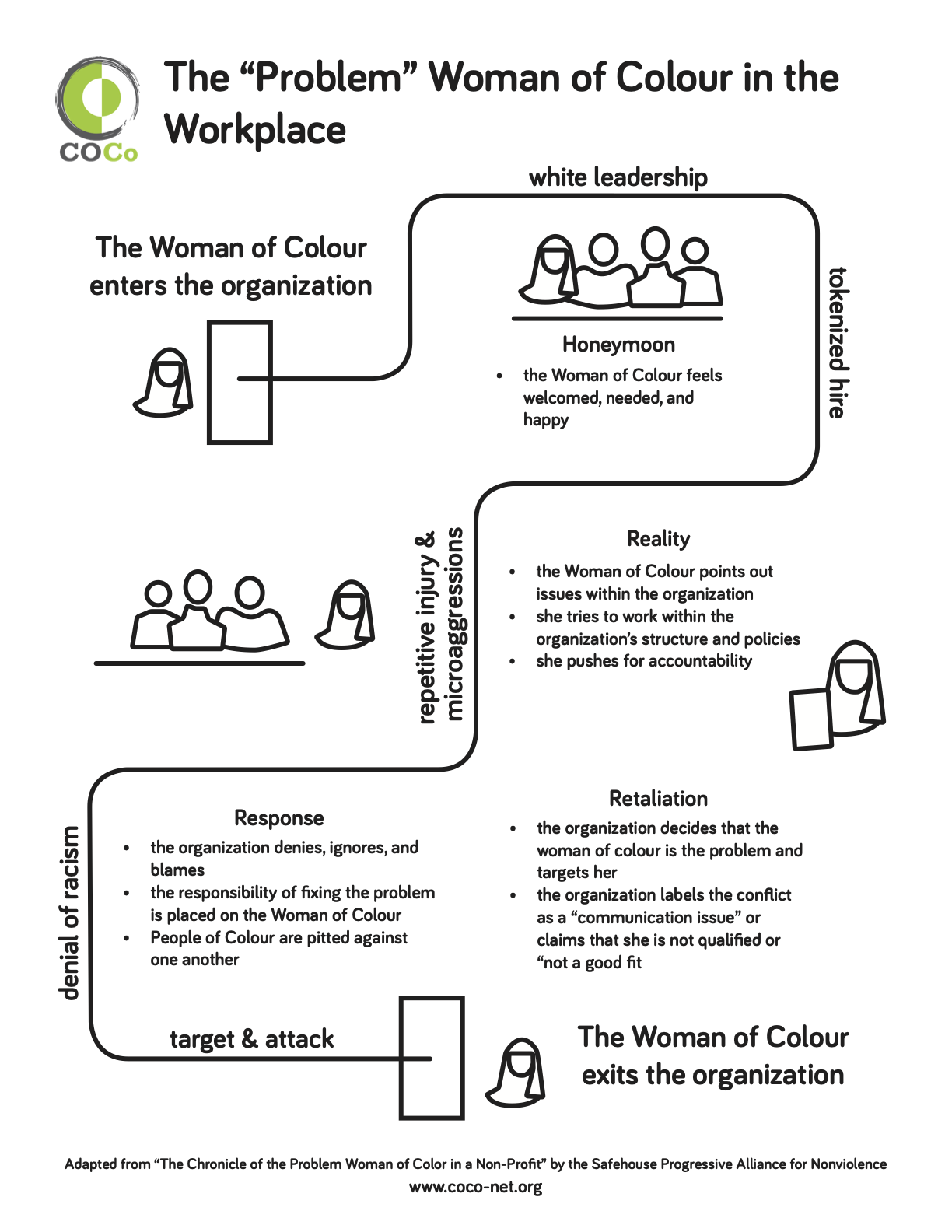
And by the end of the year, I had become the “Problem” Woman of Colour in the Workplace, as illustrated below:

I actually shared this illustration as an attachment in an email of about 1,500 words to another white director, when providing requested feedback in an attempt to avoid the outcome displayed on the chart for my damn self. I wrote so much because I thought it could yield good results, if I outlined why it was anti-Black for a white woman trainer to assign a reading with 24 n-words in the course of doing equity training, especially in a department with no Black folx in leadership. 

That was the first time I gave feedback on how problematic mandatory staff equity training was, as it demands that the most oppressed of us barter our humanity — even while still on probation.

I sent that email to my executive director on December 20, 2018, long before taking a single sick day in that department. 

I got a short email reply in response. It included appreciation for and acknowledgment of my emotional labour, along with an assurance that accountability would follow. Platitudes and zero specifics whatsoever on how accountability would be operationalized safely for BIPOC folx prevailed.

That time I had to file three union grievances in less than as many years of employment

Why do the white folx I work with think it is mandatory for the entire oppressive department to attend this training together?

Why have I been forced to attend at least five mandatory equity training sessions, just this year, including one on racial microaggressions? Why did me and other BIPOC folx have to be subjected to experiential learning in the form of dealing with real-time racial microaggressions created by a white woman who loved to derail the discussion? 

Why do I have an absenteeism letter in my HR file about missing too many days of work when my chiropractic treatment was disrupted for three long months due to the pandemic restrictions?

Why were my vacation days denied just because I wanted to take vacation at the time of scheduled anti-racism training? Why do the white folx I work with think it is mandatory for the entire oppressive department to attend this training together? 

The answer remains that Jordan Peterson’s old stomping grounds continue to value opportunities for learning for privileged willfully ignorant folx at the expense of the most oppressed of us. 

Since those with the most power often lack lived experience of oppression, their policies and procedures are devoid of a perspective that could reduce harm to the most oppressed folx. So, harm is what continues to ensue. One result of these ineffective efforts is that the appearance of progress is maintained, without any actual strides. The most oppressed folx are forced to attend mandatory training sessions that (often wilfully ignorant) privileged folx require, while our humanity is violated.

Ideally, folx with the most decision-making power would come from a variety of backgrounds that include lived experience of marginalization rather than just hiring token folx to check off the necessary boxes for diversity and inclusion. 

If I could go back in time, I would not trust white folx enough to share my feedback with them.

If organizations cannot manage that, then the least they could do is listen when oppressed folx barter our humanity and our livelihood to give them much-needed feedback about how their approaches need to change. If they want to reduce harm to us, their BIPOC staff, as well as the BIPOC students they should be serving appropriately in an equity office, they need to listen. 

Instead, I currently have three outstanding grievances against this institution that denies my vacation time when I attempt to limit the emotional labour demands of hearing colleagues debate my humanity in training I do not need (and in fact, do freelance work for, providing psychoeducational training).

That time I shared this story despite the profound risk it brings

If I could go back in time, I would not trust white folx enough to share my feedback with them. It has jeopardized my employment. I should have just smiled and nodded when this white director had the audacity to share that he thought he could “just add diversity and stir” in his department. 

This is how white supremacy and other forms of privilege continue to be weaponized against more marginalized staff, all the while, co-opting the language of social justice to gaslight us. 

As much as I can try to strategize over earlier actions, the truth is that I have never been safe from xenophobic settler colonialist white supremacist harm, even when I was less aware of the problematic status quo. 

In fact, it is a large part of why I write, as I wish someone who looked like me had warned me of how these highly bureaucratic organizations are more likely to wear down our very existence day by painstaking day, rather than feed me the fairytale that we can make change from the inside. 

Thankfully, I mostly manage not to internalize the institution’s violations of my humanity as a negative reflection of me. I cannot help but worry about how some of those equally oppressed folx with increasingly colonized minds may be at greater risk of succumbing to this though. 

It is why I will continue to speak truth to power, even as it threatens my hard-earned career. To do otherwise, would be complicity with maintaining the problematic status quo, and that will never align with my equity-oriented commitment to the anti-oppressive practice of social work.

Krystal Kavita Jagoo, MSW, RSW

Krystal Kavita Jagoo, MSW, RSW

Krystal Kavita Jagoo (she/her) is a social worker, artist, and educator who prioritizes equity in all of her work. Her visual art was featured in Pandemic: A Feminist Response, and the zine, CRIP COLLAB. She has taught “Justice and the Poor: Issues of Race, Class, and Gender” at Nipissing University, facilitates Sustainable Resistance for BIPOC Folx writing workshops and will teach the youth Writing for Social Change course at the Loft Literary Center. Her work has been published in Huffington Post, Healthline, Prism, Canadaland, etc. She can be found on LinkedIn