How I learned to say, “Not today, imposter syndrome!”

How I learned to say, “Not today, imposter syndrome!”

By Uma Rao, Founder and Capacity Building Coach at Devi Consultants

I want to talk about impostor syndrome, that little hater we all know who has grown too comfortable living in our bodies. It’s the voice that tells the story of our failure, over and over again. 

Really, it’s a wound we have to heal. Because at some point, someone told you or made you feel incompetent — and you believed them. 

Everyone, especially every woman of color I know, has this little hater inside us. I have actually been amazed watching friends of mine, women who have achieved great things in their careers, be so defeated by this little hater. I have watched myself be defeated by this hater many times. 

For example: last year, I was deciding whether or not to reach out to a prospective client. A mutual friend and colleague (who I deeply respect and admire) referred me to this potential client. The project description stated, “[redacted] is seeking someone who is highly skilled, smart, and collaborative with an excellent track record in helping small nonprofits with big programs launch their Series B round of funding. We need a feasibility study and a new case statement. We need strategy!”

When my friend asked me whether I wanted to be connected, I didn’t respond right away. Why? Because my first reaction was to freak out. I’ve been a fundraiser for more than 12 years, and I was saying stuff like, “What is Series B round of funding? What is a feasibility study?”

Say Yes Anyway

“…my first reaction was to freak out. I’ve been a fundraiser for more than 12 years, and I was saying stuff like, ‘What is Series B round of funding?’ … And here’s what some basic googling taught me … I actually have expertise in “securing Series B funding.”

I honestly had competing instinctive responses. One was to respond to my friend and say, “No, but thanks for thinking of me,” because I was too intimidated and didn’t want to make a fool of myself. The other was to say yes anyway … because … well, I honestly don’t know why. But it was an instinct. I decided, in that moment, to say yes anyway. 

Now, with some space from the situation, I can recognize that instinct as my own wisdom. The wisdom that knows that I am generally insecure but also have years of experience to draw from and know what I’m doing. 

And here’s what some basic googling taught me: 

“Series B funding is funding you get after the initial startup funding from investors.” Of course, I have done this before, and I’ll do it again plenty of times with my nonprofit clients. My fundraising experience is mostly with small grassroots groups, moving from initial startup funding to sustainability — this means I actually have expertise in “securing Series B funding.”

A feasibility study “is a planning tool that asks you to research current and potential new prospects to assess if an organization can take on an additional large endeavor, such as a capital campaign.” It’s essentially a strategic plan and workplan all at once that you create before you commit to the work. It’s a decision-making tool. 

That’s amazing! And of course I know how to make a fundraising work plan! And this sounds like an awesome opportunity to explore ideas before committing to them, afforded to those who can afford consultants (me! I’m a consultant!).

I don’t know if I can explain to you how simple and profound this moment was for me. Things that sounded so initially intimidating were actually things I know I can do. All I had to do was spend half an hour on Google to determine this. 

Once I understood the scope of work, I started a Google doc and outlined my conversation with the potential client. I spent the next 15 minutes listing all of my talking points, questions, and research. It took up just one page. After that, I was ready to talk to the potential client. 

This whole process took 45 minutes. That was it! And if I had said no right away, I could have denied myself the opportunity to go after this very interesting job opportunity (what was I thinking?)

Slow Down

My advice is: As soon as you hear that hater voice telling you to say no, ask yourself, “Is this the truth or is this the hater?” 

Trust your inner wisdom to know the difference. 

How did I know? Because I thought both yes and no at once. Often, in this case, the ‘yes’ is the truth. And while I didn’t end up taking that gig or pursuing it after an initial conversation, saying yes to the initial meeting led to an interesting conversation with the prospective client, which enabled me to make informed choices. 

Ultimately what matters is I let my wisdom make the decision for me, not my fears and insecurities.

Choose to Believe You Are That Awesome

Imposter syndrome isn’t going anywhere. It’s so old and settled in my body and it’s comfortable. Now that I’ve accepted it as a permanent guest in my psyche, I know it better.

Now that I’m in my 40s, after being in my career for 20+ years — now, 2 years after starting my own consulting business — I am choosing to believe the compliments, the positive feedback, and the referrals I get as the acknowledgment and understanding of my talents. I deserve the compliments, I deserve the referrals, and I deserve the positive feedback. 

I also accept the little hater inside of me. Imposter syndrome isn’t going anywhere. It’s so old and settled in my body and it’s comfortable. Now that I’ve accepted it as a permanent guest in my psyche, I know it better. I can recognize when it shows up. I think of it as an old bruise or wound — it lingers there, and sometimes it gets extra painful — but for the most part, I don’t need to give it any attention. 

What I’m telling you is not easy to do, and I know that. So here are some ideas I have to help train your inner wisdom to catch the little hater before it overtakes you:

  1. Think of a friend you think is brilliant and send her a compliment.Now, be your own friend and give yourself a compliment. I know it’s hard, but do it anyway. Be critical and be specific — look to a piece of work you have done and give it a solid compliment. Not something like: “It’s great” or “you’re so smart!”More like: “I found the insight you gave on the second page really helpful! It made me think about how so many people experience this.”
  2. Let go of perfection and stick to the 80% rule. You may have heard this before, but I’ll say it again: That need for perfection is a characteristic of white supremacy. It’s about the unrealistic expectation that you need to get it done perfectly the first time you do it.No one does this — no one.

    Consider yourself successful if you do something right 80% of the time. Consider yourself an expert that you know how to get it right 80% of the time — and consider yourself a pro since you know how to address challenges due to the experience of getting it wrong 20% of the time. An 80-20 split is actually the right ratio of success because it inherently means you have enough experience to inform the process comprehensively.

  3. Say yes to things that scare you. Once, I was asked to give a keynote address at a conference. My immediate reaction was, “You’re asking me? Why me?” — the little hater got me!Because I had never given a keynote before and therefore, I must not be qualified to do it, right?

    Thanks to my inner wisdom, though, I said yes and sat down to think. I asked myself, “What do I want to say about this? What advice would I offer to someone on this topic? Where has this gone wrong in my career, and what did I do about it?”

    Suddenly, I had a lot of ideas to share in my keynote address — one that got a standing ovation.

    It turns out, I am that awesome.

So am I an amazingly evolved human being? Don’t answer this question because the answer is obviously no. But I will say this — I feel much more confident that my inner wisdom, living in my body, will show up when the little hater shows up, to help me see clearly what my fears are and what my truths are. 

And when I can’t find my inner wisdom, and I get trapped by that little hater, I try to call a friend, a colleague who I think is brilliant, to help me before I get locked into that trap. I value my colleagues so deeply for this, as they have pulled me out of traps so often. And I know they know that I’m here to do the same for them: To look at their little hater directly and say firmly, “Not today! Let’s talk about all the ways you know exactly what you are doing.” 
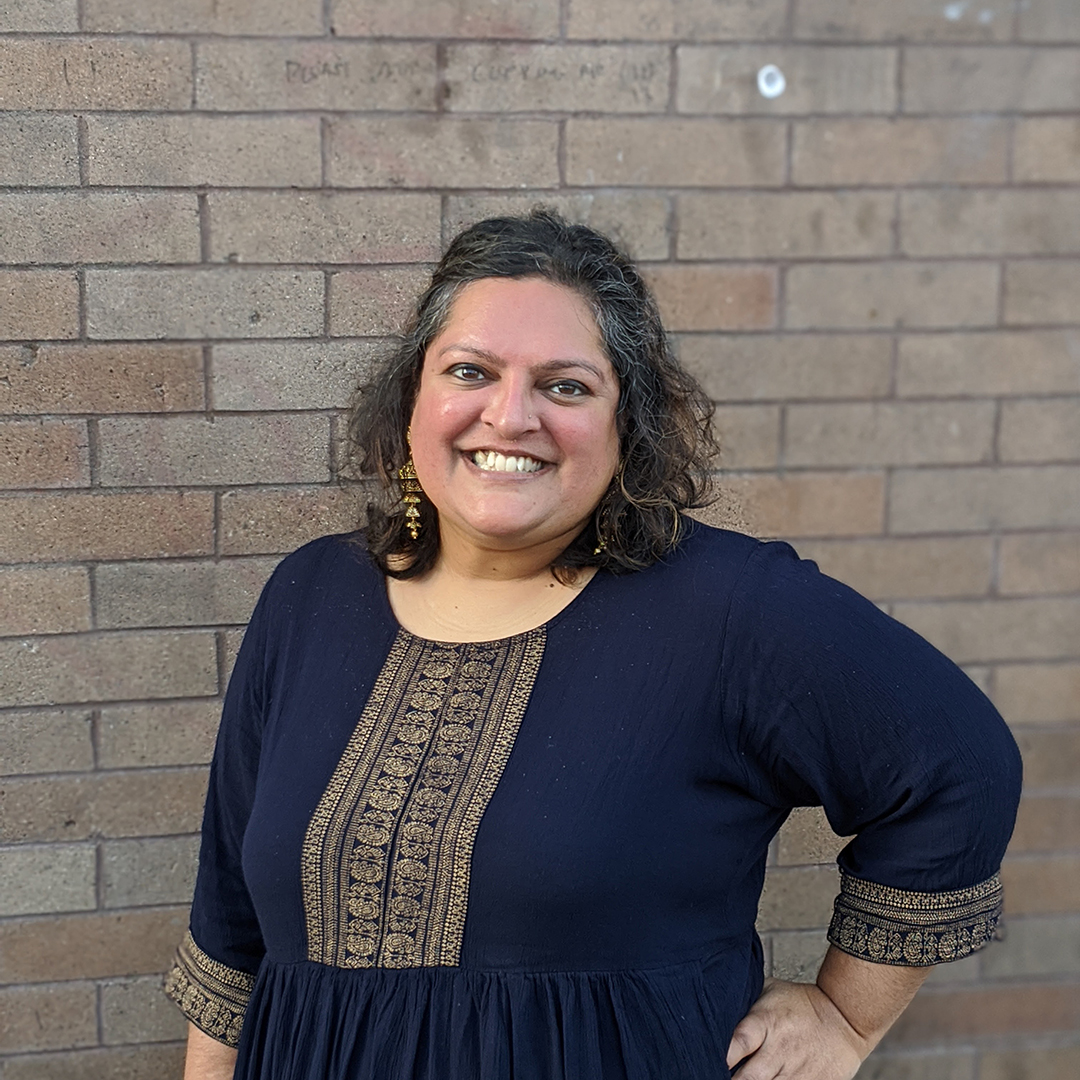
Uma Rao

Uma Rao

Uma Rao (she/her) is the founder and coach at Devi Consults, a boutique capacity building firm that approaches its work with a trauma informed, intersectional feminist lens. Her experience in working in the nonprofit field for almost 20 years at every level–advocate, board member, fundraiser, community organizer, volunteer, consultant, interim executive director–has informed her methodology in how to best assess and support an organization, its leadership and staff. She considers herself a lifelong learner and finds her political home in reproductive justice movements. She currently serves on the board of the National Network of Abortion Funds. When she’s not working she loves obsessing over her dog, searching for the best french fries in Seattle, and dancing to loud music in the mornings.
Bringing donors into the movement

Bringing donors into the movement

By Rachel D’Souza, CCF Global Council Member

Community-Centric Fundraising (CCF) is a movement founded by fundraising professionals — but its success will not be realized if we do not cast a wider net to others impacted by the ineffective and inequitable realities of the nonprofit sector.

In the summer of 2020, I nervously DM’d Vu Le on Twitter after reading his Nonprofit AF blog post on the launch of the Community-Centric Fundraising movement. The principles of Community-Centric Fundraising were already dear to my heart and integrated into my fundraising practice because of his 2017 piece (along with a number of other thought leadership pieces authored by people of color that year). Since 2017, my firm, Gladiator Consulting, has worked to identify the ways in which our sector’s inequitable realities impact our clients. Vu welcomed me to the movement with open arms.

And two years later — TWO YEARS LATER — it is incredible to see how the movement has grown and the possibilities that lie ahead.

On the Season 4 premiere of the Ethical Rainmaker podcast, I shared my reflections with host Michelle Muri and guest Henry A.J. Ramos. We could have spoken for hours. As always, the content shared on the Ethical Rainmaker always leaves me both inspired and with a new level of interrogation for how to live into the values of this movement.

Community-Centric Fundraising (CCF) is a movement founded by fundraising professionals — but its success will not be realized if we do not cast a wider net to others impacted by the ineffective and inequitable realities of the nonprofit sector. As Vu shares in the launch announcement,

I know it is so much easier to keep doing what we have been taught, what we know works to bring in as much funding to our organization as possible. And that is to base everything we do on the comfort of white donors, who hold the most wealth. It is much harder to convince donors, and ourselves, to confront difficult truths about historical atrocities like colonization and slavery, wealth disparities, unearned privileges, the harm caused by capitalism, and the process toward reparation. It is riskier. We may lose funding. We may lose donors. But if our sector is going to fulfill its promise, we must fundraise in a way that does not uphold white moderation and white supremacy.

Oof. Do you feel this call to action in your core? I did and still do, day in and day out. Being a part of the CCF movement has created a new, safe space for me: a brown girl navigating the very very white world of philanthropy and nonprofits. It has also allowed me to interrogate the ways in which I have internalized racism and patriarchy and have upheld a system that does not serve me, nonprofit missions, or the community. I have discovered new friends, funders, and colleagues who share CCF values, and together, we are on a journey to change our sector. Ultimately, it cannot just be nonprofit staff or practitioners alone who advance this change.

I can think of many times in my early fundraising career where I stumbled in donor relationships because I was scared that, if I was honest, that

  1. I would offend or upset the donor and,
  2. I would risk their contribution and put my organization’s work in jeopardy.

That is a lot of pressure for any fundraiser in any organization. But, if we believe a movement that doesn’t cast a wide net is often certain to fail, how do we bring more partners along – and specifically, how do we bring our donors along on this journey? Through Gladiator Consulting and our work with institutional clients, I have found that some donors desperately want to be a part of the conversations; they want to learn, be challenged, and ultimately do better by our community.

You know your supporters better than I do — but here’s a sequence I’ve found useful for welcoming donors to the movement.

Invite

You could have one-on-one conversations, invite a small group of donors to a conversation, or post an open call in your newsletter or social media platforms and allow donors to opt-in. Regardless of how you choose to start, you must open the door. Be honest about what you are looking for (and, what you’re not).

Inform

You’ve gathered your focus group (or whatever you choose to call them). It’s time to be authentic, audacious, and honest. Set a standard for the conversation. This is not a space for harmful words or for tolerating racist or sexist remarks and behavior. You could share prework in the form of reading an article or watching a video. Offer something that will allow participants to come to this conversation with a shared foundation. This could even be a CCF Hub article or Nonprofit AF blog.

Listen

Let them respond – and work to hear what they ARE saying and what they are NOT saying. How do your donors experience the nonprofit sector? What about privilege? What do they know about equity and justice? Where do they have opportunities to reflect and learn? It might be helpful to have a board member or staff peer sit in with you.

Co-Create

What opportunities have revealed themselves? Are your donors willing to be in a different kind of relationship with you and your organization? How does that look and feel? What feels uncertain? How will you discuss conflict as you navigate change? What do you need from each other to feel safe in a relationship with more equitable power dynamics?

Gratitude + Ask

Thank your donors for sharing their time and thoughts. And then, be clear about what you need to continue this change work – do you need more time? Do you need donors to learn in other spaces? Do you want to change the way they give? Communicate the short-term steps and the long-term goals early and often.

Here’s the thing: some donors won’t share our values. Some may move their resources to other organizations or causes. But, I have to ask: if this is the case, were you actually in a transformational relationship with these folx? Were they the right partners to support your mission and vision? Probably not, and we have to do a better job of releasing those donors who do not best serve our work. I believe when we are intentional about bringing everyone along, we will realize the change we seek in our sector.

Rachel D’Souza

Rachel D’Souza

Rachel D’Souza (she/her) is the Founder and Chief Purpose Officer of Gladiator Consulting in St. Louis, Missouri. Her identity as a justice seeker and community connector started in the home of her immigrant parents and was cemented during her experience at the National Conference on Community & Justice’s (NCCJ) Anytown Youth Leadership Institute which Rachel attended when she was just 17.

Upon obtaining a master’s degree in Public Policy Administration from the University of Missouri-St. Louis, Rachel left her position in for-profit retail leadership to join the nonprofit sector. In her early nonprofit roles, Rachel developed both a deep appreciation for and a critique of philanthropy and resource development. In 2015, she founded Gladiator Consulting, a boutique consultancy with a holistic and community-centric approach to nonprofit organizational development + capacity building.

Gladiator Consulting’s philosophy combines Rachel’s experience in resource development and organizational culture with her deep personal commitment to centering community, seeking justice, and creating belonging for those who have been disenfranchised or targeted by institutions, systems and policy rooted in white supremacy and patriarchy. Rachel models collaboration and learning from an abundance mindset, and insists on being transformational in her partnerships with clients, funders, and anyone else that crosses Gladiator’s path. She is currently pursuing a Master’s degree in Legal Studies at the Washington University School of Law.

In 2020, the St. Louis Business Journal honored Rachel with their Diverse Business Leader Award. She currently sits on the Board of the Association of Fundraising Professionals St. Louis, the c4 board of LeadMO, and the Community Advisory Board of Nine Network. As a founding member of the Community-Centric Fundraising Speakers Bureau and an inaugural member of the CCF Global Council, Rachel has found joy in connecting with purpose-driven fundraisers across the country. In 2021, Rachel’s perspective on systems change in resource development was featured in the Blackbaud Institute’s npExperts publication, The Great Reset. Rachel enjoys cooking and spending time with her two children who are 11 + 7 years old. As a postpartum SCAD heart attack survivor, she keeps her heart healthy with daily Peloton workouts and encourages all women to lean into “community-care.”

Tip Rachel — PayPal: rachel.d.siebert@gmail.com; Venmo: @RD-Siebert0620; CashApp: $GladiatorRDS

In a season of rampant anti-Indigeneity, here are some things you should and shouldn’t do to be pro-Indigenous

In a season of rampant anti-Indigeneity, here are some things you should and shouldn’t do to be pro-Indigenous

By Chris Talbot, exhausted mixed-race, separated Indigenous person in the United States working in an environmental nonprofit

Autumn is a hard time to be a mixed-race, separated Indigenous person in the United States working in an environmental nonprofit. 

On days including and between Indigenous People’s Day and Native American Heritage Day, I feel like I run a gauntlet of aggressions, micro and macro, from white-led environmental nonprofits, white people in environmental nonprofits, and sometimes even from my kinfolk who aren’t transparent when trying to get white peoples’ money to continue their good works in their nonprofits.

It’s a tiring set of days that I wish I got hazard pay for enduring each year.

In my 20 years working and volunteering in environmental nonprofits, I’ve experienced the gamut of anti-Indigenous behavior — from an ex-co-worker who would launch into a lecture about the Bering Land Bridge Theory as a response to diminish my Indigeneity whenever it was brought up to an ex-co-worker who would fart in my office, walk by my desk, and call it the Trail of Tears. And while those two things are incredibly and obviously offensive, other actions that are more commonplace in nonprofits are just as awful. And some may be so subtle that non-Indigenous folks may not realize how offensive they are.

Let’s all go through each day of that gauntlet, what Indigenous people are often exposed to during it, and how organizations and the people in them can do (or not do) to mitigate some of that harm.

Indigenous Peoples’ Day

This was not an event made for me, an actual Indigenous person. It was not one where I would feel affirmed or seen authentically as an individual. It repeated over and over again the generalized single story of the poor “Indian” who needed the white man’s help.

Indigenous Peoples’ Day is a day to celebrate the contributions and resilience of Indigenous peoples and to recognize their sovereignty.

Last year, I started attending an event hyped as a free virtual concert celebrating Indigenous Peoples’ Day. It used phrases like “celebrating Indigenous joy” and “elevating Native voices.” Being the cynic that I am, I was a bit distrustful about the advertised line-up, which, for each advertisement I saw, included a list of white musicians and only one or two Indigenous ones. But I signed up and was excited to join.

When I started watching, it became clear that this was actually a videothon to raise funds, which would have been fine, had I known that going into it. But it was advertised as and certainly wasn’t a celebration of Indigeneity or our joy or voices. It was more accurately a celebration of white saviorism with an intended audience of white people with deep pocketbooks.

Several times in the half-hour-or-so I stomached, white people came on the screen to tell me how much they cared about my plight. They exclaimed it with concerned faces that seemed to betray that they imagined me (and all Natives) as one of the featured children in the exploitive Christian Children’s Fund commercials from my childhood. Or closer to home race-wise, the fake sob stories — that rely on some white peoples’ belief that all Indigenous homes are laden with violence, alcohol, drugs, and poverty — that  St. Joseph’s Indian School uses to solicit funds.

After an amazing Afro-Indigenous musician performed, a white man came on to beg white people to give money to support “Indian kids” in getting an education. One after another, they told the single story of poor “Indian kids” that needed their white help.

Téa Leoni declared herself as an ally before unironically saying, “I amplify Indigenous voices whenever I can,” taking up space in this event…to introduce Sarah McLaughlin. I almost expected Sarah to jump into a rendition of “In the Arms of An Angel” with video recordings of dirty, unshoed niijii kids playing in the background. What she actually did, I’ll never know because I clicked out, disgusted.

This was not an event made for me, an actual Indigenous person. It was not one where I would feel affirmed or seen authentically as an individual. It repeated over and over again the generalized single story of the poor “Indian” who needed the white man’s help. It made me feel horrible for the student I saw featured — whose personal story, as told by them with nuance, didn’t reflect the narratives the white folks were spouting with their concerned looks to camera.

I wish I could say this was a white-led event. But it wasn’t. This was my kinfolks’ event. And while I respect the hustle (Do get that owed white money to send Indigenous kids to college!), not being honest about what the event was harmed me when I was looking for community to spend the day with.

I want nonprofits to be transparent about their events. Is it a celebration of Indigenous Peoples’ Day or is it a fundraiser centering white people? I also want everyone to consider how they do their storytelling. (Is it the deficit-based, single story, white savior version, or are you using an asset-framing that empowers and dismantles white people’s generalizations about our community?). Who does your storytelling center; whom might it harm?

Halloween

Now, you might be asking, “Why is Halloween on here? What does that have to do with environmental nonprofits?” That’s an excellent question! One that was not answered before environmental nonprofits I worked for held Halloween-themed benefits.

On two separate occasions, I had the displeasure of attending and working Halloween-themed events held by white-led environmental nonprofits. These were costumed, and as you can expect when majority white folks are involved, too many of the costumes were not costumes but exaggerations of peoples’ cultures.

At one such event, a donor/volunteer dressed as a “geisha” (quotes, because you know why). Another came dressed as a “Cherokee princess” (I shit you not). And it was my responsibility to emotionally regulate and not react as a Japanese-Indigenous-white USian who was on the clock. I know it was my responsibility because a “superior” saw my dagger eyes on the offending parties and came over to tell me so. They were supporters, so I had to suck it up and not ruin their night.

As the evening wore on and I heard more than one white person compliment the “Cherokee princess” on how she made such a beautiful “Indian,” I had to ask myself why I continued to give this organization my time, energy, and expertise.

I want nonprofits to consider setting boundaries for costumes before hosting a Halloween-themed event. We would hope in the 21st century, we wouldn’t have to tell white folks that cultures are not costumes, but here we are.

White folks (everyone, but only white folks seem to have internalized it) were taught since grade school that the U.S. is a melting pot and anything they wanted to adopt, bastardize, and appropriate was fair game. After all, didn’t our teachers encourage us to pretend to be “Indians” in grade school, sitting around, creating fake paper regalia, and mimicking caricatures of Indigenous peoples of the Great Plains with no background or context? Some still do! Hell, one white teacher mocked Indigenous people while teaching a math class last October. As if her students weren’t already dealing with the anti-Indigenous micro- and macro-aggressions as commonplace in Autumn as pumpkin spice.

As nonprofits holding events where we know some white folks will come dressed as someone else’s culture unless explicitly told not to, we have to take responsibility for doing a little teaching. So, set those boundaries or stop hosting Halloween-themed events.

National Day of Mourning (aka “Thanksgiving” to white folks)

The reality is white people get to decide what parts of history they want to participate in and give recognition to… while the rest of us have to continue to live with the ramifications, erasure, and harm of that history daily.

“Thanksgiving” is a triggering time and holiday for me. The concept that people have a national holiday celebrating the attempted genocide (and cultural genocide when that didn’t work) of an entire race of people is mind-boggling. I recognize National Day of Mourning instead.

I got into it with a white woman nonprofit worker in The Before Days who insisted that because of the nature of her organization, she had to have a positively-spun Thanksgiving post. And that to have anything else (or nothing at all) was mission creep.

 P.S. Her organization was a historical nonprofit. Proving once again that “mission creep” actually means including anything white folks don’t like to include.

News flash: no nonprofit, not even one centered around the holiday “Thanksgiving” (if such a nonprofit exists), needs to have a positively-spun Thanksgiving post. You can have a nuanced, true-to-history conversation with your followers without whitewashing it. Better yet, you can amplify the voices of Indigenous people (recognizing that we’re not a monolith).

The reality is white people get to decide what parts of history they want to participate in and give recognition to (as one woman of color put it while trying to mitigate the weaponized fragility I was receiving), while the rest of us have to continue to live with the ramifications, erasure, and harm of that history daily. And too often, white people decide to ignore or whitewash all the parts of history that paint their ancestors (and their accumulated generational wealth and privilege) in a negative light.

Here in Denver, things are even worse with the “Thanksgiving” racket due to the Third Colorado Cavalry’s massacre of Cheyenne and Arapaho people during the Sand Creek Massacre that directly followed “Thanksgiving” in 1864. Until the racial injustice protests in the summer of 2020 when Black Lives Matter activists of all races tore it down, Indigenous Coloradans were greeted at the Capitol by a member of that Cavalry with a plaque that named the Sand Creek Massacre as one of the “battles” of the Civil War. The Executive Order from Governor Evans that directly led to the massacre was still on the books until Governor Polis finally rescinded it in August 2020.

In Colorado, “Thanksgiving” is directly followed by the Sand Creek Massacre Spiritual Healing Run/Walk and pow wow.

And calling it a different thing, “Friendsgiving,” “National Day of Thanks,” “Tenants-giving” (a real thing that I got emailed about by the co-op space one of my workplaces occupies this year), etc., doesn’t erase the colonialism and genocide inherent in the holiday. If anything, it makes it worse, by trying to rebrand before a large-scale acknowledgment has ever happened.

I want nonprofits to question whether they need to make a statement. If you decide you need to comment, will the message you’ve created enable the celebration of genocide? Are you being honest about the holiday or furthering the incorrect narrative for the sake of white comfort? Is your silence on the atrocities and focus on the “positive side” of the holiday hindering meaningful change?

Native American Heritage Day

Native American Heritage Day is a day meant to celebrate Indigenous peoples’ rich cultures, accomplishments, contributions, and heritage. But for most white folks, it’s simply Black Friday or the day after “Thanksgiving.”

Unfortunately, last year, it was a day at least one white-led environmental nonprofit tried to leverage and ask for donations to fund their organization’s work they claimed overlapped with “Indigenous values.”

Even if their work legitimately overlapped with a local Indigenous Tribe’s values, why not just amplify that Tribe’s work?

Asking for donations on Native American Heritage Day ignores the relative power and the statistical fact that those white-led organizations historically and currently receive the majority share of funding due to philanthropic racism. Only 0.4% of charitable funds are awarded to Indigenous-led organizations despite Indigenous people making up 2.9% of the population in the U.S.

I want nonprofits to question when they make their asks, for what, and from who. Are your board and C-Suite at least 50% comprised of the identity meant to be centered for the holiday you’re trying to leverage? If not, don’t do it! Instead of co-opting this holiday, take time to introduce your donors to Indigenous nonprofits also moving the needle forward on the mission you have. Collaborate, generously share resources (including your supporters), and don’t compete. (And if the answer is yes, get that money! Hit up those white folks and get that cash.)

A great example of collaboration from last year is The Wilderness Society and NativesOutdoors project, where they partnered to share photo essays by Indigenous conservationists. The Wilderness Society leveraged its audience to amplify without advertising itself or asking for donations.  

So what can you do as a representative in a nonprofit throughout these next two months? 

  1. You can stop your organization from doing the things I outlined above. Indigenous people are real humans with real generational trauma that can easily be triggered during this time. Make an effort to disrupt the micro- and macro-aggressions you are aware of.
  2. Make an effort to amplify the voices of Indigenous people and what they think during this time. How are they asking for your allyship? Do that. Also, recognize that if sending out a “Thanksgiving” message isn’t mission creep, neither is amplifying Indigenous people on why “Thanksgiving” is harmful.
  3. Instead of asking for support on Indigenous Peoples’ Day or Native American Heritage Day, amplify the asks of Indigenous-led organizations you partner with. If you don’t partner with any, develop a meaningful relationship with an Indigenous-led organization (especially if you’re an environmental nonprofit. We’re not for tokenizing. We’re for partnering and valuing).
  4. Contract with (read: paid contract) Indigenous people for their efforts when you ask for their perspective. This includes asking for a sensitivity reading, a land acknowledgment (or better yet, a Land Back statement), or any other way you ask them to do labor for your organization. Too many times, we’re asked to do this labor for free.
  5. Spend the next two months learning about the people whose land you occupy. Who are they? What do they need right now? Some Tribes and Nations are still fighting for sovereignty; some have Land Back actions; some are asking for settler rent; some may need donations or food drives for the holidays. Find out what the Tribes and Nations in your area need and do it.
  6. Educate your co-workers, especially the decision-makers at your organization, about things they are operationalizing that cause harm.

And remember that these things apply when the two months are over. While October and November are the most brutal months to be a mixed-race, separated Indigenous person in the United States working in an environmental nonprofit (according to me), you can choose not to micro- and macro-aggress against your Indigenous community members all year round.

Chris Talbot

Chris Talbot

Chris Talbot (they/them) is a queer, trans nonbinary, mixed-race artist, activist, and nonprofit employee. When they aren’t working the day job, they spend their free time editing art and literature magazines, writing and illustrating educomics to help folks affirm their nonbinary pals, creating a graphic novel to describe what it’s like to be nonbinary in a gender binary world, cuddling their cat, and quad skating in the park. 

You can find Chris at talbot-heindl.com, on LinkedIn, Instagram, Bluesky, and Twitter — and tip them on Venmo or PayPal or join as a patron on their Patreon

From status quo to radical quo: personal lessons from electoral fundraising

From status quo to radical quo: personal lessons from electoral fundraising

By: Allison Celosia, a movement-building fundraiser and Priscilla Hsu, a money-hater

“Aren’t politicians and community organizers supposed to challenge and transform the status quo?”

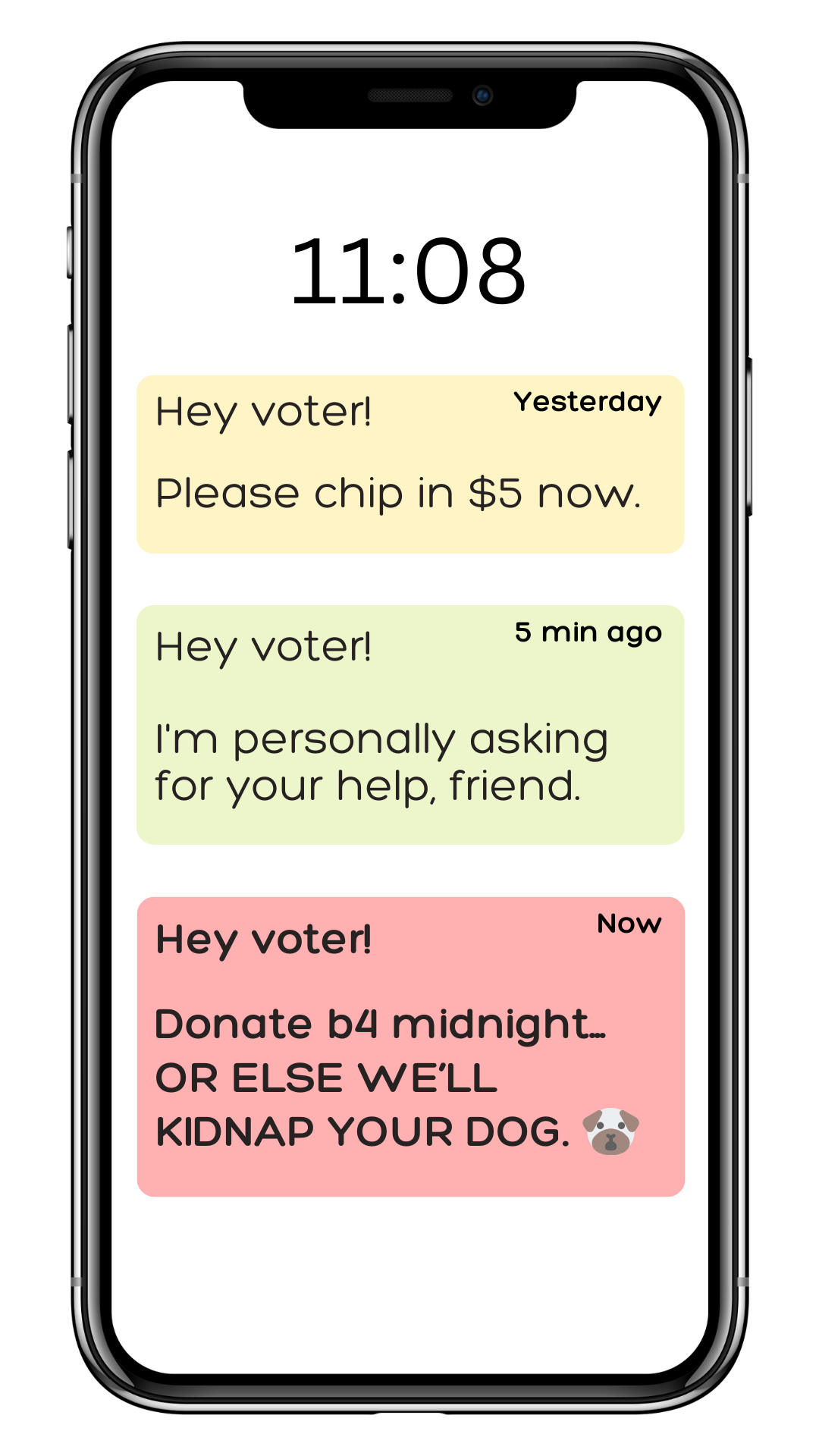
An image of a smart phone lock screen with three text notifications stacked vertically. The top text is colored yellow and reads "Yesterday: Hey voter! Please chip in $5 now." The middle text is colored green and reads, "5 min ago: Hey voter! I'm personally asking for your help, friend." The bottom text is colored red and reads, "Now: Hey voter! Donate b4 midnight... OR ELSE WE'LL KIDNAP YOUR DOG." with a surprised looking pug dog emoji at the end of the message. The time on the clock says 11:08.

It’s 2022 in the U.S., which means campaign season is up and running. If you’re registered to vote, you’re likely getting spammed by donor appeals left and right (nonpartisan pun intended!).

Please, chip in $5 now!
I’m personally asking for your help, friend.
Donate before midnight… OR ELSE WE’LL KIDNAP YOUR DOG.

Okay, that last one wasn’t real, but you get the idea.

That’s why in early 2022, when we found ourselves unemployed and burnt out from the nonprofit industrial complex, we felt particularly annoyed with campaign donor spam. We kept asking ourselves, “Why are fundraisers in electoral and advocacy spaces doing the same old nonprofit-y donor-centric scarcity mindset sense of urgency nonsense? Aren’t politicians and community organizers supposed to challenge and transform the status quo?”

Fast forward a few weeks, we saw an opening to change that fundraising narrative. At least on the local level. Thanks to our own creative ambition (or bullheaded stubbornness, depending on your point of view), we were soon hired to mobilize local donors heading into our city’s June primary election, each of us working on separate but parallel campaigns. These are lessons and reflections from our community-centric fundraising journey on the campaign trail.

Being ourselves is an asset.

“We have been asked to ‘mobilize and take action now’ time and time again, yet the status quo remains. Systems and policies are still stacked against us, and we’re still waiting for change. Why would we, a progressive campaign, double down on harm in places where we actually have control?”

We’re both queer, second generation, middle-class, femme, AAPI fundraisers. We set our scopes of work to ground the campaign strategies in CCF principles, particularly in economic justice, starting with a focus on grassroots fundraising and small-dollar donors. In our communities, that meant a multi-racial, socioeconomically diverse donor base of immigrants, artists, teachers, students, movement organizers, families, neighbors, young people, people who had never made a political donation before, and so many more folks who shared and understood our lived experiences.

There were times when it felt challenging, though. Both of us worked closely with white, upper-class fundraising colleagues on our respective campaigns. Much like our experiences in white-dominant institutions in the nonprofit sector, we had hoped to show up as our full selves while fundraising but shared the same resentment when we had to codeswitch, navigate, and strategize around whiteness. We were intimately familiar with the BI&POC working-class communities that these campaigns were representing, and had hoped that the fundraising teams would reflect that as well.

Allison: I remember a particularly stressful meeting just three weeks before the election. The folks on the leadership team, including myself – because damn straight, I advocated to be on the leadership team – were discussing ideas for fundraising emails at this critical stage of the election cycle. Based on previous email campaigns I had run that embraced the unique strengths and interests of our donor base, I had pitched a two-part series that relied on levity in part one and transparency and political education in part two. My white colleagues pushed for messaging that appealed to the election countdown and sense of urgency from the get-go.

I was triggered! I took the day to calm down and came back to the team, remaining firm on my narrative strategy. I named that I felt my BI&POC femme labor around this email campaign was being misunderstood, and went on to deliver a master class (their words, not mine!) lesson on why sense of urgency just wasn’t going to cut it for our community.

“Promoting our work through a sense of urgency is harmful. I’m tired. Black and brown people are tired. We have been asked to ‘mobilize and take action now’ time and time again, yet the status quo remains. Systems and policies are still stacked against us, and we’re still waiting for change. Why would we, a progressive campaign, double down on harm in places where we actually have control?”

Mic drop. The team received my feedback. My white colleagues let go of a sense of urgency that week, and we modified the levity series for our targeted audience. I had prioritized this community-centered narrative throughout my entire time working on the campaign, focusing on the lived experiences of our donors and advocating for Black and brown dignity. Fast forward to the post-election: our campaign not only won at the polls, but we outraised the opposing campaign in every single filing period of the election cycle since June 2021. I could proudly say that I was an integral part of that success, and I did so by being unapologetically me.

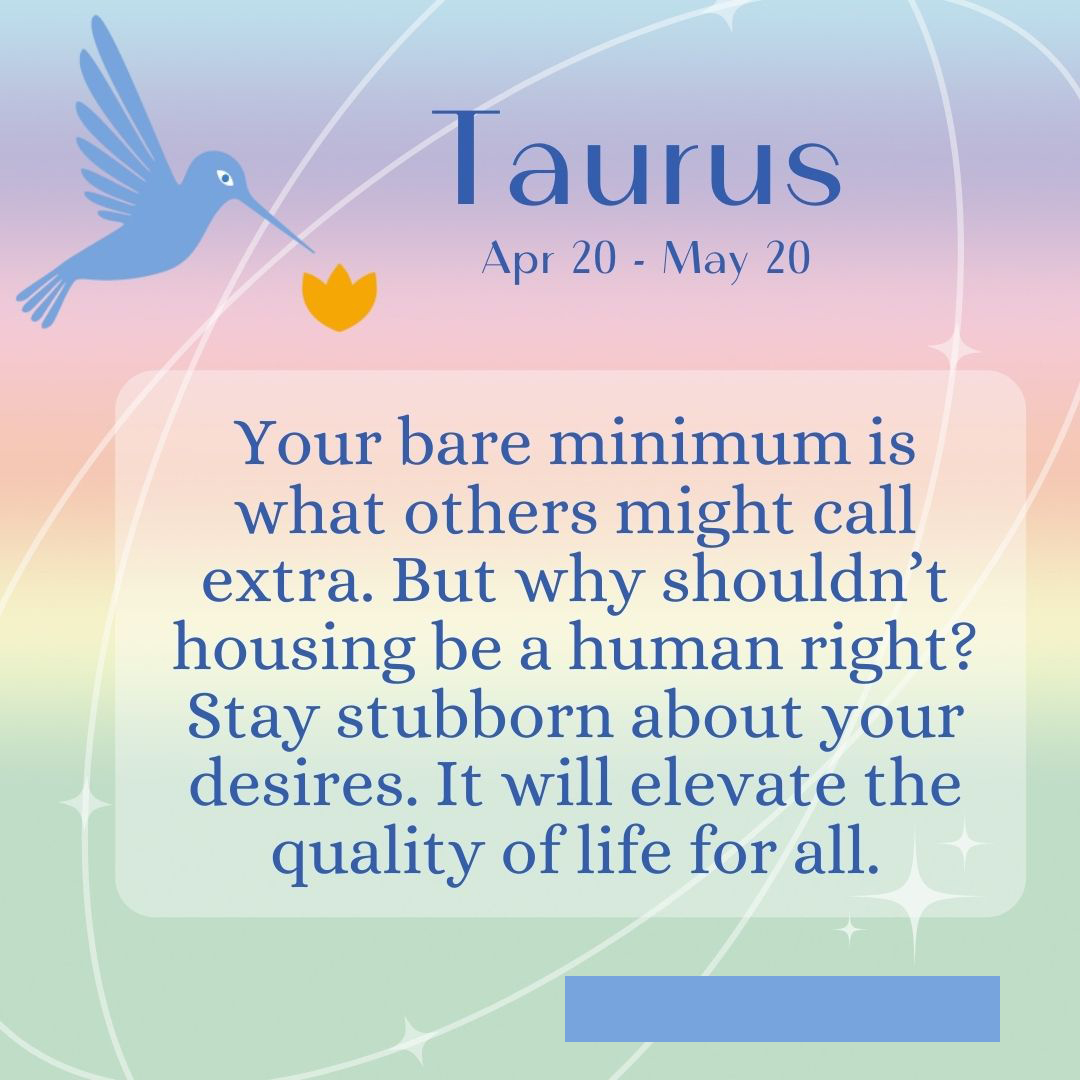
Priscilla: Likewise, as a self-identified goof, I wanted to uplift the fun in fundraising. One of my favorite projects on the campaign stemmed from the age-old question: “have you seen this meme?” I don’t have any social media accounts, but I still love when my friends include me in the meme economy, especially when they go out of their way to send me screenshots because I’ve been login-blocked. Those are friends I could easily turn to for support, whether that’s help moving furniture or help mobilizing resources towards a cause I really believe in. But those connections can be hard to keep up, which is why I wanted to create something worth sharing with friends, whether you talked last week or last year. So I made political horoscopes centered around our campaign values that I would be willing to share with my friends, and it turned out to be one of the most popular filters on the campaign account. Field staff and volunteers loved them, it was affirming to see how others shared my sense of humor, and it was work I was proud to put my name on.

A pastel rainbow gradient in the background with a stylized bird. Text says "Taurus, April 20-May 20. Your bare minimum is what others might call extra. But why shouldn't housing be a human right? Stay stubborn about your desires. It will elevate the quality of life for all."

The values alignment matters.

To them, I was some faceless fundraiser who was only here for one thing: money. And in those situations, they were right. I sent out transactional emails, and I received transactional responses. It didn’t make me feel good.

When we talk about progressive values, money is the last thing included. Critiquing capitalism, challenging donors, turning down money… that kind of analysis has gotten each of us in hot water in nonprofit spaces. Yet, on both progressive campaigns we worked on, we were able to operationalize many of our financial values and priorities: community relationships, self-empowerment, and wealth equity.

Gift policies were blunt, specific, and gratefully established before we joined the campaign teams. We had explicit financial boundaries: “No corporate money! No real estate developers! No big oil!” which ultimately helped open up countless creative ways to organize donors towards more values-aligned contributions.

Trial and error was definitely a part of the process. Both of us were constantly learning and unlearning what worked to connect with and retain diverse donors in our broader campaign networks.

Priscilla: One of my stumblings reminded me of the importance of values alignment to me in this work. I was asked to do some traditional email segmentation and email a list of people I was told had brushed shoulders with my candidate at some forum some vague time ago. I have no idea how you define ‘brushed shoulders with’ because most of my emails got blocked, presumably because they thought I was spam. The sting of impersonal rejection personally stung in only ways a fundraiser knows. It was like the time I sent out a generic International Women’s Day email for another job, and someone responded with disdain and a very personal ‘you should know better’ because of something they must have found on my LinkedIn. I never responded, but I was annoyed for days. How could they assume! They don’t know anything about me!

And that was the problem. These people who blocked me, who made assumptions about me; they didn’t know me. To them, I was some faceless fundraiser who was only here for one thing: money. And in those situations, they were right. I sent out transactional emails, and I received transactional responses. It didn’t make me feel good. And I’ve done the same thing in reverse. I’ve blocked and unsubscribed from numerous “personalized” political texts and emails. Sometimes I read them for fun, the way only people in fundraising communications read other fundraising comms for fun, but most of the time, I just don’t want to deal with another urgent plea to give… OR ELSE THEY’LL KIDNAP MY DOG.

Allison: In my role, upon learning the “no corporate, no developer, no oil money!” rule, I felt free to be creative about how to mobilize donors and resources. I designed a fundraising policy and strategy that not only prioritized grassroots donors but invested in their own financial empowerment as part of their contribution.

Speaking from my own experience and upbringing, I didn’t know how to manage money for years. I’m the daughter of immigrants from the Philippines, so my financial education was limited to “open a savings account” and “go to college and get a good job.”

That’s why when I solicited donors to make a gift, I gave them tools – the most popular of which was the 1% equity model. I asked donors to think about their own privilege and capacity to give and recommended the following sliding scale: If your monthly income is $1,000, donate a recurring gift of $10/month; $2,000, donate $20; $3,000, donate $30; and so on.

This model eliminated the barrier for folks who would otherwise feel shame about not being able to afford to donate. It also was a supportive reality check for those who could actually afford to donate more. And it worked! In one month, we more than tripled our recurring donor pool from 30 folks to just over 100 monthly donors, and their commitments ranged from $5/month to $114/month.

The cherry on top for me was the increased self-awareness and confidence our donors had regarding their contributions. I could not believe how many people came up to me on election night and told me, “Thank you for asking me for money.” At best, a fundraiser might hear “Thank you for raising money!”, but to be specifically thanked for soliciting them, for believing in their unique donation, I was honestly moved to tears. That’s the result of a transformative gift policy.

Everyone’s relationship with money needs to change.

Working on these campaigns pushed us to learn about our own money values and where they came from. Ultimately, we all have unlearning to do. Some of our biggest pushback came from within because the “now, more than ever” ways are just so easy to reach for.

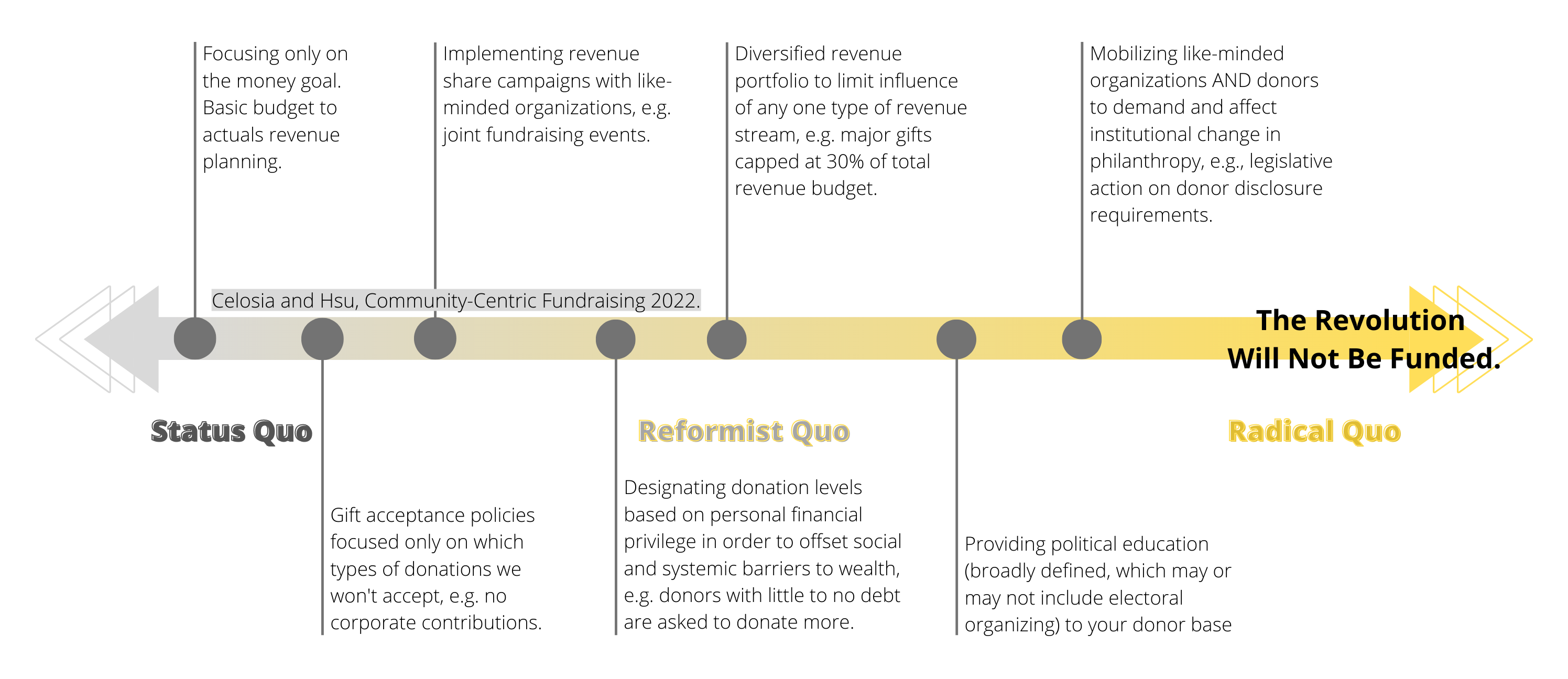
We understand that we’re reaching for a moving target in our efforts to operationalize community-centric fundraising, so we built a fundraising policy spectrum to help show what could move us from status quo towards radical quo.

Image is a landscape orientation spectrum graph with three labels to demonstrate the range. The spectrum graph is designed as a line with arrows on both ends. The left side is grey and changes gradually to bright yellow. Regarding the labels, on the left is “Status Quo, in the middle is “Reformist Quo,” and on the right is “Radical Quo” with the quote “The Revolution Will Not Be Funded.” Moving left to right from “Status Quo” to “Reformist Quo,” there are seven points on the spectrum that read: 1. “Focusing only on the money goal. Basic budget to actuals revenue planning,” 2. “Gift acceptance policies focused only on which types of donations we won’t accept, e.g. no corporate contributions,” 3. “Implementing revenue share campaigns with like-minded organizations, e.g. joint fundraising events.” Moving towards “Reformist Quo” the points read: 4. “Designating donation levels based on personal financial privilege in order to offset social and systemic barriers to wealth, e.g. donors with little to no debt are asked to donate more,” 5. “Diversified revenue portfolio to limit influence of any one type of revenue stream, e.g. major gifts capped at 30% of total revenue.” The points leading towards “Radical Quo” read: 6. “Providing political education (broadly defined, which may or may not include electoral organizing) to your donor base,” 7. “Mobilizing like-minded organizations AND donors to demand and affect institutional change in philanthropy, e.g., legislative action on donor disclosure requirements.”

Experimenting with CCF values in a political space taught us that CCF values can be broadly applied to move people away from donor-centrism, moving the nexus of decision-making (ideally) closer to the values of the movement. As we moved from status quo towards radical quo as fundraisers, we found that our solutions were just reformist in nature and still limited by the larger philanthropic industrial complex. In our wildest dreams, where communities are interdependent, safe, and supported, will there even be a need to fundraise?

Personally, we can’t wait for the revolution. Let’s make the reformist quo the new status quo and stop settling for less.

Allison Celosia

Allison Celosia

Allison Celosia (she/they/siya) is abundant. Based on unceded Tongva land, they are a fundraiser and a steward for economic justice. She is a second generation Bisaya American and the proud daughter of immigrants. Allison’s professional path is deeply rooted in the nonprofit sector. Outside of fundraising, Allison is active with local labor organizing. She encourages softness as a strength. They also mill their own flour and do a lot of home baking projects. Connect with Allison on LinkedIn and Twitter. Readers are welcome to drop some community love at Allison’s PayPal for her labor on this piece.

Priscilla Hsu

Priscilla Hsu

Priscilla Hsu (she/they) believes in radical care, Beloved Community, and us. Priscilla is on the board of the Birthworkers of Color Collective and the Arroyo S.E.C.O. Network of Time Banks, a model where time is the dominant currency, instead of federal dollars. She’s also finally trying to get paid for their care work and would love client referrals in the occupied Tongva land of Northeast Los Angeles. You can find out more at https://priscil.la/ and send money tips for their work on this piece via venmo @priskizzle or PayPal (yes, that is my rabbit).

The Ethical Rainmaker: Is ‘Impact Investing’ Just About Stroking Egos? w/ Bob Osborne

The Ethical Rainmaker: Is ‘Impact Investing’ Just About Stroking Egos? w/ Bob Osborne

By Michelle Shireen Muri, Freedom Conspiracy Principal and CCF co-chair

Episode Summary

Big money is thrown around when it comes to impact investing, but are these ‘incubators for social impact projects’ and ‘five-star conferences’ actually doing anything other than stroking egos? In this ep, Michelle and The Osborne Group’s Bob Osborne discuss their experiences and analysis!

About the Ethical Rainmaker podcast

In the United States alone, philanthropy is a $427 million dollar industry, of which 68% comes from individual donors. Yet the practices, theories, and foundation of modern philanthropy and fundraising often ignore the ways in which the industry perpetuates harm.

The Ethical Rainmaker, hosted by Michelle Shireen Muri, is a podcast that hosts authentic conversations grappling with the questions that we don’t often ask in the nonprofit world. Join us as we explore some of the practices that undermine our missions and navigate the way forward with today’s resisters, reimaginers, and the re-creators of the third sector. It’s time to think differently.

Michelle Shireen Muri

Michelle Shireen Muri

Michelle Shireen Muri (she/her) is the co-chair of the founding Seattle chapter for Community-Centric Fundraising and the host of the podcast, The Ethical Rainmaker. She is the founder of Freedom Conspiracy, a small collective of fundraising consultants focused on bringing values-aligned practices to clients in the nonprofit and philanthropy spaces. She can be reached at @freedomconspiracy on Instagram. You can send her a tip via Patreon.