Beyond Philanthropy: Disrupting Fundraising

Beyond Philanthropy: Disrupting Fundraising

About the podcast episode

In this episode, Monique and Valerie discuss the various aspects of Fundraising, how to move the practice forward, how to be more community-centric in your efforts, and how to educate donors throughout the process.

View the accessible text-only version.

About Beyond Philanthropy

Beyond Philanthropy is a podcast about how we can move beyond traditional philanthropy from co-hosts Monique Curry-Mims & Valerie Johnson. This season, each monthly episode examines systemic change and how to be disruptive in your philanthropy practice, with a mix of episodes featuring our co-hosts and episodes featuring guests from across the country.

Monique Curry-Mims

Monique Curry-Mims

Monique Curry-Mims has over 15 years of business and leadership experience in both the nonprofit and for-profit sectors. As Principal of Civic Capital Consulting, an international social impact consulting firm, Monique delivers innovative strategies that help organizations meet their mission and goals, education services that empower solutions and equity, and funding to help communities working on the ground be part of the change they need. To further change impact, Monique serves as a steering committee member of Philadelphia Black Giving Circle, Trustee and the Allocations Chair of Union Benevolent Association, and a Committee Member of AFP Global’s Government Relations Committee. Additionally, Monique serves as Founder and Convener of PHLanthropy Week and co-host of Beyond Philanthropy alongside Valerie Johnson.

Valerie Johnson

Valerie Johnson

Valerie Johnson joined Pathways to Housing PA as Director of Institutional Advancement in 2018, and was promoted to VP of Advancement and Special Projects in 2021. She co-hosts a podcast, Beyond Philanthropy, alongside Monique Curry-Mims. She was also the Director of Advancement for Council for Relationships and worked as a fundraiser for Valley Youth House and the American Association for Cancer Research. Valerie, a Certified Fundraising Executive, holds a Bachelor’s degree in Marketing and an MBA from Drexel University. A member of the Association of Fundraising Professionals since 2012, she serves on the Greater Philadelphia Chapter’s Board of Directors as Vice President of Education and Professional Development. Valerie has been a featured speaker for the Pennsylvania Association of Nonprofit Organizations, NTEN, AFP GPC, and AFP Brandywine, and contributes to Generocity. You can find her on Twitter and Instagram, where you’ll see plenty of running and baking content alongside her cats, Agador and Spartacus. 

To tip Valerie and Monique for their work on their podcast, Venmo them at: @valer1ej

highrises

highrises

By Jasmin Velez, diasporican community organizer and environmentalist

city tower tall with power 
you tease us, squeeze us…abuse us 
yet we worship you; cityscapes of euphoria 

contemporary history? maybe 
we’re engraved in the memory 
before the olden high rises weren’t visible
we cling to you, the old you 

before gentrification knocked us all out
made us dust and rubble, useless 
not even a mixture for its concrete 

when did you decide we weren’t enough? is it
because we have all become hardened, tough? did
you think that meant we stopped loving you? 

on the contrary, you were one of the few
last clings of hope to make our marks 
now we’ve become those busted old tracks
a route of what once was — 
we are forgotten history in the making.

Artist Statement

This piece was written when I was riding one of the most important lines of public transportation in Philadelphia, “The El.” I began to really notice for the first time how the façade of buildings were beginning to resemble less of the Philly charm and tradition of bricks, and more of what I call ‘ikea-builds.’  With these changes, I saw less of the street art and murals I was used to seeing during my commute. I was for the first time consciously observing how the city and many parts that I frequented were beginning to physically change and reflecting on what that meant to me. I do not want it to read as a sense of hopelessness, because I see it as an awakening of sorts; it gave me the chance to really reflect on what was happening in my community and learn to better advocate against inequitable development.

Jasmin Velez

Jasmin Velez

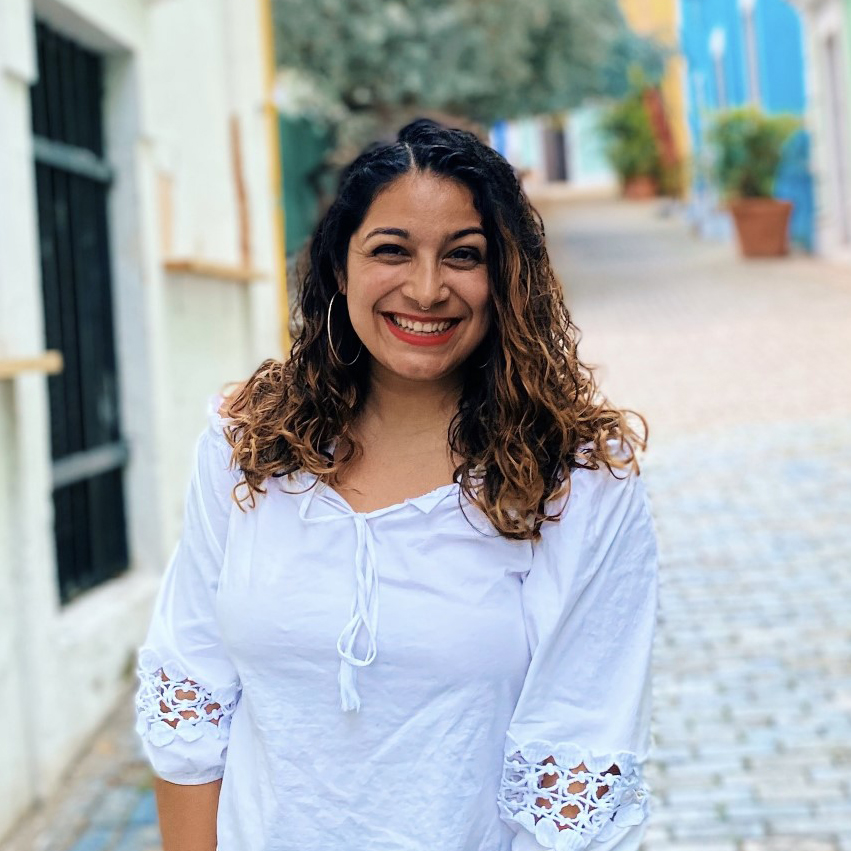
Jasmin Velez (she/her) is an applied practicing anthropologist and an almost life-long resident of the Kensington neighborhood. Jasmin grew up in Aguada, Puerto Rico, and moved to Philadelphia when she was five years old. She attended Bloomsburg University of PA, where she received her Bachelor of Arts in Cultural Anthropology, and later graduated from the University of Colorado Denver with her master’s in Medical Anthropology. Missing the diversity of her community and the east-coast city vibes, she returned to Philadelphia following her studies and returned to her neighborhood. She has been working for the nonprofit industry for close to ten years, with many of her projects focusing on community education and environmental stewardship, and justice. Jasmin enjoys writing short stories and poetry and traveling to the motherland during her free time. You can follow her adventures on Instagram at @writinghello and if you enjoy her pieces, you can fuel her coffee obsession at https://ko-fi.com/writinghello

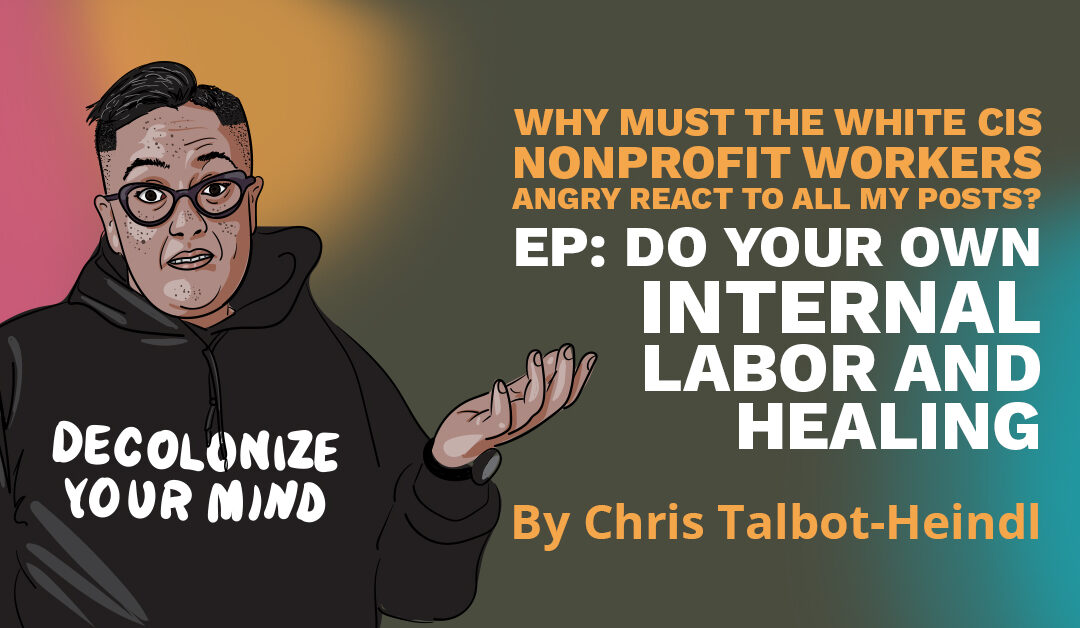
Why must the white cis nonprofit workers angry react to all my posts? Ep: Do your own internal labor and healing

Why must the white cis nonprofit workers angry react to all my posts? Ep: Do your own internal labor and healing

By Chris Talbot, communications professional and educomics creator

Go back to the infographic via this link

Introduction

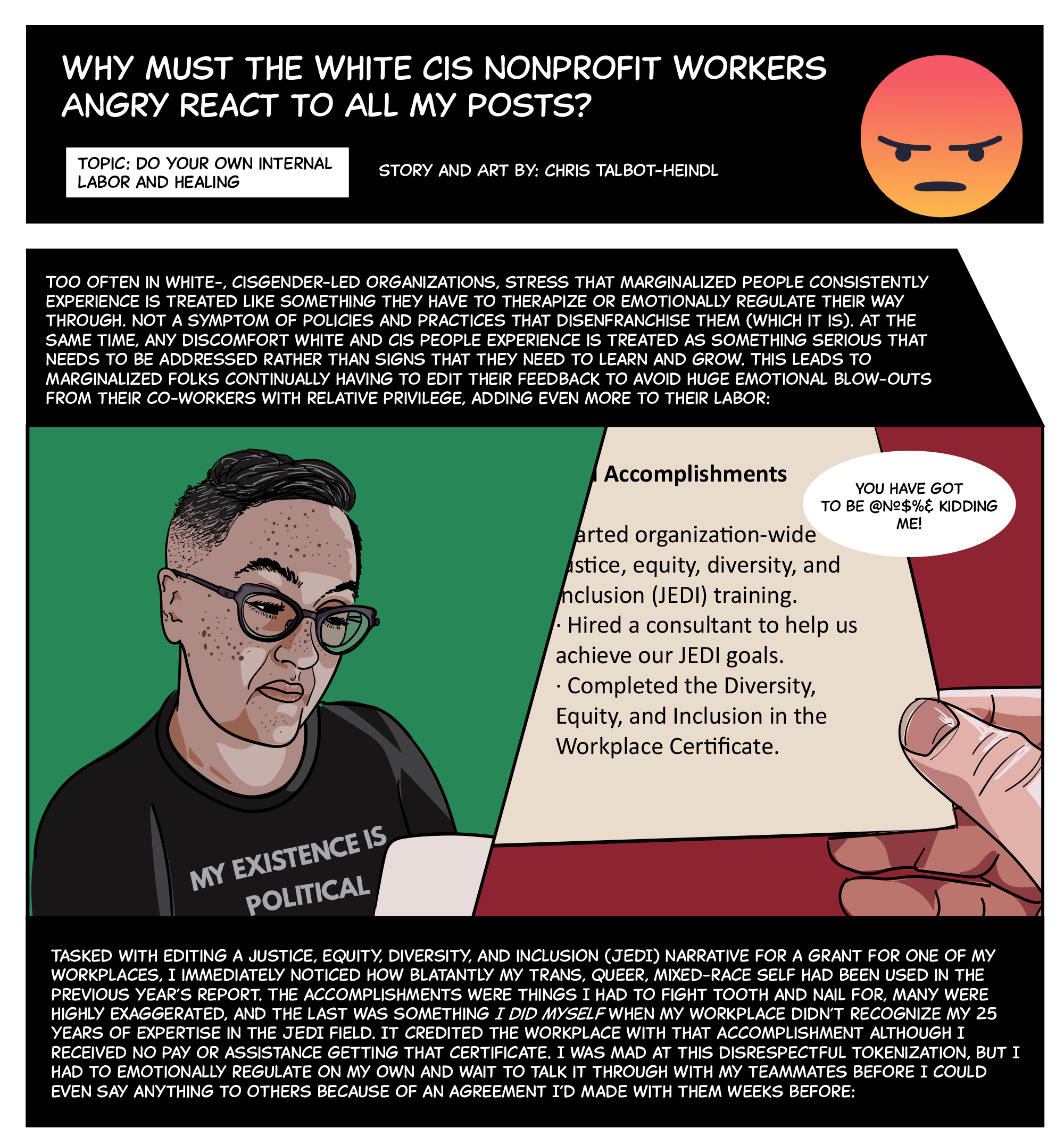
Too often in white-, cisgender-led organizations, stress that marginalized people consistently experience is treated like something they have to therapize or emotionally regulate their way through. Not a symptom of policies and practices that disenfranchise them (which it is). At the same time, any discomfort white and cis people experience is treated as something serious that needs to be addressed rather than signs that they need to learn and grow. This leads to marginalized folks continually having to edit their feedback to avoid huge emotional blow-outs from their co-workers with relative privilege, adding even more to their labor:

First Section

There’s an illustration of me reading a piece of paper. A close-up of the last part of the document is partly cut off, but it is clear it says “JEDI Accomplishments: – Started organization-wide justice, equity, diversity, and inclusion (JEDI) training. – Hired a consultant to help us achieve our JEDI goals. – Completed the Diversity, Equity, and Inclusion in the Workplace Certificate.” Text in a word bubble says “You have got
to be @#$%& kidding me!”

Text below says: Tasked with editing a justice, equity, diversity, and inclusion (JEDI) narrative for a grant for one of my workplaces, I immediately noticed how blatantly my trans, queer, mixed-race self had been used in the previous year’s report. The accomplishments were things I had to fight tooth and nail for, many were highly exaggerated, and the last was something I did myself when my workplace didn’t recognize my 25 years of expertise in the JEDI field. It credited the workplace with that accomplishment although I received no pay or assistance getting that certificate. I was mad at this disrespectful tokenization, but I had to emotionally regulate on my own and wait to talk it through with my teammates before I could even say anything to others because of an agreement I’d made with them weeks before:”

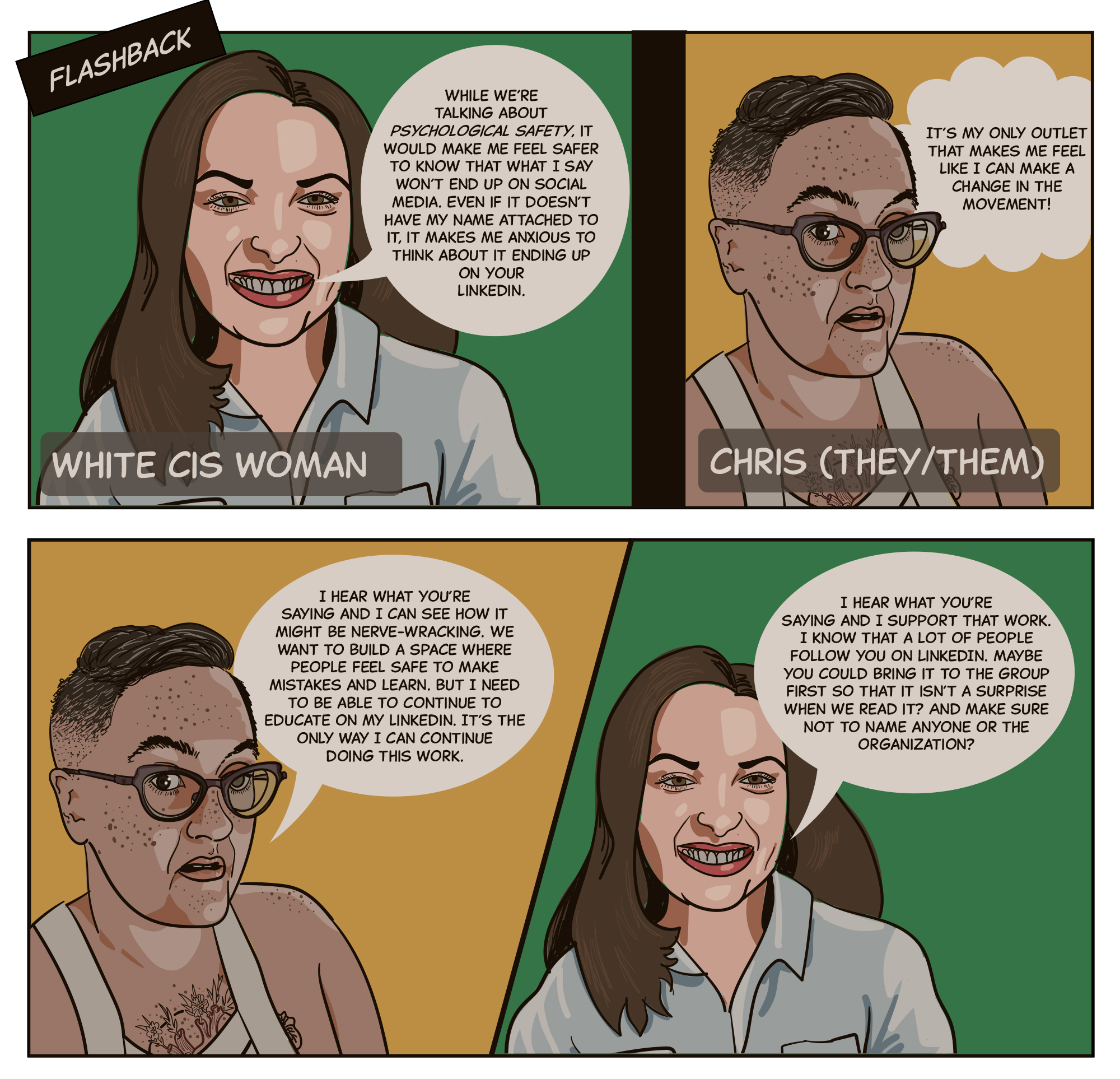
The next few cells are flashbacks to a Zoom call and have a sepia overlay making them seem “old timey.” They are labeled “Flashback.”

In the first cell, a white cis woman says “While we’re talking about psychological safety, it would make me feel safer to know that what I say won’t end up on social media. Even if it doesn’t have my name attached to it, it makes me anxious to think about ending up on your LinkedIn.”

In the next cell, I have a thought bubble which says “It’s my only outlet that makes me feel like I can make a change in the movement!”

In the following cell, I am saying “I hear what you’re saying and I can see how it might be nerve-wracking. We want to build a space where people feel safe to make mistakes and learn. But I need to be able to continue to educate on my LinkedIn. It’s the only way I can continue doing this work.”

In the next cell, the white cis woman says “I hear what you’re saying and I support that work. I know that a lot of people follow you on LinkedIn. Maybe you could bring it to the group first so that it isn’t a surprise when we read it? And make sure not to name anyone or the organization?

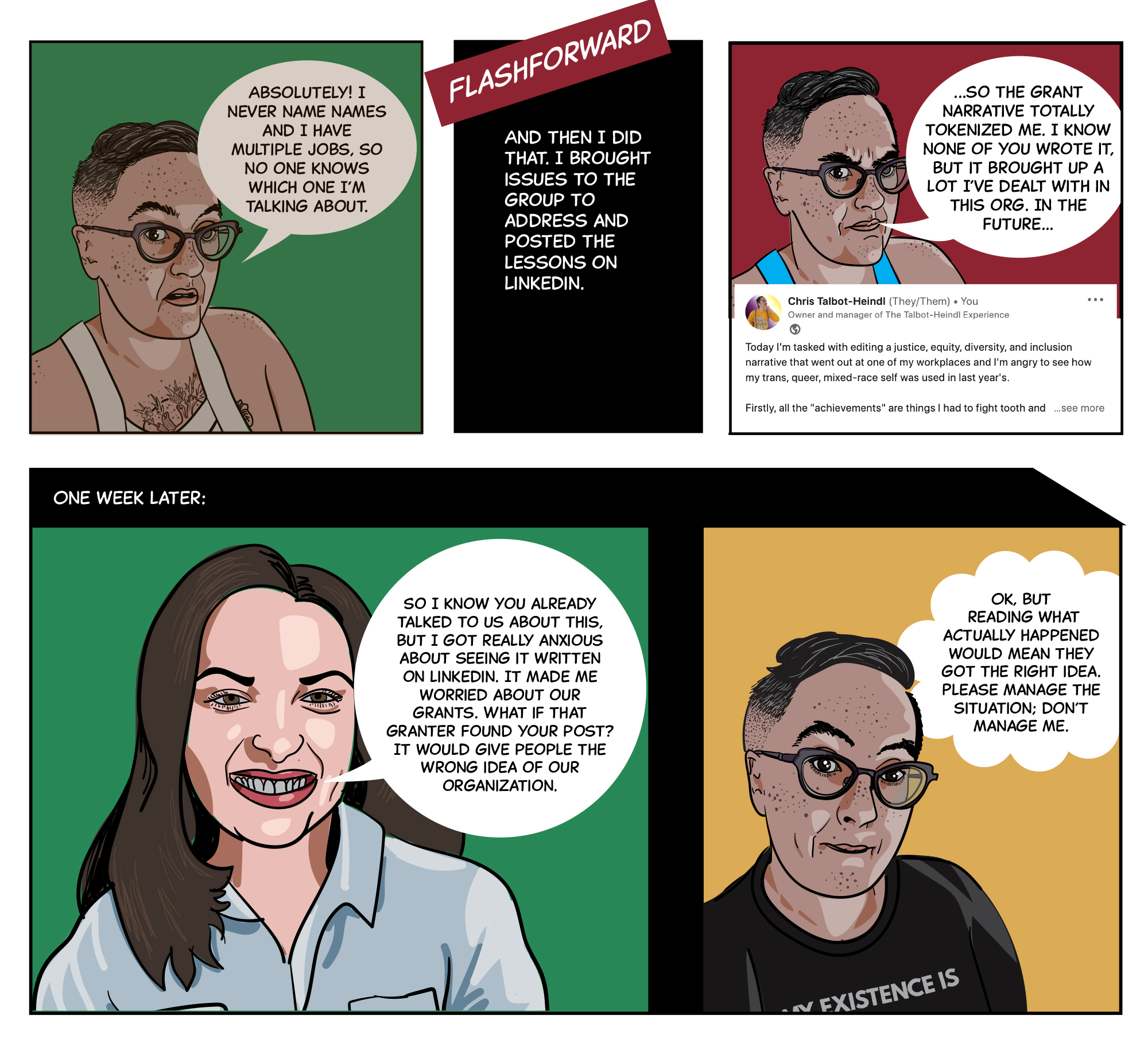
In the following cell, I reply “Absolutely! I never name names and I have multiple jobs, so no one knows which one I’m talking about.”

The next cell says “Flashforward. And then I did that. I brought issues to the group to address and posted the lessons on LinkedIn.”

In the following cell, I’m saying “…so the grant narrative totally tokenized me. I know none of you wrote it, but it brought up a lot I’ve dealt with in this org. In the future…” Below me is a screenshot from my LinkedIn post, which says “Today I’m tasked with editing a justice, equity, diversity, and inclusion narrative that went out at one of my workplaces and I’m angry to see how my trans, queer, mixed-race self was used in last year’s. Firstly, all the ‘achievements’ are things I had to fight tooth and… see more.”

The next set of cells are labeled “One week later:”

The white cis woman is saying “So I know you already talked to us about this, but I got really anxious about seeing it written on LinkedIn. It made me worried about our grants. What if that granted found your post? It could give people the wrong idea of our organization.”

In the next cell, I have a thought bubble that says “Ok, but reading what actually happened would mean they got the right idea. Please manage the situation; don’t manage me.”

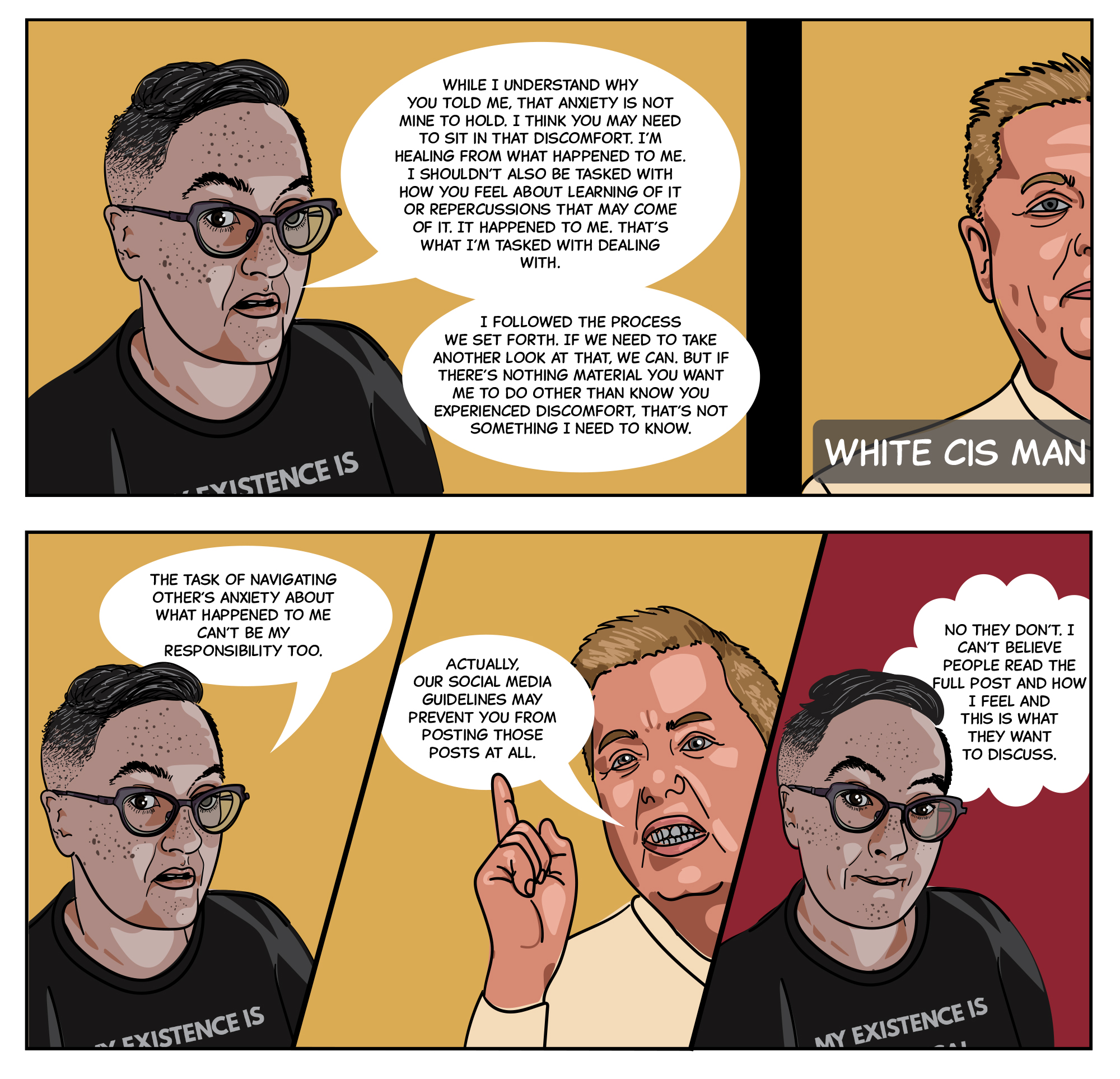
In the next cell, I say “While I understand why you told me, that anxiety is not mine to hold. I think you. may. need to sit in that discomfort. I’m healing from what happened to me. I shouldn’t also be talked with how you feel about learning of it or repercussions that may come of it. It happened to me. That’s what I’m tasked with dealing with. I followed the process we set forth. If we need to take another look at that, we can. But if there’s nothing material you want me to do other than know you experienced discomfort, that’s not something I need to know.”

In the next cell, a white cis man perks up.

I continue with “The task of navigating other’s anxiety about what happened to me can’t be my responsibility too.”

In the next cell, the white cis man says “Actually, our social media guidelines may prevent you from posting those posts at all.”

In the next cell, I have a word bubble that says “No they don’t. I can’t believe people read the full post and how I feel and this is what they want to discuss.”

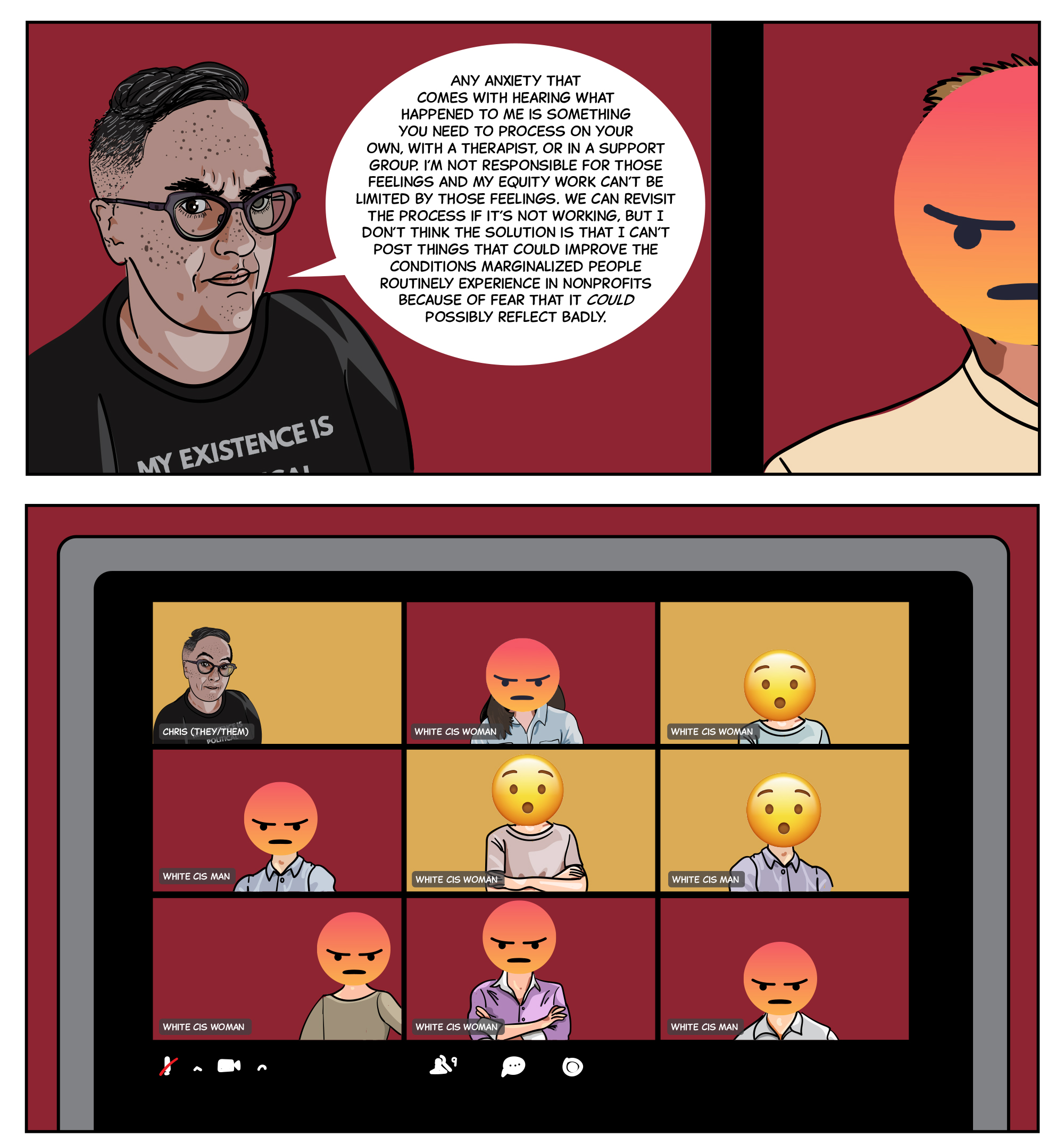
In the following cell, I’m angry and saying “Any anxiety that comes with hearing what happened to me is something you need to process on your own, with a therapist, or in a support group. I’m not responsible for those feelings and my equity work can’t be limited by those feelings. We can revisit the process if it’s not working, but I don’t think the solution is that I can’t post things that could improve the conditions marginalized people routinely experience in nonprofits because of fear that it could possibly reflect badly.”

In the next cell, the white cis man’s face is replaced by the Facebook angry react emoji.

In the next cell, there’s a Zoom screen and all the white and cis people have their faces replaced by the Facebook angry react or shocked emojis.

Second Section

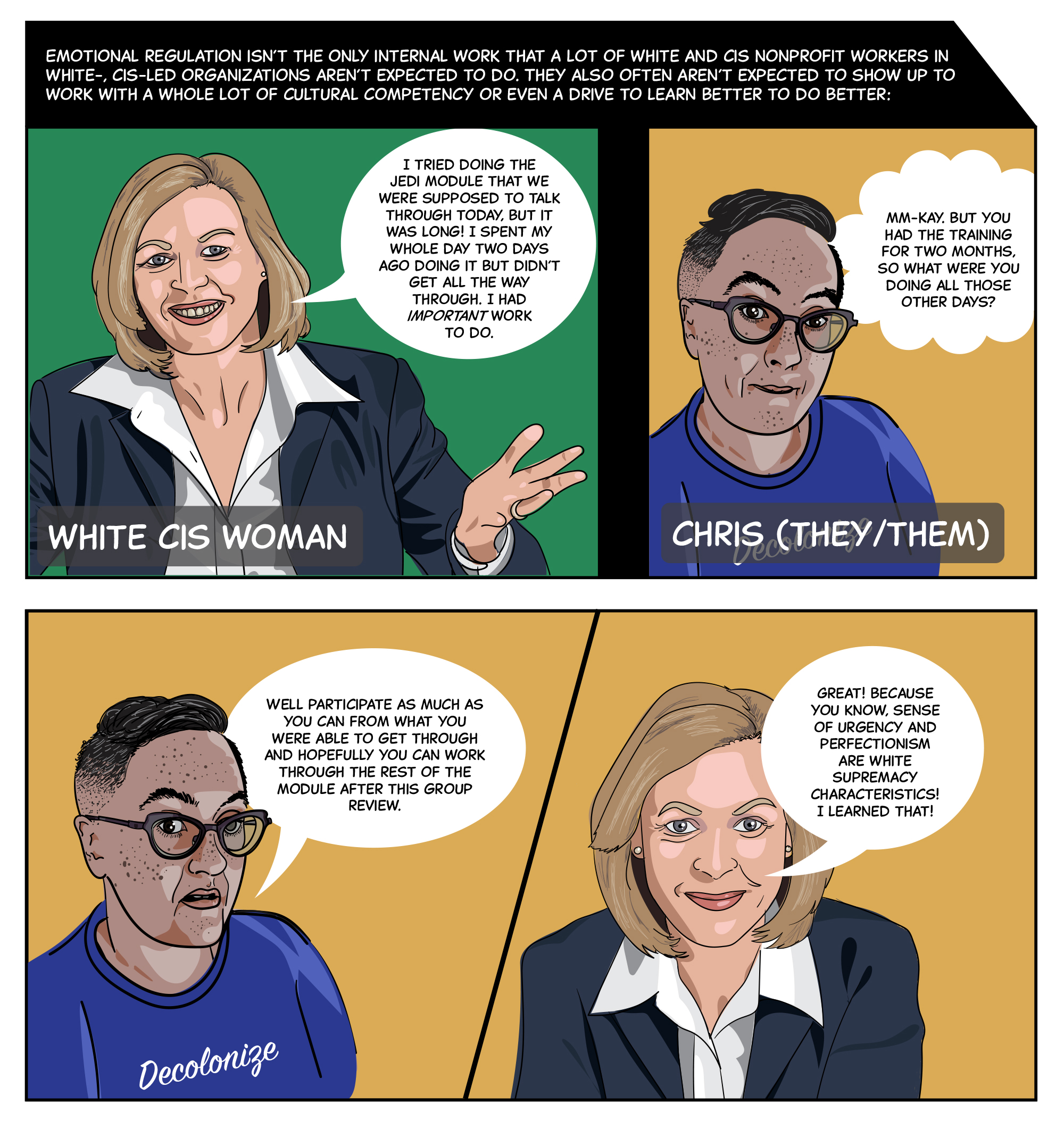
Text says “Emotional regulation isn’t the only internal work that a lot of white and cis nonprofit workers in white-, cis-led organizations aren’t expected to do. They also often aren’t expected to show up to work with a whole lot of cultural competency or even a drive to learn better to do better:”

A white cis woman is saying “I tried doing the JEDI module that we were supposed to talk through today, but it was long! I spent my whole day two days ago doing it but didn’t get all the way through. I had important work to do.”

In the next cell, a thought bubble behind me says “Mm-kay. But you had the training for two months, so what were you doing all those other days?”

In the following cell, I say “Well participate as much as you can from what you were able to get through and hopefully you can work through the rest of the module after this group review.”

In the following cell, she replies “Great! Because you know, sense of urgency and perfectionism are white supremacy characteristics! I learned that!”

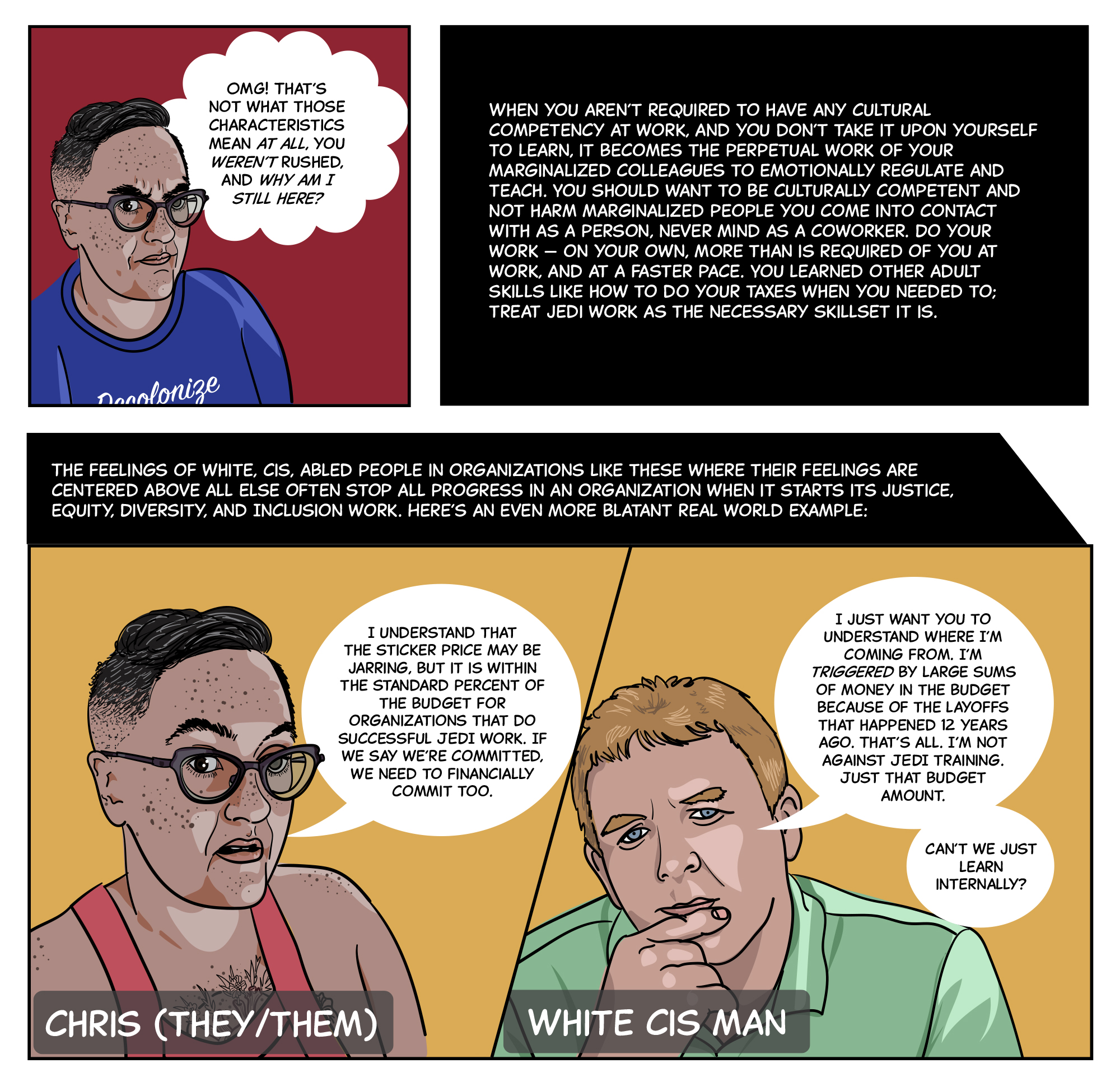
In the following cell, I’m angry. The thought bubble by my head says “OMG! That’s not what those characteristics mean at all, you weren’t rushed, and why am I still here?

Text says “When you aren’t required to have any cultural competency at work, and you don’t take it upon yourself to learn, it becomes the perpetual work of your marginalized colleagues to emotionally regulate and teach. You should want to be culturally competent and not harm marginalized people you come into contact with as a person, never mind as a coworker. Do your work — on your own, more than is required of you at work, and at a faster pace. You learned other adult skills like how to do your taxes when you needed to; treat JEDI work as the necessary skillset it is.”

Third Section

In this next section, text says “The feelings of white, cis, abled people in organizations like these where their feelings are centered above all else often stop all progress in an organization when it starts its justice, equity, diversity, and inclusion work. Here’s an even more blatant real world example:”

In the next cell, I’m saying “I understand that the sticker price may be jarring, but it is within the standard percent of the budget for organizations that do successful JEDI work. If we say we’re committed, we need to financially commit too.”

In the next cell, a white cis man is thinking. He says “I just want you to understand where I’m coming from. I’m triggered by large sums of money in the budget because of the layoffs that happened 12 years ago. That’s all. I’m not against JEDI training. Just that budget amount. Can’t we just learn internally?”

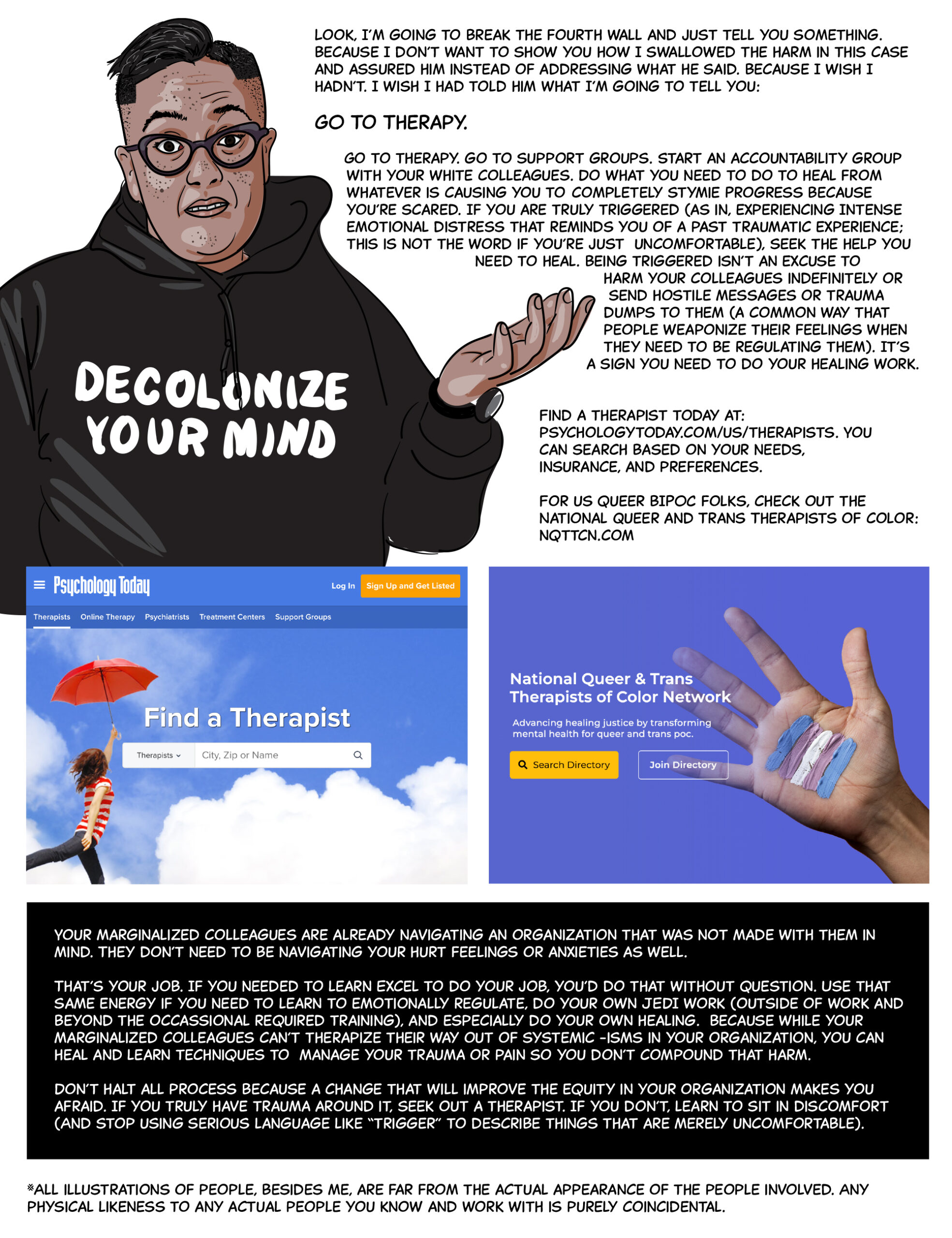
The next session has a larger illustration of me, facing the reader wearing a “Decolonize Your Mind” hoodie, and with one hand up like I’m explaining something. Text says: “Look, I’m going to break the fourth wall and just tell you something. Because I don’t want to show you how I swallowed the harm in this case and assured him instead of addressing what he said. Because I wish I hadn’t. I wish I had told him what I’m going to tell you: go to therapy.

“Go to therapy, go to support groups, start an accountability group with your white colleagues. Do what you need to do to heal from whatever is causing you to completely stymie progress because you’re scared. If you are truly triggered (as in, experiencing intense emotional distress that reminds you of a past traumatic experience; this is not the word if you’re just uncomfortable), seek the help you need to heal. Being triggered isn’t an excuse to harm your colleagues indefinitely or send hostile messages or trauma dumps to them (a common way that people weaponize their feelings when they need to be regulating them). It’s a sign you need to do your healing work.

“Find a therapist today at psychologytoday.com/us/therapist. You can search based on your needs, insurance, and preferences.

“For us Queer BIPOC folks, check out the National Queer and Trans Therapists of Color: nqttcn.com.”

There are screenshots of the Psychology Today Find a Therapist page and the National Queer and Trans Therapists of Color Network.

Conclusion

Text says “Your marginalized colleagues are already navigating an organization that was not made with them in mind. They don’t need to be navigating your hurt feelings or anxieties as well.

“That’s your job. If you needed to learn Excel to do your job, you’d do that without question. Use that same energy if you need to learn to emotionally regulate, do your own JEDI work (outside of work and beyond the occasional required training), and especially do your own healing. Because while your marginalized colleagues can’t therapize their way out of systemic -isms in your organization, you can heal and learn techniques to manage your trauma or pain so you don’t compound that harm.

“Don’t halt all process because a change that will improve the equity in your organization makes you afraid. If you truly have trauma around it, seek out a therapist. If you don’t, learn to sit in discomfort (And stop using serious language like “trigger” to describe things that are merely uncomfortable).

“*All illustrations of people, besides me, are far from the actual appearance of the people involved. Any physical likeness to any actual people you know and work with is purely coincidental.”

Chris Talbot

Chris Talbot

Chris Talbot (they/them) is a queer, trans nonbinary, mixed-race artist, activist, and nonprofit employee. When they aren’t working the day job, they spend their free time editing art and literature magazines, writing and illustrating educomics to help folks affirm their nonbinary pals, creating a graphic novel to describe what it’s like to be nonbinary in a gender binary world, cuddling their cat, and quad skating in the park. 

You can find Chris at talbot-heindl.com, on LinkedIn, Instagram, Bluesky, and Twitter — and tip them on Venmo or PayPal or join as a patron on their Patreon

Why must the white cis nonprofit workers angry react to all my posts? Ep: Do your own internal labor and healing

Why must the white cis nonprofit workers angry react to all my posts? Ep: Do your own internal labor and healing

By Chris Talbot, communications professional and educomics creator

View accessible/text-only version

Part of a comic. Full text is available via the link at the top of the page.

Chris Talbot

Chris Talbot

Chris Talbot (they/them) is a queer, trans nonbinary, mixed-race artist, activist, and nonprofit employee. When they aren’t working the day job, they spend their free time editing art and literature magazines, writing and illustrating educomics to help folks affirm their nonbinary pals, creating a graphic novel to describe what it’s like to be nonbinary in a gender binary world, cuddling their cat, and quad skating in the park. 

You can find Chris at talbot-heindl.com, on LinkedIn, Instagram, Bluesky, and Twitter — and tip them on Venmo or PayPal or join as a patron on their Patreon

Collaborations are a two-way street. Full-stop.

Collaborations are a two-way street. Full-stop.

By Meenakshi Dasnonprofit analytics consultant

…we must shift our outlook on collaborations to be inclusive, equitable, ethical, and respectful for both parties involved.

Geometry teaches a lesson — all squares are rectangles, but not all rectangles are squares. I recently realized this holds just as true for the collaborations of our industry. Human-centered, values-aligned partnerships may represent collaboration, but not every collaboration will be human-centered and values-aligned. 

Whether our collaborations take the form of corporate sponsorships, speaking engagements at annual events, or a vendor-partnership, we must shift our outlook on collaborations to be inclusive, equitable, ethical, and respectful for both parties involved.

In my role as a nonprofit analytics consultant, I consult, train, write, and speak on different data-related, data-centered projects, guided by the belief that each of us deserves a loving, curiosity-driven, well-represented relationship with data. I am a BIPOC woman, a first-generation immigrant to North America (from India). 

Through my perspective and because of my identities, hearing the phrases below motivates me to ask us to rethink our partnerships:

    • “…reaching out because we want to diversify our speakers though we can’t offer any honorarium…”,
    • “…those benefits are only restricted to our platinum sponsor-partners to engage with our members. But we can give you a virtual session space to elevate your work…”,
    • “…we elevate your voice, so we expect…”,
    • “…our sponsors want to bring a few BIPOC candidates for [this work]. We thought of reaching out to you…”

The fundamental issue in collaborations led by such statements is those collaborations are not two-way. They are not based on why someone’s work or values alignment makes them a good potential for partnering. They also disregard someone’s work and potential by choosing language like “we elevate BIPOC people…”

So, how can collaborations (of all forms) in our nonprofit industry become an inclusive, equitable two-way street?

Here are 5 ways:

1. All collaborations must start with values alignment and not dollar-value packages.

For example, take sponsorship opportunities, for example. Recently, as part of my research, I visited the web pages of 10 different philanthropic institutions to see how they approach sponsorships. Most of them had three things: a table that listed dollar values based on sponsor levels, a comparison of sponsorship benefits, and current sponsors. 

The message was loud and clear on the pages — the higher the value, the more the benefits (ranging from influence in the annual conference or galas to the number of times sponsors can be positioned before the audience). All those pages were missing a short paragraph or table of the values every sponsor must meet to become a partner. Those benefits tables also missed an extra column specifying the accountability of every sponsor — that is, how the overall combined values would need to be maintained by the sponsors not to perpetuate any community harm.

We need both clarity on values alignment before the sponsorship packages AND a set of fundamental accountabilities every partner must ensure.

2. No form of collaboration gives decision-making privileges in the nonprofit’s operations.

For example, take conference sponsors. Sponsors should not be given decision-making privileges because it could compromise the independence and integrity of the conference. Allowing a sponsor to have a say in the organization’s decision-making could also create the perception that the nonprofit is accountable to its sponsor, which could undermine public trust and support for the organization. 

Decisions like who speaks at the conference, why they are selected (or why not), topics of the conference and keynote speakers — all such aspects of the conference must be internal to the organization. Such decisions cannot be part of the benefits of higher sponsor packages.

We need to remember the purpose and influence of that conference on the community in the long run.

3. All collaborations must center the well-being of all people involved.

For example, take a virtual annual event. Collaborations here must center the well-being of fundraiser hosts and speakers as much as the attendees. Prioritizing the well-being of all people creates a culture of respect and support that helps ensure the collaboration is successful. 

This means setting up clarity during planning on what would make the collaboration (annual event in this example) successful beyond dollar values. And then clearly communicating those well-being-centered success criteria to everyone involved. When all parties feel their well-being is considered, they are more likely to be engaged, motivated, and committed to the collaboration.

4. All collaborations are set up with clear expectations — of why, what, how, when, and how long.

For example, take a podcast or social channel where a nonprofit wants to include local speakers from racially and socially diverse communities. Setting up clear expectations for both parties involved ensures equitability — expectations like:

    • why (the speaker is invited),
    • what (will the collaboration entails),
    • how (will the collaboration, from planning to any needed marketing, unfold),
    • when (will the collaboration happen), and,
    • how long (are the two parties required to share accountabilities of the collaboration).

This ensures all efforts into the collaboration are aligned, respectful, and meaningful to both the nonprofit and the speaker. It also reduces misunderstandings that can potentially cause harm for the speakers (e.g., tokenizing them).

5. All collaborations must prioritize the humanity of the collaborators at all points. 

The secret of building better collaborations is simple — focus on human beings and their values. The purpose of collaborations is community engagement, after all.

We must realize and remember collaborations are not a favor to either party. That means using humanizing language at all points — from bringing in a collaborator to post-collaboration activities. Humanizing language prioritizes the person over their identity. For example, while bringing a new collaborator from a racially diverse community for your project, instead of saying, 

“…we want to elevate BIPOC voices in this [conference/magazine/webinar/podcast]…”, 

use language like 

“…we want to share the space in [conference/magazine/webinar/podcast] with you because of [specific reasons why their work interests you].” 

This kind of language acknowledges the humanity and individuality of each person rather than reducing them to a label or a characteristic. By using humanizing language, collaborations can create a culture of mutual respect, empathy, and inclusion. 

The secret of building better collaborations is simple — focus on human beings and their values. The purpose of collaborations is community engagement, after all.

Collaborations that de-centers the humanity (even if unmaliciously) risk creating more emotional burden for a subset of the people involved/impacted by the partnership. I want us to reach a place where no one involved/impacted by our industry collaborations have self-doubt moments like, “am I here because of my work or my social identity?” 

Human-centered collaborations create belongingness, the fundamental catalyst for sustainable progress. 

So, go back to all potential collaborations in your work and take a moment to evaluate each of them. Are they inclusive, equitable, ethical, and respectful for both parties?

Collaborations are a two-way street. Full-stop.

Meenakshi Das

Meenakshi Das

Meena Das (she/her/hers) is the founder, consultant, and facilitator at her practices NamasteData and Data Is For Everyone. Her work is focused on data equity. She leads her work with love for the community, respect for her lived experiences and knowledge from decade plus experience of working with data. She supports nonprofits in 3 core areas: data collection assessments, community surveys, and staff workshops on improving data equity (through data collection, visualization, human-centric algorithms etc.) Connect with her on LinkedIn at: http://www.linkedin.com/in/meenadas