What you can do this Pride month: stop your organization from rainbowfying its logo unless it spends the rest of the year materially making things better for LGBTIQA2+ folks

What you can do this Pride month: stop your organization from rainbowfying its logo unless it spends the rest of the year materially making things better for LGBTIQA2+ folks

By Chris Talbotnonprofit laborer and perpetually disappointed queer

Supporting marginalized communities when it’s easy and lucrative to do so isn’t being a true accomplice. When it’s hard to do, and you still do it, you show your accomplice chops…

Rainbow capitalism month is upon us, and everyone is participating.

But what hardly any company, nonprofit or not, is attempting to do is make things materially better for LGBTIQA2+ folks year round. As an out, queer, trans nonbinary individual, Pride has become a headache of faux activism and false promises.

I need us to remember our roots.

The first Pride was a riot. The second Pride was a protest of the conditions that necessitated that riot.

At some point, Pride became the white, cisgender, abled, queer attempt to show white, cisgender, abled, heterosexual folks that we could play respectability politics and be “just like them” but in a gay way. (Which wasn’t great for those of us who weren’t white, cisgender, or abled and would never be “just like them” no matter what we do or how “respectable” we try to be.)

In the last eight or nine years, Pride month has felt like one slap in the face after another as corporations and nonprofits that never lift a finger for our liberation (and often cave in to pressures to negate our humanity) drape everything they own in rainbows for one month, and go back to business as usual the next.

At one point, approximately 30 years ago, that version of “showing up” was necessary. We needed mainstream approval. But today, a decade after we got mainstream approval (well, our white, cisgender, abled queer folks did, anyway), we’re no longer looking for “toleration” or “trans people exist,” we’re looking for allies and accomplices to fight for our diminishing rights to help us survive and thrive.

It’s harmful to have corporations merely affirm our existence and continue to serve platitudes like “love is love” (which we should be so far beyond), as we watch some hard-fought protections and rights being stripped away with violent fervor. (Ironically, as my older friend in my trans and nonbinary elders support group informed me, I feel we need to get back to what Pride was 30 years ago — where corporations’ footprints were sparse, queer and trans people shared their talents and artistry, and direct action and community-based organizations reigned. Notice I said “footprints” and not sponsorship; not all things need go back to how they used to be.).

Rainbow-washing and its impacts

Rainbow-washing, when you have no intention of following through as an ally or accomplice afterward, only stirs hatred and leaves the most vulnerable populations to deal with the aftermath.

At some point, corporations realized that rainbowfying during June was big business. The estimated 20 million LGBTIQA2+ people in the U.S. collectively have a purchasing power of $900 billion annually, according to a report from LGBT Capital. And Pride events are a large part of that purchasing power.

Just ask Anheuser-Busch (Bud Light), a company that, despite being one of the big five highest donors to anti-LGBTIQA2+ candidates, sponsored Pride events across the nation (which often came with the benefit of having a monopoly on the beer sold during them). In 2021, Stonewall Inn boycotted the company for Pride, as did many other Pride hosts, which I’m sure cut into their June profits just a bit.

The problem is, when push comes to shove, if these cisgender- and straight-owned companies could possibly lose money, social capital, or safety (all possible consequences of being a true ally or accomplice), they are willing to leave us high and dry, fighting off the bigots they inflamed by ourselves.

Look at Target. This year, they hired people from communities to represent their communities during their months — a noble pursuit. They curated a Black Beyond Measure Collection from Black artists during Black History Month. They also contracted with queer and trans artists for the 2023 Pride Collection. But when Matt Walsh straight up lied and said their tuck-friendly swimsuit line included child sizes (it does not), Target stores and the queer and trans artists began receiving bomb and death threats, respectively.

These bomb threats need to be taken seriously, of course. But the solution is not to pull the items they do have — again, not tuck-friendly swimsuits for children, because that does not exist — and leave the artists they amplified, who have fewer resources at their disposal, to deal with the death threats without any support from Target. Especially as this “win” to “make Pride toxic for brands,” as Matt Walsh refers to it, only chums the water for the virulent transphobes that made the threats to begin with.

Rainbow-washing, when you have no intention of following through as an ally or accomplice afterward, only stirs hatred and leaves the most vulnerable populations to deal with the aftermath.

I’m not saying Target is straight-up rainbow-washing (like Anheuser-Busch definitely is, as they donate so much money to anti-LGBTIQA2+ candidates). After all, Target has been actively supporting the queer community (read: primarily the cisgender gay and lesbian community) since 2012 with products and donations. (This was after a rocky start where they donated $150k to pay for TV ads to support Tom Emmer, a gubernatorial candidate who wanted to ban marriage equality. But it seems they’ve taken accountability and moved beyond it.)

Supporting marginalized communities when it’s easy and lucrative to do so isn’t being a true accomplice. When it’s hard to do, and you still do it, you show your accomplice chops.

You might be saying, “But Chris, these are corporations, not nonprofits!” But nonprofits are not immune to the rainbow-washing. I think — I hope — it comes from a more authentic place of wanting to be allies and accomplices, but nonprofits fall short just as often.

And I can’t count the number of nonprofits, especially environmental nonprofits since I work in that realm, rainbow-wash their logo for the month but don’t do anything materially at all to make things better for their LGBTIQA2+ employees, never mind the environmental nonprofit industrial complex or the world at large. In nonprofit organizations I’ve worked at over the last 21 years, I’ve had to fight to have my humanity as a queer and trans person matter more than potential donations (not even real-life donations, mind you, but the potential that someone may donate) more than once. And many organizations within my network, when I call them in and point out ways they alienate or other especially trans individuals, become hostile at the correction.

All of these organizations drape themselves in the flag every year. I openly refuse to participate with my organization until we do something real and material for the LBTIQA2+ community. (And as the graphic designer and person with the know-how of the bunch, that’s become our de facto policy. LOL.)

So what should you do this Pride month?

Authenticity matters. If your organization can’t “listen and learn” (the phrase folks most often like to use when I point out harm) when an LGBTIQA2+ person calls them in, don’t let them drape all of your logos and social media banners in rainbows. Rainbowfying should be a way to signify minimal allyship, and your organization isn’t ready to do it.

Here are some (non-prescriptive and non-exhaustive) ideas for what your organization should be pushing for before it starts draping itself in the rainbow flag:

  1. Listen and learn faster — It often feels like organizations in the “listening and learning” phase of their advocacy for marginalized people only do so when an incident arises and goes back to ignoring the needs of that community in between incidents. That will never be an effective way to “listen and learn.” Your organization needs to include researching and learning justice, equity, diversity, and inclusion (JEDI) principles in its regular operations and have regular training until JEDI principles become just another lens through which you do your work.

    Hire an outside consultant rather than relying on your LGBTIQA2+ employees to shoulder this work. Not only is Outsider Efficacy Bias a thing, but they will also burn out; trust me on this.

    A good way to start is to consider hiring the people in the community who call you in, if they offer those services. Ask them if you can meet with them to talk more about what they’re telling you, and pay them for their time and expertise. (Looking at you, all the organizations I’ve provided free education to!)

  2. Get an internal evaluation of your organization — Before we can talk about things that we can implement to improve our workplaces, we have to take an authentic, honest look at where our organizations are. When you skip this step, you end up with optical allyship that puts band-aids (or rainbows) on problems but harms people once they experience the actual culture.

    We also tend to want a prescriptive sequence of checkboxes. If you do x, y, and z, you are certified safe for LGBTIQA2+ employees and supporters. But life doesn’t work like that. All organizations are different and will have different needs when it comes to improvements.

    There needs to be an internal evaluation of systems of oppression from an outside contractor who is educated in how to do that sort of thing (read: relying on your LGBTIQA2+ employees to avoid paying for this doesn’t cut it). Analyze the organization’s ideologies, determine what biases got operationalized over time, and evaluate how your organization adheres to a white-, cisgender-, heterosexual-, abled-, and Christian-normative culture. We all have things we will continually need to work on — this is not one-and-done work, so make sure you work with a contractor who prioritizes an ongoing relationship. In the environmental nonprofit field, organizations like The Avarna Group, the Center for Diversity and the Environment, and Justice Outside are excellent places to start.

    What to look for before you sign the contract: make sure the work is done in conjunction with a team from your organization. If they do it separately and come back with a list of changes your organization should take, how likely do you think the organization will enact those? Prioritize organizations that work with your specific capacity and goals. And be sure that they center the justice, equity, and inclusion of people from marginalized groups rather than the feeling and comfort of people with relative privilege. Since the summer of 2020, too many rubberstamping so-called equity organizations have popped up, and while they’ll give you a rubberstamp after completing their privilege-centered program, they won’t lead to meaningful change, and you’ll have wasted your dollars.

  3. Support and amplify groups doing this work — If you are a well-resourced organization in your field (or even if you aren’t and just want to show up this year authentically), maybe this month can be spent encouraging your supporters to support on-the-ground community-based organizations doing similar work.

    According to a recent report, LGBTIQA2+ nonprofits got 0.13% of all charitable giving in 2019, and this was after a 46.3% increase in giving between 2015 and 2019. The exact amount spikes when something horrible happens to the community — like an attack in a statehouse or a mass casualty event. But if all the giving to our community occurs as a triage measure when we desperately need it to survive, how will we ever get to the point where we’re ready to thrive?

    If you’re in the environmental nonprofit industrial complex or work in the outdoor equity arena, you could choose to amplify and ask for donations to Queer Nature, Out for Sustainability, Queers 4 Climate Justice, Pride Outside, and The Venture Out Project.

  4. Cater your efforts to all queer folks, not just the white, cisgender, and abled ones — If your actions don’t improve the condition of BIPOC (especially Black and Indigenous), transgender, and disabled queer folks, you’ve failed. Too many organizations, especially the most resourced ones, leave the most vulnerable members of the LGBTIQ2+ community to fend for themselves. That’s how we got marriage equality across the nation in 2015, but we still don’t have a prohibition against the gay and trans panic defense, “shield” laws protecting access to transgender health care, bans on conversion therapy for trans youth, or the right to pee in public restrooms in every state. Well-resourced LGBTIQA2+ organizations tend to start and end their advocacy with the most resourced members of the community because of the donation feedback loop.

    I have a feeling this is why so many Pride parades still have cops as well — white, cisgender, and abled queer folks and organizations led by them aren’t the targets of police violence, so they trust the cops will protect them and value that security. BIPOC, transgender, and disabled queer folks have healthy social paranoia regarding police, who they protect, and who they target.

    If you aren’t sure what BIPOC (especially Black and Indigenous), transgender, and disabled queer folks need, do listening sessions and pay them for their time.

  5. Modify your programming to meaningfully include LGBTIQA2+ people — Programming at organizations rarely considers our community. Events, like charity walks and runs, are often gendered unnecessarily without a category for those who don’t fit in the categories of “men” and “women.” Silent auction items are often offered in “his and her” packages, prioritizing heterosexual couples. Programs that are meant for gender parity ignore that people other than cisgender women need those programs as well — and statistics show that other marginalized genders need them more.

    In 2016, my supervisor at the time created a program that was meant for gender parity in STEM careers that was focused entirely on cisgender women (not even all women, but cis women exclusively, because she wasn’t sure how to meaningfully include transgender women and rather than learn, she was choosing to exclude). I spent years working to get her to understand that other marginalized genders needed to be included. The program was finally shifted when I took a more rigid stance and said I wouldn’t be helping the program until it was changed. (Again, a moment where being the person with the know-how meant I got to determine the de facto policy. LOL. Allies and accomplices, take note and learn to leverage that kind of power for equity!).

    If you have a parity program, it’s worth noting that if your pay equity program doesn’t include (really, prioritize) trans, nonbinary, gender non-conforming, or Two Spirit individuals, you aren’t doing pay equity at all. You’re building an even more significant gap between transgender and cisgender individuals.

    According to the statistics, full-time employed people in the U.S. had weekly median earnings of $1,001 through the third quarter of 2021. All men had weekly median earnings of $1,100; all women had weekly median earnings of $916. Race played a significant factor, of course, with white women receiving $929; Black women receiving $783; Hispanic or Latiné women receiving $723; and as usual, Indigenous people weren’t considered in this fact-finding. Trans men had weekly median earnings of $700; nonbinary, gender non-conforming, and Two Spirit individuals received $698; and trans women received $600. Race was not considered in this fact-finding.

    With these stats readily available, showing the incredible disparity based on gender identity and race, there’s no excuse to have a pay equity program that focuses solely on cisgender women (and especially white cisgender women). Please use this information to pivot your pay equity programs to include other marginalized genders.

  6. Make Pride an event that materially improves the lives of LGBTIQA2+ people again — For those working at organizations that put on Pride events or those that have the ear of organizations that do, I implore you to ask them to make their events improve the lives of LGBTIQA2+ people again. As we’ve seen with articles in The Hub around sponsorship, we need to revisit sponsorship and what it means to make it more community-oriented.

    In years when Target, Anheuser-Busch, and Starbucks (they have at least one incident every year, don’t they?) walk back allyship, give unprecedented amounts of money to anti-LGBTIQA2+ lawmakers, or use transgender healthcare benefits “as a cudgel against unionization” respectively, the community impacted shouldn’t have to watch their rainbow-washing float in the parade.

    Maybe the new standard is that these sponsors are mentioned, but they don’t get a spot in the parade or a tent in the park. Perhaps the parade should be full of useful resources for the queer community instead — companies and organizations typically priced out of sponsorship because the minimum sponsorship level favors those with wealth. Maybe the corporate sponsors can sponsor those slots instead. Maybe for slots that they specifically need work in, as the first step towards repair, and they are only mentioned if they have committed to repair. Example: “And here comes the RodeoH float. RodeoH offers a gender-neutral, size-inclusive range of comfortable and stylish underwear (including packing underwear), apparel, harnesses, and more. Learn more at Rodeoh.com. This year’s RodeoH float is sponsored by Target as a first step towards repair for removing their Pride collection this year. They have committed to [input changed behavior].”

    I don’t know what your local solution might be. I just know that queer and trans health resources, trans-affirming therapists and healthcare professionals, queer-owned local companies, and on-the-ground community-based nonprofits materially helping the community would be better to see in the parade and vendor booth area each year. I can envision announcers sharing the names of these local community-based companies and organizations and their work. I can imagine myself taking notes and following up once Pride is over. I can envision Pride as a helpful resource connecting people and building community.

    How cool would it be if instead of exclusively having your top beer sponsor’s products at Pride (especially if it’s rainbow-washing Anheuser-Busch), there were also local queer-owned microbrews available at Pride? In Denver, this could look like having Lady Justice Brewing, Fiction Beer Company, Goldspot Brewing Company, and I’m sure many other queer-owned breweries I’m currently unaware of. It would keep the money in the family and let folks know that queer-owned microbrews are available in town.

    How cool would it be if Denver Pride had a tent for gender-affirming services, complete with hair stylists from Let Em Have It Salon and Above Ground Denver (the two gender-neutral and affirming hair salons I’m aware of) giving quick cuts and fades? And my trans massage therapist (and any others) working in it? Not only would it set those businesses that are actually queer-owned up for life, but it might also take the fear and stress out of trying to find a trans-affirming hairstylist or massage therapist on your own (Which, in my experience, has been an exercise in weathering micro- and macro-aggressions. If you’re in Denver, the Inclusive Guide can help you find places you’ll be safe, welcomed, and celebrated!).

    Instead, we are bombarded with miles of corporations in their rainbowfied tee shirts handing out cards about their Pride specials to get their slice of the $900 billion annual spending dollars when they don’t materially do anything (or worse, actively working against our liberation), for the rest of the year.

    And I, for one, am tired of waiting for our liberation.

    Just to kick a dead rainbow-emblazoned corporate logo, I wanted to share that in 2019, I walked around to the vendors at Denver Pride. I asked them two questions; if they 1. were queer-owned, 2. if not, donated a portion of the proceeds to queer nonprofits or community mutual aid asks. That year, I had decided to only purchase from vendor booths that did one or the other. Despite the plethora of stalls present, I walked away from the event with a handful of Dylan Edwards zines and nothing else.

    This is not how we reach our liberation.

So, before you allow your organization to rainbowfy its logo and social media banners in a show of faux support, please sit with decision-makers and decide if you can genuinely articulate anything your organization is materially doing to improve the conditions of LGBTIQA2+ folks inside or outside of it. If you can’t communicate meaningful measures with actual outcomes, consider asking your organization to hold off and work on some of these steps instead.

We don’t need and will never again need “tolerance” or “trans people exist.” We need organizations and corporations to be true allies and accomplices to the community while we weather these unprecedented attacks on our humanity. We need organizations and corporations that will fight for our rights and stand in the way of bigotry that comes from that stance so that we can continue to survive and eventually get to that thriving bit.

Want more on this topic? Check out Carlos García León’s essay “Take your Pride month and shove it.”
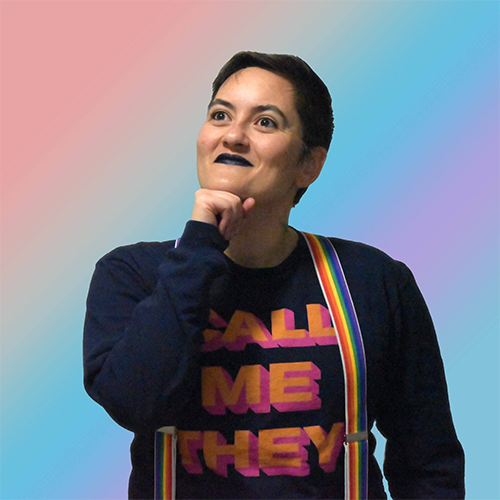
Chris Talbot

Chris Talbot

Chris Talbot (they/them) is a queer, trans nonbinary, mixed-race artist, activist, and nonprofit employee. When they aren’t working the day job, they spend their free time editing art and literature magazines, writing and illustrating educomics to help folks affirm their nonbinary pals, creating a graphic novel to describe what it’s like to be nonbinary in a gender binary world, cuddling their cat, and quad skating in the park. 

You can find Chris at talbot-heindl.com, on LinkedIn, Instagram, Bluesky, and Twitter — and tip them on Venmo or PayPal or join as a patron on their Patreon
Make CCF principles your own; that’s the only way you can engage with this

Make CCF principles your own; that’s the only way you can engage with this

By: Meenakshi Das, data equity consultant, trainer, and speaker

To me, community-centric fundraising is an approach centered on community relationships, empowerment, and equity. It seeks to address the historical power imbalances that have perpetuated systemic inequalities and limited the potential of marginalized communities to participate in philanthropy.

I have been in rooms where it took all my energy, plus some to compensate for the disengaged expressions. And it has always bothered me as a BIPOC immigrant woman in this part of the world. 

At one of my old jobs, I remember someone unmuting and interrupting the presentation, saying, “I cannot make what she is saying. Can someone translate that for me in our English?” I also recall the first day of a job when my manager told me my onboarding would include “learning more English like North America.” All this after I have three English-based advanced degrees in computer applications, data science, and human-centered design thinking!

I have taken more courses than I remember to cover up for those instances — like I had to learn something more, a bit extra, to be seen enough. Navigating those moments was a lonely experience and very exhausting. 

That is until I came across the ten CCF principles.

I cried when I first found the web page with the ten principles. Those bold words challenging traditional defaults stated the most obvious for our field — be human. I remember my heart and mind telling me in those moments — “see, didn’t we say you have always been enough?” Knowing that my ideas to be in philanthropy were ordinary and human — like other strangers of this CCF group felt, too — was empowering.

This article is to share with you my process of owning those principles. Because they need to be yours, deeply and truly, so you can engage well with the core idea — that community is at the center of all.

To me, community-centric fundraising is an approach centered on community relationships, empowerment, and equity. It seeks to address the historical power imbalances that have perpetuated systemic inequalities and limited the potential of marginalized communities to participate in philanthropy. This approach emphasizes building trust, creating meaningful engagement, and promoting shared ownership of fundraising efforts. To fully realize the principles of community-centric fundraising, it is necessary to consider data equity as an integral component.

For me, reading those ten principles started with feeling validated and heard, yes, but they also quickly opened questions. Like:

  • What does this all mean for data and data equity?
  • Why should I always factor wealth, power, and influence to sort and segment?
  • And then why should I sort and segment every time?
  • Or is my story (an immigrant with just enough income, a rented apartment, no significant assets, student loans, health loans, advanced degrees, and years of data experience) too insignificant to be considered necessary in the formula of “supporter” and an ”ally”

So, I did what I do best — I went into a rabbit hole of what, why, and how these principles work with the ideas of data collection, reporting, and consumption…

The CCF principles are not end-all, be-all statements. They are evolving and breathing, meaning I needed to commit to continuous learning.


I contextualized the CCF principles with the ideas of data equity, research, and algorithms through my four-step process:

  • Understand “why”: I went through each principle and pulled as many themes as possible based on what I agreed with and what I needed to explore more.
  • Explore gaps and build accountability: Once I started to grasp the principles’ themes, I applied those lenses to the data practices in philanthropy and beyond. I have worked for over fifteen years in data with different titles and teams. This step was more about identifying the gaps and acknowledging my power to address those gaps. I created multiple “I” statements to design more accountability in my actions with data.
  • Create spaces for continuous learning: The CCF principles are not end-all, be-all statements. They are evolving and breathing, meaning I needed to commit to continuous learning. As I progressed in my exploration and design of CCF principles aligned with data equity ideas, I intentionally built spaces where this knowledge could be shared more broadly — newsletters, publications, data equity workshops, and such.
  • Surround myself with a community with whom I share this language, knowledge, intentions, and strength: One of the early lessons from exploring the principles was that I am allowed to ask for support. And I realized in this exercise that I need to commit to reaching out to people and communities who share the language, knowledge, intentions, and strengths of learning and living these principles to make my joy in this work sustainable

Going through this process helped me to set the foundation of my consulting practice around data equity. Data equity is a framework for ensuring that data is collected, analyzed, and utilized in an inclusive and equitable manner. And doing good with data requires a commitment to understanding the social, political, and economic contexts in which data is collected and a willingness to engage with diverse perspectives and experiences.

In the context of community-centric fundraising, data equity is essential for ensuring that fundraising efforts are informed by the needs and priorities of the community and that the data used to guide these efforts is not biased or discriminatory.

For example, one key aspect of data equity in community-centric fundraising is collecting and using demographic data. This includes information on the race, ethnicity, gender, sexual orientation, income, and other characteristics of community members. Collecting this data can be challenging, as it requires building trust and establishing relationships with the community. It is essential to approach this process with sensitivity and respect and to be transparent about how the data will be used.

Another example of data equity is the use of data in decision-making. Data should not be used as a tool to impose preconceived notions or goals onto the community. Instead, it should be used to inform discussions and decisions that are driven by the community’s priorities and needs. This requires a willingness to engage with diverse perspectives and experiences and to recognize the value of community knowledge and expertise.


Data equity requires a commitment to transparency, accountability, and continuous learning. This means being transparent about the collected data and how it will be used and being accountable to the community for the decisions made based on that data. It also means acknowledging and addressing biases or shortcomings in the data and learning collaboratively with the community to improve on the gaps.

Owning the 10 CCF principles helps me find my own ways to build a better world.

So, go back to those principles, re-read them, reflect on them, and question them. That’s how you will make those yours.

Because there will always be someone in the room who might think I don’t belong there. But I can also guarantee that learning to center community humanely will also mean you will find another individual in the same room who shares your joy and intentions.

You and I are working for those believers in the room.

Meenakshi Das

Meenakshi Das

Meenakshi Das (she/her/hers) is the founder, consultant, and facilitator at her practices NamasteData and Data Is For Everyone. Her work is focused on advancing data equity for nonprofits. She leads her work with love for the community, respect for her lived experiences and knowledge from decade plus experience of working with data. She supports nonprofits in 3 core areas: data collection assessments, community surveys, and staff workshops on improving data equity (through data collection, visualization, human-centric algorithms, etc.) You can access some of her intentionally designed community resources here. Connect with her on LinkedIn.

How consulting can help women of color get out of toxic nonprofits, set boundaries, and have the energy and space to create the change we want to see

How consulting can help women of color get out of toxic nonprofits, set boundaries, and have the energy and space to create the change we want to see

By Esther Saehyun Lee, new fundraiser, young leader, and Scorpio; and Maria Rio10+ years of experience in nonprofit project/people management

The system is designed to push out those of us with skin in the game while those who don’t look, talk, or act like us play allyship, put our organizations on their resume, and pat each other on the back. As a result, people of color who advocate for equity and demand better from the sector are often pushed out, ignored, or even penalized.

We’ve all heard the saying: “People quit bad bosses, not companies.” While some sectors question if staff attrition should be attributed to poor management over toxic cultures, the nonprofit sector doesn’t have to worry about this question: we have an abundance of both.

In recent years, there has been a growing trend of fundraisers leaving in-house roles and transitioning into consulting roles. You may very well know someone who has made this shift, and if not, I want to share with you why I did it.

Here are some key experiences over the past decade that have built up to me choosing to go into consulting:

  • Being tokenized for my lived experience as a refugee from Mexico, with colleagues and the ED asking me to put on an accent for promotional materials or donor pitches;
  • Experiencing the board completely disregarding extremely toxic behavior of a Director out of fear of being perceived as racist, even though the culture has caused dozens of people to quit;
  • A Director suggesting we all don hijabs for World Hijab Day and post it on social media;
  • The organization I worked for publicly supporting a TERF, and my ED using our organization’s Twitter to condone the work of the Winnipeg police (TW for murder);
  • “You don’t like spicy? Aren’t they going to revoke your Mexican ….? Hahaha”;
  • “If we had to draft a tweet about every Black, trans, disabled, queer, POC person …” in response to me saying we should make a statement about the murder of D’Andre Campbell;
  • Being diagnosed with GERD due to the stress of promoting and fundraising for organizations that I didn’t believe were managing staff or funds well, and were actively tokenizing me while ignoring my expertise;
  • Being ground down by performative allies unwilling to do the work, get political, relinquish power, center the community, or change our practices to be ethical.

This list could go on and on, but you get the idea. And that is on top of borderline-ridiculous fundraising expectations, burnout, no staff support, no budget for professional development, inept or megalomaniac board members and EDs, sexual harassment from donors, etc.

These incidents, along with many others, are emblematic of a toxic culture that prioritizes the comfort and convenience of white individuals in power over the safety and well-being of people of color.

Who would want to stay in-house? 

Statistically, even you, the reader, have personally thought about leaving your organization within a year or two. I can relate.

Many fundraisers, especially those with intersectional identities, have become disillusioned with the sector and are seeking new ways to make an impact or seeking to leave the sector altogether. For women of color, consulting offers a unique opportunity to resist and challenge the structures in place. By being open to work with multiple organizations, consultants can choose to only partner with nonprofits focused on ethical fundraising and dignified work. By leaving toxic organizations and setting boundaries and values through consulting, they can find organizations truly committed to equity and social justice.

I’m telling all BIPOC ladies — you don’t need to sacrifice your well-being to teach others about anti-racism, speak in a way they will listen, or carry the entire organization on your shoulders. Whether an organization crumbles or not is not your responsibility. Your responsibility is to find your people, prioritize your health, and use your skills to further better organizations. We need to stop propping up toxic leaders and toxic spaces.

The system is designed to push out those of us with skin in the game while those who don’t look, talk, or act like us play allyship, put our organizations on their resume, and pat each other on the back. As a result, people of color who advocate for equity and demand better from the sector are often pushed out, ignored, or even penalized. To us, justice is not a hobby, debate, or a thought exercise. We don’t clock out of the work of equity when we clock out of work. We do this work so we can survive. 

This very system makes leaving and setting boundaries through independent consulting an exceptionally attractive option for women of color. By doing so, we can truly work towards building a more equitable and just society. Through consulting, we can advocate for ethical fundraising practices, prioritize the needs of marginalized communities, and hold organizations accountable for their actions. 

Most importantly, we can prioritize our well-being, our mental and physical health, and our sense of belonging; to me, this is a much better option than supporting people who really don’t care about us.

As consultants, we can choose to work with organizations that align with our values. As community-centric fundraisers who are committed to shifting the needle, not just for our organizations but our sector, it is imperative that we hold each other accountable in the work of social justice. The question is: are fundraisers able to do so when they are surrounded by leaders who perpetuate the systemic inequities they profess to want to dismantle? Fundraisers are running for the hills and going into consulting so they can actually work on ethical practices and protect their peace. And it’s important that they do so. But, eventually, leaders in the nonprofit sector really must ask — why is consulting the only liberation for women of color in nonprofits and how can we change that?

Esther Saehyun Lee

Esther Saehyun Lee

Esther Saehyun Lee (she/her) (she/her) is most well-known by her peers as an excellent meme/personal emoji creator, and creative co-conspirator. She continues to create space within systems of oppression to develop engagement and fundraising practices as a consultant at Further Together. She joined the nonprofit sector because of the CCF movement and is honored to be a member of the CCF Global Council to continue to hold the sector accountable in its mission and values. As a feminist killjoy and unabashed nerd, she is committed to creating environments that are centered in laughter, curiosity, and justice in the work of equity.

Maria Rio

Maria Rio

Maria Rio (she/her) is a fundraising consultant with Further Together with 10+ years of non-profit experience. She is regularly asked to speak on issues related to fundraising and her op-eds have been featured in national publications. She was a finalist for the national 2022 Charity Village Best Individual Fundraiser Award and has a deep passion for non-profit work. Maria also sits on the Board of Living Wage Canada.

You can connect with Maria through Further Together or through LinkedIn.

Gentrification: When neighborhood changes aren’t shaped by us and are no longer for us

By Jasmin Velez, diasporican community organizer and environmentalist

I have been working for the nonprofit sector in community engagement and development all my career. There is an ebb and flow to the work and how it makes me feel. Usually, I get a burst of energy when engaging residents on local projects, community gardening, and collectively working towards shaping our community how we’d like to see it. Lately, however, I have been feeling drained. 

While I have the privilege of working in the field I love, my dual identity as an active community member and a staffer for one of the nonprofits serving my neighborhood can be a lot to balance. Sometimes the lines can get blurry, and I often find I have to vocalize, “Hey, this is my work hat, and this is my personal hat.” Learning that took me a few years, and some days are easier than others. When it is most difficult, however, is when we are discussing the future of the neighborhood.

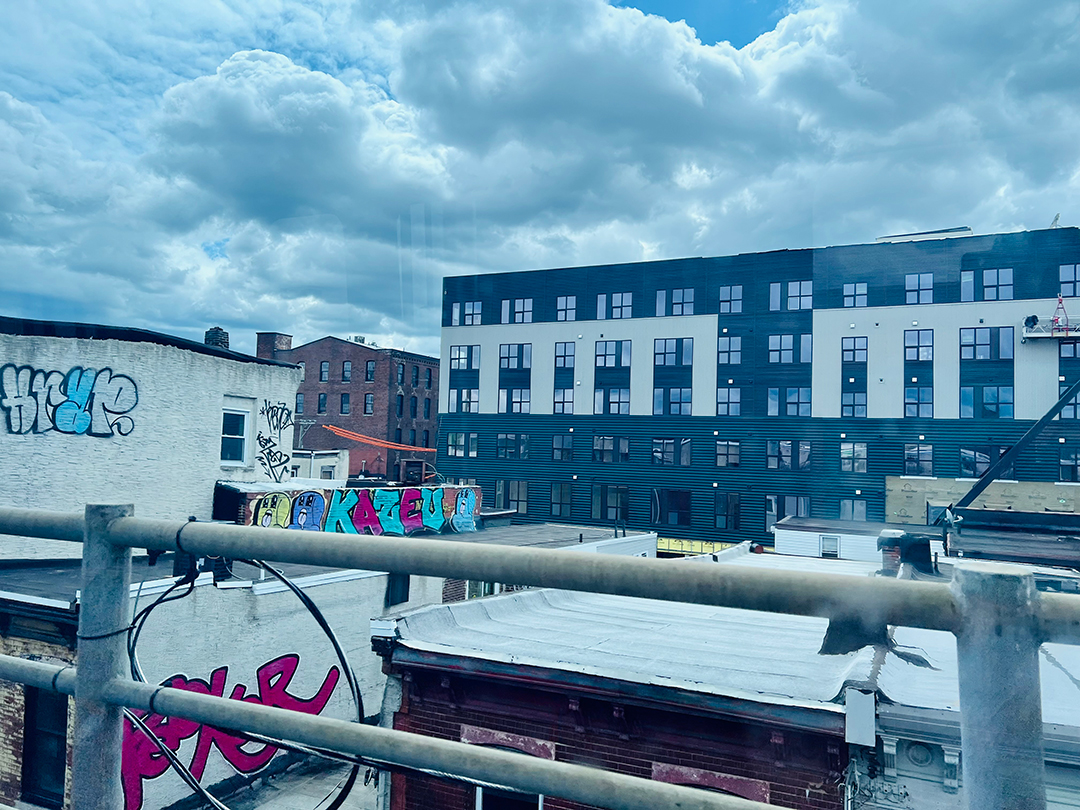
Photograph of new development among older existing buildings
Photograph of new development amongst old existing buildings

Over the years, I have been in many rooms where outsiders plan and decide what projects we need for the community and what they think it ought to look like. Of course, I advocate and raise my voice so they are aware that there is a lack of representation from folks in the community in these decision-making processes. The responses are usually “Of course; we will engage the community on this,” or “Well, let’s discuss how this would look like first,” and so forth. I don’t think many can recognize how planning for the community is actively working against the goal of working with the community.

In my experience, community engagement is being used like a buzzword, just as freely as “trauma-informed” or “community-based participatory research.” This sparks another debate around how sometimes even the best intentions can cause harm. I’d argue that is exactly what happens when we fail to truly build relationships and engage from the beginning.

Half-a-million dollar condos next to family homes

I am not saying things do not have to change. I think there is a balance necessary in any community. We need to see economic development, we need more housing, and we want the beautiful things every other community gets too: but what is the cost?

I work and live in a neighborhood in Philadelphia called Kensington. It has been my home since I moved to the city from Puerto Rico when I was five years old. Since I was a young girl, I have seen the community go through so many cycles of change, though none as drastic or “othering” as the changes lately. Perhaps the most difficult of them has been seeing the rapid gentrification creeping north toward us. Every week we see a new building come up, and little by little the demographics are beginning to change. As time passes, you hear that the auntie or grandmother that lived on the block for 35 years can no longer afford to live in the neighborhood or that the challenges have become too much to bear.

Kensington has a lot of complex issues, one of them being the impacts of an opioid crisis ignored by the officials in this sector of the city. Containment strategies and decades of disinvestment and unjust policies have led to Kensington dealing with a lot of open narcotics sales, open drug use, vacancies, public health concerns, and the list can go on. It is important to acknowledge this concern because, despite these complexities, there does not appear to be a cease in how rapidly things are developing. In a community where the average gross income is at or below $25,000 a year, we see high rises and lofts charging upwards of $1200-$2500 for rent. Perhaps, if you live well above the poverty line, that amount may seem doable, but it is entirely inaccessible in this neighborhood.

It is a strange dichotomy to see half-a-million dollar condos built next to pockets of the neighborhood where the families living nearby could not even afford half the cost.

I recently took a ride on the El train with a few of my colleagues, specifically to discuss how you can see the development approaching. Fishtown, a neighboring community, has become unaffordable, and the need to develop further north is evident as you ride the El back and forth. Once more, the image strikes you because you see old row homes next to new buildings with facades that don’t blend with the beautiful historical architecture.

Every time I ride the train, I reminisce about my times as a teenager heading into the city for school and think about the vacancies I passed every single day. I am not saying things do not have to change. I think there is a balance necessary in any community. We need to see economic development, we need more housing, and we want the beautiful things every other community gets too: but what is the cost?

The cost of a lack of true engagement and rapid development

The cost of a lack of true engagement and rapid development is the loss of a community and the uniqueness of its people.

This community is made up of over 50 percent of Latine individuals, many speaking Spanish and many of them identifying as women. When youlook in the room of folks making decisions for about 30-40K individuals in the neighborhood, most do not look like the population nor live in this community. I find that problematic. Acknowledging that community engagement is necessary and doing community engagement are two different things. Without representation from the neighborhood, you lose the uniqueness of what makes a community special; just like the new buildings, you lack character and charm.

This is not a blow to all the organizations working in the neighborhood either. Many do a great job of being inclusive of neighborhood residents, but that’s not always the case. As the community continues to gentrify, we must acknowledge that the demographics are changing, and there is a sense of abandonment from the original neighbors. I have much too often heard comments of “That’s not made for us or our kids,” or “I wish I would be here to enjoy it.”

As neighbors are actively being priced out, they are also being asked to give input on what they want to see or what projects they’d like to participate in. All of that feels performative and lacks the true trauma-informed approach of recognizing how change and planning for the future can be disheartening or difficult for many folks. I do not wish to impart my own feelings or biases onto others’ experiences, either. Yet these conversations have happened far too often for me not to recognize that they are what many others feel and fear too. I have lived here most of my life, and even with that, it took me many years to build relationships and trust with neighbors so that we could candidly have those conversations. Many times they happen offline, with the request that I do not take their feelings back to the organizations.

You may ask why that is, and my response would be that people understand that sometimes these organizations are another system that may betray them. I honor that fear because, as I see the conversations taking place, it is evident that they are right. As I mentioned, I sometimes have the privilege of being privy to the planning phases of things, but if my voice is not honored in those spaces, then how will residents’ voices be?

The cost of a lack of true engagement and rapid development is the loss of a community and the uniqueness of its people. When we see only a few individuals in power making all the decisions about what a community ought to look like, it is actively being shaped the way they want it to be. And when those folks are not from the community or only came at the jump of a real estate opportunity, then what is being shaped is a neighborhood not by us, and quite frankly, not really for us either.

Jasmin Velez

Jasmin Velez

Jasmin Velez (she/her) is an applied practicing anthropologist and an almost life-long resident of the Kensington neighborhood. Jasmin grew up in Aguada, Puerto Rico, and moved to Philadelphia when she was five years old. She attended Bloomsburg University of PA, where she received her Bachelor of Arts in Cultural Anthropology, and later graduated from the University of Colorado Denver with her master’s in Medical Anthropology. Missing the diversity of her community and the east-coast city vibes, she returned to Philadelphia following her studies and returned to her neighborhood. She has been working for the nonprofit industry for close to ten years, with many of her projects focusing on community education and environmental stewardship, and justice. Jasmin enjoys writing short stories and poetry and traveling to the motherland during her free time. You can follow her adventures on Instagram at @writinghello and if you enjoy her pieces, you can fuel her coffee obsession at https://ko-fi.com/writinghello.

Just give the damn money: why nonprofits and foundations get in the way and how we can do better without them

Just give the damn money: why nonprofits and foundations get in the way and how we can do better without them

By Yolie Contreras (she/her), fledging fundraiser and Zinester

Why are nonprofits and foundations getting in the way of mutual aid?

It might seem like an easy question to answer, but it’s loaded with layers and layers of white supremacy, gaslighting, and othering. As we know, the nonprofit industrial complex is this tangled web of boards, applications, qualifications, etc.

But how did we get to a point where the complex would actively hinder mutual aid projects that are engaging in and doing meaningful, grassroots work?

Factors contributing to our toxic nonprofit and foundation funding system

When you veer so far away from mutual aid and toward nonprofits, you remove the voice and agency of people who are actively living under multiple avenues of oppression.

One factor is that white people have dominated nonprofits since their inception and have moved away from trust-based practices to arbitrary criteria. Operating on trust should be the ultimate goal when offering support and solidarity. Funding shouldn’t be withheld for not meeting certain criteria that a mostly all-white board has deemed important.

Nonprofits that are created by white people are inherently for white people. When you are not honoring and involving the people directly affected by the issues you are trying to fix, you are removing the very essence of this work. When you veer so far away from mutual aid and toward nonprofits, you remove the voice and agency of people who are actively living under multiple avenues of oppression.

Some of you might not know that there is a very distinct difference between nonprofits and mutual aid. The quick version is that once upon a time, wealthy white people felt that it was their “duty” to give back in some way to society, which included donating to causes. This is already a problem because now we have rich white people taking it upon themselves to create clubs, causes, and organizations that they deemed worthy enough to support. They then created rules and processes to access this support, denied those in the most need, and decentered the voices of people with lived experience in favor of the “right” way to give. We see the legacy of this history within most nonprofits and foundations today, with their long-winded grant applications, reports, qualifications, requirements, etc.

Mutual aid, on the other hand, has been in practice for thousands of years but really came into prominence over the last 100 years or so through community organizers and activists. One of the best examples of mutual aid is when the Black Panther Party created a free breakfast program (among other community programs) that fed thousands of hungry children. This was later co-opted and monetized by the federal government.

See a theme here? What nonprofits generally do is no better.

Especially when larger and more well-known nonprofits swoop in and completely overshadow existing organizers while hoarding all of the available resources.

How many movements have been built and sustained by Black and Brown people, only for a larger, mostly white, nonprofit to overstep and barrel through? Then these same organizations go on to ignore Black and Brown people in favor of centering their own “mission.” In the end, replicating a lot of harmful white supremacist actions.

If you ask me, you can’t fix or defund an organization that was built upon white supremacy and white saviorism. It needs to be completely abolished. I don’t care how many DEI classes the white folks at these nonprofits and foundations want to take. If you are not involving and centering those that can actually speak to different aspects of marginalization, then what are you doing?

How we can detoxify and better support our communities

In the end, embracing mutual aid is decentering whiteness and white saviorism because you are giving your money directly to people being actively marginalized.

You may now be asking, how can we begin to move past this toxicity? For one, let’s not just look towards the “popular” nonprofits out there. It’s not always best practice for one organization to be the face and voice of people who are actively being marginalized. Find what mutual aid groups are out there doing the work for causes you want to support. Utilize social media to follow hashtags for organizations. There are so so many mutual aid groups out there and mutual aid requests directly from the people. You just need to look.

Another idea is to just give the damn money already, honestly. Donors need to shift their giving away from an intermediary, such as a nonprofit, and pay Black and Brown folks directly. Take the time to examine your own thoughts and approach toward donations. When you give money, what are you expecting? A thank you note? Acknowledgment? Do you want this “gift” to only be spent in a certain way? I gotta tell you, at that point, it’s no longer a gift, but a transaction, and I am not in the business of selling you anything.

High-profile nonprofits: share your large platform highlighting mutual aid groups that are led by People of Color and others who are navigating society under multiple identities. Offer partnerships to groups with small budgets, be a mentor and share access to resources. Turn down money and recommend others if you find you have enough. You’ll have plenty of opportunities, I assure you.

In the end, embracing mutual aid is decentering whiteness and white saviorism because you are giving your money directly to people being actively marginalized. You don’t need a nonprofit intermediary in order to show your support, give freely and without strings. I’m sure the people that you want to support will appreciate it more than you’ll ever know.

Yolie Contreras

Yolie Contreras

Yolie Contreras (she/her) is a Salvi-Chicanx writer, fundraiser and neurodivergent babe. She believes that words and actions matter, and as long as systems of oppression exist, it is our duty to dismantle them. She is a freelance nonprofit consultant and you can learn more about her services here. When she’s not working, Yolie spends her time restoring dollhouses and drinking iced coffee. She currently lives in Tucson, AZ with her husband Billy and their cats named Ricky and Fred. Find her on Instagram @Yolie4u. Send her a tip via her Venmo, Yolie4u.