Community-centric from the beginning: CCF training for Mountains and Plains EJ Council

Community-centric from the beginning: CCF training for Mountains and Plains EJ Council

By Jenny Brandtmember of CCF Global Council and co-lead of membership team

The Environmental Protection Agency (EPA) is going to be granting $600 million dollars to disadvantaged communities in the US over the next three years via the Environmental Justice Thriving Communities Grantmaking (EJ TCGM) program.  They have selected 11 organizations to distribute these funds. JSI – a global nonprofit dedicated to improving lives around the world through greater health, education, and socioeconomic equity for individuals and communities – is the designated Mountains and Plains EJ Grants Hub that will be distributing these funds within EPA’s Region 8 which includes: Utah, Montana, Wyoming, Colorado, North Dakota, South Dakota, and 28 federally recognized Tribes.  

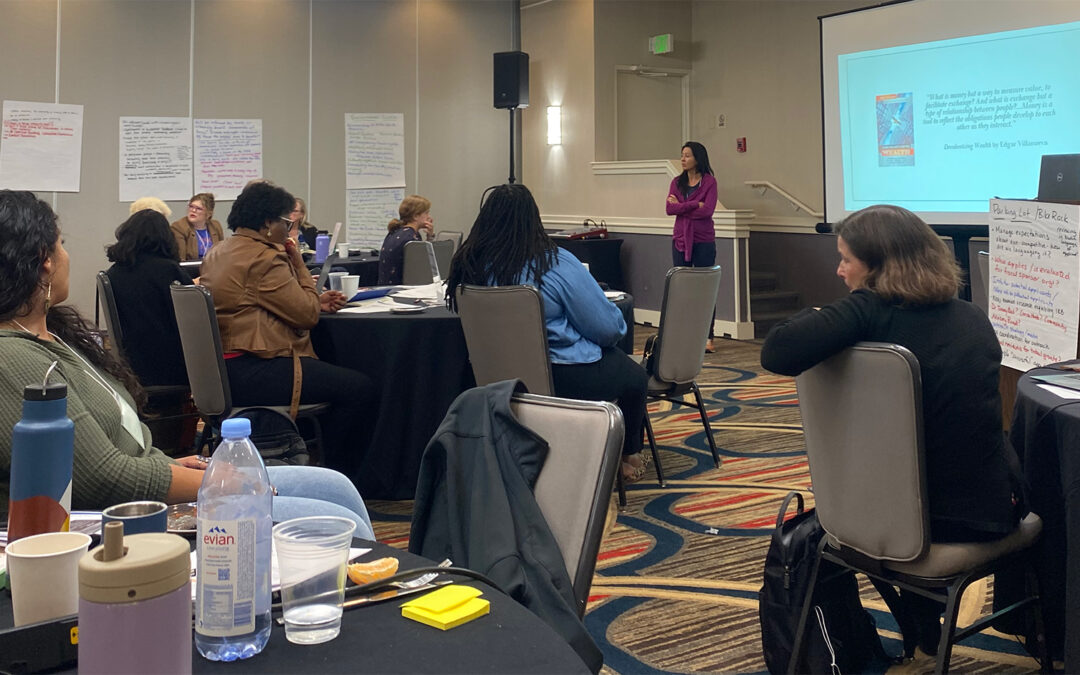
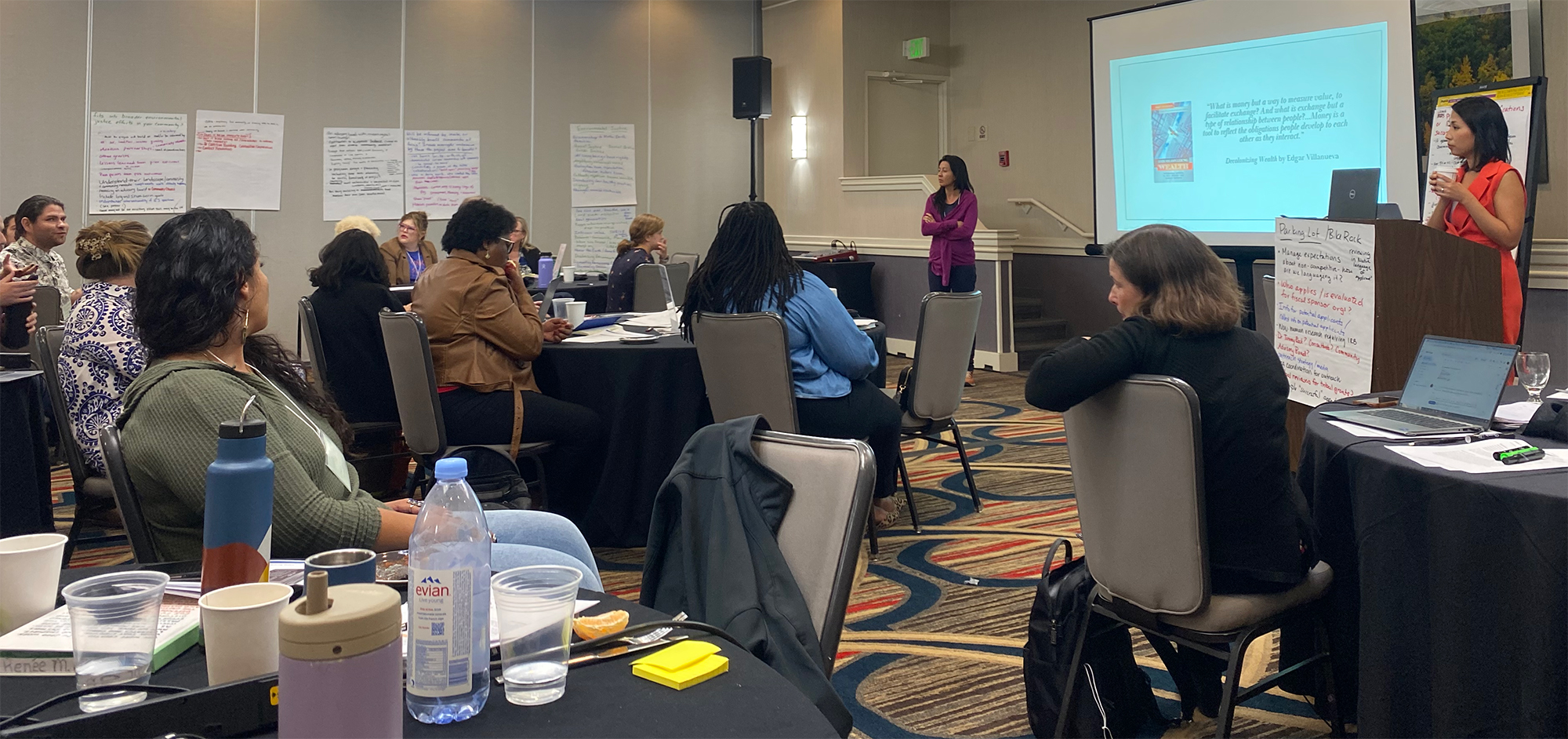
Community-Centric Fundraising (CCF) is a thought partner and trainer for the MAP EJ Grants. Three Global Council members – Esther Saehyun Lee, Meena Haque, and I – attended their in-person training in Denver, CO, on October 8-10. We led various sessions to introduce the EJ Council to our Principles to ground their grantmaking in equity. 

Experts themselves, the EJ Council shared their experiences with funders who earned and lost their trust. Together, we came up with the Council’s values of solidarity and integrity, we imagined what success for the region would look like beyond the lifecycle of this grant, and we led a session about rest.

The EJ Council will score grant applications during at least three grantmaking cycles between now and December 2027. The first grant cycle opens on October 28 and closes Dec. 12, 2024. You can sign up for updates on their website here

The council members helped in the overall strategy, and the applications are designed to be more accessible than Federal grants typically are.  

The community partner organizations from the region are the Cheyenne River Youth ProjectDakota Resource CouncilHealthy Environment Alliance of UtahMontana Watershed Coordination Council, Wyoming Outdoor Council, Green Latinos, Womxn from the Mountain, North Dakota Native Vote, and Montana Association of Conservation Districts.  

Interested in applying for funding? Here’s what you need to know.

The communities eligible for these grants can be determined using the IRA Disadvantaged Communities Map

These designations are based on calculations determined by the Climate and Economic Justice Screening Tool (CEJST), which was created to help guide 40% of the overall benefits of investments in climate, clean energy, and related areas to disadvantaged communities as part of the  “Justice40” Initiative created in President Biden’s Executive Order 14008

Communities that reside in disadvantaged areas can apply for funds to address the following:

  • Air quality and asthma
  • Fence line air quality monitoring
  • Monitoring of effluent discharges from industrial facilities
  • Water quality & sampling
  • Small cleanup projects
  • Improving food access to reduce vehicle miles traveled
  • Stormwater issues and green infrastructure
  • Lead and asbestos contamination
  • Pesticides and other toxic substances
  • Healthy homes that are energy/water use efficient and not subject to indoor air pollution
  • Illegal dumping activities, such as education, outreach, and small-scale clean-ups
  • Emergency preparedness and disaster resiliency
  • Environmental job training for occupations that reduce greenhouse gases and other air pollutants
  • Environmental justice training for youth

Funding will be awarded in these formats:

  • Tier 1 Assessment Projects up to $150,000 (1 year)
  • Tier 2 Planning Projects up to $250,000 (1-2 years)
  • Tier 3 Development of Projects up to $350,000 (2 years)
  • A limited number of $75,000 non-competitive fixed-amount subawards will be available for severely capacity-constrained CBOs to access.

The Mountains and Plains EJ Grants Hub will support you from the point you are funded. If your application is not funded, they will set up a session with you to go over your application and what would make it stronger (if you wanted to resubmit it in a future round of applications). 

If you need assistance prior to that point, you should contact the local the Mountains and Plains Thriving Communities Collaborative, the region 8 Thriving Communities Technical Assistance Centers (TCTAC pronounced “tic-tac”). Learn more about Montana State University’s MaPTCC pronounced “map-tek”) and the services they can provide here.

If you and the communities you work with are not in region 8, you can find grant makers as well as a national grant maker for your region and the supporting Thriving Communities Technical Assistance Centers (TCTAC) below:

Region Grantmaker EJ TCTAC(s)
1 — Serving CT, ME, MA, NH, RI, and VT. Health Resources in Action (HRiA) Institute for Sustainable Communities
2 — Serving NJ, NY, Puerto Rico, the U.S. Virgin Islands, and 8 federally recognized Indian Nations. Fordham University

West Harlem Environmental Action, Inc. (dba WE ACT for Environmental Justice)

and

Inter-American University of Puerto Rico-Metropolitan Campus

3 — Serving DE, DC, MD, PA, VA, WV, and 7 federally recognized Tribes. Green & Healthy Homes Initiative Inc. National Wildlife Federation
4 — Serving AL, FL, GA, KY, MS, NC, SC, and TN.

Research Triangle Institute

Research Triangle Institute (RTI International)

and

Deep South Center for Environmental Justice (DSCEJ)

5 — Serving IL, IN, MI, MN, OH, and WI. The Minneapolis Foundation

Blacks in Green (BIG)

and

University of Minnesota

6 — Serving AR, LA, NM, OK, and TX. Texas Southern University

Deep South Center for Environmental Justice (DSCEJ)

and

New Mexico State University

7 — Serving IA, KS, MO, and NE. Research Triangle Institute (National Grantmaker)

Wichita State University

8 — Serving CO, MT, ND, SD, UT, and WY. JSI Research and Training Institute

Montana State University

9 — Serving AZ, CA, HI, and NV. Social and Environmental Entrepreneurs (SEE), Inc

University of Arizona

and

San Diego State University

10 — Serving AK, ID, OR, WA, and 271 Native Tribes. Philanthropy Northwest

Willamette Partnership

and

University of Washington

NATIONAL Regions 1-3 Institute for Sustainable Communities (ISC)

(See above)

NATIONAL Regions 4-7 Research Triangle Institute

(See above)

NATIONAL Regions 8-10 Climate Justice Alliance

(See above)

Jenny Brandt

Jenny Brandt

Jenny Brandt (she/her) is a member of the Global Council at CCF. She is a co-lead of the Membership and Regional team and is building the network in Latin America.

Her career in non-profit organizations has focused on building equitable access for Latino communities to health, economic justice, advocacy, jobs within the Federal government, environmental justice, resources, and conservation.

She currently resides in Chetumal, Mexico, where she loves taking photographs. You can find her on Linkedin here

Community-Centric Fundraising joined JSI as a community partner for groundbreaking environmental justice funding

Community-Centric Fundraising joined JSI as a community partner for groundbreaking environmental justice funding

Community-Centric Fundraising (CCF) has joined JSI as an official community partner of the Mountains and Plains EJ Grants Hub (MAP EJ Grants Hub)

As recipients of the Environmental Justice Thriving Communities Grantmaking (EJ TCGM) program from the EPA Office of Environmental Justice and External Civil Rights, JSI, through the  MAP EJ Grants Hub, will be distributing $40 million in EPA Region 8 (comprised of Colorado, Utah, Montana, Wyoming, North Dakota,  South Dakota, and 28 Tribal Nations) to underserved communities to address environmental and climate justice challenges.

Community-Centric Fundraising was created and designed to ground the nonprofit sector in equity and social justice. Our mandate is to prioritize the entire community over individual organizations, foster a sense of belonging and interdependence, present our work not as individual transactions but holistically, and encourage mutual support between nonprofits.

In another way, our work is about distributing power and resources in a way that centers the community over individual organizations. So when JSI invited CCF to be an official community partner of the Mountains and Plains EJ Grants Hub, we knew we had an unprecedented opportunity to help ground the grantmaking process in equity for environmental justice. 

JSI invited the CCF Global Council to co-lead the MAP EJ Grants Hub Partner Gathering held in Denver three weeks ago. We were honored to develop and facilitate critical conversations about fundraising, power, and equity.

Jenny and Esther teaching in front of a group of JSI.

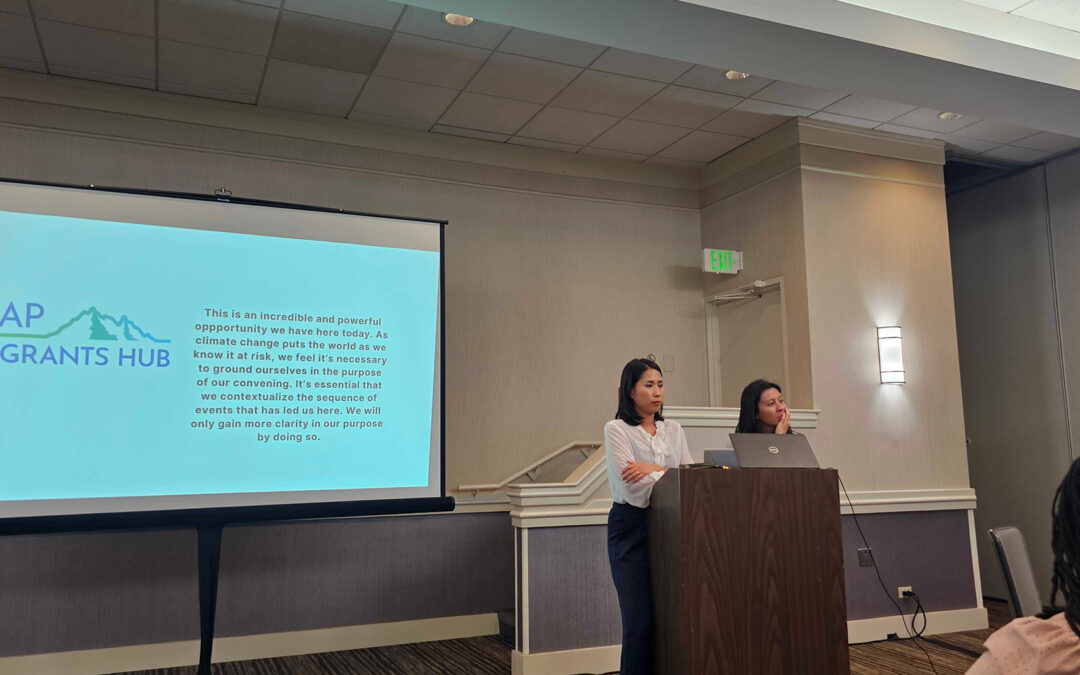
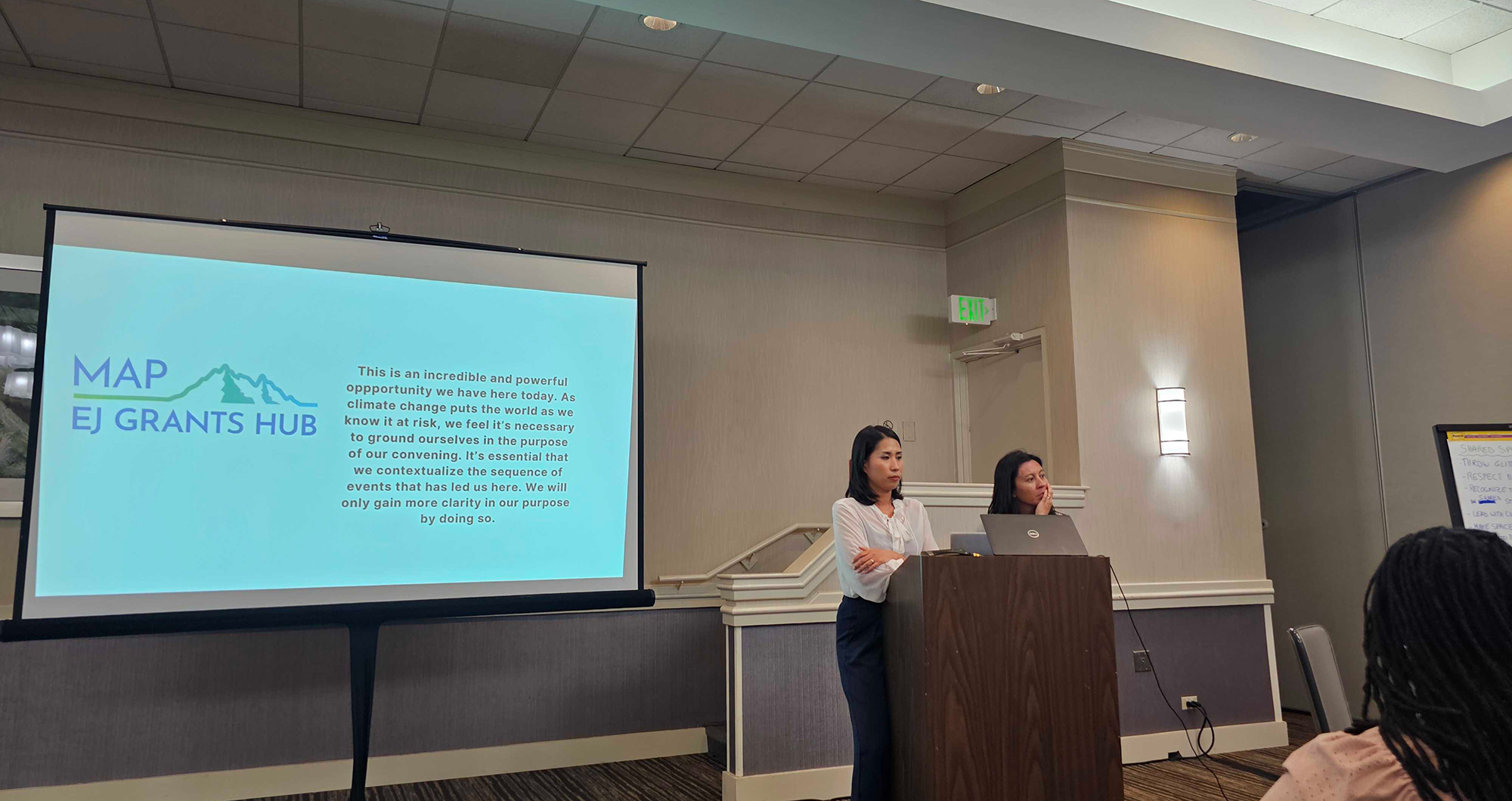
CCF facilitated sessions titled “MAP EJ Grants Hub: Grounding Us in Our Purpose” (with an overview and context of the EPA Environmental Justice Thriving Communities Grantmaking Program), “The Speed of Trust: Co-Creating MAP EJ Grants Hub Norms and Values,” “Dreaming and Visioning a Healthy and Thriving Region 8,” and “Abundance, Equity, and Care.”

Throughout the convening, we centered our discussions and facilitations on building trust, examining power, and centering community. 

The common thread in all our facilitations was that we were seeking to invoke conversations about how fundraising is resource mobilization and how to co-create a shared vision.

CCF’s mandate is to shift the sector to more equitable practices. This opportunity to shape such an historic grant program for environmental justice renewed our commitment to do so. We’re grateful to JSI for inviting us to be part of the program from inception and are excited to see what this grantmaking program will be when it’s grounded in CCF’s principles.

The CCF Global Council is honoured to be part of this program and vision. We’re excited to continue to be in these rooms where we can call for equity, justice, and abundance for the communities we serve.

In solidarity,
Esther Saehyun Lee, Jennifer Brandt, Meena Haque
Community-Centric Fundraising Global Council Members

Community-Centric Fundraising is a Community Partner for Groundbreaking Environmental Justice Funding

Community-Centric Fundraising is a Community Partner for Groundbreaking Environmental Justice Funding

Grants Now Open for Underserved Communities in Region 8

FOR IMMEDIATE RELEASE:
November 12, 2024

MEDIA CONTACTS:
Jenny Brandt (she/her), jbrandt36@gmail.com, (202) 697-9737

Denver, CO – Community-Centric Fundraising (CCF) is an official community partner of the Mountains and Plains EJ Grants Hub, a project of JSI. 

JSI is one of 11 Environmental Justice Thriving Communities Grantmakers selected by the EPA to distribute grant funds to underserved communities nationwide. JSI is the Region 8 grantmaker and developed the MAP EJ Hub to administer $40 million over the next three years to address environmental and climate justice challenges in Colorado, Utah, Montana, Wyoming, North Dakota, South Dakota, and 28 Tribal Nations.

JSI invited CCF to be a thought partner and facilitator for the program. In October, CCF co-led the Initial Partner Gathering in Denver, bringing the MAP Environmental Justice Council Members together for training in equitable grantmaking. CCF will continue to assist in-person, and through e-learning sessions as well as coaching sessions throughout the course of the program.

Global Council members Jenny and Esther present to JSI

“Having CCF be a part of the grantmaking process from the start will no doubt ground this entire process in equity and justice. It’s thrilling to see the movement gain traction to inform this scale of funding, and we look forward to continuing the partnership with JSI and the MAP EJ Grants Hub to resource organizations and communities committed to environmental justice.” Esther Saehyun Lee, CCF Global Council Member.

“CCF is thrilled to be participating in Justice40 programming that seeks to invest 40% of infrastructure investments in communities that have been systematically disadvantaged up until now. We hope to see this program extend beyond December 2027.” Jenny Brandt, CCF Global Council Member

“Community-Centric Fundraising is thrilled to partner with the MAP EJ Grants Hub in this vital initiative, aligning our commitment to reshape traditional funding models with the program’s focus on environmental justice. This collaboration enables us to uplift rural and tribal communities and those impacted by legacy pollution, advancing a more equitable approach to addressing the climate crisis. Together, we aim to equip these communities for resilience and lasting change, setting a new standard for funders to lead with social justice and reduce harm.” Meena Haque, CCF Global Council Member

“JSI is grateful for the intentionality and expertise that CCF is bringing to the MAP EJ Grants Hub as we work together to ensure that equity is at the center of both the process and outcomes of this important work. We know that those who live through the experiences and with the effects of health inequity and environmental harms on a daily basis are best positioned to address these injustices, and the MAP EJ Grants Hub aims to bring resources and support to those communities who have long been marginalized and underserved.” Elizabeth White, JSI Senior Associate & Deputy Director for the MAP EJ Grants Hub

Learn more at https://mapejgrants.org/

Jenny and Esther in front of the JSI team for the training

###


JSI is a global nonprofit dedicated to improving lives around the world through greater health, education, and socioeconomic equity for individuals and communities.

Community-Centric Fundraising is a fundraising model that is grounded in equity and social justice. It is a movement that seeks to shape and evolve how to better distribute power and resources in the nonprofit sector. It is a movement created to support fundraisers and other nonprofit professionals to re-examine fundraising philosophies and practices, engage in vigorous ongoing conversations, and explore fundraising in ways that reduce harm and further equity.

Possibility Labs is CCF’s fiscal sponsor. Possibility Labs is the platform for building a new economy where all people & the planet thrive.

When idealism meets reality: The fundraiser’s dilemma

When idealism meets reality: The fundraiser’s dilemma

By Michelle Flores Vryn, CFRE, frontline fundraiser, board member, and content creator

So, what will it be? Do you stay and struggle against the tide, or do you leap into the unknown for a chance at true impact? 

Let me describe an experience that is universal among fundraisers. (If you’re not a fundraiser, consider yourself lucky. This is not a happy story but one of deep and layered disappointment.)

You interview at a good amount of places to make sure you find the right fit. You’re not in a hurry. Far from it. You want the right professional landing. There are some real outrageous nonprofits out there and you want to steer way clear of that mess. 

So you interview and you select a place that feels pretty great. 

The excitement is palpable! The people and mission are fabulous and they are open to having you teach about a “culture of philanthropy.” Can you believe it? They even use that term. This is a good sign. 

The first few weeks or even months are pretty good. All in all, you feel confident in your selection choices. Go you! 

But then it happens. The inevitable. It’s one of two scenarios. If you have poor luck, you get slapped in the face with both. 

Scenario 1:

The board is not happy with the fundraising progress. This message flows down to you. Your eyes grow bigger with shock. It’s only been 10 w-e-e-k-s! and we discussed how relationship-building takes time! We had dialogue around it. Heck, you even interviewed with the board chair, who seemed like he “really got it.” Whatever it is. 

Scenario 2:

Your CEO asks in your weekly check-in where the million-dollar gift pipeline is. “This is great but where’s the real money? Like million-dollar gifts?” Now you’re caught off guard. It’s a Zoom call. You can see your own face in the upper corner. Don’t look shocked. Don’t look angry or taken aback. Get curious. Right? That’s what your therapist said. Don’t let anger take over. Ask why. 

So you do. 

You mutter back, “Hmmm, can you tell me more about what you mean by a million-dollar pipeline? Are you not satisfied with the people in our pipeline?”

“No, they are not million-dollar-level gifts. These are small players. We need bigger fish. Where are they?” 

So now, you enter the stage of second-guessing yourself. At first, you think, “Am I wasting time on the wrong prospects?” No, you know you’re not. These are good fits—you did your research. 

But how do you convey this? 

“You want million-dollar gifts? Huh, well you better start forming million-dollar relationships.” 

Too snarky. You cannot say that. Be realistic. So what do you say?

Enter the realization

In that instant, true colors have been revealed. You now face a fork in the road. Not to be decided in this conversation. One that has to be put on hold and fully digested after the call. You know, when you reevaluate your decision to take the job and jeopardize your whole career.

A path of two choices

I repeat. You have two choices.

Choice 1

You stay and try to teach and persuade the organization—let’s face it, it’s really the top leadership—to exercise more patience. Relationships take time. They are nonlinear. We put in the work and it pays off. Our work is impressive and people want to back it. We have to understand it’s a slower burn than we’d like. That’s the nature of the fundraising game. Also, throw in some Giving USA data for backup.

The problem with Choice 1: You’ve been here before. It never worked. Never. Not one time did you actually succeed at changing people. Your therapist says this feat is impossible. But what does she know anyway? People tendencies, I suppose.

Choice 2

You plan your exit strategy. Your well-being is not worth being stuck in a capitalistic mindset wrapped around the nonprofit industrial complex. You are talented. Heck, multi-talented. You’re a brilliant strategist. You could get hired anywhere. One snag though: despite its endless flaws, you actually like nonprofit work. God only knows why. The people are so hard to work with. Unrealistic expectations out the wazoo.

But what is the exit strategy?! How do you not go down with a sinking-and-on-flames ship? 

You have to jump. But … does this mean you’ll have to compromise what you want? Become a consultant. Ugh. Like the sector needs one more consultant. 

So, what will it be? 

Do you stay and struggle against the tide, or do you leap into the unknown for a chance at true impact? 

The choice is yours. 

What’s the good ending to this story?

Is there one?

Michelle Flores Vryn, CFRE

Michelle Flores Vryn, CFRE

With 15+ years in nonprofit work, Michelle (she/her/ella) has led both fundraising and communications teams. She is the Head of Development at iNaturalist, one of the largest databases of the world’s biodiversity, and has previously worked in missions focused on endangered species, climate solutions, and civic engagement. 

Michelle serves on the board of the Association of Fundraising Professionals (AFP) Global and co-organizes the Texas chapter of the Community-Centric Fundraising movement. She is a first-generation college student and holds a Certified Fund Raising Executive (CFRE) credential and a master’s degree in cultural anthropology.

Find Michelle on LinkedIn – she’d love to connect!

Check out her website to learn more about her work.

Send Michelle a tip via Venmo: @Michelle-Flores-Vryn

Centering community in year-end appeals

Centering community in year-end appeals

By Kelly Phipps, Community-Centric Fundraising Global Council Member and annual giving fairy

Tinkering with the tried-and-true formula of appeal writing to incorporate community-centric approaches can feel daunting. And to be clear, I’m a student of the CCF appeal craft offering my noticings as a jumping off point for future conversations. Ready to learn with me?

There’s an unspoken vulnerability embedded in Holiday giving appeals. Simply check your inbox on Giving Tuesday morning, and you’ll experience the parade of personal testimonies and stories of individuals going through what may be the hardest moment of their life and how we, as readers, are the ones who can save them. 

The extractive tension between centering stories that connect donors to an issue and maintaining the storyteller’s agency can be a narrow line to tow. And when the balance is off, it is the individuals who are vulnerably visible that feel the impact.  

When I worked at a university, I often felt this tension when navigating appeal writing specifically for scholarship recipients. At first glance, the story of a scholarship recipient is a heart-warming story of a thankful student who one day may be a researcher, made possible by the Frank Smith Award. Yet, on a deeper level–due to systemic issues like the wealth gap, rising costs of housing, and the lack of free higher education–countless college students across the country silently struggle not only to pay tuition but grapple with housing and food insecurity. And the national student debt crisis continues to harm millions. While I wasn’t fully landed into a CCF framework in that role, it was an important lesson learned on the types of questions we as fundraisers can ask when caretaking the stories of those in our community.

Tinkering with the tried-and-true formula of appeal writing to incorporate community-centric approaches can feel daunting. And to be clear, I’m a student of the CCF appeal craft offering my noticings as a jumping off point for future conversations. Ready to learn with me? Here are some CCF appeal approaches that are helpful keep in mind: 

1) Ground in values and principles

The Community-Centric Fundraising (CCF) principles and values are a great starting point to ground your appeal writing. To kick it off, challenge yourself to go through each CCF principle or value and ask, for example, “How does my appeal to fund a local food bank relate to equity?”

One surprising way this grounding shifted my thinking was the CCF concept of movement building. It’s very rare that a nonprofit organization would be positioned to solve a societal issue completely on its own. This past spring, this meant that in a Mother’s Day solicitation for an annual program, our appeal uplifted and linked out to our partner organizations to both honor their programmatic role and create opportunities for individuals to support them directly. We also reshared fundraising asks from these same partners on social media. Rejecting the competitive framework that is often the default can create space for a beautiful and community-affirming approach to inviting support. 

2) Unearth the real root problem

What is the cause of food insecurity? Why can’t a student afford tuition? Why are the arts underfunded? What are the real drivers of a particular illness? Why is gun violence more prevalent in this city? 

No matter what you fundraise for, if you were to ask why the problem your organization seeks to fix exists, it always points to a systemic problem. Naming the systemic “why” is important — without situating a social issue within the framework of systems-level drivers, we can inadvertently place “blame” onto those most impacted through a flimsy lens of personal choice or lack of knowledge. 

For example, it’s easy to say that a particular neighborhood has high rates of an illness because they don’t know how to eat healthier. A zoom out to the real root problem, however, would reveal how corporations intentionally deprive certain communities of healthy food options, or how the weathering effect of racism and existence of medical racism not only lead to increased illness in people of color but those community members are also less likely to get a diagnosis because of factors outside their control. 

Naming these root problems can feel radical and political. And yes, it is. 

I’m a big believer in “familiar language.”  The takeaway here is not that you have to put the phrase “systemic oppression” in your appeal letter. Framing information in ways that are understandable for your audience, to call people into a belief in a relationship-centered way, is powerful. 

The definition of what familiar language is depends on the audience. It requires having somewhat of a pulse on how your audience feels about a topic, their level of proximity to the topic, and other specific factors. It’s also important to be clear that using familiar language should never whitewash the radical. It’s one thing to use a defining sentence instead of jargon to ensure the audience understands a concept, it’s another to erase sharpness of your framing by shying away from the hard thing. I often find I can strike this balance by being specific. 

For example, an appeal letter may say, “Minority students are underrepresented at the university because they need scholarships to afford college.” But through leaning into specificity and familiar language you can better uplift the root causes you instead could say “Each year, thousands of Black students are in jeopardy of graduating simply because they can’t afford tuition. The hurdles to fairly access education have increased as the cost of living impacts worsen the acute harm unjust policies and practices have created for working class Black and brown communities.”    

Ensuring the “problem” in your appeal points to the systemic in a way that brings your audience along is key to centering the dignity and humanization of your community. 

How would you write this example? Let me know!

3) Maybe we don’t need heroes  

Do we need heroes or do we need community?

CCF and donor-centric discourse can easily fall into a false binary. Writing your holiday appeal doesn’t mean that you forgo painting a clear and compelling picture of how a donor has a role as a partner in your work. 

However, there are two problems with centering the donor as the singular “hero.” One is that it strips the benefiting communities, identities, and people of agency. The second reason is that it’s also incomplete. 

When we think about who drives in-community solutions and work, those most impacted by a societal problem often have the expertise and leadership. For example, the strategies and policy visions within criminal justice advocacy work are sharpest when led by system-impacted people. Within reproductive and gender justice work, it is trans people, women (especially Black women), pregnant people, those who have had abortions, and those impacted by gender-based violence who are the impact-makers. 

If your appeal is focused on an individual, this shift often means uplifting their personal agency and expertise within the outcome of their story. When speaking more broadly, it might mean specifically naming the ways community expertise is infused in your work. You might name how a new research program was born from cancer survivors who saw a gap in outcomes and advocated for that focus, or how a community outreach program is making unprecedented impact because of who is leading the outreach specifically.  

This should also feel true to how your organization operates to be genuine. If the community your nonprofit focuses on isn’t represented in leadership, on your board, in spaces where they can offer insights, the tension you feel within your appeal writing is actually pointing to a larger conversation needed at your nonprofit. 

Stepping back from the hero-mindset within your appeal is exciting because it creates space to likely spotlight the voice of someone whose leadership is largely unseen by society. 

4) Get specific in the ask

We’ve often been taught that specificity in “the ask” is best practice. And I think there is a deeper “why” to underscore the importance of being specific about how a donor can help. It’s really easy to lean into the compelling, inspirational ask in a Holiday appeal. The one that makes it seem like their gift will solve world hunger and make the nonprofit’s mission possible. 

While it’s true that a donation to STEM education for girls will help close the STEM representation gap, making clear how a gift of $200 means that one girl can access a computer training that is a prerequisite to attending a university program by covering the cost of her tuition is exciting too. It makes it clear how the donor made an immediate difference while understanding the larger context (closing STEM representation gap). 

It’s more actionable too. Understanding how my $200 is helping someone in a concrete way is more believable than thinking my $200 ended tech sexism. And it does so in a way that makes my contribution feel important and without taking away from the agency of the recipient. It’s still her skills, dream, and hard work that will drive her future success. 

5) Cherish gratitude

Fundraising in a community-centric lens is, in many ways, a balancing of complicated truths. We are fighting for a world that aligns with our justice-centered values while still operating within a societal structure that is capitalistic and riddled with power dynamics and oppression. 

Within this balance, though, gratitude is still a necessary strategy and value. Community-centric fundraising calls us towards deeper, more authentic relationships, not only with our community but with our donors. It invites people into a framework that celebrates the contributions of everyone’s role.

A lot of angst that fundraisers have when falling into the donor-centric vs. community-centric trap is thinking that the centering of community erases gratitude to the person making a gift. To that, I say, throw gratitude around like confetti. 

Be thankful for the leadership of communities driving social change. 

Be thankful for the individual who realized their privilege in having an extra $3,000 and decided to donate it with no strings attached.

Be thankful for the beautiful constellation of people, roles, and resources that together care about ending illness, closing an equity gap, ensuring everyone has housing, or human rights needs. 

Because it’s truly together that change happens. 

If someone can understand the real problem, their role in supporting the leadership of communities, and your thankfulness for that partnership when reading your holiday appeal—congrats! You just wrote your first CCF appeal.

Kelly Phipps

Kelly Phipps

Kelly Phipps (she/her),  is a doting auntie, audiobook-lover, and dog-cuddles enthusiast. When she isn’t in the thick of an Afrofuturist novel or learning to dance, Kelly serves as the fundraising and communications director at a social justice organization. 

Kelly has spent the last decade in nonprofit fundraising and communications (in healthcare, higher education, and grassroots community work) and is excited to co-learn community-centric approaches with others who care about mobilizing resources for our communities. You can connect with Kelly here.