
Trump and Trumpers aren’t to blame for everything happening right now. It’s white supremacy culture, and you might be contributing.

Trump and Trumpers aren’t to blame for everything happening right now. It’s white supremacy culture, and you might be contributing.

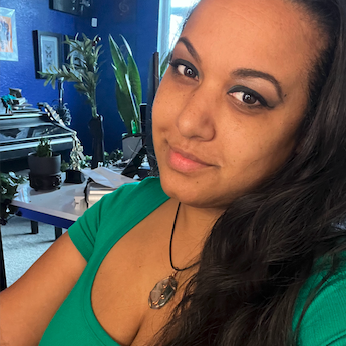
By Chris Talbot, queer, trans nonbinary, mixed-race, neurodivergent activist, artist, writer, editor, and justice, equity, diversity, and inclusion consultant

we’re letting far too many people and entities off the hook when we desperately need them to examine their behavior, beliefs, and actions that contribute to the oppression that those of us who are minoritized have always experienced and led to this fascist regime we’re sliding toward now.

It’s wild to have been the target of white supremacist attacks for the last 42 years (how long I’ve been alive) and watch as articles and statements from so-called liberal white folks and publications declare that this or that item from the Trump administration is “unprecedented” or signifies a great shift in our national culture.

I can’t even imagine what it’s like to watch these articles and statements come out as a member of the Global Majority whose nation has continually been under fire with oppressive USian policies and insidious political destabilization.

This is exactly what our culture has been since the colonization of Turtle Island.

I guffawed when I saw The New York Times (NYT) February 9th article “Trump’s Shameful Campaign Against Transgender Americans.” NYT has published hit piece after hit piece against gender-affirming care for children and adults; continually platformed Pamela Paul – a virulent anti-trans propagandist – for anti-trans pieces, as recently as November 14, 2024; and continuously uplifted non-science-based speculations by other transphobes for years. NYT articles have directly been cited by extremists in Capitols around the nation to justify the onslaught of anti-trans laws we’ve seen in recent years. Erin Reed wrote an excellent post detailing their hypocrisy and complicity, so I’ll redirect you there rather than expand on it here.

Besides all of these individual accountability shifts being ahistoric and ridiculous if you think about it for more than a couple of seconds, they’re also dangerous. Because it means that we’re letting far too many people and entities off the hook when we desperately need them to examine their behaviors, beliefs, and actions that contribute to the oppression that those of us who are minoritized have always experienced and led to this fascist regime we’re sliding toward now.

(I have started using “minoritized” rather than “minority” because not all minorities are minoritized. I had a white, cisgender, heterosexual, abled man tell me, in earnest, that he was a minority in a space that was navigated mostly by white, cisgender, heterosexual, abled women. He didn’t realize that his being outnumbered didn’t mean he was being oppressed in any way, and that marginalization wasn’t just about numbers, but about power and equity. So I feel the need to use minoritized moving forward.) 

Anti-DEI sentiment isn’t exclusive to Trump or Trumpers. Have you contributed?

Speaking of ahistoric, I feel the need to remind people that anti-DEI (I will be using diversity, equity, and inclusion moving forward because I think far too many people feel safe hiding their resistance and outright opposition behind the acronym) sentiment isn’t exclusive to Trumpers as all the articles and opinion pieces laying all the blame squarely on their shoulders are beginning to come out.

I’ve personally experienced anti-diversity, anti-equity, and anti-inclusion sentiments in the workplace from mostly white, cisgender, heterosexual, abled men and women who believe they’re liberal.

The first time I was told that I was a diversity hire was when a white, cisgender, heterosexual, abled colleague and I went after the same position, and I was chosen over him. In that tiny, predominantly white town and all-white except me workplace, he was considered as leftist as they come. My being chosen made perfect sense considering my CV compared to his and my position — it was a lateral move for me to get away from a supervisor who continuously weaponized her white woman tears, and it would have been a promotion for him. But his response was to tell me, to my face, that I was a diversity hire.

White, cisgender, heterosexual, abled, liberal folks tend to believe justice, equity, diversity, and inclusion work is great until they learn they have work to do or that building equity means that their marginalized colleagues are given a voice or power. Then it quickly becomes “mission creep,” “reverse racism,” “penalizing me for my privilege,” “creating dysfunction in the workplace,” or “injecting personal views and interests.” Because they see themselves as the default and all other cultures, opinions, and ways of being as “other” and not appropriate for the workplace, not realizing that is the textbook definition of white supremacy culture and exactly what Trump is doing on the national stage. 

When you operationalize that bias in the workplace by deciding that BIPOC colleagues can no longer share their personal views, cultures, and opinions because it made someone of privilege uncomfortable to hear, while having no such guidelines for white colleagues, it becomes oppression.

Additionally, if you don’t disrupt these conversations to operationalize that bias in the workplace, you are complicit in the creation of oppression. Not speaking up for your minoritized colleagues as white supremacy culture is being enacted is white supremacy culture. 

So what can this look like? If you believe (or don’t disrupt someone who believes) that BIPOC folks should be in your company to add legitimacy to that work but shouldn’t infuse themselves or their cultures into the way they work or share the perspectives their cultures and experiences give them, you are being anti-DEI and oppressive.

An example of this: At one workplace, I was tasked with giving land acknowledgments during events. As an Indigenous person, this gave legitimacy to the organization’s land acknowledgment that otherwise wouldn’t be there. At one event, I shared my personal land acknowledgment, sharing what perspective I was giving it from (an Indigenous person by way of Canada, but a settler on these specific lands), and included a Land Back statement that I expressly stated was my own belief. 

A colleague who clearly did not understand what Land Back meant (he believed that established white folks would be kicked out of their homes and replaced by displaced Indigenous people both on Turtle Island and in Palestine and Israel, as he also misunderstood the Right of Return), brought up how he opposed it in our next staff meeting. He began stating untruths as facts and began using anti-Arab dog whistles, and I disrupted it, saying I needed to have the conversation with a facilitator present to ensure it was rooted in fact and respectful. We agreed as a group to table it, but the group also decided I couldn’t so much as express that I support Land Back in future land acknowledgments. 

Two years later, we still hadn’t had the meeting with a facilitator, and I had given many land acknowledgments without a Land Back statement – providing legitimacy to the organization through my identity but not being allowed to show up authentically how my identity called on me to show up. 

That colleague ended up writing a hit piece to try to get me fired from my job and used the Land Back example as one of the ways in which I “inject personal views and interests” without a shred of awareness that his opposition was doing the same. Because that’s what we do in workplaces. We share our personal views and interests. But, just like Trump is doing, white supremacist workplaces make policies against or try to get minoritized colleagues fired when they do it.

Trump may have attempted to outlaw diversity, equity, and inclusion work, but there were plenty of white, cisgender, heterosexual, abled folks chomping at the bit for that work to end (for minoritized people, not for themselves; they appreciate it when it benefits them) and quick to jump when it is under attack and when no one is willing to stop them.

Be the someone who stops them.

Trump and Trumpers didn’t make you stop services to minoritized clients or remove mentions of their specific needs from your website. Did you choose to pre-comply?

I need organizations to stop obeying in advance. In Denver, Colorado (and all over the nation), healthcare organizations pre-complied with directives to end gender-affirming care to people under the age of 19 a mere three days after Trump signed an executive order, the intentionally misleading “Protecting children from chemical and surgical mutilation.”

Those edicts haven’t even gone into effect yet. The directives require rule changes, which can take months, and a federal judge has temporarily blocked it, stating that it “blatantly discriminated against trans youth.” Hopefully, it won’t go into effect ever as there are a host of lawsuits to block it, including a joint lawsuit from Attorneys General all over the nation challenging the order – Colorado’s Attorney General was late to the party, but he did add Colorado to the suit on February 19. 

But almost immediately after the executive order was announced, Denver Health, UCHealth, and Children’s Hospital Colorado pre-complied, notifying children and 18-year-old adults all across Denver and Colorado that they would no longer be receiving their life-saving care.

Denver has some of the strongest protections for transgender people in the nation (the bar is so low, it’s in hell), so we’ve gotten a lot of transplanted folks for our protections and safety. But these organizations pre-complied and stopped providing puberty blockers, HRT, and gender-affirming surgeries overnight, despite those being the only medical treatments available for gender dysphoria.

The only way an order like this would have an impact is if those who purport to care comply. And Denver Health — a company that touted itself as the go-to place for LGBT healthcare for years and marketed itself on that, making some serious bank — folded within three days, before it even took effect.

If no hospital complied, this couldn’t go through. There’s no way an entire state’s worth of hospitals could lose federal funding. Obeying before it’s even in effect lets us know how much you’re willing to fight for the most vulnerable in your community, which is not at all. You might tell news outlets, as Denver Health did, that you “recognize this order will impact gender-diverse youth, including increased risk of depression, anxiety, and suicidality.” But you won’t do anything to resist it. Because trans children are expendable to you.

But trans children aren’t expendable, and we need to fight tooth and nail for their right to survive their childhood so they can become trans adults who thrive.

Since Attorney General Phil Weiser joined the lawsuit last week, Denver Health immediately resumed its care, and Children’s Hospital Colorado has stated it will resume its care for trans patients under 19 years old starting today (if the judge that issued the temporary restraining order extends it to cover Colorado – again, waiting for political cover before doing the right thing for patients under their care). But that care should never have been pulled in the first place, and I’m terrified to know how many children took drastic, permanent, and dangerous measures while it was.

If you work in an organization that serves minoritized people who are currently under attack by the Trump administration, you should not comply with any of the edicts coming down to remove your services to them. And you especially should not pre-comply.  

Be someone who protects people and ignores unjust edicts.

Trump and Trumpers aren’t making you expect inhuman amounts of emotional regulation from your minoritized colleagues. Are you expecting more from them than would ever be expected of you?

I need people of privilege to realize that the discombobulation they feel right now because of how many horrible things are happening in the federal sphere, how quickly new attacks are coming, how powerless they feel to weather or counter them, etc., is how BIPOC, trans, and disabled folks often feel navigating predominantly white, cisgender, and abled institutions that haven’t done any or are just beginning to do their justice, equity, diversity, and inclusion work.

If you find yourself becoming dysregulated and having a shorter fuse, realize that has been your minoritized colleagues’ experience with you and your workplace, but they’ve stifled it because they aren’t allowed to be dysregulated at work. Because perfection is expected of them, and when they don’t achieve it, they are penalized.

They are navigating the same horrible things you are in this moment, except a lot of the executive orders and stochastic terrorism are aimed at them. Plus, they are navigating what you regularly subject them to at work. Their ability to continue to regulate may be at an all-time low. 

This is an excellent time to gain some perspective and empathy regarding what life is like for minoritized people so that you can learn to have the sort of grace, patience, and generosity of spirit you’ve been afforded in the moments and years your minoritized colleagues have emotionally regulated and put their relational responsibilities first, knowing you didn’t so much as see your responsibility to them.

Please don’t squander the opportunity.

You don’t get a free pass for not being Trump or a Trumper. What do you need to investigate?

Investigate how you think about diversity, equity, and inclusion in the workplace and how many times you’ve considered your white, cisgender, heterosexual, abled colleagues bringing their beliefs, values, and opinions to the table as normal, and how many times you’ve considered your minoritized colleagues doing the same to be inappropriate for the workplace or sowing dysfunction. Investigate how you’ve treated someone speaking up for diversity, equity, and inclusion when it made you feel uncomfortable. Investigate if you’ve silently allowed someone to abuse someone speaking up for diversity, equity, and inclusion, thereby being complicit in that abuse.

Investigate how your organization might be pre-complying with edicts that are immoral and discriminatory, if not downright terrorizing, to minoritized people and what message that sends. Investigate the true risk assessment of your organization if you don’t comply, remembering that if we all resist united, we build our power.

Investigate if you are showing your minoritized colleagues care, compassion, and grace in a moment that you are finding hard to navigate even as you aren’t the direct target of the stochastic terrorism being enacted. Investigate the discrepancies in how your minoritized colleagues are always expected to show up regulated, no matter what is happening for them, when other colleagues are allowed to show up how they show up.

You don’t get a free pass for not being Trump or a Trumper. Be curious about how you’ve contributed to white supremacy culture and how not challenging it head-on has led to this moment we’re all collectively experiencing. 

And then get to work to prevent it from getting worse in your sphere of influence.
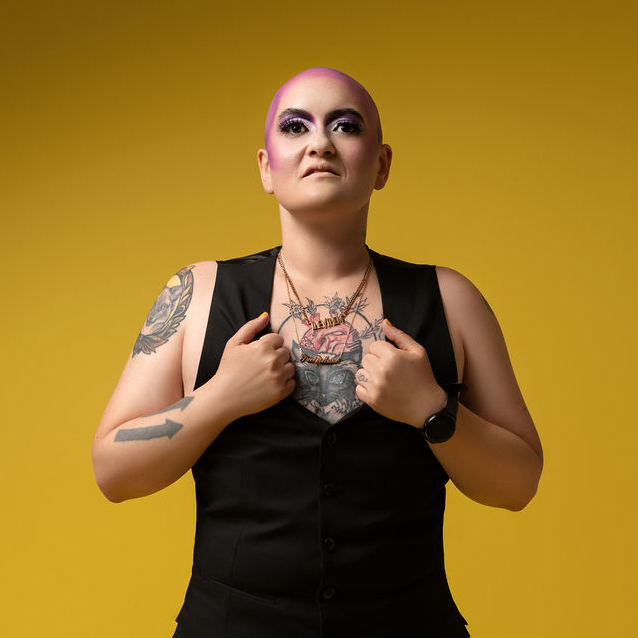
Chris Talbot

Chris Talbot

Chris Talbot (they/them) is a queer, trans nonbinary, mixed-race artist, activist, and nonprofit employee. When they aren’t working the day job, they spend their free time editing art and literature magazines, writing and illustrating educomics to help folks affirm their nonbinary pals, creating a graphic novel to describe what it’s like to be nonbinary in a gender binary world, cuddling their cat, and quad skating in the park. Purchase their debut book, Why Must the White Cis Nonprofit Workers Angry React to All My Posts? A compilation of essays, posts, and thoughts by a queer, trans, mixed-race professional surviving predominantly white cisgender heterosexual institutions.

You can find Chris at talbot-heindl.com, on LinkedIn, Instagram, Bluesky, and Twitter — and tip them on Venmo or PayPal or join as a patron on their Patreon

Photo credits: Makeup by Brittany Blaze-Shearz; Direction and photograph by Chermetra Keys/The Female Shoota; cattoo by Aura Rain Heindl-Rockman.

Ethical layoffs: 10 steps to minimizing harm and supporting employees

Ethical layoffs: 10 steps to minimizing harm and supporting employees

By Vanessa Diaz, a queer Latinx graphic design and marketing professional passionate about equity and liberation for all

Nonprofit organizations forced to do layoffs can take steps not to leave their ex-employees high and dry and actually support them during this time of need.

As someone who was laid off seven months ago from a nonprofit organization and has applied to over 100 jobs, invited to 15 initial interviews, and five second-round interviews, I can confidently say layoffs are unmotivating and exhausting. 

But I believe there can be a way to make them less horrible and highly empathetic. 

Countless nonprofit organizations claim to be mission-driven, community-oriented, and a safe space for all, but that suddenly comes to a halt when they call you into HR for a “chat.” The ways in which they express their sincerest apologies speak volumes to how senior leadership is being trained in letting people go and what they are doing (or not doing) leading up to the termination date and weeks after.

It can start to feel very personal if your former boss doesn’t offer any words of support or if the resources provided to you feel abysmal. This goes for any and all former employees, especially those in good standing, who have received no warnings, are highly productive, and are excellent collaborators across staff.

Nonprofit organizations forced to do layoffs can take steps not to leave their ex-employees high and dry and actually support them during this time of need. This not only shows tremendous character but leaves both your exiting and remaining employees with high morale, knowing that everything was done to support affected individuals and came from a place of kindness. 

In my humble opinion, here are 10 things nonprofit organizations can do to ensure ethical layoffs:

10. Be upfront about expectations before the termination date:

Be upfront with your former employee if you’ll be taking away all passwords or important document access right away, if you won’t be inviting them to any new meetings, or what their workload will be like. The sudden change can cause whiplash, and any forewarning is helpful. Alternatively, if taking sick days until their termination date is possible, then offer that to your former employee.

I was not offered any additional conversations with my team about the reduction in force. I was removed from all passwords and applications within an hour of being notified that I was laid off, and was only left with limited email access. No one reached out about an off-boarding plan for the following two weeks after, and the layoff was well-known by senior leadership ahead of time, so if they had wanted to reach out, they could have.

Other colleagues within the organization worked all through the two weeks leading up to the termination date and were offered transparency in their off-boarding.

9. Resources and options for 401k and healthcare:

Prepare a “cheat sheet” for laid-off employees on how to transfer their retirement funds outside of the organization and options outside of COBRA for healthcare. Many folks often forget their 401k accounts, and then their former employer changes providers, and that money can get lost. 

COBRA is ridiculously unaffordable in many cases. Offer Medicaid options for healthcare and other reasonable resources to follow that can guide them through that process. Anything that gives them a few options, websites, or numbers to call is helpful.

In my experience, I was sent a very basic one-pager that only included the minimum amount of information they could possibly fit on one page. To say the least, I was left with so many questions that I had to follow up with HR and do some extensive research on my own. I did request a meeting with someone from HR to talk about my questions, but they ignored my request, which felt very unsupportive during such an emotionally exhausting time. 

Due to the lack of information about what to do with their 401k, some former colleagues ended up paying high transfer fees without needing to do so.

8. Let your ex-employees obtain files for various portfolios:

This shouldn’t be an awkward conversation to have. Under appropriate supervision, allow soon-to-be ex-employees to retrieve files as needed, giving them visual proof of all their experience. It’s important for portfolios of work in the fields of UX/UI design, graphic design, illustration, website design, and fundraising, for example, to have real-life examples. Set your former employees up for success. 

If you feel the need to, you can also make an agreement about crediting the work as the property of the organization so everyone feels good.

For example, I have friends who have been laid off and did not have permission to copy files from a company cloud or drive. Hypothetically, if this were permissible to exiting employees, the company could include a watermark or logo, and draft up a contract with reasonable limitations of use. This could really create a tangible way for folks to maintain trust with their former employer and have something to show for their years of hard work.

7. Resources on FSA/Commuter Benefits:

Many folks plan ahead and pre-pay for commuter benefits and FSA funds, which means some of those funds are already paid for and need to be spent before your termination date. Please train your HR employees on what updated options are available to you.

I had to ask HR to stop my commuter benefit weekly payments, which was super frustrating because the payments were accumulating into an account that would have to be used within a short time period. I had assumed payments from my weekly paycheck would automatically be on pause, or best case scenario, I would have been alerted by HR to stop these payments to avoid spending so much in one sitting. 

I did end up having to spend well over $500 before the two weeks, which proved difficult since I stopped going to work and bus tickets have an expiration date.

6. List of trusted contacts that could possibly lead to job interviews:

You don’t have to be aware of who’s hiring, but at least keep a spreadsheet of folks that your leadership has a good relationship with and send that out to laid-off employees to do their own outreach. 

That in itself would be super helpful and if their former boss can vouch for the employee, it would be an instant referral.

It is a fact that executive teams and senior leadership are connected and in collaboration with other like-minded individuals with local nonprofits. These contacts could easily be put into a spreadsheet with their name, organization, position, and who in your organization they’re connected to, and kept updated on a quarterly basis. 

That way, if laid-off employees contact those people or look into who’s hiring, they can put down the contact’s name as a referral and go in with higher chances of getting their applications looked at. 

Laid-off employees are allegedly let go due to a reduction in force, restructuring, or budget reasons, so the nonprofit should have no issues giving up their contacts. 

5. Resume reviews or career coaching through partnerships:

The nonprofit world is filled with sponsorships from large corporations funding massive galas, building new office spaces, or donating new technologies. Let these corporations help your laid-off employees with resume reviews, career coaching, or financial tips. Organizations are always looking for volunteer opportunities!

In my experience, medium or large nonprofits are well connected to banks or corporations that offer their corporate employees perks for volunteering at the nonprofits they donate their money to. My former place of employment held an annual career fair for members of the LGBTQ+ community and part of their programming was holding resume reviews, career coaching, and offering financial literacy workshops. 

Seeing as these programs are already being offered to community members, it would be easy to extend the same resources to their former employees. Assuming programs have the capacity to take on more people, this offering would be a free way to help support laid-off employees.

4. Do not tell your team that you are “safe” from layoffs:

Layoffs are often a last resort and may affect anyone from leadership to associate positions. Any boss shouldn’t be telling employees anything that could potentially change.

Yes, this was my experience. My boss assured our team most other teams would be affected except ours. Being wrong about such an assurance does more damage and lessens the trust and credibility you have as a leader of your department.

3. Provide an exit interview:

It’s degrading to see some laid-off employees get exit interviews and others not. Train leadership on best practices on how to let go of staff. Yes, it’s awkward for everyone, and emotions can be high. But, assure your soon-to-be former employees that their skills and experience at the organization were highly valued by a person who worked closely with them. 

Do not ghost them. Do acknowledge their current situation is hard. Maybe take them out for lunch or do one last outing as a team to acknowledge a farewell in good spirits (after checking in with them to see if that is something they want to participate in).

2. One final email from the CEO or COO:

Layoffs are usually a decision made from higher up in leadership. Offering all the support previously suggested in one email from the CEO or COO is not only helpful but will genuinely feel like they didn’t want to have to do this. CEOs and COOs are often so removed from their staff members that an email of this sort can feel like a small gesture of kindness. 

For organizations laying off less than 20 staff, a personalized email for each laid-off staff member would be living up to your values.

1. Ensure recommendations from a former boss, supervisor, or close colleagues:

Make sure to offer recommendations with no animosity, including folks who personally laid off staff. There should be no reason for this not to happen. 

If someone was not on good terms with a former supervisor or boss, it would be at the discretion of the former employee to make a decision on whether their former boss, supervisor, or close colleague would provide a good reference.

No one expects a layoff to happen to them. At a bare minimum, organizational leadership should provide support that doesn’t cost them anything. You never know how long your former employee will be out of work, so why not set them up for success? 

Even with severance agreements and nonprofit lawyers in place, unethical layoffs only decrease the morale of current staff, increase the chances for whistleblowers, legal lawsuits, and poor working conditions, and remove accountability of leadership, who will continue to perpetuate unethical layoffs.

To all nonprofit leaders: please live up to the mission and values of the organization. You want your former employees to potentially come back as contractors, collaborators, volunteers, program attendees, donors, or even write your organization in their will. 

If you want to be proud to be a nonprofit space that values the lives of current staff, community members, and former employees alike, please do better with layoffs. Consider adopting ethical layoffs as much as possible. Your community will thank you for it.

Vanessa Diaz

Vanessa Diaz

Vanessa Diaz (she/her) is a first-generation queer Latinx graphic designer and marketing professional with over eight years of experience working with nonprofit organizations. Passionate about equity and storytelling, she co-founded Fulbright Latinx in 2019, an online community dedicated to addressing inequities in international education and inspiring future Latinx applicants for the U.S. Fulbright Student Program. Vanessa has had the privilege of living in Lebanon, Qatar, and Jordan, where she deepened her global perspective and even picked up some Arabic along the way.

You can check out her design portfolio here; she is currently open for freelance opportunities. If this article resonated with you or inspired you in any way, and you’d like to show support, feel free to send a little love via Venmo (@vanes792)—every bit helps fuel more creative and community-driven work! 💛✨

Feedback as a tool for liberation

Feedback as a tool for liberation

By Dāna James, feedback & connection coach, engagement strategist for people-powered projects

There’s an entire sector of nonprofit professionals, funders, and organizations dedicated to fostering meaningful conversations that go beyond the surface. This isn’t feedback for feedback’s sake; it’s feedback as a tool for transformation. When I attended the Feedback Labs Summit, it felt like entering a magical place where it seemed like maybe, just maybe, people were actively trying to live out this vision of connection and accountability.

Feedback is a strange thing. We’re surrounded by it constantly—whether it’s from friends, coworkers, or even strangers on the internet—but very few of us have deeply studied how to give or receive it in a way that fosters connection. And yet, we rely on feedback to build and maintain our relationships. Without a feedback practice, our connections remain fragile, like an angry voice on the internet—loud but lacking depth or substance. Without shared language, there can be no shared culture. And without shared culture, there is no hope of psychological safety. 

As a 2024 Feedback Champion Fellow, the language of the feedback sector is new to me, but the practice of feedback is not. In one of our first sessions, fellow Feedback Champion Garrett Blaize said something that immediately resonated with me: “Oh, so we’re just learning new language to assign to this practice, but the elements of this are naturally present within many of our cultures.” 🔥

Garrett’s words instantly struck a chord. Feedback isn’t new—it’s part of our day-to-day world, whether in family, community, or professional settings. What’s different now is how, through our nonprofit work, we’re systematizing the language around it, giving us tools to sharpen how we navigate dissonance and connection. 

Garrett’s sense of self—his clarity, his deep-rooted voice—reminded me how powerful it is when someone speaks from a place of truth. There’s no questioning the authenticity of that kind of voice. I want to be him when I grow up.

Feedback is necessary to address conflict

That moment hit me on a personal level because it spoke to something I’ve been reflecting on for a while: the way our world responds to itself feels out of sync. We keep rebranding the same tools and frameworks and moving goalposts, but we rarely address the core dissonance that sits beneath the surface. What is feedback for, if not to address dissonance?

Dissonance—or, more commonly, conflict (or the fear of open conflict for those who that resonates with)—is something our dominant culture struggles with. There’s a deeply ingrained discomfort with open conflict, with any critique touching the heart of our identity, especially when it comes to philanthropic work. 

No one wants to be seen as the villain, the problem. But friends, what is a story without an antagonist? What is triumph without challenge? Feedback, messy and uncomfortable as it can be, helps us face these challenges head-on and grow through them.

This is why I find the world of feedback so exciting. There’s an entire sector of nonprofit professionals, funders, and organizations dedicated to fostering meaningful conversations that go beyond the surface. This isn’t feedback for feedback’s sake; it’s feedback as a tool for transformation. 

When I attended the Feedback Labs Summit, it felt like entering a magical place where it seemed like maybe, just maybe, people were actively trying to live out this vision of connection and accountability. The effort Feedback Labs put into shaping and collaborating with the local community as well as the community they serve was tangible. 

The sessions at the Summit were rich with insight. Each one brought its own special flavor, methodologies, and frameworks for building better relationships through feedback. But beyond the techniques, what stood out to me was the vulnerability in the room. The dedication and passion for their work shone as each person contributed a bit of their story to convey the takeaways and lessons embedded within their experiences. People were not just sharing what worked—they were sharing their own stories, their challenges, and their struggles with feedback in their own lives and work giving us as attendees the gift of their vulnerability, presence, and reflections. 

Feedback definitive language about systems at play and a shared understanding of what that language means

It really was amazing to see so many spaces so focused on truly interrogating their relationship to feedback as a practice. But I am who I am, and I am drawn towards the intangible. The unsaid and unseen. And I noticed something.

Even in the midst of that openness, I couldn’t ignore a lingering tension. I noticed it in the hesitation I had about what to wear to certain events. I saw it in the way many of my cohort expressed being unsure if they had prepared enough, and how I sometimes didn’t feel quite comfortable offering feedback in certain sessions. 

Even though our program manager, and the whole team over at Feedback Labs, really, encouraged us over and over to show up as our authentic selves, I still felt this tug of unease. I trusted their words, but something held me back. 

Why was I, and so many others, still hesitating? Me and my inexhaustible curiosity could not stop sitting with this dissonance. Wondering what lay at the heart of it for me.

It didn’t take long to connect the dots. It wasn’t that I didn’t enjoy these sessions, I did. I’m someone you want in your audience. I will appreciate your offering. This goes without saying. I honor folks who have the courage to be seen, regardless of what they show. That’s my culture. 

But the thing I was really engaging with as I watched all of these sessions was this underlying dance I felt myself observing. Each session focused on the contributing factors to why feedback practices may be challenging. As I attended different sessions, I noticed that many presenters were dancing around the same thing: language. Each session was trying to grapple with issues like systemic inequity, diversity, power dynamics, and conflict—but the words they used were all different. Some leaned into emotional intelligence; others talked about class structures or historical extraction. But one thing stood out to me: no one was saying “white supremacy culture.” No one was naming whiteness directly.

Why not just say it? Why not call it what it is?

As a multiracial Black woman, the language of whiteness and white supremacy culture has been a framework that helps me make sense of the world I move through. It gave me the language to understand and navigate the complex, often invisible dynamics I’ve faced throughout my life. And we have the language now. It’s out there, researched and documented by scholars, activists, and professionals. 

Yet, even in spaces that seem progressive, where there’s a shared goal of fostering equity, we hesitate to use definitive language.

I couldn’t let it go. So I started asking questions. I poked around after sessions, and eventually, I found some answers. 

One particularly insightful session got me closer to what I was searching for. They said that they noticed if they used that “whiteness/white supremacy culture” language, they ended up spending more time educating about what whiteness/white supremacy culture is than actually getting to the work of improving dynamics within the teams that hired them to do just that. 

You can’t not get to the goal of what you were contracted to do. That’s a bad business model. You gotta deliver on your promises, and do what you came to do. So they use the term “white dominant culture,” to keep the conversation moving. (Which, honestly to me, feels almost more aggressive but I’m not a native to cultures who identify with whiteness so I can’t speak to the why… but I do still wonder about it.)

Fascinating. 

That explanation made me pause and wonder if my privilege kept me from seeing how little the shared understanding of what makes up a culture of whiteness is actually shared. The resource that defined day-to-day characteristics of white supremacy culture is a website, but it could’ve been a book. Then there would have been a barrier to the education, something the creator, Tema Okun, didn’t feel comfortable doing, recognizing that she herself had learned and developed this content with and from the contributions others. 

But how in capitalism are we to tell if something is actually valuable without a value being ascribed to it? If nobody spent money on it, is it even worth something? Whew, our culture is a loopty loop.

A shared literacy of what makes up the cultural practices of “whiteness” has provided such clarity and common ground with the spaces and faces with which I choose to spend my time. It’s clear that most of us don’t want to align with white supremacy culture, and it’s an easy place to start from. 

But only if you’re all using the same words. Only if there’s shared literacy. And I truly wish that for everyone. 

Never seen anyone not benefit from greater literacy around the tenets of white supremacy culture and the resulting American caste system we now all exist within on this land. Without it, feedback can feel hollow, unable to fully address the deep cultural forces that shape our interactions. And if we can’t use the language, what message does that send to those of us who will always see the practices of whiteness in the room? 

It’s in the water we swim in, so it’s necessary to acknowledge in real time if we want to develop trust and get closer to our goal of psychological safety. 

So when our reactions pump the brakes when change is on the agenda, but we can openly reflect with a shared rubric of patterns we don’t want to perpetuate—well in life there are no shortcuts, but it sure feels like one. 

My feedback: Don’t stop speaking about whiteness and white supremacy out loud, even when the words feel risky

I like to say I speak whiteness as a second language. I function as a translator in most spaces, helping make the intangible tangible so that we can use all our creativity to be brave enough to challenge the status quo.

Allowing my generational intuition and curiosity explore the frameworks of our work and finding spaces that are dedicated to acknowledging the poisons in the water has shown me that there are so many more models of success than what makes it to the big screens orwhat gets amplified onto our feeds.

Beginning in 2020, after the brutal, public murder of George Floyd and the summer of protests and marches that followed, the language of DEI (Diversity, Equity, and Inclusion) became, let’s face it, trendy. Organizations, from nonprofits to Fortune 500 companies, were suddenly adopting anti-racist language and frameworks. DEI initiatives were sprouting up everywhere. It felt like a moment of collective reckoning, a long-overdue recognition that the status quo was deeply flawed and needed to be addressed. 

But fast-forward to 2024, and we’re seeing a sharp pullback. Institutions, fearing backlash from right-wing attacks, are retreating from that language. The fear of lawsuits, of being targeted by conservative media, or of running afoul of Supreme Court decisions has led to a chilling effect. DEI is no longer the buzzword—it’s become contextualized as a liability.

If the language is no longer safe to use, what does that mean for those of us who have always seen and felt the practices of whiteness in the room? What does that mean for people like me, forced to learn to code-switch to survive, to navigate these spaces without rocking the boat too much by suppressing the pieces of ourselves that don’t seem welcome? Those who carry the generational fear of moving within an ecosystem that has never been calibrated to our safety? 

I can code-switch, sure, but man, am I tired. Aren’t you?

I wonder what this retreat from language is doing to our collective psyche. For those of us who have learned to see practices of whiteness for what they are, who have embraced the language as a tool for liberation, what happens when that language is deemed too risky to use? The silence speaks volumes. And it makes me wonder: how do we foster feedback that’s truly transformative if we can’t even name the culture and systems we’re trying to change? How do we signal safety to those for whom the workforce was never built to support?

For marginalized communities, psychological safety is always a complicated thing. In professional settings, especially ones steeped in dominant cultural norms, psychological safety is a promise most often broken. We can’t control what others will say or do. We can’t predict how biases will manifest or how feedback will land. 

And yet, we have to engage. We can’t afford not to. Literally. What we can do is build cultures of accountability, where feedback isn’t just a formality, but a practice that acknowledges power dynamics and systemic inequities. We may not be able to guarantee safety, but we can commit to accountability.

This requires courage. It means being willing to have hard conversations, to sit with discomfort, and to call things out, even when the words feel risky. It’s the only way forward. We can’t afford to retreat from the language of transformation just because it’s under attack. We owe it to ourselves—and to each other—to keep pushing forward.

Feedback is not just about improving systems or achieving goals. It’s about creating spaces where we can show up as our full selves, name the forces at play, and challenge the status quo. It’s about building cultures where feedback isn’t just another tool for grant reports, but a practice that truly moves us toward justice, equity, and inclusion. 

Without shared language, there can be no shared culture. And without shared culture, there can be no psychological safety. And without psychological safety, there can be no real experimentation, no true innovation. Our creativity is the cure, but it’s gotta be a safe space to play.

How to begin to use feedback as a tool for liberation

Working on our relationship to feedback is essential if we want to create a sense of belonging in every space we inhabit. Feedback is not just a tool to improve performance or efficiency—it’s a way to build relationships and communities where everyone feels seen, heard, and valued. 

But the day-to-day characteristics of white supremacy culture—things like perfectionism, defensiveness, urgency, and power hoarding—are barriers to engaging in critical feedback. These traits keep us from being honest with each other, and more importantly, with ourselves. They keep us locked in patterns of behavior that prevent growth, stifle connection, and perpetuate harm.

Defensiveness, in particular, is a good place to start for anyone who is genuinely interested in implementing a transformative culture within themselves. When we feel attacked or criticized, our first instinct is often to protect ourselves, to build walls around our identity, and to deflect any feedback that might challenge our sense of self. 

But defensiveness is also an opportunity—a place where we can pause, reflect, and start to unravel the toxic traits we’ve internalized. If we have the courage to sit with our discomfort and listen, we can begin to dismantle the limiting beliefs that exist in our bodies as a result of normalizing these toxic traits for generations.

This work is not easy, and it’s not quick. It’s personal, it’s collective, and it’s lifelong. But one by one, person by person, we can grapple with these patterns. We can learn to identify the poisons we’ve absorbed and choose, consciously, to release them. 

Feedback, when practiced intentionally, can be a tool for liberation—a way for us to break free from the cycles of harm and build something new.

The future is ours to build, friends. There are poisons in our love well, yes, but we can still love well. With shared language, co-created culture, and a feedback practice to keep the wheels turning, we can move toward a future that feels worthy of our efforts. 

I hope we each find the courage to name the impacts of white supremacy. Call it white dominance culture, white supremacy culture, or some clever euphemism—specific characteristics led us here. 

This sector exists because of a history of extraction, supported and celebrated by those who walk with whiteness. And no amount of creative language changes that fact. It is better to face it, grieve it, and realize that it is a part of our stories and likely still a part of us. It preys on our fears and our human vulnerabilities. We have to practice not letting it. 

I find joyful effort in my practice of seeing whiteness. I see it in the struggles of my favorite animated characters and between the lines of conversations left unsaid in workspaces. 

When I’m given feedback that makes me feel Defensive, I know what conversation to have with myself. I also know which friends to call who can hold me in my vulnerability while I process holding myself accountable. When I get caught being stubborn about something, my community can remind me that there is no One Right Way, and when I exclaim “Oh, come on!” we can laugh together at the fact that no matter how hard we try, old habits are hard to break. But it’s easier when we’re held accountable. 

I can laugh because I know I’m good enough. I’m human, and I’m trying.

These patterns are tangible and present. We must be present with them in order to change them. 

This is the feedback I have for us: If we are afraid of words, we will remain terrified of conversation. And there are lots of conversations standing between us and the future we hope to build. 

So find the words that work for you, have the conversations, move at the speed of trust, and know that there is support out there. This is the work of people and spaces who believe we are better together. Feedback nurtures trust. Trust nurtures community. If we listen with more than our ears, we will always find the words we can use to move forward. 

Dāna James

Dāna James

Dāna James (she/her) is a key member of Berklee’s Alumni Affairs team and serves as Global Council Member and Community Architect for Community-Centric Fundraising (CCF), where she empowers individuals to build inclusive, intersectional spaces of belonging. Recognized for her expertise in workflow design, power dynamics, and grassroots engagement, Dāna is a dynamic speaker and currently a 2024 Feedback Champion with Feedback Labs.

Her knack for blending technology solutions with team culture has made her a go-to resource, and her analytics and engagement insights are widely respected. As the founder of the Transformative Culture Coalition, she has created spaces to recognize and unlearn white supremacy culture in everyday practices—encouraging ongoing, transformative learning that builds more supportive work environments.

A proud data nerd and classic music-theater kid, Dāna is an unapologetic voice celebrating the bittersweet symphony that is the human experience, championing those on their path to empowerment and self-expression. Blending antiracism principles with the arts and storytelling, she helps creative professionals overcome the constraints of mainstream U.S. culture and speak with their full voice. As Dāna says, “You make sense. You are enough. Be seen.”

Follow @practicedana on Instagram.

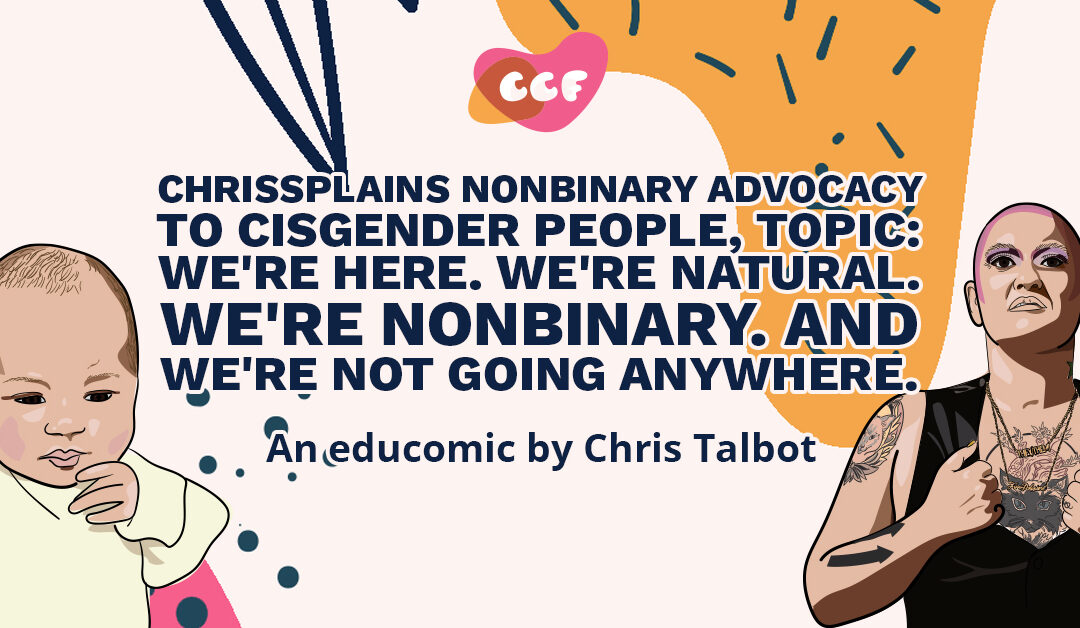
Chrissplains Nonbinary Advocacy to Cisgender People, Topic: We’re here. We’re natural. We’re nonbinary. And we’re not going anywhere.

Chrissplains Nonbinary Advocacy to Cisgender People, Topic: We’re here. We’re natural. We’re nonbinary. And we’re not going anywhere.

By Chris Talbot, communications professional and educomics creator

Go back to the infographic via this link

CW: This post deals with trauma, childhood sexual assault, transphobia, conversion therapy, homelessness, and suicidal ideation and may be triggering to some readers. Please proceed with caution. If you need immediate assistance, please follow this link to International Suicide Hotlines. If you need help specific to your identity, there is Trans Lifeline (877-565-8860 for trans folks), The Trevor Project (866-488-7386 for LGBTQ youth ages 13-24).

Introduction

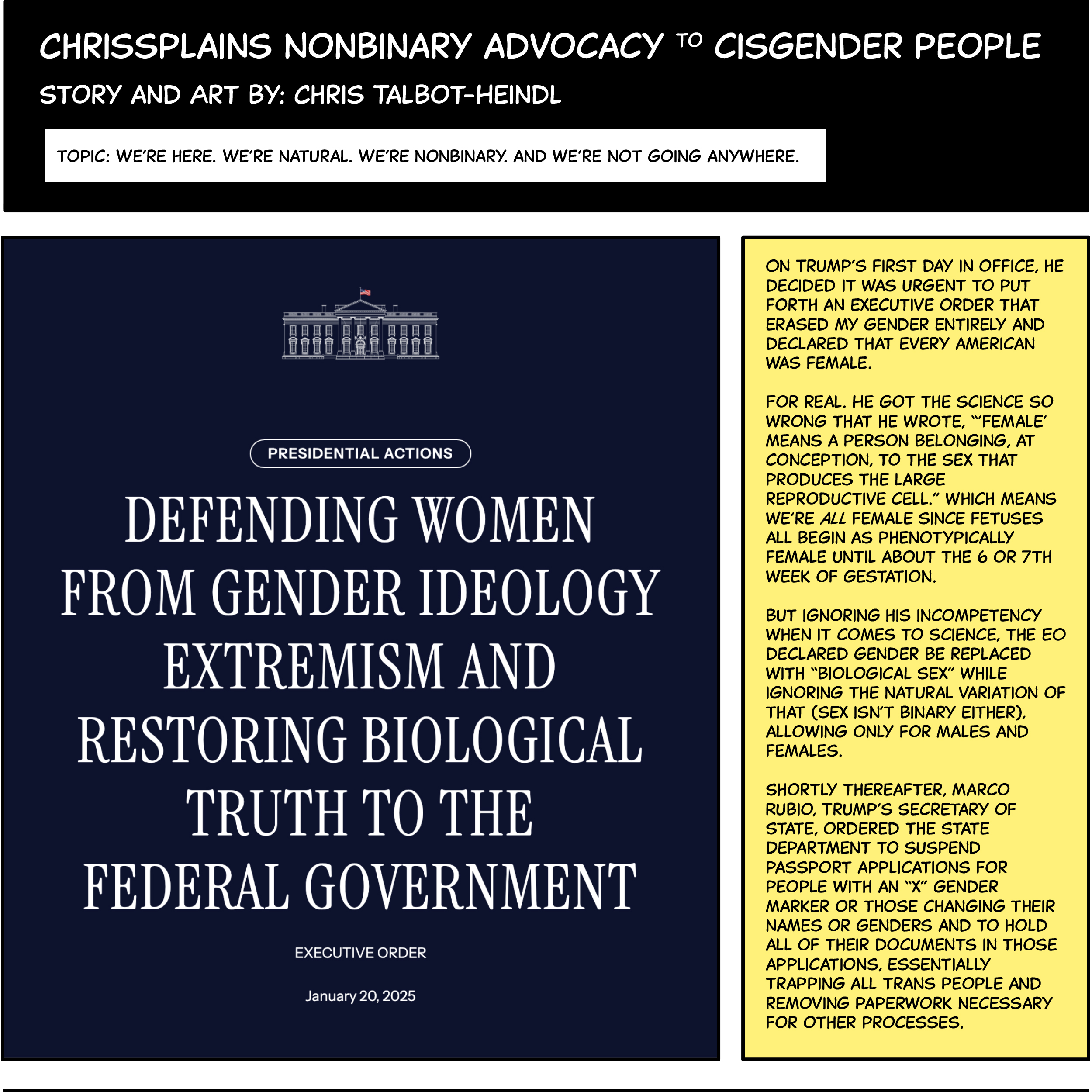
There’s a screenshot from one of Trump’s Executive Orders from his inauguration day (January 20, 2025). The title is “Defending Women from gender ideology and Extremism and Restoring Biological Truth to the Federal Government.” Text in the next comic panel says, On Trump’s first day in office, he decided it was urgent to put forth an executive order that erased my gender entirely and declared that every American was female. For real. He got the science so wrong that he wrote, “’female’ means a person belonging, at conception, to the sex that produces the large reproductive cell.” which means we’re all female since fetuses all begin as phenotypically female until about the 6 or 7th week of gestation. But ignoring his incompetency when it comes to science, the EO declared gender be replaced with “biological sex” while ignoring the natural variation of that (sex isn’t binary either), allowing only for males and females. Shortly thereafter, Marco Rubio, Trump’s Secretary of State, ordered the State Department to suspend passport applications for people with an “x” gender marker or those changing their names or genders and to hold all of their documents in those applications, essentially trapping all trans people and removing paperwork necessary for other processes.

First Section

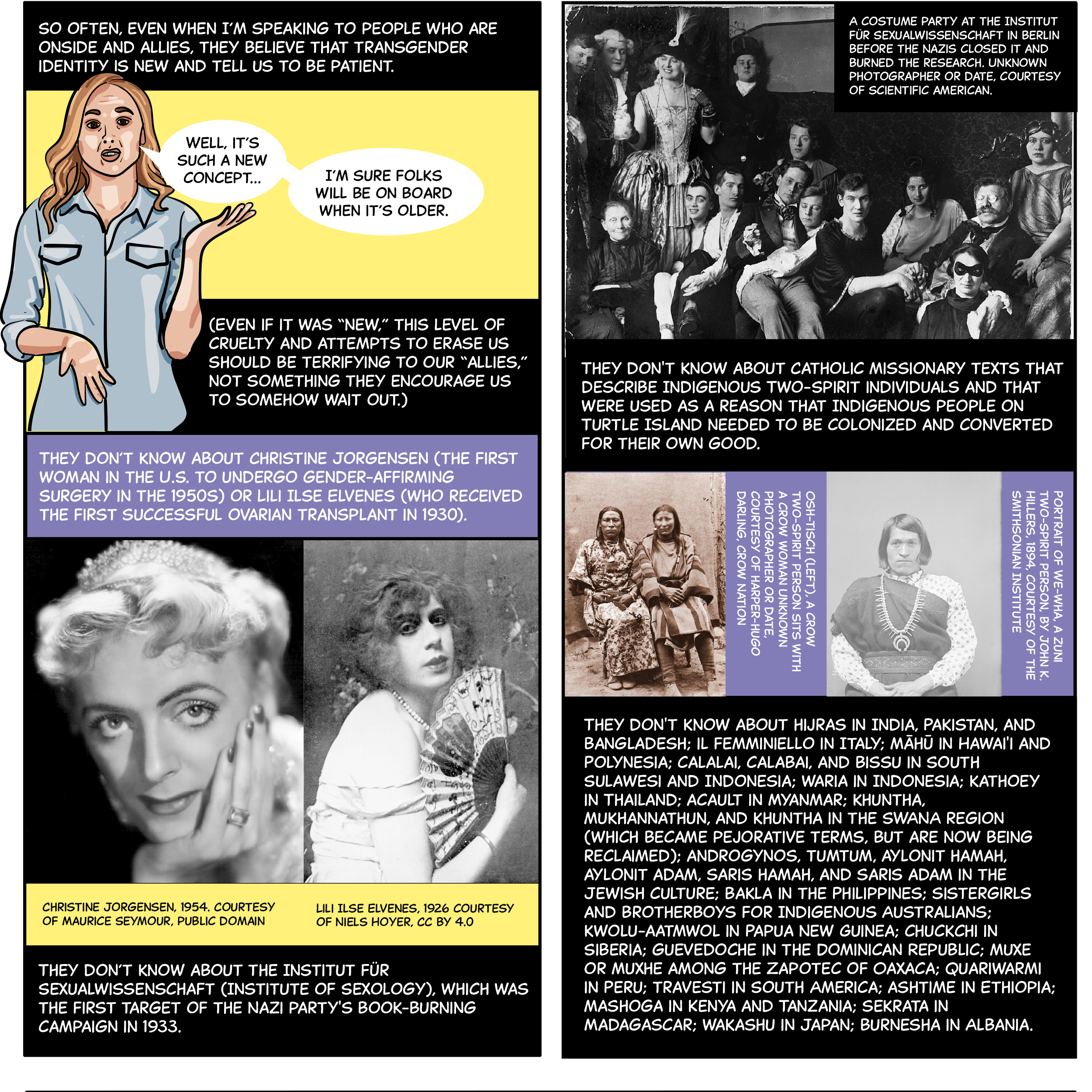
Text says, So often, even when I’m speaking to people who are onside and allies, they believe that transgender identity is new and tell us to be patient. There’s an illustration of a white woman. She is a saying “Well, it’s such a new concept… I’m sure folks will be on board when it’s older.” Text beneath that says, (Even if it was “new,” this level of cruelty and attempts to erase us should be terrifying to our “allies,” not something they encourage us to somehow wait out.)

In the next panel it says, They don’t know about Christine Jorgensen (the first woman in the U.S. to undergo gender-affirming surgery in the 1950s) or Lili Ilse Elvenes (who received the first successful ovarian transplant in 1930). There are photographs of both Christine Jorgensen and Lili Ilse Elvenes.

Beneath that, it says, They don’t know about the Institut für Sexualwissenschaft (Institute of Sexology), which was the first target of the Nazi party’s book-burning campaign in 1933. There’s a photograph of a bunch of folks dressed up in elaborate dresses and suits. Text describes the photograph as a costume party at the Institut für Sexualwissenschaft in Berlin before the Nazis closed it and burned the research. Unknown photographer or date, courtesy of Scientific American.

Beneath that, it says, They don’t know about Catholic missionary texts that describe Indigenous Two-Spirit individuals and that were used as a reason that Indigenous people on Turtle Island needed to be colonized and converted for their own good. There are photographs of Indigenous Two-Spirit individuals. Text describes them as Osh-tisch (left), a Crow Two-Spirit person sits with a Crow woman. Unknown photographer or date, courtesy of Harper-Hugo Darling, Crow Nation. And portrait of We-wha, a Zuni Two-Spirit person, by John K. Hillers, 1894, courtesy of the Smithsonian Institute.

Text says, They don’t know about hijras in India, Pakistan, and Bangladesh; il femminiello in Italy; māhū in Hawai’i and Polynesia; calalai, calabai, and bissu in South Sulawesi and Indonesia; waria in Indonesia; kathoey in Thailand; acault in Myanmar; khuntha, mukhannathun, and khuntha in the SWANA region (which became pejorative terms, but are now being reclaimed); androgynos, tumtum, aylonit hamah, aylonit adam, saris hamah, and saris adam in the Jewish culture; bakla in the Philippines; sistergirls and brotherboys for Indigenous Australians; kwolu-aatmwol in Papua New Guinea; chuckchi in Siberia; guevedoche in the Dominican Republic; muxe or muxhe among the Zapotec of Oaxaca; quariwarmi in Peru; travesti in South America; ashtime in Ethiopia; mashoga in Kenya and Tanzania; sekrata in Madagascar; wakashu in Japan; burnesha in Albania.

Second Section

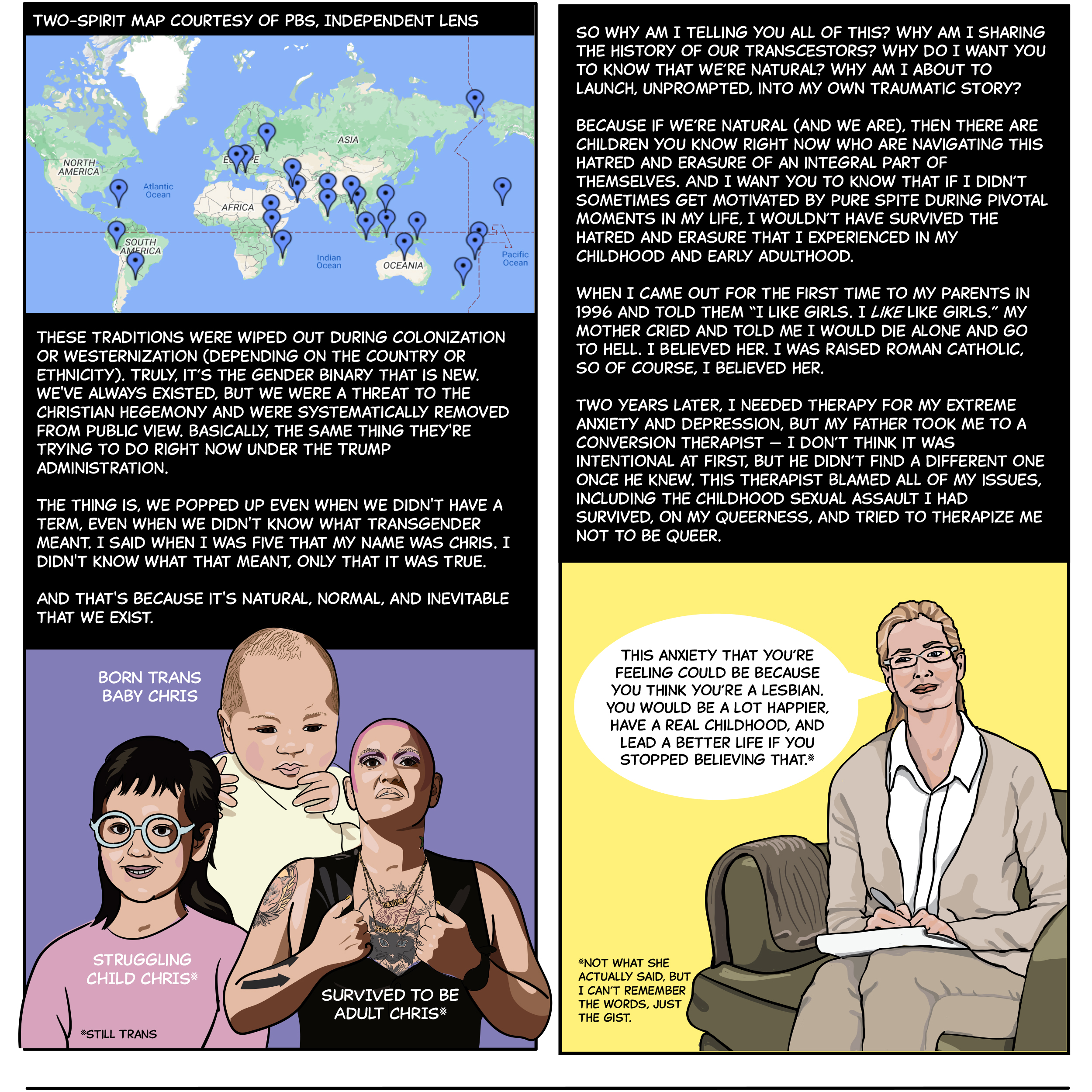
There’s a screenshot of a world map with dozens of location markers. Text says, Two-Spirit map courtesy of PBS, Independent Lens. Text beneath it says, These traditions were wiped out during colonization or westernization (depending on the country or ethnicity). Truly, it’s the gender binary that is new. we’ve always existed, but we were a threat to the Christian hegemony and were systematically removed from public view. Basically, the same thing they’re trying to do right now under the Trump administration. The thing is, we popped up even when we didn’t have a term, even when we didn’t know what transgender meant. I said when I was five that my name was Chris. I didn’t know what that meant, only that it was true. And that’s because it’s natural, normal, and inevitable that we exist.

In the next panel, there are illustrations of a baby, child, and adult. The baby is a newborn with an off-white onesie. The child is wearing a pink shirt, baby blue bottle cap glasses, and a mullet. The adult is bald with heavy purple makeup covering their head with a flat chest, wearing a black vest. They are opening the vest up to show a chest tattoo of a cat and an anatomical heart with plants growing out of the heart valves. The illustrations are labeled Born trans, baby Chris; struggling child Chris*; survived to be adult Chris*. *still trans.

The next panel says, So why am I telling you all of this? Why am I sharing the history of our transcestors? Why do I want you to know that we’re natural? Why am I about to launch, unprompted, into my own traumatic story? Because if we’re natural (and we are), then there are children you know right now who are navigating this hatred and erasure of an integral part of themselves. And I want you to know that if I didn’t sometimes get motivated by pure spite during pivotal moments in my life, I wouldn’t have survived the hatred and erasure that I experienced in my childhood and early adulthood. When I came out for the first time to my parents in 1996 and told them “I like girls. I like like girls.” my mother cried and told me I would die alone and go to hell. I believed her. I was raised Roman Catholic, so of course, I believed her. Two years later, I needed therapy for my extreme anxiety and depression, but my father took me to a conversion therapist — I don’t think it was intentional at first, but he didn’t find a different one once he knew. This therapist blamed all of my issues, including the childhood sexual assault I had survived, on my queerness, and tried to therapize me not to be queer. There’s an illustration of a therapist sitting in a chair with a notebook and pen. She’s saying, “This anxiety that you’re feeling could be because you think you’re a lesbian. You would be a lot happier, have a real childhood, and lead a better life if you stopped believing that.*” Beneath that it says, *Not what she actually said, but I can’t remember the words, just the gist.”

Third Section

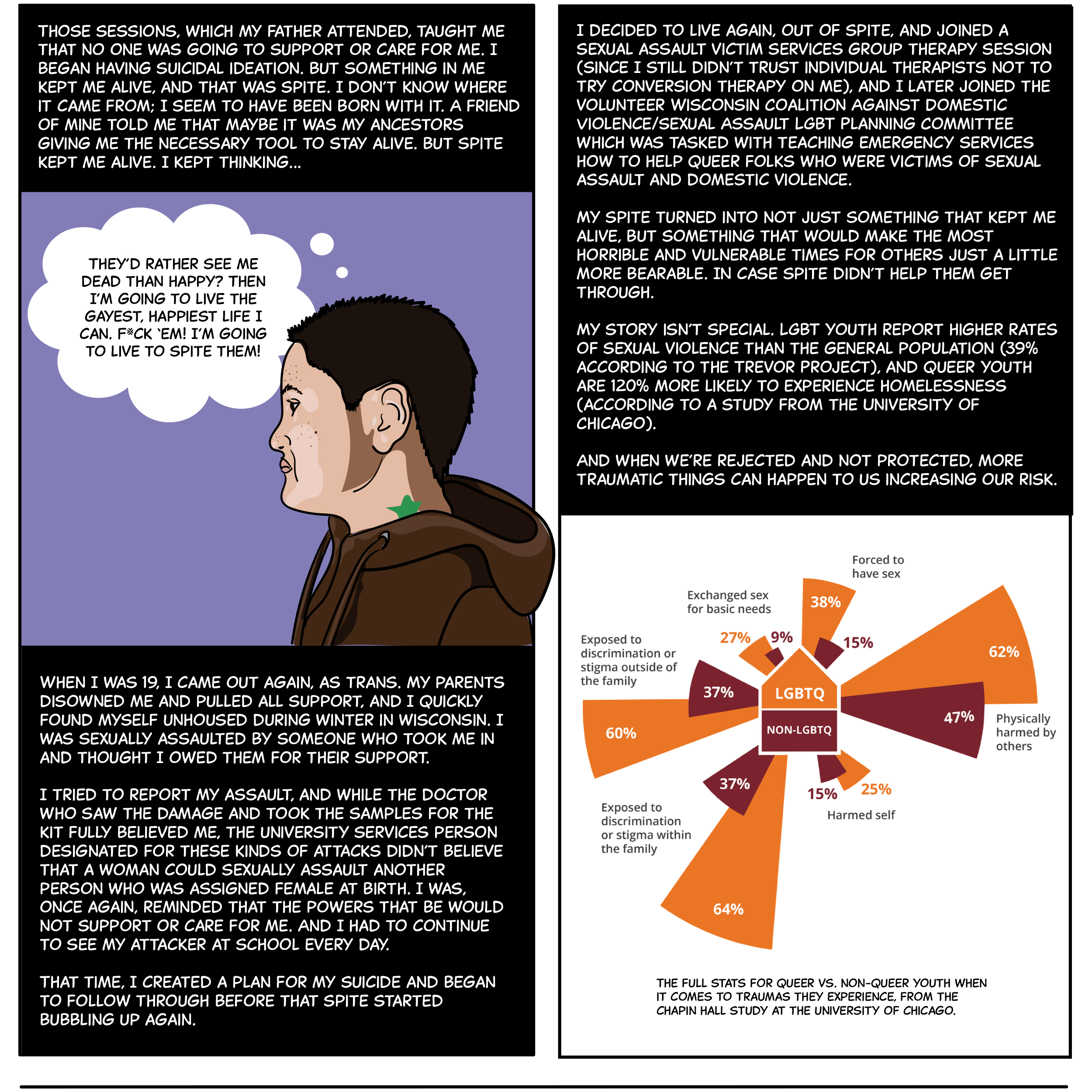
Text says, Those sessions, which my father attended, taught me that no one was going to support or care for me. I began having suicidal ideation. But something in me kept me alive, and that was spite. I don’t know where it came from; I seem to have been born with it. A friend of mine told me that maybe it was my ancestors giving me the necessary tool to stay alive. But spite kept me alive. I kept thinking…

There’s an illustration of teenager Chris with a green star tattoo on their neck, a buzzed head, and wearing a brown hoodie. A thought bubble says, “They’d rather see me dead than happy? Then I’m going to live the gayest, happiest life I can. F*ck ‘em! I’m going to live to spite them!”

Text says. When I was 19, I came out again, as trans. My parents disowned me and pulled all support, and I quickly found myself unhoused during winter in Wisconsin. I was sexually assaulted by someone who took me in and thought I owed them for their support. I tried to report my assault, and while the doctor who saw the damage and took the samples for the kit fully believed me, the university services person designated for these kinds of attacks didn’t believe that a woman could sexually assault another person who was assigned female at birth. I was, once again, reminded that the powers that be would not support or care for me. And I had to continue to see my attacker at school every day. That time, I created a plan for my suicide and began to follow through before that spite started bubbling up again.

Text in the next panel says, I decided to live again, out of spite, and joined a sexual assault victim services group therapy session (since I still didn’t trust individual therapists not to try conversion therapy on me), and I later joined the volunteer Wisconsin Coalition Against Domestic Violence/Sexual Assault LGBT Planning Committee which was tasked with teaching emergency services how to help queer folks who were victims of sexual assault and domestic violence. My spite turned into not just something that kept me alive, but something that would make the most horrible and vulnerable times for others just a little more bearable. In case spite didn’t help them get through. My story isn’t special. LGBT youth report higher rates of sexual violence than the general population (39% according to the Trevor Project), and queer youth are 120% more likely to experience homelessness (according to a study from the University of Chicago). And when we’re rejected and not protected, more traumatic things can happen to us, increasing our risk.

Beneath that is a screenshot of a graph showing stats of traumatic events for queer vs. non-queer youth, from the Chapin Hall Study at the University of Chicago. It shows that 15% of non-LGBTQ and 25% of LGBTQ youth have harmed themselves; 47% of non-LGBTQ and 62% of LGBTQ youth have been physically harmed by others; 15% of non-LGBTQ and 38% of LGBTQ youth have been “forced to have sex”; 9% of non-LGBTQ and 27% of LGBTQ youth have “exchanged sex for basic needs”; 37% of non-LGBTQ and 60% of LGBTQ youth have been “exposed to discrimination or stigma outside of the family”; and 37% of non-LGBTQ and 64% of LGBTQ youth have been “exposed to discrimination or stigma within the family.”

Fourth Section

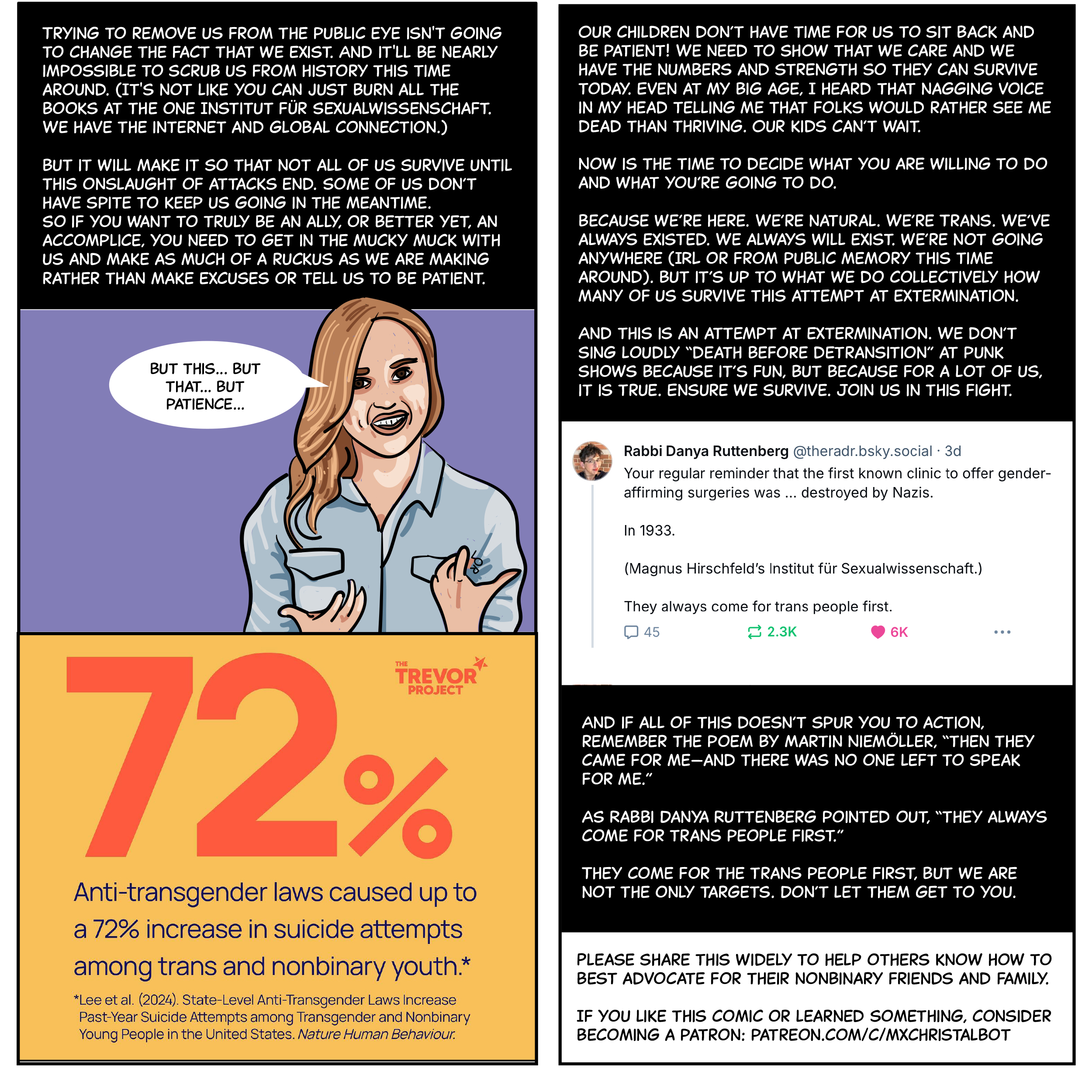
Text says, Trying to remove us from the public eye isn’t going to change the fact that we exist. And it’ll be nearly impossible to scrub us from history this time around. (It’s not like you can just burn all the books at the one Institut für Sexualwissenschaft. We have the internet and global connection.) But it will make it so that not all of us survive until this onslaught of attacks end. Some of us don’t have spite to keep us going in the meantime. So if you want to truly be an ally, or better yet, an accomplice, you need to get in the mucky muck with us and make as much of a ruckus as we are making rather than make excuses or tell us to be patient. There’s an illustration of a white woman saying “But this… but that… but patience…”

Beneath that, there is a post from Trevor Project which says “Anti-transgender laws caused up to a 72% increase in suicide attempts among trans and nonbinary youth.” The citation says “Lee et al. (2024). State-Level Anti-Transgender Laws Increase Past-Year Suicide Attempts among Transgender and Nonbinary Young People in the United States. Nature Human Behavior.

Text in the next panel says Our children don’t have time for us to sit back and be patient! We need to show that we care and we have the numbers and strength so they can survive today. Even at my big age, I heard that nagging voice in my head telling me that folks would rather see me dead than thriving. Our kids can’t wait. Now is the time to decide what you are willing to do and what you’re going to do. Because we’re here. We’re natural. We’re Trans. We’ve always existed. We always will exist. we’re not going anywhere (IRL or from public memory this time around). But it’s up to what we do collectively how many of us survive this attempt at extermination. And this is an attempt at extermination. We don’t sing loudly “death before detransition” at punk shows because it’s fun, but because for a lot of us, it is true. Ensure we survive. Join us in this fight.

There’s a screenshot of a Bluesky post from Rabbi Danya Ruttenberg which says “Your regular reminder that the first known clinic to offer gender-affirming surgeries was… destroyed by Nazis. In 1933. (Magnus Hirschfield’s Institut für Sexualwissenschaft.) They always come for trans people first.

Text says, And if all of this doesn’t spur you to action, remember the poem by Martin Niemöller, “then they came for me—and there was no one left to speak for me.” AS Rabbi Danya Ruttenberg pointed out, “they always come for trans people first.” They come for the trans people first, but we are not the only targets. Don’t let them get to you.

Please share this widely to help others know how to best advocate for their nonbinary friends and family. If you like this comic or learned something, consider becoming a patron: patreon.com/c/mxchristalbot

Chris Talbot

Chris Talbot

Chris Talbot (they/them) is a queer, trans nonbinary, mixed-race artist, activist, and nonprofit employee. When they aren’t working the day job, they spend their free time editing art and literature magazines, writing and illustrating educomics to help folks affirm their nonbinary pals, creating a graphic novel to describe what it’s like to be nonbinary in a gender binary world, cuddling their cat, and quad skating in the park. Purchase their debut book, Why Must the White Cis Nonprofit Workers Angry React to All My Posts? A compilation of essays, posts, and thoughts by a queer, trans, mixed-race professional surviving predominantly white cisgender heterosexual institutions.

You can find Chris at talbot-heindl.com, on LinkedIn, Instagram, Bluesky, and Twitter — and tip them on Venmo or PayPal or join as a patron on their Patreon

Photo credits: Makeup by Brittany Blaze-Shearz; Direction and photograph by Chermetra Keys/The Female Shoota; cattoo by Aura Rain Heindl-Rockman.
Chrissplains Nonbinary Advocacy to Cisgender People, Topic: We’re here. We’re natural. We’re nonbinary. And we’re not going anywhere.

Chrissplains Nonbinary Advocacy to Cisgender People, Topic: We’re here. We’re natural. We’re nonbinary. And we’re not going anywhere.

By Chris Talbot, communications professional and educomics creator

View accessible/text-only version

CW: This post deals with trauma, childhood sexual assault, transphobia, conversion therapy, homelessness, and suicidal ideation and may be triggering to some readers. Please proceed with caution. If you need immediate assistance, please follow this link to International Suicide Hotlines. If you need help specific to your identity, there is Trans Lifeline (877-565-8860 for trans folks), The Trevor Project (866-488-7386 for LGBTQ youth ages 13-24).

Part of the educomic. For the full alt-text, visit the link to the text version.


Part of the educomic. For the full alt-text, visit the link to the text version.


Part of the educomic. For the full alt-text, visit the link to the text version.


Part of the educomic. For the full alt-text, visit the link to the text version.


All illustrations of people (besides the ones of the artist), are from the actual appearance of the people involved. Any physical likeness to any actual people you know and work with is purely coincidental.

Chris Talbot

Chris Talbot

Chris Talbot (they/them) is a queer, trans nonbinary, mixed-race artist, activist, and nonprofit employee. When they aren’t working the day job, they spend their free time editing art and literature magazines, writing and illustrating educomics to help folks affirm their nonbinary pals, creating a graphic novel to describe what it’s like to be nonbinary in a gender binary world, cuddling their cat, and quad skating in the park. Purchase their debut book, Why Must the White Cis Nonprofit Workers Angry React to All My Posts? A compilation of essays, posts, and thoughts by a queer, trans, mixed-race professional surviving predominantly white cisgender heterosexual institutions.

You can find Chris at talbot-heindl.com, on LinkedIn, Instagram, Bluesky, and Twitter — and tip them on Venmo or PayPal or join as a patron on their Patreon

Photo credits: Makeup by Brittany Blaze-Shearz; Direction and photograph by Chermetra Keys/The Female Shoota; cattoo by Aura Rain Heindl-Rockman.