7 tips to write content that is more accessible

By Stacy Nguyen, communications and branding consultant, CCF editor

Beyond boring, you know what a 50-page unreadable report also is? Yep, inaccessible.

As a communications and branding person that works with a lot of nonprofit clients, I can’t tell you how many times I’ve written something really pithy and scarily simplistic for a client, only for them to resist and start trying to sneak back in paragraphs upon paragraphs of really specific information about this or that. 

I totally get the human desire to be comprehensive, accurate, thorough, and historically factual. 

But that stuff is often so boring to read. It’s hard enough to get people to legit read every word of an annual report — getting people to read a 50-page annual report with stacks upon stacks upon stacks of thick paragraphs is like OMGGG. 

Beyond boring, you know what a 50-page unreadable report also is? Yep, inaccessible.

I think we’re all a bit prone to thinking that accessibility is tied to technology — like a website’s coding, the structure of a PDF, metadata, whatever — and so we think that accessibility is an ‘expert’s domain,’ like we kinda assume it’s the web developer or graphic designer’s job. But actually, accessibility comes in really varied forms, including how we write. And this is cool because just about everyone writes and reads, which means everyone can play a part in creating more accessible content. 

1. Write plainly, not like you’re sooo fancy. 

I think the U.S. education system and also our professional workplaces pressures us into communicating a certain way to sound important, authoritative, and leader-y. Like, do y’all remember teachers telling you to stop saying “like” all the time because it doesn’t sound polished or whatever? 

As a result of that kind of repeated training, so many of us get into this weird academic mode whenever it’s time to write. Like, we’ll totally speak like a normal person in meetings or when we’re telling our colleagues about what we did over the weekend, but when it’s time to put it down on paper, suddenly it’s all like, “On Friday, the 26th of October, I envisioned a lovely breakfast for myself that was simultaneously physically nourishing and emotionally fulfilling.” 

The thing is wordiness, jargon, or other types of ‘in-crowd’ language nearly always excludes. It creates a bar that people have to clear in order to be ‘qualified’ to understand something. It also makes it hard for people who have reading, memory, attention deficit, or other cognitive issues to understand what is being communicated. 

It’s better to keep sentences efficient, logical, and straightforward. An easy way to do this (but it’s not the only way) is to just keep your sentences short and simple. 

2. Stack high-value information at the top.

Unless the topic you’re writing about is inherently super interesting (like aliens) or you’re a really good storyteller (no pressure), it’s generally a good idea to get to the point or the mission of your writing right away. There’s not much point in teasing it out because we rarely have perfect audience members.

Most of the time, our readers are quickly scrolling through their phone and skimming stuff on their lunch breaks. Our readers are us! We’re super busy people with a lot of life things pulling at our attention and a lot of the writing and reading that we do is information-sharing rather than epic-artistic things. 

So that’s why it’s good to just immediately lay out what we’re gonna be talking about and why we’re gonna talk about it. Skim-readers often read just the first few lines of content, and if they don’t get the info they need quickly, they might just move on to the next tab open in their browser. 

3. Subheadings and paragraph breaks are your friends, so use them.

Look, I know the bleak hopelessness that a person can feel inside when they open up a URL or a PDF and see just blobs and blobs of loooong paragraphs. That’s why nearly every Community-Centric Fundraising (CCF) hub essay has subheadings and itty bitty paragraphs. 

A lot of the time, people vet a piece of content before they commit. That is, they will grab an overall impression of content before they make the decision to pause, go back to the beginning, and do a deep reading. Breaking big paragraphs up into smaller chunks is cool because it’s easier for the eyes to scan over text. Also! Because so much of us do our reading on mobile devices these days, the smaller paragraphs read more comfortably on small screens.  

I love subheadings. They are great for organizing and structuring long-form content (like CCF essays, which tend to be beautiful 2,000-word monsters!), which helps out writers as well as readers, and they are also handy for those using screen readers. Subheadings can serve as chapter markers or a roadmap for screen readers, allowing people to freely jump from section to section rather than be trapped in a nightmare forest of unending paragraphs. 

4. Try to baby-bear bullet points — not too much, not too little — go for just right.

Bullets are generally awesome because they are visually pleasing to look at. (Think about what you’d rather see: Your grocery list written as a paragraph, or your grocery list stacked in bullet points. That’s what I thought.) Plus, screen readers will tell users how many items are on a list if the list is correctly bulleted. So, in that case, rather than having the screen reader read all 20 items of a grocery list, the human reader can just NOPE OUT of that situation because they get the gist. In contrast, when you write 20 items repetitively in a paragraph, screen readers will read every single boring item. 

We can overuse bullets though — like when lists get way too long or when bullets get sub-bulleted a whole bunch of times and stuff starts sloping down the page and making that triangular block of text — that’s going too far.

A general rule of thumb is if the list isn’t a reference list (such as a grocery list) — if it’s a content list (example: “Donors prefer to get messaged in the following ways:”)  — it’s best to keep the points of the list at about five items or so.  

5. When it comes to words, avoid relying on visual emphasis.

I know it’s tempting to get artistic and use bold, italics, the CAPS LOCK key, and strike-throughs all at once — but don’t do it. When it comes to screen readers — they don’t read ALL CAPS consistently and sometimes they think words are acronyms when they’re not (and vice versa). The screen reader also doesn’t see all the words you are bolding and italicizing or striking through. 

That’s why it’s generally best to convey the big emotions in the content of the writing itself, or contextually. Like this:

“So I screamed at him and said, ‘You don’t even know what you’re talking about!’”

It’s also cool to use italics as emphasis sometimes, but just don’t depend on it to carry meaning. Think of it as a nice-to-have, rather than a must-have. Like this:

“Are you for real, right now?” 

My last word on this is that bolding and italicizing stuff should be used sparingly. No one truly wants to see an entire paragraph in italics. No one!

6. Be structurally consistent to help people continually find their footing in your writing.

In longer pieces of content or a content series (like social media posts), it’s super helpful to readers if content is consistent and matchy-matchy. Sometimes clients fight me on this and are like, “But Stacy, don’t people want something new and original each time?”

No. 

They don’t. 

Because that means they have to re-learn how to read or absorb your information each time, and people don’t want to be mentally working that hard all the time. So like, if your content series ends with a food-for-thought question each time — include that for the entire series. 

In the context of a single piece of content, this often means keeping sections of the content consistent and predictable. Like if your first subheadings is a full sentence, make them all full sentences. If you have a bunch of subsections in your content and write the first one like a call-and-response, it would be real nice if the rest of the subsections are also call-and-responses. Get formulaic with it. 

7. Put yourself in your very smart but under-informed reader’s shoes constantly. 

It’s super important to create content that can stand alone, content that doesn’t require reading footnotes or clicking on links to understand and comprehend — content that deeply considers the reading experience. This means anticipating moments in the text that might be a little inaccessible to your readers and proactively giving them information that they need to understand just enough to get your point.

Consider this sentence:

“The nonprofit industrial complex is a trillion-dollar industry.” 

I know most of us reading this essay get the implication of that, which is nice. But some of our readers are also not that familiar with CCF or its principles. Some readers seriously just Googled something random and accidentally ended up here and are like, “Whoa! That industry makes a lot of money! Should I get a job there?” 

Anticipate those bits of confusion or misunderstanding and tend to them. We actually don’t even have to spill a lot of words to do it. Like, we can just adjust it to this:

“The harmful nonprofit industrial complex is a trillion-dollar industry.”

Stacy Nguyen

Stacy Nguyen

Stacy Nguyen (she/her) is a Vietnamese American visual designer/artist and branding consultant. She works out of the Seattle-area, often with BIPOC-led nonprofits there. Her work mostly involves creating visual brand identities and storytelling. She loves all of her clients but is never above subtweeting about them. Earlier in her career, she was a journalist and news editor, which was where she learned she loves helping writers feel more okay about expressing themselves more authentically. She oversees Community-Centric Fundraising’s external communications and the Hub content with her super awesome team members. Connect with Stacy on Instagram.


The top 5 reactions I hear from nonprofit leaders when I bring up ‘inclusive and equitable research and analytics’ — and how I respond

By Meenakshi Das, fundraising consultant

We, as a world, take pride in our data collection abilities and the evolving technologies at our disposal. However, when we look closely, we often realize that especially in our nonprofit sector, the data we have is flawed. 

For far too long, we have ignored collecting critical data points, missed creating healthy dialogues around that data, and we have added our biases to all of it — all of it — to perform research operations and take crucial decisions from it. And, while we leveraged this insufficient data to build our research capabilities, a set of analytics-based terms entered our industry – machine learning, deep learning, and artificial intelligence. 

While these new algorithmic techniques are indeed powerful, the only problem to efficiently leverage those algorithms is that we’ll still be using the same data and the decision-making process from it. Machine learning will not change the underlying inequitable practices.   

In my clients’ puzzlement, I see an opportunity to share knowledge. What has been surprising though is this pattern of skepticism in our conversations.

In my consulting practice, I push for equity practices with my clients (nonprofit leaders). Because of this, the words “inclusive and equitable research and analytics” come up a lot in our conversations. 

Now, I know it’s a mouthful. I do expect some hmmms and ohhhs and ummms whenever this gets brought up. 

In my clients’ puzzlement, I see an opportunity to share knowledge. What has been surprising though is this pattern of skepticism in our conversations. That’s why I want to distill down my 30-ish Zoom meetings, 40-ish emails, and 35-ish LinkedIn messages into 5 broad reactions I have received when I bring up inclusive and equitable research and analytics — and how I respond to skepticism.

I believe that digging deeper into the 5 reactions can lead us to empathize and understand what we need to encourage sustainable change via research and analytics.   

Reaction 1: “You make donor sound like a bad word. Is it bad?”     

No, donor is not a bad word — it’s the overuse of it that is the issue. In terms of research, here are some instances when our current practices reflect inequity:

  • Data hygiene (i.e., the processes conducted to ensure the cleanliness and completeness of data) around donors is approximately 70-80%, while for other constituents, say, volunteers, data hygiene is usually not higher than 30-40%. 
  • Engagement data from non-transformational donors, volunteers, staff, philanthropy circles, etc., are often missing. (Non-transformational donors refers to those who make less than 5+ digit gifts.)
  • Often, constituent-level analysis (e.g., analyzing for prospects from the donors) is driven by higher-the-better wealth analysis and ends up filtering the records for ‘     top priority’      donors. And this prioritization is commonly accepted regardless of whether such an analysis is for a time-sensitive campaign or not.

The problems in centering data, research, and analytics majorly around donors is that we could lose opportunities for real connection with constituents, our data-driven decision making could be flawed, and we may miss realizing who truly represents our community.

Reaction 2: “That sounds great theoretically, but it’s hard to change something that’s already working.”

There are two aspects to this statement. One: Yes, it’s hard to change. Two: What you feel is ‘already working’ may reflect an outdated system. 

Take the time to understand who your real community is. Maybe that’s not an internal conversation —  perhaps it’s one that involves a few key stakeholders invested in the success of your mission. Once you understand who your real community is, go back to the data and see to what extent those data pieces translate to benefit your community. 

For example, say your organization supports at-risk youth education. Of the approximately 10K constituents, you have 2,000 active volunteers, representing the age range of 30-45, spending roughly 10-15 hours per week with you (including both online and in-person) and giving 2-5% of their monthly wage towards your mission. Say you also have 5-10 transformational donors who may contribute 2-5% of their 5-year capacity towards your mission once a year. When you are analyzing these constituents, how would you assess them for their philanthropic attitude and commitment? This is something that I prefer to call the “philanthropic quotient.” The contributions of these two groups more or less equal one another. Then why is it that the small number of transformational donors get a lot more attention and acknowledgment than the 2000 volunteers?

While I’m not saying that we blanketly ignore dollar values, I am asking you to examine your organizational practices and ask: Do our actions and decisions from our data help us realize how and with whom we are building long-term, meaningful philanthropic engagement? 

If not, then maybe it’s time to acknowledge we need to change, to pull up sleeves and do the work required.

Reaction 3: “Good for you. You are a BIPOC woman. Talking about inclusivity and equity suits you. But I’m not BIPOC …”

Okay, I always have to stop myself from rolling my eyes when people say this to me.

Inclusivity and equity are universal needs. Talking about Diversity, Equity, Inclusion and Accessibility (DEIA) and prioritizing it in my work does not originate from my individual identity. My identity (as a BIPOC immigrant woman) only empowers me to bring my perspectives and experiences into my professional expertise in research and analytics.      

Terms like diversity, equity, inclusion, intersectionality, marginalization, systemic bias, and institutional racism are not pandemic trends, either. These are the truths that should be acknowledged and learned from. We should support anyone bringing these lenses to their work.

Response 4: “Is this something new? Did this always exist?”     

Well, both the values of inclusion and the research practices have always existed. The only new thing here is we are collectively acknowledging when, where, and how we must pause to infuse inclusion and equity. 

In this case, I want to bring them to my professional world of research and analytics. It’s time we become mindful of the benefactors of our research, what we research, why we research, and what enables that research to be more impactful.

Response 5: “What’s equity got to do with research? We are already thinking about diversity and inclusion in donor relations.”

Diversity and inclusion should be part of everything we do. While I’m glad donor relations are actively considering it, understand that diversity and inclusion are not a complimentary service to pick and choose for different work areas.      

To give an example — if you get hired at a new job, would you want to feel included only until your onboarding? Or would you like to continue feeling included in the organizational events, development opportunities, team meetings, and other such workplace areas? I know I would choose all.

The same idea extends to fundraising. Research, solicitation meetings, annual galas, donor stewardship or any other aspect related to fundraising — the tenets of DEIA are non-negotiable concepts if we want to promote true generosity for the entire community we serve.


So, ask of every analysis and the decisions you take from them — ask if and how your community is being supported. Know that there are no wrong answers here. There are only action steps — true action steps, not shortcuts or band-aid solutions — from the initial questions that will lead us further toward equity and inclusion. This is a long road, and we all have a part to play.

For me, the immediate goal remains to continue these uncomfortable conversations until I start hearing a different set of reactions — reactions that welcome the ideas of reflection and change.

Meenakshi Das

Meenakshi Das

Meenakshi (Meena) Das (she/her/hers) is a fundraising analytics consultant with her own practice, NamasteData. She specializes in designing survey-based research tools and analyzing engagement. Meena appreciates spending her time outside work as a mentor to immigrants and as pro bono research advisor to small shops. Her two recent favorite projects are working on making data-based research tools more DEIA (Diversity, Equity, Inclusion, and Accessibility) compliant and designing the second season of her podcast “Being and Unbeing an Immigrant” where she wants to bring together the families of immigrants left behind in the home country. Connect with Meena on LinkedIn. If you’d like to tip her, you can do so through her PayPal.

It’s time to rethink ROI metrics in racial justice

By Sapna Sopori, CEO of Sapna Strategies, LLC and career NPO professional

Don’t get me wrong, measurable tangibles such as assessments and plans are important to racial justice — but these are not the only ‘returns’ we need in order to create a more racially just workplace.

Are you a member of a racial justice team at a white-led organization? 

Do you constantly get asked by organizational leaders, “What have you accomplished so far? Your team has been meeting for 6 months, so what has that investment gotten us? Show me the numbers!”?

Are you having a hard time responding to these questions? 

If so, you are not alone! I have been there, both as a justice team member within organizations and as a consultant working with these teams to build their capacity. This frustration is very common and it exists because there is a dissonance between how organizations invest in racial justice work and the returns they expect on that investment.

At the heart of this issue is that we invest in what we value. But in many white-led organizations, we only value quantifiable returns. In Tema Okun’s “White Supremacy Culture — Still Here,” she writes, “Things that can be counted are more highly valued than things that cannot. For example, numbers of people attending a meeting, newsletter circulation, and money raised are valued more than quality of relationships, democratic decision-making, ability to constructively deal with conflict, morale, and mutual support. Little or no value is attached to process in the internalized belief that if it can’t be measured, it has no value.” 

Don’t get me wrong, measurable tangibles such as assessments and plans are important to racial justice because we need to think strategically for the long-term and have the tools in place to inform and guide behavior — but these are not the only ‘returns’ we need in order to create a more racially just workplace.

The reality is these tangibles are only useful if the culture within which they are applied has sufficiently developed the skills and dispositions to bring them to life in racially just ways. How we do matters just as much as what we do. We must identify these intangibles and understand how they are connected to the tangibles. And we need to sustainably and equitably invest in the development of both.

So, how do you explain all this to your boss (or your boss’s boss) when they ask for returns, especially given the irony that their demand for quantifiable, “easy-to-understand” ROI personifies the exact culture you are trying to shift? And how do you explain this all in ways that don’t accidentally anger your boss (or your boss’s boss) who may still be steeped in white fragility? And how do you craft such a delicate response during the few hours you have each month to do racial justice work! Ugh!

To untangle all this, we need organizational leaders and racial justice teams to self-reflect. So, here are some questions to get both parties started: 

Leaders: Is your organization really investing in your justice team?

Organizations that expect racial justice returns must invest equitably and sustainably in their racial justice teams — but very few do. If you are an organizational leader reading this, you may be thinking, “Of course we invest in our teams! We allowed them to form, and we let them meet each month during work hours! We are fully invested in racial justice work!” But so often this investment is an illusion, a performative action that leaders and even justice team members buy into. 

Here are a few hard questions to investigate this supposed ‘investment’

  • Do we believe staff should be paid for all the work they do for the organization?
  • Do we believe racial justice work is work the organization needs?
  • Have we allocated paid hours for the staff on the racial justice team to do the work? Does this show up in the organization’s budget?
  • Have we removed work in equal ratio from those team members’ plates so they can add these new hours? Does this show up in the organization’s budget?
  • Did we subsequently shift the organizational goals to reflect the removal of those hours? (Did we decrease the overall number of kids taught or dollars raised or contracts signed because these staffers are serving on the racial justice team?)
  • Did we shift the organizational goals to include the racial justice team’s work? (Note: this should include tangible and intangible deliverables.)
  • Did we equitably compensate/resource the racial justice team for the emotional toll this work takes, especially on BIPOC members who have to navigate the racist systems they are also trying to uproot?
  •  Did we consider that a cross-hierarchical team will have very different hourly rates by positionwhich intersects with race and gender, which means the white men on the racial justice team in higher-power positions who lack lived experience with racism and sexism are getting paid more to serve on the team than the BIPOC women team members in lower-power positions? 

If you answered no to any of these questions, your organization is not yet investing equitably and sustainably in its racial justice team, and its racial justice team is essentially volunteering their time. In other words: Your organization is exploiting its staff. Ouch. And therefore your organization has no right to ask for a return on that said ‘investment.’

What can you do about this? 

Change the dynamic. Dig into those questions and sit with the discomfort (BTW, that’s a racial justice skill to cultivate.). Use your positional power to examine the “investment illusion” and change it from performative to sustainable and equitable. This does not need to happen overnight but it does need to happen — intentionally and deliberately and in collaboration with the justice team. Remember: How we do matters just as much as what we do. Rethink your investments.

 Without this examination, organizational leaders will continue to hypocritically expect racial justice returns without really investing in racial justice work. And when they ask teams to demonstrate their returns on investment, they are actually saying, “I’m not going to value your time nor will I approve the hours you need to do this work nor will I release you from the obligations of your full-time job nor will I consider the disproportionate impact of this work on BIPOC team members nor will I recognize the hypocrisy of paying higher-power white staff more to do this work than lower-power BIPOC. But I am going to expect you to use your unfunded time to continue to meet with the team, and create reports on your progress that are crafted in ways that don’t make me feel guilty or defensive, and meet milestones that the other senior leaders and I think are valuable even though we have done little to nothing in racial justice ourselves. Oh, but I stand with Black Lives Matter.”

Gross.

Justice teams: Are you letting the system you are fighting determine what your returns should be?

But, if the group making the decision hasn’t spent time to build trust between the team members — they’ll likely end up with the same decision they would have made before they implemented this new process …

Like all teams, racial justice teams should identify, monitor, and regularly communicate their work. But, they need to examine how they do this. Yes, teams need to develop tangible deliverables; but they need to do so in ways that model the culture they want for their organizations. This means they need intangible justice skills, such as being comfortable with discomfort, normalizing conversations on race and racism, developing trusting relationships with teammates across racial and positional power boundaries, engaging openly and vulnerably in meetings, centering and amplifying BIPOC voices, and so on. These intangibles are critical because any organizational plan or policy produced will only be effective if drafted and implemented in racially just ways.

Take for example a decision-making process that centers and amplifies BIPOC voices. This is a tangible product, a written process highlighting strategies like progressive stack during discussions, weighted voting to amplify BIPOC input, and transparent sharing of process and results with staff.

But, if the group making the decision hasn’t spent time to build trust between the team members, if they haven’t discussed how positional power and racial identities influence discussions, if they haven’t confronted the implicit fear of retaliation in the work culture and how it intersects with race and position, then the team will go through the motions of progressive stack and weighted voting — and likely end up with the same decision they would have made before they implemented this new process because people were scared to speak up, their silence was taken as affirmation, and everyone voted defensively to avoid retaliation.

This ‘racially just’ decision-making process will ultimately reinforce the white dominant status quo, leaving white folks to pat themselves on the back for an equity job well done and BIPOC folks to walk away biting their tongues — again. As they say, culture eats policy for lunch. 

As Okun states, we can counteract this dynamic by including “process goals in planning. For example, make sure your goals speak to how you want to do your work, not just what you want to do. And look for ways to measure process goals. For example, if you have a goal of mutually respectful relationships [on your team], think about ways you can measure how you are living into that goal.”

Here are some questions to help your team identify the full breadth of your returns, both tangibles and intangibles:

What tangibles have we created so far?

(These can include protocol, trainings, assessments, team meetings, team job description, meeting norms and agreements, newsletters, etc.)

What intangible skills did we cultivate by creating these tangibles?

For example, by creating a justice team job description, did you examine how racial identities influence members’ contributions to the team’s work? Or, when meeting as a team each month, are you normalizing conversations on race and racism? Or, when crafting a staff assessment, did you consider how to safely elicit and amplify the voices of those most impacted by workplace racism (BIPOCs)? Get these down on paper; include those you feel you have made progress on and those that need further development.

How do these intangible skills support the tangibles? 

In other words: How do the intangibles bring each tangibles to life?

Now think vice-versa: How was that assessment better as a result of safely eliciting and amplifying the voices of BIPOC staff? How are those team meetings more impactful as a result of normalizing conversations on race and racism? (And so on.) Remember: It is an iterative process so these tangible and intangible returns are building on each other.

How do we know we’ve cultivated these intangible skills? 

Describe any measures of progress, or ‘look fors,’ to help monitor.

For example, the team might report they are more “comfortable with discomfort” by regularly observing: “We take more time to sit in silence and think about challenges rather than react immediately with an answer.” Or, the team might report they are better able to center and amplify BIPOC voices in decision-making by observing: “It’s a habit now to ask at our meetings, ‘How do we know this is what our BIPOC staff want and need?’ and then triangulate our work with their input from the last survey.” Getting these ‘look fors’ down on paper raises them to our conscious awareness so we can better monitor the team’s culture shift over time.

How are these skills helping our team practice and model our vision of a racially just workplace?

Whatever your vision of a racially just workplace, it will require intangible skills to bring it to life. For example, if your vision describes a racially diverse staff at all levels of the organization, ask yourself what skills and dispositions are needed to recruit and retain BIPOC staff in a majority white organization? What skills and dispositions are needed to support a racially just workplace, not a tokenizing one? These are the same skills and dispositions the justice team is developing on a small scale with the intention of rippling out to the organization, so take time to articulate how practicing these skills in a microcosm (the team) can model a racially just culture for the macro-system (the organization).

As we can see, it’s a classic both/and — we need both tangible and intangible deliverables on racial justice teams. But if we skip this examination, we default to the valuation and expectations of the dominant culture. And, if teams keep defaulting to the white supremacy dogma that only the tangibles matter, they will start to believe that false rhetoric: “Maybe we haven’t actually accomplished anything over these last 6 months. Ugh! We are failing!” They will essentially gaslight themselves! But don’t let the system you are fighting determine what your returns should be. Take this opportunity to develop and communicate a more robust ROI narrative.


Doing organizational racial justice work is really hard; we know this. But it is made even harder when we lack real investment and are constrained to valuing only half our work. We can twist ourselves up in knots and spend our precious, limited time crafting carefully worded responses that only tell a portion of our story. But by addressing this dissonance head on, by having the hard conversations with ourselves, our teams, and our leaders, we can untangle those knots and upend some of the white supremacy culture that impedes our work. And then we will start seeing real returns on our racial justice investments. 

Sapna Sopori

Sapna Sopori

Sapna Sopori, (she/her) CEO of Sapna Strategies, LLC, a strategic planning firm that helps leaders develop and operationalize their DEI intentions. She is Indian American, raised by a single-mother whose own challenges and opportunities in this country shaped Sapna’s understanding of the intersection between race, gender, and immigrant-status. As a consultant, educator, and activist, she works with organizations to identify and uproot biases in their policies/procedures/protocol to ensure that the good work they hope to do in the world is not undermined by how they do it. Read her blog on her website! She can be reached on LinkedIn.

Pay me like a white man: Support BIPOC creatives and professionals through tipping

By Yolie Contreras, professional zinester and fledgling fundraiser

As I’ve grown as a writer, I find that more and more (white) people are sharing my work, whether it be in newsletters, curricula, or lesson plans. While that is amazing and gets my name out there, BIPOC writers don’t generally see extra income from the sharing of our work.

We all know that white men are at the top of the career food chain when it comes to earning power — with white women being a close second. BIPOCs under-earn compared to their white counterparts — so seeing as pay equity isn’t happening anytime soon, there needs to be creative ways to tend to this gap — at the same time we also push for systemic change.

There are many ways to tackle this inequity, and I will present a few of my humble offerings towards this goal. 

As I’ve grown as a writer, I find that more and more (white) people are sharing my work, whether it be in newsletters, curricula, or lesson plans. While that is amazing and gets my name out there, it doesn’t always turn into a type of quantifiable success. BIPOC writers don’t generally see extra income from the sharing of our work. 

A disclosure: Community-Centric Fundraising pays all of its writers a very generous sum for published articles. While this is a great place to start and while I love sharing my writing with the world and having difficult conversations, what some are expecting from my writing and me is an education — and that’s an entirely different matter when it comes to compensation. 

Now, we are all aware of the history of tipping — it was created to keep wages low and put the burden of paying a cost of living wage on the consumer instead of the business. The history of tipping has very clear racist and classist undertones, because the majority of those in the service industry are working class BIPOC.  

And I’m suggesting that we flip that notion. In addition to our base pay/stipends/salaries, I want abundance for my BIPOC siblings. So I’m telling you to throw a little extra our way, redistribute wealth in the form of virtual tipping and/or donations. I am specifically talking to the white people who consume our content and share with their white colleagues and friends. Giving a tip is a small price to pay for engaging with BIPOC work and art. 

Here are some ways that I am trying to incorporate pay equity in both professional and creative settings. 

Open your wallet in the workplace 

As a woman of color, I am expected to work harder and more efficiently, all for the same amount of pay or less. We are taught to be grateful for crumbs and expect nothing more.

You might be asking yourself, “Why is Yolie so obsessed with money?” 

Because BIPOCs have so little, that’s why! For many of us, it’s a constant struggle to keep our heads above water in order to simply live. 

I also want to see the antiracism community in action, helping each other to make everyone’s lives easier and manageable. I also want to recognize that it’s capitalism that has enabled the wage gap to widen — and until capitalism burns to the ground, why not try to support our community members as best we can? 

Okay, so let’s talk about how we can incorporate the practice of donations/tipping into our nonprofits and other professional settings. I’ll use myself as an example. My “official” title at my organization is fundraising coordinator, but for a while I have been taking on media duties since we are currently without a media coordinator. This has meant more work and responsibilities for me, which I have been happy to take on because I love the organization that I work for. 

My team (mostly comprising BIPOCs) noticed the extra work, time, and effort that I have been putting forth and decided to send me a stipend in appreciation and to compensate for this additional labor. I was really blown away by this act. The thought never occurred to me that I should expect to be paid for this extra output — because why would I? 

As a woman of color, I am expected to work harder and more efficiently, all for the same amount of pay or less. We are taught to be grateful for crumbs and expect nothing more. 

Seeing as I have worked in predominantly white spaces, I found the stipend completely unexpected but very much welcomed. This is why I urge you to take a good look at your team members and see what their actual output is. If they are consistently taking on responsibilities beyond their stated roles and/or above their pay grade — either give them (or advocate on their behalf) a full-on raise or provide a stipend to recognize their efforts. 

My organization also has dedicated stipends for BIPOCs who volunteer with us. Because sometimes, being able to devote time and energy to volunteering is something that very few can actually afford. (Most of the time, volunteering seems reserved for affluent white people, let’s be real.) So my organization offers these stipends to our BIPOC volunteers in order to make volunteering more accessible to people who have been marginalized. 

Another way to support BIPOC in a professional setting, is to start paying people who are being interviewed for a job, especially if they identify as BIPOC. It takes so much time and effort to not only apply for a position, but also to go through multiple rounds of interviews. Work the cost of paying interviewees into your yearly budget. It shows BIPOC communities that they are valued and sets an amazing precedent. 

BIPOC creatives need love and abundance as well

All of this to say that I welcome white audiences but am also asking for donations/tips for engaging with my knowledge and art.

I have been given so many amazing creative opportunities this year, and it has opened my mind and heart in re-evaluating how I can give some monetary support to other BIPOCs. The work is also internal. Let’s not forget that! 

I will be hosting several online panels in the near future and all will include honorariums for the panelists in attendance. It’s a fairly new concept to me, that people of color would actually get paid to speak about our knowledge and experiences. I will also be requesting that panelists put their Venmo/Paypal accounts in the chat in case the attendees want to send a tip their way. 

This is all voluntary of course — we don’t want to force or shame anyone who might not have access to funds. You can start incorporating this into your own personal/creative pursuits as well. Add your Venmo, Cash Apps, or PayPal to your bio. You might be surprised how the community shows up. 

Alright, say you run a blog and you can’t afford to pay people right now. That’s okay! Another example of closing the pay gap that I have from my own life is when I recently wrote an article for another blog and they couldn’t pay me, which was totally fine — but they had a unique way of compensating me. Each writer included their Venmo or Cash App into their bio, and I found that to be a genius way of ensuring some abundance is sent our way. I took their practice and applied it to my creative and professional practice. 

All of this to say that I welcome white audiences but am also asking for donations/tips for engaging with my knowledge and art. 

I suggest you take these small steps and make them bigger. Fold them into your daily lives and in the workplace. The bottom-line is to stop asking for, expecting, and giving away free labor. (If people want free, well, Google is free.) If you are using BIPOC words and art to learn and to educate your fellow white coworkers, friends, or colleagues, then open your wallet. 

A parting reflection

I know it can be hard to ask for tips, my beautiful fellow people of color, but please consider this a lesson in receiving. We are so used to giving and having things taken from us that it’s so hard to open ourselves up to receiving. 

Also, I do realize that people of color are not a monolith and that embracing the notion of accepting donations/tips in relation to art and work might not be for everyone. 

But I do encourage every BIPOC creator to consider it, because I believe it’s a small way to bridge the wealth inequality gap and help support BIPOC creatives and professionals in more tangible ways. 

YOLIE CONTRERAS

YOLIE CONTRERAS

Yolie Contreras (she/her) is a Salvi-Chicanx writer, fundraiser and neurodivergent babe. She believes that words and actions matter, and as long as systems of oppression exist, it is our duty to dismantle them. When she’s not working, Yolie spends her time writing zines about depression, anxiety and OCD. She currently lives in Tucson, AZ with her husband Billy and their cat named Frida. Find her on Instagram @Yolie4u. Send her a tip via her Venmo, Yolie4u.

Everyone has support needs — we are just choosing to center non-disabled employees

By Jessie Calerofundraiser and freelance writer

With the economic impacts of the COVID-19 pandemic continuing to unfold, one thing seems to be true throughout the country: We’re in a workforce crisis. While both the cause and the cure seem to be up for debate, the untapped labor force that is universally dismissed is disabled folks. With employment rates among people with disabilities having dropped precipitously low to only 17.9% during 2020, there has never been a more opportune time to address accessibility and inclusive hiring practices within nonprofit organizations. 

If your work environment and culture are inaccessible from the get-go, it is unlikely that disabled folks would feel encouraged to apply for or accept a position within your organization.

Among any employer (for-profit and nonprofit alike), the primary fears related to hiring a person with a disability always come down to cost. Employers assume that increased training processes, workplace accommodations, and unexpected expenses lurk around every corner when hiring a person with a disability. 

What they fail to take into consideration is that everyone, whether disabled or not, has support needs, both in the workplace and at home. Non-disabled people constantly utilize tools and technologies developed by and for disabled folks, such as text messaging, speech-to-text services, automatic doors, Velcro, keyboards — the list goes on. Even video call technology was initially developed to allow Deaf users to communicate directly via sign language in lieu of TTY and interpreting services. 

While many of these technologies are used by everyone today, the idea of accommodating a specific need is often considered inconvenient, unreasonable, expensive, or uncomfortable when it is in response to a disability. 

Yet, among the wealthy and privileged, it has become commonplace to hire tutors, housekeepers, and personal assistants — all of whom provide enhanced support, allowing a person to focus their bandwidth on other priorities (like opening family foundations that don’t accept unsolicited proposals … ). People who can afford these luxuries are never accused of laziness, incompetence, or being a burden on society. 

The thing is, in most employment settings, accommodations can usually be offered at no or minimal cost. In situations where significant changes need to be made to accommodate the needs of a disabled employee (environmental modifications as an example), there are often funding opportunities available to employers through tax incentives and state vocational rehabilitation offices

Most nonprofit organizations, most likely due to being underfunded and overworked, deal with accessibility issues and accommodations from a defensive position. I would encourage these organizations to begin acting offensively, identifying, and mitigating accessibility barriers before an employee with a disability crosses their threshold. 

I mention this for two reasons: If your work environment and culture are inaccessible from the get-go, it is unlikely that disabled folks would feel encouraged to apply for or accept a position within your organization. With the continued impacts of the pandemic, our generation will grapple with disability at increased frequency and greater complexity than ever before, relying on already under-resourced and over-burdened support systems that are wholly unprepared for increased demand. This will only be exacerbated by the support needs of an aging generation of Baby Boomers. Accommodating disabled employees may be on your organization’s backburner, but any non-disabled member of your team can become disabled at any time. 

There are a number of ways to create an inclusive, disability-friendly workplace. 

1. Normalize allowing your employees to communicate their support needs (and then meet them). 

Employers should believe and respect disclosure (when a disabled person shares their disability and/or support needs with another person), especially among those whose disabilities are not visible. Disability looks different for everyone. Making comments like, “But you’re so smart,” or “We’re all a little autistic, aren’t we?” aren’t accurate, helpful, or supportive. Providing validation, acknowledging a person’s experience, and sharing a willingness to learn about a person’s support needs is essential to creating an inclusive workforce. While disabled people like me who are able to ‘pass’ as non-disabled experience a significant amount of privilege, it can be incredibly difficult to navigate life when your support needs are dismissed because you exhibit independence in other areas.

It’s important to recognized that disabled people have been asking to work from home for years — something that — along with remote medical appointments, remote school, and a variety of other accommodations — was considered impossible prior to the onset of the COVID-19 pandemic, but then became ubiquitous when it was necessary for non-disabled employees to successfully and safely work.

While each disabled person may struggle with different aspects of a typical work environment, one of the most immediate and cost-effective accommodations can be through providing sensory accommodations and setting universally beneficial boundaries in the workplace. 

Most neurotypical folks are able to ‘screen out’ or adapt to sensory input. As an autistic person, I constantly hear the air conditioner running, the fan on the computer tower next to my desk, the traffic outside the building, and the sound that most office light fixtures make. Add in someone’s overpowering perfume, another person’s lunch, and a flickering bulb over my desk — the sensory overload becomes unbearable. And if, in the midst of all that, someone tries to share an update on the latest team project, it can be difficult for me to process anything that they’re saying. Even more so if they expect me to make eye contact. 

Many autistic people struggle to process more than one source of sensory input at a time. For me, making eye contact with a stranger, acquaintance, or colleague can be so uncomfortable that I will struggle to process what they are saying. More often than not, I am able to do my closest listening when staring into space or looking away from someone, but that can feel upsetting or dismissive for neurotypical folks. 

While some of these problems may seem difficult to mitigate, inclusive offices can allow neurodivergent folks (and all team members) to shut their office doors to reduce noise and unexpected interruptions, provide noise-canceling headphones or specialized ear plugs that mute background noise (no endorsement deals on the horizon but there is a brand I absolutely recommend), set boundaries through office hours, embrace a low or no-scent environment, and encourage email communication outside of pre-arranged meetings, something that allows neurodivergent folks to process and respond to new information at their own speed.

Organizations can also provide opportunities for job-sharing, something that can benefit disabled and non-disabled employees. Within the disabled community, physical limitations, chronic pain, or the need to access extensive medical treatment can make working full-time hours impossible, while for others the need to access benefits is contingent on not exceeding a specific income threshold (I’ll save my rant on how government programs require disabled people to live below the poverty level in order to access benefits they need to survive for another time). Within an organization that has one full-time position to fill, certain jobs can be shared by two part-time employees, both of whom might have a disability or other reason why full-time work is not feasible. 

In situations where job seekers are able to be more selective of the environments, wages, and other features of a workplace they are willing to tolerate or would like to actively pursue, employers should be maximizing and marketing the options they provide their employees that add value to positions without having to add dollar signs that tight budgets won’t allow. One effective way of doing this is allowing people to work from home. Not only has this practice proven to increase productivity, cultivate better work-life balance, and reduce the costs and time employees spend commuting — this practice also increases access to work opportunities for disabled job seekers, especially given the wider breadth of applicants an organization can access by removing geographic restrictions (disabled folks often struggle with moving across state lines because benefits vary state-to-state and would have to pass up employment opportunities that require relocation and the potential loss of support). 

It’s important to recognized that disabled people have been asking to work from home for years — something that — along with remote medical appointments, remote school, and a variety of other accommodations — was considered impossible prior to the onset of the COVID-19 pandemic, but then became ubiquitous when it was necessary for non-disabled employees to successfully and safely work. Employers should make concerted efforts to continue to allow remote and hybrid work options when feasible.

2. Physical accessibility requires more than installing a ramp.

While ramps and elevators provide essential access to wheelchair users and others who benefit from physical accommodations, most organizations’ accessibility measures begin and end at the front door. Nonprofit organizations must expand their definition of accessibility. 

Organizations should be examining whether their restrooms are truly wheelchair accessible. (Get out your measuring tapes, 36-inches is the bare minimum, especially for motorized wheelchairs.) They should also consider providing adult changing tables in their public spaces. Many adults with disabilities require assistance with personal care, and many of them are being forced to access this care on the floor of public restrooms. 

Employers should also be embracing unisex restrooms. While this positively impacts a number of folks (increasing safety for trans and nonbinary folks, reducing long restroom lines, and allowing parents to easily and safely provide support to young children), this practice also increases comfort for disabled people. If an disabled person requires assistance in the restroom, but does not share the same gender identity as their support provider, it can create uncomfortable situations in the restroom if they are segregated as male and female. Also, there are plenty of disabled people who also identify as trans or nonbinary, only further underlining the need to provide accessible restrooms for everyone. 

Physical accessibility needs to be addressed outside of restrooms as well. Nonprofit organizations often don’t consider their distance from public transportation when identifying where they purchase or lease space to provide services. This distance can determine whether a disabled employee or service recipient would have the ability to reach your offices. Additionally, some organizations don’t enforce parking policies, allowing board members or valued donors to use accessible parking as VIP spaces. 

Many physical accommodations can be made by swapping a simple fixture. A typical round door knob requires grasping, which is inaccessible to those who have difficulty grasping (either due to sensory sensitivity or due to fine motor limitations), as well as those who do not have hands. A lever style door knob allows someone to press down without grasping or use an elbow or other part of the body to move the lever and open the door. 

Ideally, organizations would be able to provide automated doors, increasing access for everyone. (However, even organizations that have invested in automated electric doors have been known to turn them off to “save electricity.”) 

Even desk and table heights can present barriers to disabled folks. Providing adjustable-height workstations, as well as information or reception desks that allow a wheelchair user or little person to see the person they are addressing, creates an environment where everyone feels heard and valued.

3. Examine your biases around what jobs disabled people can perform and what your perfect applicant ‘looks like’ on paper (and in person).

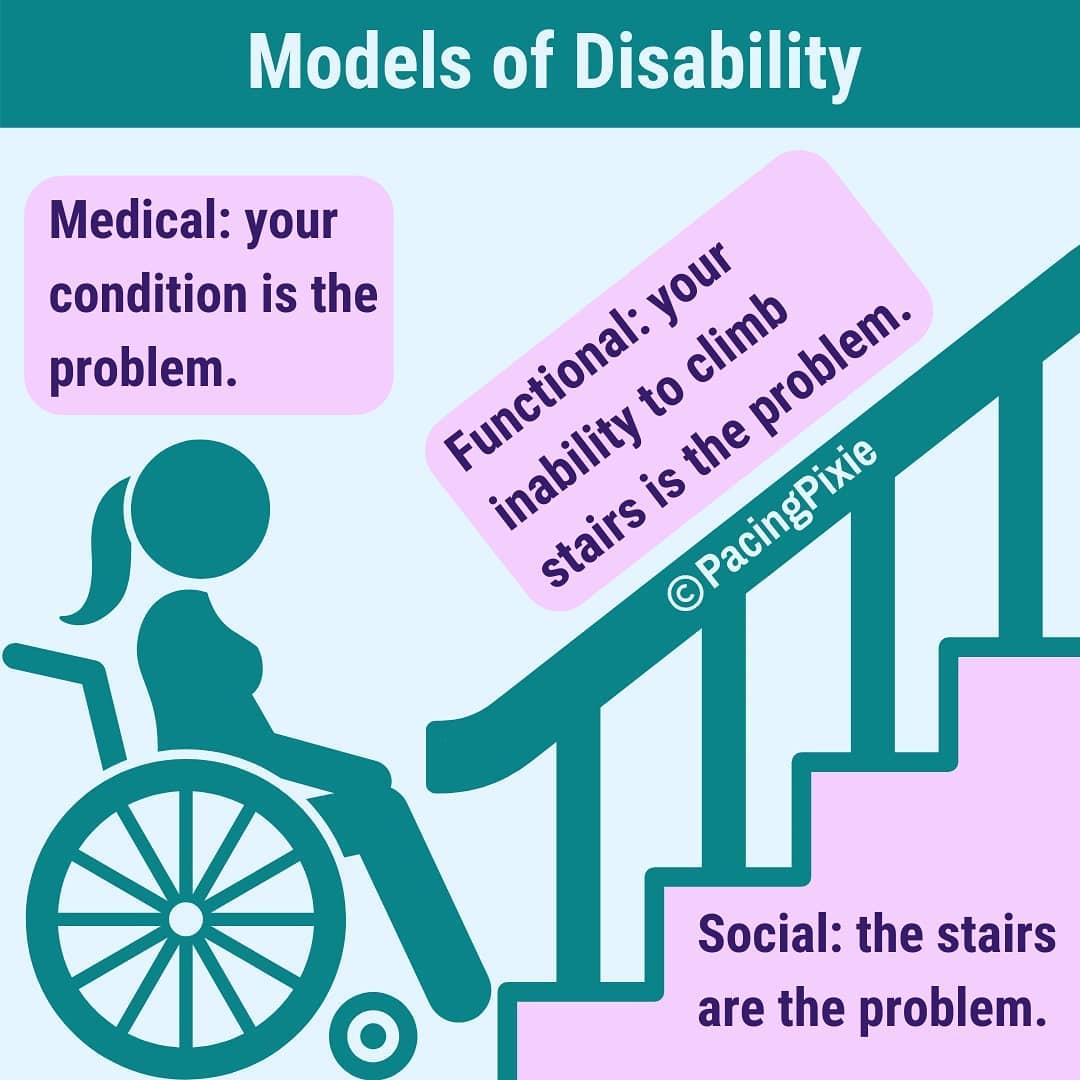
There are a variety of lenses through which the world views disability. @PacingPixie illustrates the varying models of disability beautifully. Under the medical model, a person’s diagnosis is the problem. Under the functional model, the individual’s capacity is the problem. Finally, under a social model, the actual barrier is the problem.  

Image is labeled Models of Disability and has an illustration of someone sitting in a wheelchair approaching stairs. The different models are Medical, Functional, and Social. The Medical Model says "your condition is the problem." The Functional Model says "your inability to climb stairs is the problem." The Social Model says "the stairs are the problem."

In embracing a social model of disability, organizations can re-examine the work they have been taught that disabled people are capable of doing. Just as a wheelchair user is able to easily enter a building when a ramp is available, disabled folks are able to perform a wide variety of tasks and job demands when their support needs are met. 

Disabled folks are often relegated to entry-level service, retail, and production occupations, not because those are the only jobs at which they are competent, but because society has decided those are the only jobs disabled folks are deserving of. When evaluating the strengths disabled folks offer in the workplace, there is often a focus on quantity over quality. This is rarely touched on when employers screen non-disabled applicants. How many of us have been asked, “How quickly can you stuff an envelope for a direct mail appeal?” when we interview for a new fundraising position? However, a preoccupation with an employee’s speed, rather than job performance is often used to justify sheltered workshops and sub-minimum wage compensation for people with disabilities. 

Organizations should also be examining whether they account for lived experience when screening applicants. Focusing on post-secondary education (or even high school graduation) and work history above all else often screens out eager and experienced disabled job seekers. Eliminating minimum education requirements and other fairly subjective hiring criteria also positively impacts those who did not have the opportunity to graduate high school, pursue higher education, or access other experiences seen as valuable in the workplace but are rooted in privilege (unpaid internships, extensive travel, and significant volunteer history or board service). 

Job applications (especially those that are digitally automated to screen out applicants based on multiple choice responses) can also be a means of discouraging disabled applicants from reaching the interview stage. Many jobs specify the need for a driver’s license or specific lifting requirements for positions that don’t require lifting or driving. 

4. Deconstruct a culture of “professionalism” that is rooted in racism and ableism. 

Ableism and racism are deeply connected. Both determine who is valuable to society based on criteria that fall outside an individual’s control (including appearance, language, social conformity, and productivity). Within work environments, an ableist culture is also often racist as well. 

Ableism and racism thrive in work environments where, above all else, we are expected to ‘behave professionally.’ There are inherent dangers in allowing the workplace to be ruled by ‘professionalism.’ In these spaces, Black and Indigenous hair is policed and labeled distracting. ‘Professional’ work attire and the philosophy that we should all ‘dress for the job we want’ centers those that are already in positions of wealth and who can therefore afford to do so as well as those for whom professional clothing is made for and readily available (something that is not often the case for fat and/or disabled folks). In these environments, facial expressions and body language are monitored closely and used to communicate messages neurodivergent colleagues never receive. Direct, honest, and clear communication is dismissed in favor of hint-dropping, passive aggression, and lying to preserve inauthentic relationships (especially with donors). 

I encourage us all to consider whether it is more important to create a work environment rooted in professionalism, or if it might be more valuable to build a culture of respect

I challenge you to build a more committed, engaged, and diverse workforce that reflects the community in which you live.

As our society continues to grapple with the ways in which the COVID-19 pandemic has impacted our public health systems, economy, and communities, we know that no one organization can solve all these problems or fully mitigate the impacts of COVID-19. 

However, we need to acknowledge that there is not a shortage of well-equipped, enthusiastic, and motivated workers in our country. There is a shortage of employers that prioritize inclusivity, equitable pay, and accessibility. 

As organizations navigate the ripple effects of being under-resourced and having been held hostage by the misconception that nonprofit employees should be paid less or should do without necessary resources, I challenge you to offensively tackle issues of equitable reimbursement and access. I challenge you to tap into an existing workforce that wants to contribute to their community and their local economy. I challenge you to build a more committed, engaged, and diverse workforce that reflects the community in which you live. 

Jessie Calero

Jessie Calero

Jessie Calero (she/her/hers) is a life-long resident of New Mexico who earned her Bachelor and Master of Arts degrees from the University of New Mexico. With over 10 years of experience in nonprofit leadership and fundraising, Jessie serves as a development professional within a civil legal services organization in Albuquerque, New Mexico. She enjoys freelance writing and tackling home improvement projects in her spare time. As an autistic woman, Jessie also provides training focused on ableism and its impacts to nonprofit organizations and community businesses that want to prioritize accessibility, inclusivity, and universal design. She can be reached via email or on LinkedIn.