Use informed consent to build trust and answer that damn demographics survey on grant applications

By Allison CelosiaA #PassThePROAct fangirl and movement-building fundraiser

Imagine this: It’s grant deadline day. You get on the grant portal to submit your materials. Proposal, check. Project budget, check. 

You scroll down the list of required attachments. Wait a second, what’s this? Staff and board demographics… you must’ve forgotten, darn it.

So in a rush, you scroll through the current staff and board rosters and hastily assign demographics to them “to the best of your knowledge” according to the survey categories. Save and submit. Phew! 

You’re done, right? And you feel… just okay about it.

Feels familiar, huh? But doesn’t it also feel… wrong?

Identity politics… in a grant proposal?
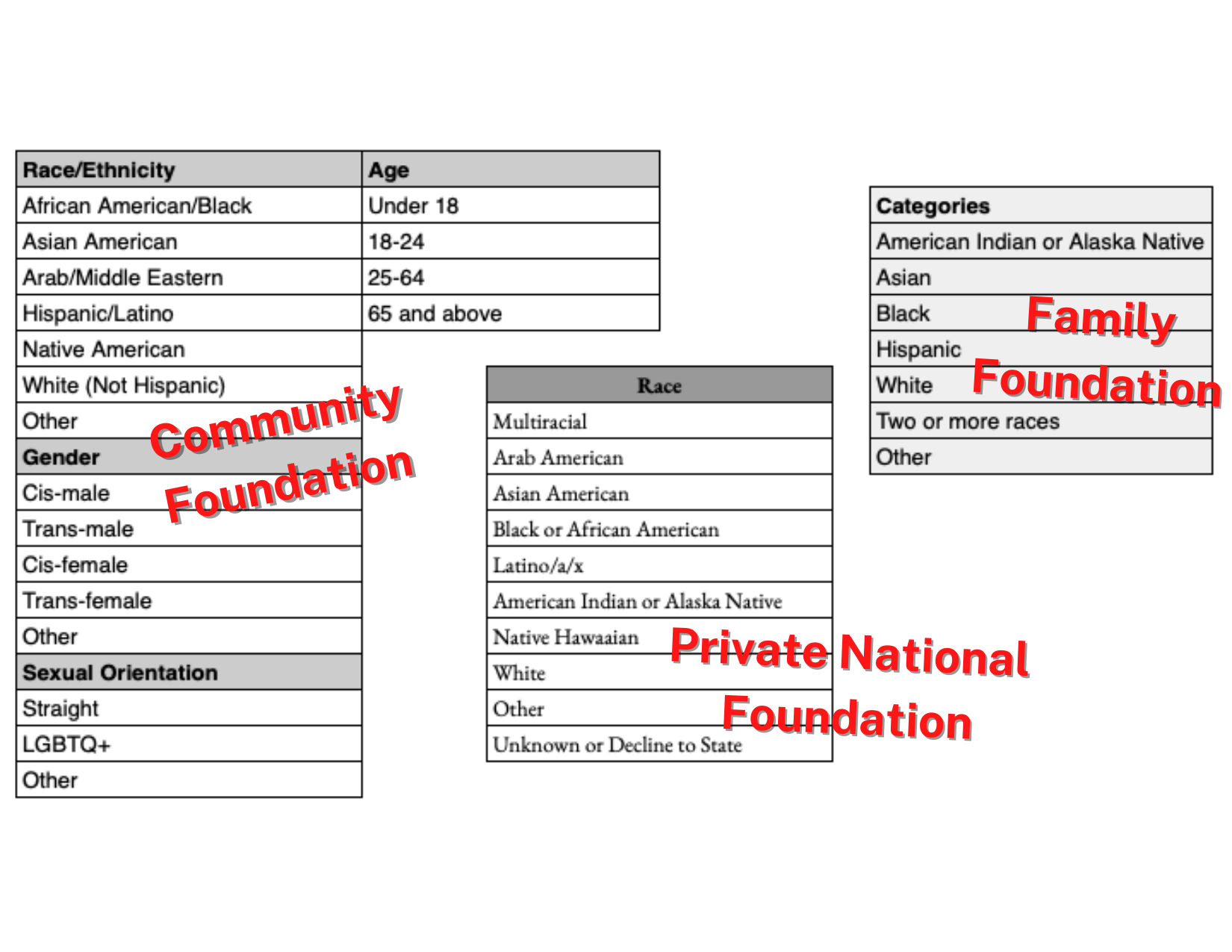
Screenshots of three different demographic surveys, which list a range of demographic categories, including race, gender, sexual orientation, and age. The answer options vary. For example, you may answer one of the following for race depending on the survey: “Native American” or “American Indian or Alaska Native.”

For most grant managers, the demographics survey is just another attachment to check off in a long list of complex documents needed to finalize a grant application. By the time we get to it, we’re tired, cranky even, at that point in the proposal process.

Nevermind when we actually sit down and look at the survey, that’s frustrating too. Nearly every funder has their own version of this survey with varying categories and formats. Most surveys will ask about race and gender, and increasingly we’ve seen questions regarding sexual orientation, disability, income, age, country of origin, language, and more.

Hastily filling out the demographics survey last minute skips an important step, one that is embedded in research design for good reason: informed consent.

Dig in deeper, and the survey response options are often wildly inconsistent. Or worse, limited in choice. For instance, are there only “male” and “female” boxes for gender? Is there just a box that says Hispanic and not Latinx? Does the option for “other” even leave space for explanation? Yikes! 

The simple task of filling out a demographic survey suddenly becomes an ethical clusterfuck on how to present the whole, honest self of each staff and board member, especially if they identify with multiple marginalized identities. 

Tempting as it may be to just get the survey done and out, there is value in taking time to collect and review staff and board demographics. On a surface level, these surveys provide nonprofits and funders insight and accountability on building diverse workplaces, ones that represent the very communities we work with. On a deeper level, though, they affirm the lived experiences of our staff and board. It’s a powerful but often overlooked opportunity to show solidarity in the workplace. If we are required to report on demographics to our funders, let’s do so respectfully and thoughtfully to honor the full humanity of our colleagues. 

Asking for permission: Who are we?

Embracing our abundant identities requires honest communication and understanding. Hastily filling out the demographics survey last minute skips an important step, one that is embedded in research design for good reason: informed consent.

Is collecting informed demographic data a waste of time? Well, let me phrase it this way: Is respecting people’s identities a waste of time?

In one simple definition, informed consent is the practice of letting folks know what data is needed from them, how it’s going to be used, and asking for their permission to use said data. This practice has its origins in medical and scientific research in the mid 20th century. It has since become standard procedure as part of a clinician’s ethical responsibility to the patient and/or participant in a research study: People have to say yes before any treatment or experiment is conducted. 

Nowadays, establishing consent is the ethical norm across a growing number of fields and social contexts to ensure equity, accountability, and safety for everyone involved. The nonprofit and philanthropic sectors are no exception.

Admittedly, prioritizing demographic data doesn’t come easily. Consulting staff and building in consent processes take an inordinate amount of staff time and resources when (let’s be honest) funders glance two seconds at the demographics, if they even look at all. 

Given that capitalist reality, isn’t collecting informed demographic data a waste of time? Well, let me phrase it this way: Is respecting people’s identities a waste of time? When we ask ourselves that question, we’re more open to change, and hopefully, we’ll move quickly and operationalize collecting staff and board demographics with an inclusion and equity lens.

HR is your friend for demographic data

One example of buddying up with HR comes from my collaborative demographic survey project with Ever Galván (they/themme/elle), People and Operations Director at Californians for Justice Education Fund (CFJ). CFJ is a statewide youth-powered organization fighting for racial justice. The staff historically has been a multiracial, multigenerational team, with 88% of the leadership team identifying as Black, Indigenous, People of Color (BI&POC) and 100% of program staff identifying as BI&POC. Embedded in the organization are deep values of Black liberation, equity, and political education. 

At the time of the project, I was Development Manager in charge of grant writing and foundation giving. I was up to my eyeballs in proposals and reports, and there I saw it: another demographics survey. 

I had already wrestled with incomplete staff data in a previous submission. This time, I wanted to be more intentional about reporting demographics. 

I reached out to Ever for help. I knew they were collecting similar data to support recruitment and retention strategies for a diverse staff team. This way, we could share the work of collecting employee demographic information. It actually was a cool opportunity to challenge ourselves creatively: “What if we could embody inclusive community practices around demographic data and identity politics? Just imagine the possibilities!” we exclaimed. (We’re nerds for DEI and data. Can you tell?)

Fast forward through two weeks of research sharing and co-writing several different drafts, we came up with a staff demographics survey that would meet both our departments’ needs. 

The decision points were so thoughtful, for example:

  • We disrupted the gender binary, so no respondent would feel pressured to answer with their assigned-at-birth gender. Instead, the drop list embraces fluidity. Ever’s favorite of the options is “Woman/Man (non-cisgender).”
  • On race, gender, and sexual orientation, we made sure to rename the Other option, so no one would feel erased. It’s now called “None of the above, will specify below” with a short text field for explaining. I particularly love the freedom to claim my Bisaya roots.
  • We affirmed and prioritized our staff’s personal safety and anonymity in disclosing their information by inviting respondents to be expansive and share as much or as little as they wanted in order to feel safe in the process.
  • We even took a political stance upon feedback from our colleagues. In naming Middle East North Africa (MENA) as one of the race categories, we included a descriptive list of countries covered by this region and intentionally listed Palestine, and not Israel. As a racial justice organization, we knew it was the right move for CFJ. I share this to demonstrate that it sometimes takes discomfort and generative conflict to land an organizational values-driven decision like that. And believe me, there was a lot of discomfort.

Still, there was more to do to make this data work for fundraising. How the heck would I answer a limited format survey from our funders? What if the identities our staff held for themselves weren’t listed or recognized appropriately?

Insert honest solution: informed consent! 

In the opening paragraph at the top of our survey, I explained, “As part of this data collection, the Development team will be periodically sharing results with our funders. With your consent, we may recategorize the data to fit the strict guidelines of their survey form. It is our intention to represent your identity safely to our funders.” 

I acknowledged the harm involved, and formally asked for permission. If staff members disagreed or had questions, I encouraged them to speak with me directly. This humble request made all the difference.

We presented the demographics survey at an all-staff meeting. Our colleagues felt validated in their identities and informed about the process. Many staff thanked us for designing such an inclusive survey. They appreciated our transparency, saying, “I had no idea this was part of your job, this really means a lot.” It was a great success! 

Ever and I wrapped up the project soon afterwards, tying up a few loose ends for internal control. The staff survey results would ultimately be held confidentially in People and Operations, aka HR. The Development team would have access to a disaggregated, anonymized table of results that would be updated every six months with the support of the People and Operations team. Then, the Development team would be solely responsible for collecting and updating board demographic information in a similar process. Finally, the two teams would review the policy and procedure annually to make changes as necessary.

The missing data set: funder diversity

That is why I am calling for a fundraising world where demographic information flows both ways … Navigate challenging conversations through mutuality and, most importantly, informed consent.

This project really felt like the best of both worlds: operationalizing a core job responsibility and validating the humanity in our work. Yet, the process left me wanting more, particularly from our funders. Who are they? What is their staff and board diversity like?

Nonprofits are constantly asked to provide demographic data, but rarely do we receive the same information in return. If staff and board demographic surveys were designed to promote diverse workplaces in the nonprofit sector, to ensure programs and services were being led by people from the community, can’t we ask for the same from philanthropy? Are grantmakers similarly representative of the people and communities served? The short answer is no. 

That is why I am calling for a fundraising world where demographic information flows both ways. Build it into the grant agreement. Invite both the foundation and grantee to report annually on diversity. Navigate challenging conversations through mutuality and, most importantly, informed consent. 

This level of transparency and trust will only deepen the funding relationship. Our shared humanity belongs in these spaces, funders and fundraisers alike. We’ll be able to understand our partnership in the movement all the better when we can be our full selves together. 

P.S. Here’s a gift to the CCF community: an open-source version of the CFJ staff demographic survey. Feel free to adapt accordingly for your own demographics survey with source credit to “Adapted from Informed Consent Demographics Survey. Source Credit: Allison Celosia and Ever Galván, Californians for Justice Education Fund (2021).”  Thanks!
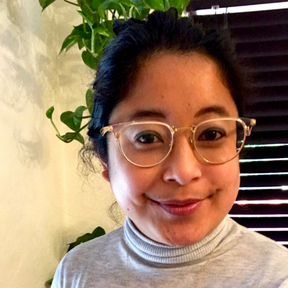
Allison Celosia

Allison Celosia

Allison Celosia (she/they/siya) is abundant. Based on unceded Tongva land, they are a fundraiser and a steward for economic justice. She is a second generation Bisaya American and the proud daughter of immigrants. Allison’s professional path is deeply rooted in the nonprofit sector. Outside of fundraising, Allison is active with local labor organizing. She encourages softness as a strength. They also mill their own flour and do a lot of home baking projects. Connect with Allison on LinkedIn and Twitter. Readers are welcome to drop some community love at Allison’s PayPal for her labor on this piece.
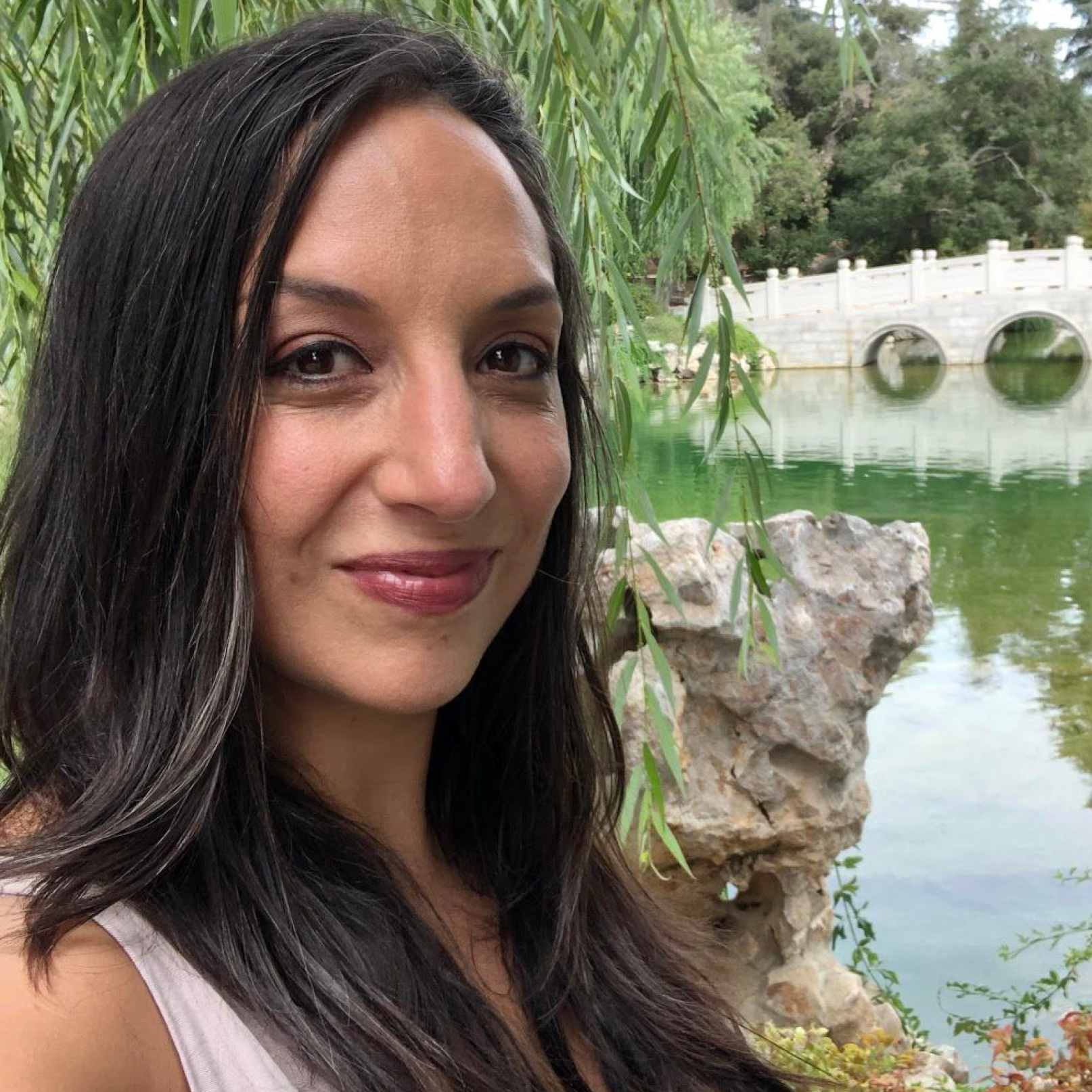
The Ethical Rainmaker: Raci$$$m with Phillip Chavira

By Michelle Shireen Muri, Freedom Conspiracy Principal and CCF co-chair

Episode Summary

​Phillip Chavira talks about why Capitalism is trash, how money is a tool for and against the movement and where we have power to make decisions that center our communities and our values. Find the episode notes and the podcast transcript here.

About the Ethical Rainmaker podcast

In the United States alone, philanthropy is a $427 million dollar industry, of which 68% comes from individual donors. Yet the practices, theories, and foundation of modern philanthropy and fundraising often ignore the ways in which the industry perpetuates harm.

The Ethical Rainmaker, hosted by Michelle Shireen Muri, is a podcast that hosts authentic conversations grappling with the questions that we don’t often ask in the nonprofit world. Join us as we explore some of the practices that undermine our missions and navigate the way forward with today’s resisters, reimaginers, and the re-creators of the third sector. It’s time to think differently.

Michelle Shireen Muri

Michelle Shireen Muri

Michelle Shireen Muri (she/her) is the co-chair for Community-Centric Fundraising and the host of the new podcast, The Ethical Rainmaker, launching July 29. She is the founder of Freedom Conspiracy, a small collective of fundraising consultants focused on bringing values-aligned practices to clients in the nonprofit and philanthropy spaces. She can be reached at @freedomconspiracy on Instagram. You can send her a tip via Patreon

America’s charitable problem extends far beyond Giving Tuesday, and the Global South is bearing the consequences

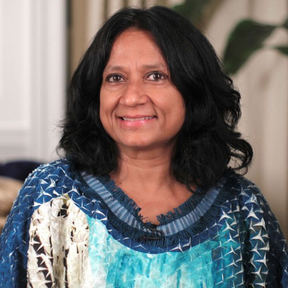
By Geetanjali Misra, co-founder and executive director of CREA

“Change a child’s life for the price of a cup of coffee.” 

“What will your selfless acts be this holiday season?” 

“TODAY is our LAST CHANCE to SAVE LIVES.”

Do these sound familiar?

The Tuesday after Thanksgiving has become a charity free-for-all, with pleading subject lines vying for attention as they flood mailboxes. Nonprofit organizations have seized onto Giving Tuesday as an opportunity to reap a kind of fiscal penance after the indulgences of Black Friday and Cyber Monday. 

After spending one day feasting and feeling thankful for all we have, and spending the next days consuming even more, it is difficult to turn away from societal injustices like homelessness and hunger.

This worldwide annual drive to solicit individual philanthropists to give what they can works astoundingly well. Giving Tuesday is the largest day of the year for direct donations. An estimated $2.47 billion was donated to U.S.-based charities by over 34 million people in 2020 during the one day campaign. The value of this funding goes far beyond the stunning numerical total at the bottom of a budget line, because this is money without strings attached. 

While the global community has started to rally around the call that development solutions need to come from the Global South, the funding to make that a reality has not materialized. Instead, Global South organizations are often seen as essential but rudimentary. When funding does arrive, these local nonprofits are usually expected to do more with less because of their lower costs of operating.

And for nonprofit organizations based in the Global South, this is a luxury that they rarely get from the international community.  

Fundraising in the Global South (countries that have been marginalized within political and economic systems, post-colonization, by Global North countries) requires resources that are often out of reach. The old adage “it takes money to make money” is true even in the world of nonprofit organizing, where our literal distance from funders becomes a disadvantage. 

While the global community has started to rally around the call that development solutions need to come from the Global South, the funding to make that a reality has not materialized. Instead, Global South organizations are often seen as essential but rudimentary. When funding does arrive, these local nonprofits are usually expected to do more with less because of their lower costs of operating. 

However, while these organizations may be locally-based, their work can span from community level to regional — and global scale and requires significant financial resources. While funding support from generous donors can facilitate program growth, many of these grants are project funding. Support to specific projects, be they girl’s empowerment programs or reproductive health service strengthening, don’t provide support for organizational development in terms of institutional strengthening and further fortifying internal capacity to deepen work. 

This keeps Global South nonprofits dependent on the Global North for funds that offer temporary relief rather than sustainable change.

Nonprofits without offices in the U.S. or Europe often do have lower overheads and higher cost effectiveness, but they also spend a great deal of resources proving that to potential funders. Rarely trusted with core funding to use at their own strategic discretion or self-identified priorities, organizations in the Global South are forced to fundraise for small projects rather than long term missions or sustainability. 

There is an obvious need for systemic shifts in how we fund work in the Global South at the institutional level, but there is much that can be done at the private and individual giving levels as well.

Most often, funding only trickles down to the Global South via larger Global North-based institutions and foundations, which syphon off much of the budget along the way. In their most recent report on private philanthropy, the OECD estimates that 97% of U.S.-foundation giving in 2013-15 was funneled through intermediary and non-governmental organizations such as WHO and UNICEF.  

A report by the Vodafone Foundation and ClearView Research on ‘Barriers to African Civil Society’ found that while U.S. foundation funding to Africa jumped more than 400% from $288.8 million in 2002 to nearly $1.5 billion in 2012, most of this funding, went to organizations headquartered outside Africa — making it harder for informal and smaller organizations to secure resources needed to sustain their work. 

In our own underfunded nonprofit sector, data from 2016/17 showed that only 1% of gender equality funding went to women’s organizations, and the vast majority of this went to international organizations based in the donor countries. 

The power imbalance is not just about where we give the money but how we give the money. 

American foundations may fund progressive causes but their grantmaking processes create bureaucratic barriers to small local organizations who are located closest to the challenges they try to solve. 

A recent study that assessed the grantmaking practices of 148 largest private and community-based U.S. foundations found that only around 10% allowed grantees or community members most influenced by the funding to decide how the funds should be allocated. Again, that means that few nonprofits were trusted to choose how to spend their funds.

There is an obvious need for systemic shifts in how we fund work in the Global South at the institutional level, but there is much that can be done at the private and individual giving levels as well. Many of the U.S.-based organizations participating in Giving Tuesday this year will be putting out calls to fund their work countries around the globe. And you should continue to give because these direct fundraising efforts fuel important efforts. 

However, double-check that you have some Global South organizations on your Giving Tuesday list as well. Your dollars, pesos, rupees, shillings, and more really do go further when we trust Global South organizations to strategically invest in their visions for a more equitable future.

Geetanjali Misra

Geetanjali Misra

Geetanjali Misra (she/her) is the co-founder and executive director of CREA, a feminist human rights organization that is based in New Delhi and led by Southern feminists. She has over three decades of experience working at the activist, grant-making, and policy levels on issues of sexuality, reproductive health, gender, human rights, and gender-based violence. She holds Master’s degrees in International Affairs from Columbia University and in Economics from Syracuse University. She writes on issues of sexuality, gender, and rights, and has co-edited ‘Sexuality, Gender, and Rights: Exploring Theory and Practice in South and Southeast Asia’ from SAGE. She is also the author of ‘The Power of Movements’ published by AWID.

The annual report that never was …

The annual report that never was …

A collaboration between Marisa DeSalles and Michelle Flores Vryn

Photo by Lukas from Pexels.

These graphs are pretty, but meaningless — just like most of the data we tend to present in our annual reports.

As DEI professionals will tell you, one way to assess the authenticity of your workplace culture is to take stock of the types of messaging that circulate around the office. Are they overwhelmingly positive? (“We received this grant!” “Enrollment goals were exceeded!” “We can make payroll!”) 

Seriously though, consider whether you are perpetuating a tone of toxic positivity. If you are, it likely flows over into your external messaging. Like your annual report.

Go us! Look at what we’ve done!

We’re good at touting our accomplishments as nonprofits. We write annual reports as our centerstage statement of impact. Typically, this caters to our donors, reinforcing their feelings of being good people, thus increasing the chances they’ll fund us again. It’s a self-fulfilling cycle. Or at least we hope it is.

Photo by Alexander from Pexels.

“This stock image doesn’t represent our workforce at all, but we hope it will make us appeal to millennial donors of color”

Here are questions we often ignore though: 

What do annual reports communicate about us, in terms of what we do not say? What if we wrote them honestly, for and with the community instead?

If we’re being honest …

Recall your last annual report — now, imagine it if it were honest. Like, this-couples-therapy-is-our-last-desperate-shot-before-divorce honest. 

Do your donors (big and small), funders (local and national), staff (entry level and c-suite), and volunteers (board members and program supporters) actually know what your day-to-day reality is? Do they know the infrastructure needs that you lack? What about your actual holistic need? 

Or is it just about which of their initiatives or personal priorities you currently happen to fit into? 

Do they not know these facts because you are distorting reality?

Let’s be more real about the challenges we’re up against, including our gap in service each year. I mean, we never fully accomplish our potential for impact, do we? Many times, that is understandable — after all, we’re tackling the world’s most complex and deeply rooted injustices — but that should not prevent us from being real about our service gap and resource need. 

Being more honest will help all players in the social impact ecosystem be better equipped to build high-impact relationships, select joint priorities, and collaborate effectively.

Annual reports are too often like posts on Instagram, where content is highly curated and the beauty filter is liberally applied to faces and to lifestyles. Let’s get a little more authentic. 

What does this toxic positivity conceal? Who’s excluded?

By only highlighting what we have accomplished and neglecting to discuss the gap of service that we have yet to fill, we are painting an incomplete picture. Worse, by misrepresenting our reality, we are excluding our strongest supporters from the opportunity to direct more resources to where we really need them.

Here’s an example:

A nonprofit organization we know suffered during the pandemic, like many other nonprofits. This particular one dealt with the sudden loss of their charismatic founder. Their infrastructure was woefully inadequate for online programming. They lacked reliable internet, and their office was a windowless cloakroom in a hundred-year-old building with mice and a broken elevator. They hired and lost their first full-time ED in mere months.

However, at their recent board retreat, they were also able to identify the gaps in service and infrastructure as well as honestly explored their own lived experiences and connections to the mission. They realized that one of their core programs was effectively serving as a pipeline of talent for their team of volunteer support group facilitators — a pipeline that could be more efficiently utilized.

They had also recently won a big grant and were in a position to win more funding for their work.

So, which of those stories are they going to tell this year in their annual report? 

Conventional wisdom might say they should highlight the grant, make the most of the programs they were still able to deliver, and maybe only briefly mention the leadership transition.

Or, they could write about the full picture. They could include a photo of their current dismal little office, They could openly discuss the challenges of finding the perfect leader during a pandemic. They could end with an appeal to the community for help in finding new offices and a new ED.

Remove the rose-colored glasses, then articulate funding the full picture

Annual reports are tweaked to highlight the positive statistics. But stating the full need should not make us, as nonprofits, feel ‘less than’ or inadequate. On our shoulders we carry the psychological impact of trying to heal the wounds of society. It’s a lot. And we cannot do it all. Nor should we have to. 

The wider community, including donors, need this full picture to understand their place in the cycle of social impact. It is our responsibility, as nonprofits, to tell an authentic story of need — this includes what’s lacking to fulfill our mission. 

The ugly truth about our staff

Imagine if your staff update read something like this:

“We’re happy to report we’ve opened up our offices again amidst a rise in Delta variant cases. Absolutely none of our staff surveyed want to be working in the office full time, but our board president felt it was more important to have ‘coverage’ of a physical space no one is visiting, in spite of the fact that phone numbers can be forwarded. Besides, we thought it would be unfair if we allowed workplace flexibility to those who came to depend on it for childcare and eldercare this past year.

“We’ve made great progress on our DEI efforts. Our frontline staff, all underpaid and mostly people of color, created a beautifully detailed work plan for improvements. We promptly gaslit all their experiences and hired an expensive consultant to evaluate our salary structure instead of just giving them raises. 

“Also, in an unrelated matter, we’re hiring for sixteen staff positions.”

Photo by Yan Krukov from Pexels

“Gotta have that coverage!”.

Okay, maybe that was too honest. Now, obviously we might not want to shine a light on our staffing struggles. We fear it may make us appear unsustainable. But maybe that’s the real problem — maybe our workplace practices are unsustainable. As a sector, our crappy, antiquated hiring practices (#showthesalary) and workplace conditions came under a harsh and unforgiving light this past year. 

Many nonprofit pros, especially women and people of color, are moving away from the sector for entrepreneurship or leaving the job market entirely. They are disillusioned by the gap between high ideals and harsh workplace realities, and tired of juggling the demands of family along with work. Younger folks are discovering that nonprofits are painfully slow to keep up with the changing demands of a workforce facing life-altering, global challenges, and looking elsewhere.

The Great Resignation is well underway. Nonprofit employers, wake up. It’s not unemployment benefits that are keeping people out of the job market. It’s a realization: We deserve better and there are employers who will give it to us.

Being more honest about your struggles could actually help you attract and retain better staff. Also, give them a raise, a bottle of their favorite beverage, a hug, and an extra week of PTO while you’re at it.

A better way forward

This is a time for us as nonprofit leaders to speak honestly about our needs, about our successes and about our crushing defeats. This is a time for radical honesty. 

January 1st is an opportunity to toss out your existing template and go through this thought exercise. Deeply review your organization’s messaging and evaluate its honesty and transparency. At your team meeting, ask:

  • Why are we doing this — who is this report for?
  • Can we see our authentic selves in this write-up? 
  • What areas are we more opaque about (hint: overhead) and what impact would it have if we highlighted these areas?
  • Is this the right template to show our work? Are we thinking critically about the kind of metrics that are most meaningful to us (such as measuring donor love)?
  • Are the voices of our community truly represented? Are the stories that we are telling, being told ethically?
  • Are the right voices in the decision making space? 
  • What is the gap of service that has not been filled, and why has it not been filled? 
  • How can the reader engage in solving the gap?

If we were to start from scratch, the annual report should really be a co-creation between the nonprofit and community served. You might be in a position to do just that — but we recognize that change is more often incremental and nonprofit progress is slow. Maybe your annual report template was carved in stone by the board president’s great-uncle and painted in the blood of your revered founder, may she rest in peace. 

But you can still get creative and find a way to include marginalized voices and stories, even if not in this communication. Consider creating an adjunct report that is co-authored by the community you serve, that articulates their vision of your services. Maybe you put forth a new space on your website or a separate social account solely for community-generated stories, like a participatory video series.

Our supporters deserve honesty. Let’s uncheck the filter button and show the moles, pores and wrinkles. We believe readers will not be turned away, but lean more deeply into our mission. 

Authors’ note: Portions of this article were inspired by anonymous contributors who shared their personal stories of working in nonprofits. To them, we are eternally grateful. 

Marisa DeSalles & Michelle Flores Vryn

Marisa DeSalles & Michelle Flores Vryn

Marisa DeSalles (she/her) is spending her quarantime growing zucchini bats on her front lawn, obsessing over other people’s Zoom rooms, and actively spoiling a multi-generational and multi-species household. Her favorite superhero is Word Girl and she is overly fond of commas, especially the Oxford one. Please subscribe to her new blog at marisadesalles.com so she can justify renovating her she-shed. Politics on Twitter, critters and plants on Insta @kidscatzntech. You can send Marisa a tip via her Venmo, @marisa-desalles.

Michelle Flores Vryn, CFRE (she/her/ella) has worked in almost every area of development: institutional giving, major gifts, membership, capital campaigns, consulting, special events, and annual giving. She has a healthy obsession for equitable social impact and currently serves on the Association of Fundraising Professionals (AFP) Global’s Marketing, Awards & Communications Committee. Michelle lives in Austin, Texas and is always down for spontaneous outdoor adventures and dropping in on live music. She is a two-time graduate of the Hispanic Serving Institution (HSI) The University of Texas at San Antonio. Find her on LinkedIn to keep the CCF convos going! You can send Michelle a tip via her Venmo,  @Michelle-Flores-Vryn.

The Ethical Rainmaker: Shattering Fragility with Liz LeClair

By Michelle Shireen Muri, Freedom Conspiracy Principal and CCF co-chair

Episode Summary

Controversial. Polarizing. Divisive. Liz LeClair has gained a reputation for her famous call outs of both sexual assault and racism within the nonprofit world. In S3:E1, Michelle interviews this writer, fundraiser and badass who talks about calling out white fundraisers for their racism, taking responsibility for being part of the problem, and her experience speaking out about sexual harassment in the fundraising space, including cofounding the National Day of Conversation in Canada. “Every generation you either change and evolve or you become irrelevant.” You are going to love this episode.

Find episode notes and the podcast transcript here.

About the Ethical Rainmaker podcast

In the United States alone, philanthropy is a $427 million dollar industry, of which 68% comes from individual donors. Yet the practices, theories, and foundation of modern philanthropy and fundraising often ignore the ways in which the industry perpetuates harm.

The Ethical Rainmaker, hosted by Michelle Shireen Muri, is a podcast that hosts authentic conversations grappling with the questions that we don’t often ask in the nonprofit world. Join us as we explore some of the practices that undermine our missions and navigate the way forward with today’s resisters, reimaginers, and the re-creators of the third sector. It’s time to think differently.

Michelle Shireen Muri

Michelle Shireen Muri

Michelle Shireen Muri (she/her) is the co-chair for Community-Centric Fundraising and the host of the new podcast, The Ethical Rainmaker, launching July 29. She is the founder of Freedom Conspiracy, a small collective of fundraising consultants focused on bringing values-aligned practices to clients in the nonprofit and philanthropy spaces. She can be reached at @freedomconspiracy on Instagram. You can send her a tip via Patreon