Why journalism needs to rethink its gold standards, especially when reporting on communities of color

By Elisa Shoenberger, Journalist and Writer

We need to explore how journalism’s best practices may be supporting these structures of power and figure out how to make the practice of journalism more equitable and inclusive.

So much of how the world understands philanthropy is through the help of journalists (as well as development communications folks) who write about the issues to get people interested and involved. For people outside of the philanthropic sphere, it’s how they learn about what’s going on in our sector; and often, it’s also how people inside that world learn about what’s going on. 

But as we examine the ways that philanthropy has historically and currently supported white supremacy and structures of power, it’s time to look at how its partner, journalism, has also helped uphold these values. We need to explore how journalism’s best practices may be supporting these structures of power and figure out how to make the practice of journalism more equitable and inclusive.

Working with sources

I became a freelance journalist because I love talking to people about what they do and what they are passionate about. It’s the best part of writing articles — I get to talk to incredible humans about themselves. This led me to become an oral historian and, eventually, a freelance journalist.

But what do you do if you are working with people and communities who have been harmed by the media?

One of the biggest differences between the two practices is how they approach sources and their quotations. Oral historians typically share the transcripts of the interviews with people whereas journalists typically don’t share quotations or paraphrases or even the direction of the article. Many publications’ editorial policies do not permit journalists sharing anything with sources prior to publication. A few will share quotations for purposes of fact-checking and there are some outlets, like the CCF Hub, that are open to the practice.

The argument for why journalists should not share material with sources is freedom of the press. We don’t want sources to dictate the article. And I totally understand that. Last year, I wrote an article that was critical of a government agency and got an earful from the public official I had interviewed about it. He didn’t like the tone of the article. If I had shared parts of the article with him, I imagine he would have wanted the entire piece to read differently.

But what do you do if you are working with people and communities who have been harmed by the media? I talked with Corinne Rice Grey Cloud, Indigenous diversity equity and inclusion educator, a Lakota and Mohawk woman, and an Indigenous journalist, about how the media has harmed Indigenous people in the past and the present day.

There’s a lot of mistrust of the media in Indigenous communities due to the way the media has treated people.

“The media will come to Indigenous people for a conversation about topics that are emotionally straining or draining to talk about and [are uncaring that we are] reliving that,” Grey Cloud said.

For instance, with all the recent mass burials of children being uncovered at residential schools in Canada, journalists have been reaching out to residential school survivors, she explained, without considering the impact on their mental health from their own trauma.

“Essentially what you’re asking [these people is]: ‘Step into your trauma, and explain your abuse to me, as someone who’s never seen it so that I can write an article that will appease an audience that has never heard of your pain or trauma,’” she said.  She added that there’s also a fixation on poverty in Indigenous communities, which she says is poverty porn.

Historically and currently, journalists have been known to misuse people’s words or not put their words into context. Members of the media will use quotes to serve their own purposes of the story.

“It can absolutely cause real harm to that person’s life, within the community, your reputation, and who you are and what you do for your people,” Grey Cloud said.

Grey Cloud explained that as a journalist, she also has to earn the trust of the Indigenous communities herself, even when she’s working to uplift the community. To gain people’s trust, she shares the framing of the story, the quotations and sometimes the entire story with her sources before publication. “If they felt that it represented what they wanted in their story, to be communicated to the world in a good way, then I would send it to my editor,” she explained.

Often, non-Indigenous journalists may not have cultural understanding of Indigenous viewpoints and histories and may make significant mistakes in articles. This problem is exacerbated by journalists who just want the quick story and leave. They aren’t thinking about developing a long term relationship with their sources and the communities they are in.

“It just really sours the relationship in that particular community, with anyone trying to come in and write about what’s happening. And then the [true] story never gets heard. And then [there’s] missed opportuni[ties] for education, or for joy and success,” Grey Cloud explained.

Working with sources together to help tell their stories is definitely one step that journalists may want to consider, especially when working with marginalized communities.

“I think that approach in journalism, in that way, is pretty decolonizing,” she said. “Because [as a source,] what you’re doing is you’re reminding the journalists that you need to have some humanity in what you’re doing. It isn’t a commodity. Our story is not a commodity. Our stories are our human experience.”

Not everything is fit to print

There’s a tendency to think that we can and should write about anything that we hear, as long as it is not obtained through false pretenses. Anything is for the taking. But the longer I work in this field, this attitude is a little worrisome. There can be consequences for people who talk to journalists and that has to be considered.

JoAnna Haugen, Writer, Speaker, Solutions Advocate, and Founder of Rooted who recently presented on “Responsible Travel Writing” at a writer’s conference, said, “It’s important to get ongoing consent. It’s important to establish clear boundaries and expectations. Just because somebody shares their story in history and culture with you doesn’t mean that you necessarily have the right to share that with other people.”

She also notes that not everyone understands what it means to share a photo on Instagram.

Now it’s critical that this consideration doesn’t turn into some new-paternalism. But we need to consider the impact of what we are writing will have on people. For instance, I was working on a story with creators on TikTok several months ago and two of my sources mentioned some concern that they might be punished by the platform for talking to me. While they had already decided to talk to me anyway, I felt it was my duty to keep making sure they were okay with the interview and mentioning their names in the article. If they changed their mind, I needed to know. The article would have been poorer for it but it was their decision at the end of the day, not mine.

Whose objectivity?

But who decides what is objective? Who does it serve?

There’s a lot of discussion about the importance of objectivity in the press. We are supposed to be dispassionate observers of the truth.

But who decides what is objective? Who does it serve? In this incredible essay by Mary Retta in Bitch, she writes, “Because journalism is a field traditionally dominated by wealthy, white male voices, the latter perspective is the one that is typically heralded as objective and fair.”

Retta explains that many media outlets believe in the necessity of giving space to both sides of an issue, but that can cause great harm. For instance, she cites the case of Senator Tom Cotton’s fascist op-ed last summer in The New York Times, where he advocated for military involvement in protests.

We need to stop acting as both sides of an issue are equally relevant, especially when it comes to people’s lives.

This also means thinking about how we approach sources differently.

“The same way you have to handle conversations with all types of people, you have to handle your journalism differently with different types of people,” Grey Cloud explained. The conversation you have with a government official should not be the same as the way you conduct an interview with a woman who has been a victim of sexual assault, she said.
It goes back to Grey Cloud’s comment about bringing humanity back into journalism. Treating everyone the same doesn’t make sense because the power structures are different. Journalism needs to hold officials accountable but other sources shouldn’t be treated the same way.

As a corollary to that, we have to be more mindful about the identities of our sources. Haugen noted: “It’s really important that we clarify pronouns and identity as part of our interviewing process, so that one of the things you don’t do is misrepresent the way somebody identifies. That is not up to a writer to determine, that is up to the person to self-identify.”

Being proactive with editing process

But ultimately, we have to do better as an industry at thinking through these issues. We shouldn’t cause harm to the communities and the people we report on.

For many journalists, filing the story is the be all and end all. But Haugen noted, “I think it is important for writers to become more involved in the editing process.” That means being proactive with the story to flag things that might be of concern, she said.

Additionally, writers should take a more interest in headlines, photos, and the captions of photos because they can also be places of harm. In an effort to make headlines more exciting, the titles can mischaracterize the entire piece and cause problems therein. I’ve had this happen to me a few times when the headline was inflammatory when the article was not.
Haugen said that she has talked with several editors and the consensus is that they don’t want their publications to misrepresent people or situations either. Many editors are open to more involvement with writers in the process, she said.

But what do you do if you are working at a publication that does not permit reviewing of quotations, and other equity-based practices? That’s a tough one especially for freelance writers who don’t typically impact policy at the publications we contract for.

We can always try to explain the reasons why we think that they should reconsider the policy but they may not agree. In that case, we should at least be very clear with our sources and give them the opportunity to pull out of the article (again, consent). Or, we can try to find a more open publication for the article. There may be other suggestions out there on this —  this is something I’m still working on myself.

These are just a few thoughts on how to rethink the way journalism is conducted to make it more equitable and inclusive. It’s meant to be a beginning of a discussion, not a prescription for change. I know there is a lot that isn’t mentioned here including #OwnVoices, which is worthy of its own article. I have no doubt there are many angles that I don’t even know to include at this point.

But ultimately, we have to do better as an industry at thinking through these issues. We shouldn’t cause harm to the communities and the people we report on. We need to look at the ways we relate to people and their stories and move past the quick soundbite. Journalists, hopefully, got into the business because we like telling stories about the world. But we have to remember that often these are not our stories and there are consequences, good and bad, to the people who live them.

Elisa Shoenberger

Elisa Shoenberger

Elisa Shoenberger (she/her) has worked in the fundraising field as a prospect researcher and data analyst for over eight years. She is a Research Consultant for Aspire Research Group. She is a journalist and writer and has written on numerous topics about philanthropy for Inside Philanthropy, Brainfacts.org (Society for Neuroscience), Council for the Advancement of Education, MoneyGeek, The Daily Dot and many others. She has also written for the Boston Globe, Huffington Post, Business Insider, and many others. You can find her at @vogontroubadour or at Bowler Hat Fox, LLC.
Why I can’t get North Carolina’s state motto out of my head (and what other white people can learn from my obsession)

By Nate Levin-Aspenson, writer and grants manager

Let’s be honest: As a white dude, you tend to get more credit than you earn. I know from firsthand experience. The bar is so far below ground that it has been reabsorbed into the composite metals of the Earth’s core.

My friend Jess Null recently started a book club for the Rhode Island AFP Chapter. It’s been great, and not just because I need structure and deadlines to finish anything. We’ve been able to have some really rich discussions of important texts in fundraising.

For the last one, I finally read Edgar Villanueva’s Decolonizing Wealth. Near the end Villanueva, a fellow North Carolinian, ties the book together by recalling the North Carolina state motto, and how that phrase informed the values he grew up with.

Rather than paraphrase, I’ll let him tell it:

The state motto of my home state is Esse quam videri, a Latin phrase meaning “To be, rather than to seem.” It was also my mother’s motto in child rearing. I can hear her now: “No half stepping! We must be real Christians, not just in name.” “We must really love people, not just do good for how it looks.”

I had to put the book down and sit with it for a minute because friends, those words haunt me.

The words feel like they’re written on the inside of my eyelids just before I wake up. As the day goes on, they migrate down my neck, settling heavy above my stomach while I’m brushing my teeth. In my best moments, I could say they live in my hands. Other times, I want to fling them at others, and I can feel them collecting — acidic — on the back of my tongue.

I have to keep the words close and sharp, because I know what happens if I don’t.

We could put on a show

Let’s be honest: As a white dude, you tend to get more credit than you earn. I know from firsthand experience. The bar is so far below ground that it has been reabsorbed into the composite metals of the Earth’s core. In 2016, I could get a standing ovation for showing up to a meeting and talking about how systemic racism is real. I once went to a rally and someone handed me the Oscar that “Crash” won for Best Picture in 2006 just for making the trip out. I don’t even know where they got it.

It’s a strange feeling to know you’re getting more praise than you’ve earned for doing something, although it’s a very common phenomenon for white dudes. It really messes with your ability to receive and process outside feedback.

There are a few ways this can shake out. For a certain number of cream-colored adult babies, it tilts the entire scale heavily towards the top, making outsized rewards feel normal and criticism feel alien and unwelcome. Other Tarantino fans have learned to put on a show, performing the behaviors that are socially rewarded by their chosen circle. I fall into the final group of boat-shoe enthusiasts, with the internal scale tilted instead towards the bottom — making criticism feel normal and positive feedback feel strange and unearned.

This sounds like a lot, but I can’t live with myself only seeming. I have to be the person that I say I am. White supremacy is ready to take me back the second I stop moving, and it polishes the world’s perception of me by design.

This makes three things true in my internal reckoning:

  1. I am always going to get more credit than work I have done to earn it, therefore
  2. Only my internal measurements of my work are reliable and
  3. The only thing I can really be sure of is that I’m not doing enough.

I know how easy it would be to perform the ‘seeming’ version of myself. To talk on Twitter, at work, among friends about the values I say I have without ever acting on them.

I know that if I’m not careful, I might actually start to believe that I wrote, produced, and directed the motion picture “Crash.”

I didn’t, though

I think the reason that we see failure after failure to meaningfully address systemic racism, sexism, and ableism in the nonprofit workplace is that these efforts are driven primarily not by a desire to correct systems, but by a desire to repair self-image.

But what I think about myself is A) a mystery, known only to me and mediated to others through the clumsy and imperfect medium of words and B) deeply unimportant.

In the grand scheme, anyway. Which is why I find it so surprising that it seems to be the guiding ideology of so much nonprofit DEI work. A huge chunk of the failures that I see in justice, equity, and diversity in the nonprofit field don’t seem to stem from mistakes that occur naturally in the course of any work, but from starting from a point of self-reflection rather than an earnest desire to change unjust material conditions.

We see this all the time. A horrible tragedy precipitates a flashpoint in the conversation around our sector. Organizations are driven first to self-reflection. Meetings are held. Statements are drafted and then released. Sometimes, but not always, policies are changed.

But why are these changes always reactive? The material circumstances that they are meant to address always predate the flashpoint. Gender and racial pay gaps have been around. Discrimination in hiring and lack of representation have been around. Overwhelmingly white and male organizational leadership have definitely been around. In many cases, people in leadership were already aware of the problem and perhaps taking incremental steps to address them.

Flashpoints only change two things: the circulation of information about the problem, and — perhaps more importantly — the social importance of the problem.

As the conversation shifts towards radical solutions and more social value is assigned to justice and DEI work, people and organizations are forced to reckon with the reality of their failure to address these issues in the past. Their self-image is called into question: ‘How can I be good, when my inaction has contributed to these problems?’

I think the reason that we see failure after failure to meaningfully address systemic racism, sexism, and ableism in the nonprofit workplace is that these efforts are driven primarily not by a desire to correct systems, but by a desire to repair self-image.

An unpleasant look in the mirror

2020 was scary for a lot of reasons. I remember a year ago last summer when there were protests on the streets of Providence nearly every night. Every time I saw sirens, I was worried that the Providence Police Department would hurt or kill someone when they showed. A few times, I witnessed the violence they were willing to bring to bear on people taking to the street, and that did nothing to alleviate my fears.

The nights when I couldn’t make it out were worse, because I could only speculate what might be happening out there between my phone ‘bwimp’ing with signal updates. It was miserable and scary, even from my position of immense privilege.

Guilt is not a good friend to action, but it is a frequent travelling companion of rest. Before bed I would have to remind myself that I was not the fulcrum on which the movement rested, and that it would go on fine without me. My head believes it. My heart doesn’t

Those nights went worse for others.

Okay, let me really be honest. Most of the time I feel like dead weight. I take up space in the movements I care about, and I’m not sure the meager time and energy I’m able to provide is worth the real estate I’m occupying.

I went back to work full-time in 2020, and the flexibility and additional time that my previous life as a consultant afforded me evaporated. I dropped out of committees. I narrowed my focus areas. I shrank. It feels selfish, making more money and spending so much less of my time on the things I care about.

The people I work with and the people I know doing movement work are so kind, and so generous, and they work so hard. They treat me like the person I’m trying to be, even though I don’t feel like I’ve earned being that person to them. I’m almost in tears writing this, but the kindness and esteem of my comrades unmasks me. I accept their words politely and file them away with other things ephemeral, and go back to sharpening the words that really matter to me.

To be, rather than to seem.

Every time I feel this way, I am desperate to feel anything else.

Desperation

So, we find ourselves at this tension point, between what we want and what we need — between what white supremacy demands of us, and what will actually accomplish our stated goals.

We are all steeped in white supremacy culture our entire lives, and it shapes how we view the world, how we think, and how we respond to problems. It is also deeply rooted in our organizational structures, including here in the nonprofit sector. It’s why DEI initiatives stall and sputter out between these moments of flashpoint.

White supremacy hoards power.

In order for power to be more equitably distributed — in wages, in hiring, in leadership representation — some people have to cede power. One of the reasons our DEI efforts so often feel cosmetic is that organizations attempt to solve a lack of equity and representation without a cessation of power. This cycle continues until another flashpoint, when they feel an increased demand for immediate action to demonstrate that their values are not only performative.

White supremacy demands urgency.

This sense of urgency exists for a reason: to perpetuate power. Quick solutions are rarely comprehensive solutions, and that is no accident, but is also not by conscious design. Our sector and the people in it want to do good. Faced with the reality that they are not, they are quick to act to correct that. Therefore, I find that urgency also has another parent: the desire to align with self-image.

White supremacy demands perfection.

Yet these actions have yet to yield the desired result. Too often, we fall into the trap of endless self-reflection and discussion. Iteration after iteration of half-measure programs with no editing or even retention of knowledge between steps. We talk ourselves in circles about learning and growing, but who does that help? But if we act only to satisfy the feeling of urgency, who does that help?

So, we find ourselves at this tension point, between what we want and what we need — between what white supremacy demands of us, and what will actually accomplish our stated goals.

When I find myself holding this tension, I ask: What is guiding me?

What guides me

I liken white supremacy to a kudzu. I am not the first one to do so. Cruel and invasive, it has grown over everything, even me. I may stand up from the bed of leaves, but its cuttings still weave through my flesh. Lay down for too long, and it will surely take root again.

I have to keep at it, but my obsession with my state motto is just another exercise in seeming. It doesn’t help anyone. For justice and DEI work to succeed, in our sector or anywhere, it must be guided first and foremost by a love for oppressed people and a desire to remove the material circumstances of oppression.

I keep the words of North Carolina state motto with me because at their best they are a tool against complacency and half-heartedness, but they are not enough. I keep them company with others:

This work can feel overwhelming, and our contribution to it, so small. But as a friend recently reminded me: you don’t have to be enough, because you’re not alone. That’s one.

Another is the Jewish concept of Tikkun Olam — the idea that you come into a world that is already broken, and we have a collective responsibility to heal it. You are not responsible for finishing the work of fixing the world, but neither are you free to desist.

Or, finally, as Lizzo tells us, I know that it’s hard, but you have to try.

Nate Levin-Aspenson

Nate Levin-Aspenson

Nate Levin-Aspenson (he/him) is a writer and fundraiser based in Rhode Island. Born and raised in Durham, NC, he has since left the South and has not shut up about it since. He currently serves as the Lead Grants and Foundations Relations Manager at Newport Mental Health. He serves on the Professional Development and IDEA committees of the Association of Fundraising Professionals, Rhode Island Chapter, and has several cool rocks on his desk. You can get in touch with him by email and he is also on Twitter more than he probably should be.

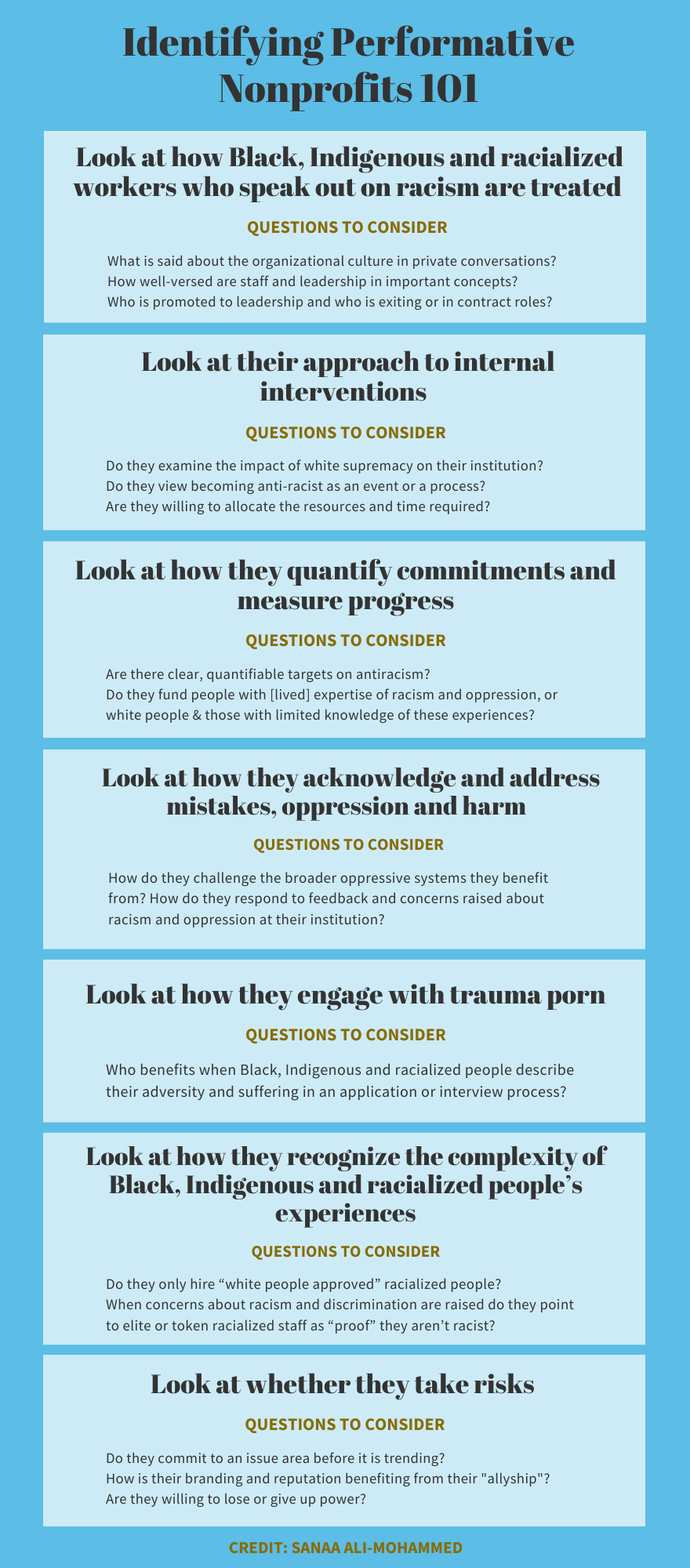
7 questions to help figure out if you’re dealing with a performative nonprofit

By Sanaa Ali-Mohammed, nonprofit research & inclusive program design  

Some time ago, staff from a nonprofit I had no prior engagement with reached out and requested I share my experiences of racial discrimination with a journalist, to support an initiative they were working on.

The framing of the request didn’t sit right with me, and I ultimately decided not to lend my voice to the organization’s work. It took me some time to identify precisely why I was so uncomfortable with the request.

Why does performative activism in the sector matter?

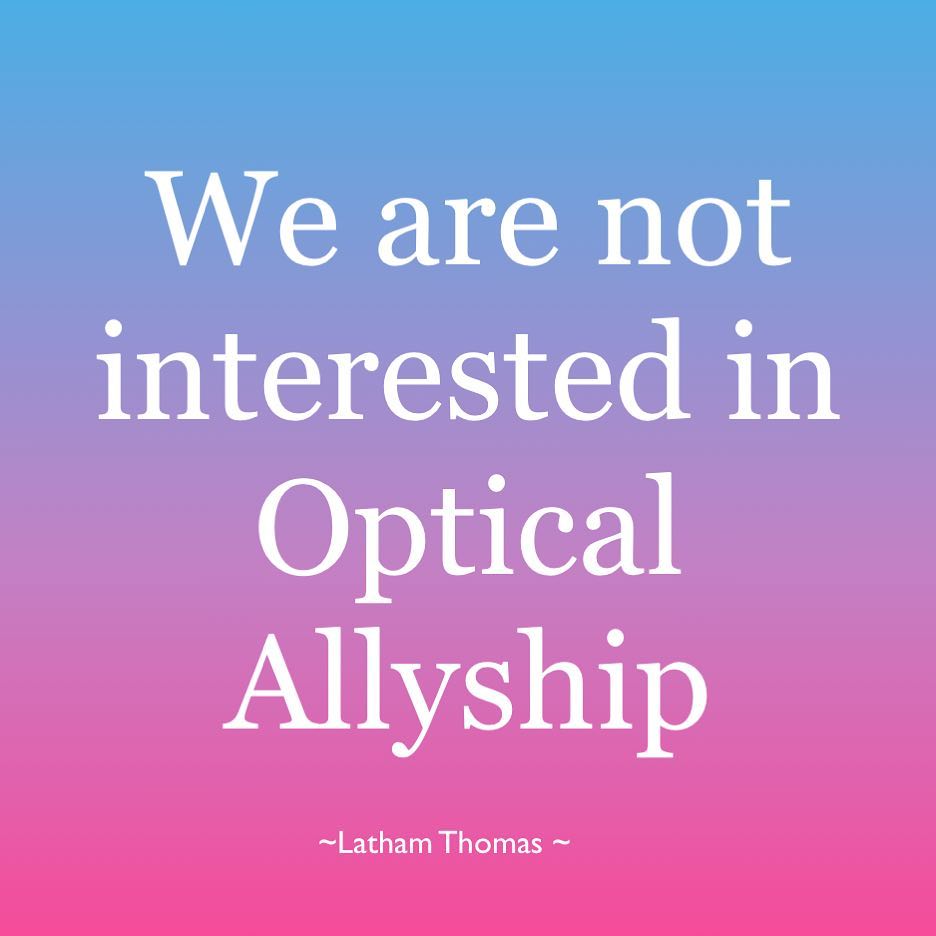
Banner says We are not interested in Optical Allyship. The quote is credited to Latham Thomas.


From an Instagram post by Latham Thomas.


Right now, we are witnessing a surge in institutions and leaders co opting language and reinventing and marketing themselves as “antiracist,” “inclusive,” or “equitable.” But many have been and will continue to engage with important issues in performative ways.

We know performative activism occurs when those with power wish to give the appearance of supporting members of Black, Indigenous and racialized communities — but aren’t willing to transfer power and transform organizational cultures, policies, practices and behaviours. 

We also know those engaged in performative activism often do so reactively, to avoid being called out on racism, or are motivated by benefits they can derive from appearing to be antiracist — for example, increasing profits or brand recognition — rather than a commitment to a more racially just world.  But why should we care about performative activism in the sector?

Firstly, given the sector’s historical relationship with white saviorism, performative activism is widespread in settler-led nonprofits, charities, and philanthropy across Turtle Island. 

Secondly, according to numerous scholars and experts, performative activism leads to new and insidious forms of oppression for Black, Indigenous and racialized people. Performative institutions distract from the real issues at stake and also create additional labour for the Black, Indigenous and racialized people who end up collaborating with them. This can take a toll on our emotional and physical health. 

It’s time to ask tough questions

Click to read Sanaa’s questions to consider when identifying performative nonprofits.

Too often, it’s white-dominant institutions assessing the credentials, experience, and projects of Black, Indigenous, and racialized people for alignment with their missions and visions. But what if we flipped the script and asked them to demonstrate their alignment with our objectives too?

I spoke to antiracist leaders, advocates and workers in various industries to see if there were commonalities that could help identify those engaged in performative activism on racial justice. It turns out there are several signature behaviours that indicate you have a performative institution on your hands. 

Here are 7 questions we think everyone should be asking to help identify and avoid them:

1. How do they treat Black, Indigenous, and racialized workers who speak out about white supremacy and racism? 

When I spoke to Habibah Haque, a Tkaronto-based human rights advocate and project manager with Hijabi Ballers, a nonprofit dedicated to promoting inclusion in the sports industry, she pointed to an internal “culture of privileged behaviour” at many nonprofits, which allows bias, favouritism, and tone-policing to flourish. 

“[At these institutions,] leaders tend to favour the ones who make them feel comfortable, who aren’t asking the organization and leadership to do better,” said Haque. This disadvantages workers who are vocal about discrimination.  

Yet simultaneously, these institutions “will put out equity-based programs for members of racialized and underrepresented communities to build their [institution’s] reputation,” said Haque.

Many institutions also devalue lived experiences of racism as a form of expertise, and subsequently do not compensate workers for labour that leverages this expertise. 

Nawal, who works in the tech industry, told me how a previous manager characterized the educational activities on antiracism she organized for her then-employer as “fluff” that would not be considered in her annual performance review. 

“I did all of that on top of my day job. The event was attended by over 200 staff nationwide, and I received a lot of recognition from VPs [at the company], but my [then] manager said, ‘I don’t know why you’re bringing this up’ [during performance review], ” she said. 

In her subsequent job search, Nawal asked questions about prospective employers’ approaches towards allyship with Black, Indigenous, and racialized workers to get a sense of their competency in the subject. 

2. How do they approach internal interventions?

I also spoke with Tanya Hannah Rumble, CFRE, a racialized settler of multiethnic origins living and working in Tkaronto who wears multiple hats. Not only is she a professional fundraiser, she also leads a philanthropy and equity community of practice for white allies and those with visible identities.  She noted many institutions and leaders prefer a “warm bath” approach.  

“[They] shy away from training and conversations about anti-racism, instead preferring to speak about equity, diversity and inclusion. However, you can’t have equity if you’re not dismantling oppression and talking about anti-racism,” said Rumble.

Anisa Jama, a Tkaronto based nonprofit manager, human rights organizer, and public policy graduate student (she’s a hustler!), concurred. She believes institutions must go beyond “surface level training … and dig deeper” to consider “conversations about white supremacy, because it is the root of systemic racism which is being circumvented.”

I also chatted with Eaman Fahmy, who provides antiracism and anti-oppression consulting to nonprofits. Like Tanya and Anisa, she believes the unwillingness to center race indicates where an organization is in its journey. In addition, she said, performative nonprofits often adopt a “checkmark” approach of “let’s do training, so we can say we’ve done training.” 

As someone who provides antiracism training and consulting, I’ve noticed  this in my own practice too. Sometimes leaders who subscribe to the checkmark approach  will also stipulate that training needs to be completed within an hour or two, instead of approaching it as an ongoing process of learning and self-reflection.  

But anti-racism work is not just about training, Fahmy observed. It’s also about shifting culture and policies embedded across all levels of an institution, which requires allocating the time and resources needed to do so effectively. 

3. How do they quantify their commitments and measure progress? 

Leaders and advocates noted that statements without targets describing exactly how institutions will challenge the racial status quo are of limited utility. 

As Rumble explained, “For a sector [like fundraising and philanthropy] that has become so good at quantifying things, that organizations don’t have measurable outcomes [especially for addressing anti-Black and anti-Indigenous racism] is concerning.”

In my conversations with Aseefa Sarang, Executive Director of Across Boundaries, a mental health centre serving racialized people in and around Tkaronto, she noted the absence of clear targets results in limited progress, and funders may fuel this approach. While certain funders are now asking grant-seekers to submit “equity plans” as a prerequisite for funding, the question remains what they are actually measuring and what plans are being measured against.  

“It’s very easy for organizations to fashion them [equity plans] to make it seem like any kind of work is equity work,” said Sarang. “[This does not] result in any real or meaningful outcomes for marginalized communities and certainly does not address the root issues of racism, anti-Black racism, or other forms of oppression.”

As someone who has seen a lot of questionable “equity” plans in my practice, I couldn’t agree more.

Jennifer Chan, Tkaronto-based CEO of a national nonprofit, described her experience with a funder that “put out a call for proposals … prioritizing applications from Black, Indigenous, and people of colour.” She later discovered, of five funded projects, only one was led by a person with a visible (racialized) identity. 

“So when you say you’re prioritising Black, Indigenous and people of colour and equity, what does that mean?” she asked.

4. How are mistakes, oppression, and harm acknowledged?

Haque believes that without acknowledgement of harm caused and apology and reparations to those who have been harmed, institutions and leaders cannot form authentic relationships. 

Rumble agreed, telling me that in philanthropy, “People don’t necessarily want to acknowledge their donors and their work has been built on racism.”

Nikki Chau, an abolitionist organizer based in Seattle, on Coast Salish territory, and co-founder of Gathering Roots, a healing centre and collective, adds that failure to address the source of harm makes any acknowledgement meaningless. They cite American  immigration reform as one example of performative activism, “[It ] doesn’t change the fact that our bombs are destroying their [refugees’] homes in the first place,” said Chau. 

This highlighted for me that performative leaders and institutions will often fail to acknowledge or challenge the broader systems — like imperialism, capitalism or settler colonialism —  that lead to specific instances of oppression, and will instead focus on the resulting symptoms.  

5. Do they demand trauma porn? 

Multiple leaders described how performative institutions demand Black, Indigenous, and racialized people’s stories of overcoming pain and adversity, in many cases in exchange for access to resources like funding.  

Chan sees this often in grant applications and believes the practice opens up wounds while providing limited returns and support to Black, Indigenous, and racialized people.

“Even when groups do get shortlisted, and get glowing remarks, they still might not be successful in getting funding. There is a lot of labour involved, and … how do you not leave them broken?” she asked.

Similarly, in the case of the nonprofit I turned down when they asked me to go on record with my experiences of racism, I remember feeling underwhelmed by the unequal nature of the exchange. My participation would have allowed the organization, with its questionable history, to grow its credibility in the antiracism space and access further public funding. 

6. Do they recognize the complexity of Black, Indigenous and racialized people’s experiences?

Performative institutions often mask internal issues of racial discrimination through tokenism, which relies on the idea that all Black, Indigenous, and racialized people are interchangeable for one another. 

According to Sarang, many of these institutions will engage Black, Indigenous, and racialized people to front for dialogue on antiracism or anti-Black racism. This allows for buy-in from marginalized communities but is superficial. This misrepresentation perpetuates racism and does nothing to eradicate systemic issues while maintaining the status quo.

As Jama and Chan both said, performative institutions privilege model minorities, who benefit from white supremacy. 

“[These are often] elite Asians, people who are backed by whiteness or white people approved,” said Chau.

Chau argued that within performative institutions, “the class aspect [especially] is collapsed,” which
gives institutions the opportunity to install “[an] oppressor who looks like me. We [as a society] are preoccupied by needing someone to look like us, but [more than that] they also need to have the policies that will liberate us.” 

Fahmy added  that while “more diverse voices and diverse leadership” are needed, ” we have to be careful if we categorize it that way because people of colour can also internalize the characteristics of white supremacy.” 

7. Are they taking risks?

It’s important to recognize that authentic allies are willing to take risks to interrupt oppression. 

This means, “[They’re] speaking out about [otherwise overlooked] human rights issues even when others are not,” Jama told me

Fahmy added that performative leaders and institutions will often avoid naming and addressing particular forms of oppression when doing so has a cost, such as losing power. 

Aziza, Jama, and Fahmy’s comments, for me, evoked the concept of retroactive allyship theater, evident in several institutions developing an interest in the work of Black, Indigenous, and racialized communities now that the risk-taking moment has passed. Their interest coincides with the “trendiness” of the work and the opportunity to reap benefits like public recognition. In most cases, the risks involved in taking action on these issues have already been absorbed by the people who experience the greatest oppression in society.


My conversations with leaders and experts illustrated that performative activism on racial justice is constantly evolving. It shows up in complex ways and is prevalent in the nonprofit, charitable and philanthropic sector. 

The reality is, many of us may still be forced to collaborate with performative institutions in the sector for pragmatic reasons. However, the knowledge that an institution or leader is performative can help us protect ourselves by limiting the energy we expend in our collaboration and inform how we allow them to leverage our stories and voices. 

End note: I’d like to acknowledge and thank all the experts quoted who contributed their knowledge, time and labour to this piece. 

Sanaa Ali-Mohammed

Sanaa Ali-Mohammed

Sanaa Ali-Mohammed (she/her) is a proud Muslim woman,  community researcher and program design consultant based in Dish with One Spoon Treaty Territory. She has nearly a decade of combined experience in policy advocacy and the nonprofit, charitable, and philanthropic sectors. Sanaa sits on the Board of Directors at the Urban Alliance on Race Relations and is an incoming PhD student planning to explore policy solutions to #performativephilanthropy  in Ontario. You can find her on Twitter @snarkysanaa and LinkedIn.

Collaborative philanthropy is rooted in African communal practice. Let’s reclaim it.

By Samra Ghermay, associate director of client engagement, Wingo NYC Fundraising Studio

“… proverbs originated in African cultures, covering themes of unity, collective action, networks, and cooperation. Our proverbs convey history, insight, revelations, ideas and learnings, and most importantly, they center community and partnership.”

Anyone who knows me, knows I love a good African proverb. I grew up hearing these sayings as commentary on my actions —  the not-so-silent judgements on the quality of my chores, the are-you-sure-about-that questions about my decisions, the life lessons waiting to be discovered from a respected elder waiting to impart them on me. Proverbs are built into our stories and were how my elders communicated messages to my sisters and me, how we were implicitly told to do certain things. Proverbs were essentially a coded game. And we happily accepted the challenge and grew all the better for it.

In philanthropy, we have all heard and have possibly even used the African proverb: “It takes a village to raise a child.” 

I find it to be overused, so here’s one I like better and use more often: “If you want to go fast, go alone. If you want to go far, go together.” 

Yes, this quote has also been attributed to Cory Booker, Warren Buffet, Hillary Clinton, Al Gore, and many others to bolster their speeches, declarations, and social media posts. The only ‘collective’ piece in this, is that they’ve ‘collectively’ decided that homogenizing African proverbs is good for business. Still, it doesn’t take away from the fact that proverbs originated in African cultures, covering themes of unity, collective action, networks, and cooperation. Our proverbs convey history, insight, revelations, ideas and learnings, and most importantly, they center community and partnership.

The “go together” proverb I referenced supports a growing concept in fundraising — that collaboration and working together is far more sustainable than going at it alone. 

From proverbs to practice

Collaborative philanthropy is already at the root of many communal Indigenous and African societies. In fact, it was collaboration and fundraising from diasporic communities that supported liberation struggles, which then led to independence from colonial rule. On the heels of Pan-Africanism, a movement based on the belief that unity is fundamental to socio-economic and political progress, African leaders, such as Tanzania’s first president Mwalimu Julius Nyerere, recognized that the fight against colonization was a common thread, a shared experience that could bring African nations together. 

As a result, ideologies centering the spirit of togetherness took form, having been built up from proverbs and put into practice for the future sovereignty of African nations. This allowed for an outlet of African communal practices such as the Mbongi (which translates to house without rooms) out of the Congo region, Ujamaa (also the fourth principle of Kwanzaa around cooperative economics) which formed the basis of Nyerere’s development policies in Tanzania after its independence, and Ubuntu of Southern Africa, where the term is used to convey a belief in the universal bond of humanity. I would also argue that Shir assemblage of Somalia, Gaçaça courts of Rwanda, and Judiyais of Southern Sudan are all central tenets of communal reconciliation and healing. 

These are only a few examples of many that depict the history, harmony and power of collaborative ideologies and collective action in African societies.  

The colonization of collaborative philanthropy 

In fact, [collaborative philanthropy] has been co-opted to fit within an institutional setting, and seems to embody a different motivation, one which ignores key players.

I first heard the term “collaborative philanthropy” linked to a large institutional foundation in early 2019, but this phrase (also known as impact philanthropy) has seen a lot of traction in recent years. Despite its growing popularity in our lexicon, it doesn’t give credit to communities who have been practicing it, nor does it acknowledge the history of fundraising that promotes community care. 

In fact, it has been co-opted to fit within an institutional setting, and seems to embody a different motivation, one which ignores key players.

These days it refers to funders and high net worth donors working together with nonprofits towards a social cause. The framework of impact philanthropy doesn’t center constituents or take into account community fundraising practices. Instead, it reinforces the power dynamic of those with wealth over the most significant of collaborators — the people they serve. 

Given the investor-type relationship of impact philanthropy and considering that money is coming from the private sector and lucrative industries, it can come off feeling transactional rather than transformational. The true sense of collaborative philanthropy should counter the harms of capitalism and colonialism — it should counter the idea that funders are the ones that create and cultivate strategies for social change. 

I believe that we, as constituents and community leaders, must reclaim the term and the ideology. Reclamation will help ensure that nonprofits can receive significant resources to successfully and sustainably overcome systemic barriers to transform and lift up communities of color.

Reclamation

Philanthropy is full of complexities that have contributed to a long history of exclusivity and patronization. Let us demand true collaboration, allowing for a democratic process where all stakeholders, including constituents, can be seen, heard, and honored.

Recently, I wrote a piece for Candid titled, “Fundraising will only be inclusive when we acknowledge the legacy of giving in communities of color.” In it, I observed how identity-based giving has, for generations, been an effective way for belief-aligned groups to get together and actively create change to address root causes of systemic issues in their communities. I cited examples of Tanda lending circles led by Latinx community members, of Susus in West African immigrant communities, and Ukub from my own homeland of Eritrea. 

These types of collective kinship support are often ignored (in the U.S.) and are not given the same recognition as those of wealthy white donors and established foundations. Tanda, Susus and Ukub, among others, are truly collaborative because they are authentic, intentional, and consensus-driven. 

We need to continue to acknowledge the legacy of community fundraising, where we affirm and give agency to members of our communities, where we work collectively towards an objective and not an end goal. We need to challenge and conquer “-isms” that are detrimental to the transformational work that we do. We need to recognize the impact of traditional practices and collaboration from our communities. 

Philanthropy is full of complexities that have contributed to a long history of exclusivity and patronization. Let us demand true collaboration, allowing for a democratic process where all stakeholders, including constituents, can be seen, heard, and honored. This approach produces a more seamless passage into movement building to bring about real societal change. Let us move away from a mindset that focuses on fundraising without collaboration. Otherwise, we’ll be sounding a lot like author and chief defender of colonialism Rudyard Kipling, who once said: “He travels the fastest who travels alone.” 

Simply put, we need collaboration in order to inspire advocacy and assert our work so that together, we can go far to create lasting change.

SAMRA GHERMAY

SAMRA GHERMAY

Samra Ghermay (she/her) brings her strong commitment to social justice and human rights to Wingo NYC and their clients, not just as a manifestation of her ideology but as the result of her lived experiences. She is a proud immigrant and Black feminist living in Brooklyn by way of Eritrea. Samra’s career has centered the acknowledgment, inclusion, access, and well-being of historically underrepresented groups. Samra has provided fundraising coaching for Africa-based grantees of the Arcus Foundation and has bolstered the missions of UNICEF, UC Berkeley Horn of Africa Project, Restless Development, Sadie Nash Leadership Project, and President Obama’s Young African Leaders Initiative, to name a few. She also sits on the Board of the Black Alliance for Just Immigration (BAJI). Samra completed her BA in Interdisciplinary Studies from UC Berkeley and an MA in International Affairs with a concentration on News, Media, and Culture from The New School University. She has lived in Eritrea, Mali, and Tanzania and has traveled extensively to other parts of the world. She can be connected with on LinkedIn

(Samra’s photo was taken by Jeremy Amar.)

The Ethical Rainmaker: Part 2: The Racist Roots of Nonprofits & Philanthropy LIVE with Christina Shimizu

By Michelle Shireen Muri, Freedom Conspiracy Principal and CCF co-chair

Episode Summary

By popular demand, Christina Shimizu is back as a guest for Part 2 of The Racist Roots of Nonprofits & Philanthropy, LIVE at the Washington Nonprofits conference! “How on Earth can we solve the issues our communities face if we can’t first acknowledge that there is a problem?” On this, the last episode of Season 2, Michelle and Christina go deeper with the recent history of how some of our ethos in philanthropy came to be, why philanthropy is built on deep injustices and a little about community centric fundraising. Remember…if we don’t examine how these things came to be, we can never hope to reimagine them, improve them or do better, to benefit the communities we are trying to serve. 

Find episode notes and the podcast transcript here.

About the Ethical Rainmaker podcast

In the United States alone, philanthropy is a $427 million dollar industry, of which 68% comes from individual donors. Yet the practices, theories, and foundation of modern philanthropy and fundraising often ignore the ways in which the industry perpetuates harm.

The Ethical Rainmaker, hosted by Michelle Shireen Muri, is a podcast that hosts authentic conversations grappling with the questions that we don’t often ask in the nonprofit world. Join us as we explore some of the practices that undermine our missions and navigate the way forward with today’s resisters, reimaginers, and the re-creators of the third sector. It’s time to think differently.

Michelle Shireen Muri

Michelle Shireen Muri

Michelle Shireen Muri (she/her) is the co-chair for Community-Centric Fundraising and the host of the new podcast, The Ethical Rainmaker. She is the founder of Freedom Conspiracy, a small collective of fundraising consultants focused on bringing values-aligned practices to clients in the nonprofit and philanthropy spaces. She can be reached at @freedomconspiracy on Instagram.