Why must the white cis nonprofit workers angry react to all my posts? Ep: White women, stop gatekeeping progress

Why must the white cis nonprofit workers angry react to all my posts? Ep: White women, stop gatekeeping progress

By Chris Talbot, communications professional and educomics creator

View accessible/text-only version

Part of a comic. Full text is available via the link at the top of the page.

Chris Talbot

Chris Talbot

Chris Talbot (they/them) is a queer, trans nonbinary, mixed-race artist, activist, and nonprofit employee. When they aren’t working the day job, they spend their free time editing art and literature magazines, writing and illustrating educomics to help folks affirm their nonbinary pals, creating a graphic novel to describe what it’s like to be nonbinary in a gender binary world, cuddling their cat, and quad skating in the park. 

You can find Chris at talbot-heindl.com, on LinkedIn, Instagram, Bluesky, and Twitter — and tip them on Venmo or PayPal or join as a patron on their Patreon

Why must the white cis nonprofit workers angry react to all my posts? Ep: White women, stop gatekeeping progress

Why must the white cis nonprofit workers angry react to all my posts? Ep: White women, stop gatekeeping progress

By Chris Talbot, communications professional and educomics creator

Go back to the infographic via this link

First section introduction

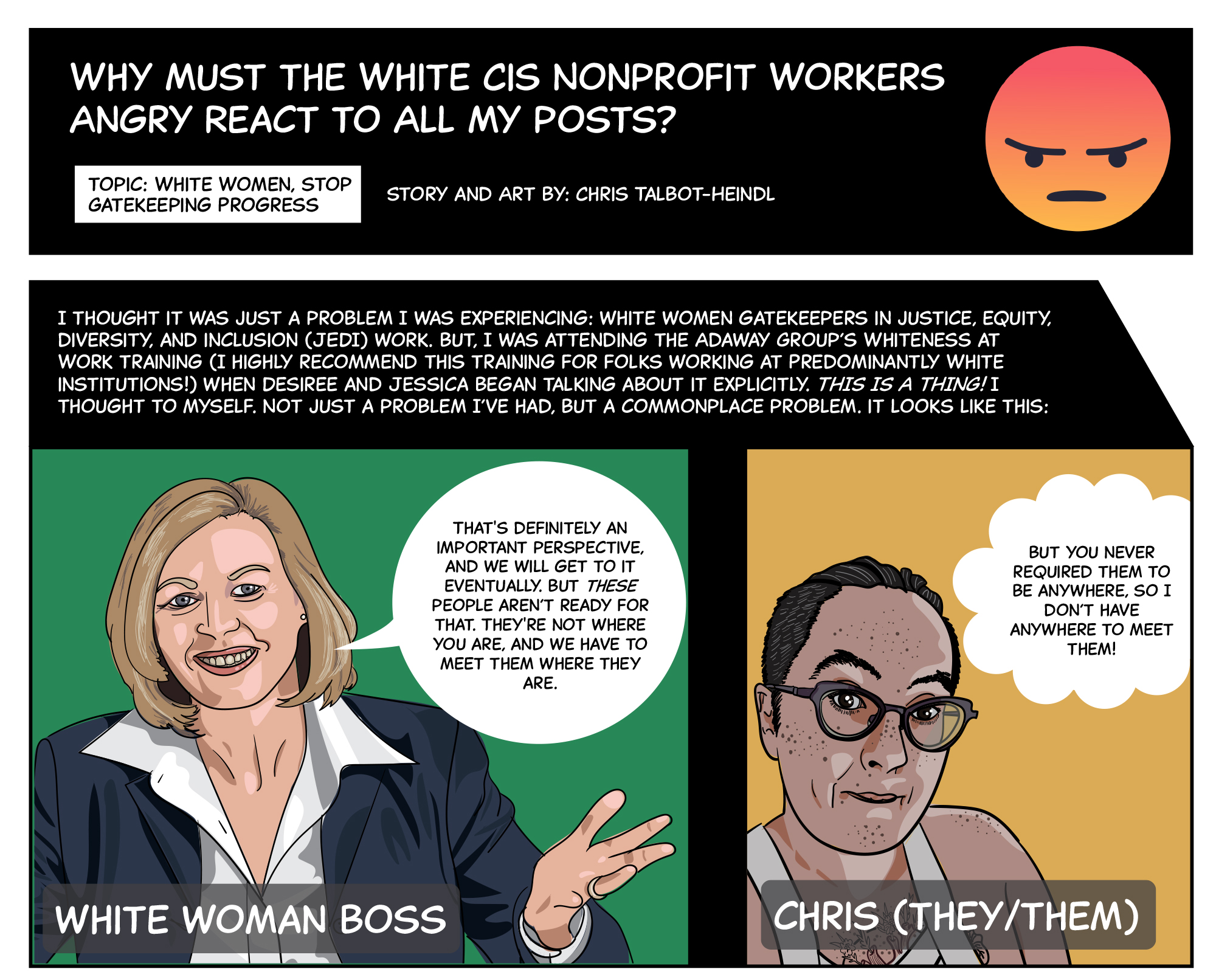
I thought it was just a problem I was experiencing: white women gatekeepers in justice, equity, diversity, and inclusion (JEDI) work. But, I was attending The Adaway Group’s Whiteness at Work Training (I highly recommend this training for folks working at predominantly white institutions!) when Desiree and Jessica began talking about it explicitly. This is a thing! I thought to myself. Not just a problem I’ve had, but a commonplace problem. It looks like this:

First section

The first section shows a portion of a Zoom screen, with one box labeled “white woman boss.” There’s an illustration of a white woman with blonde hair wearing a suit with a green background. She is gesturing with her hands and smiling. She says “That’s definitely an important perspective, and we’ll get to it eventually. But these people aren’t ready for that. They’re not where you are, and we have to meet them where they are.” Next to that Zoom box is a partial box with a yellow background. That Zoom box has the label “Chris (they/them).” There’s an illustration of myself looking perplexed and sucking in my bottom lip. I have a thought bubble that says, “But you never required them to be anywhere, so I don’t have anywhere to meet them!

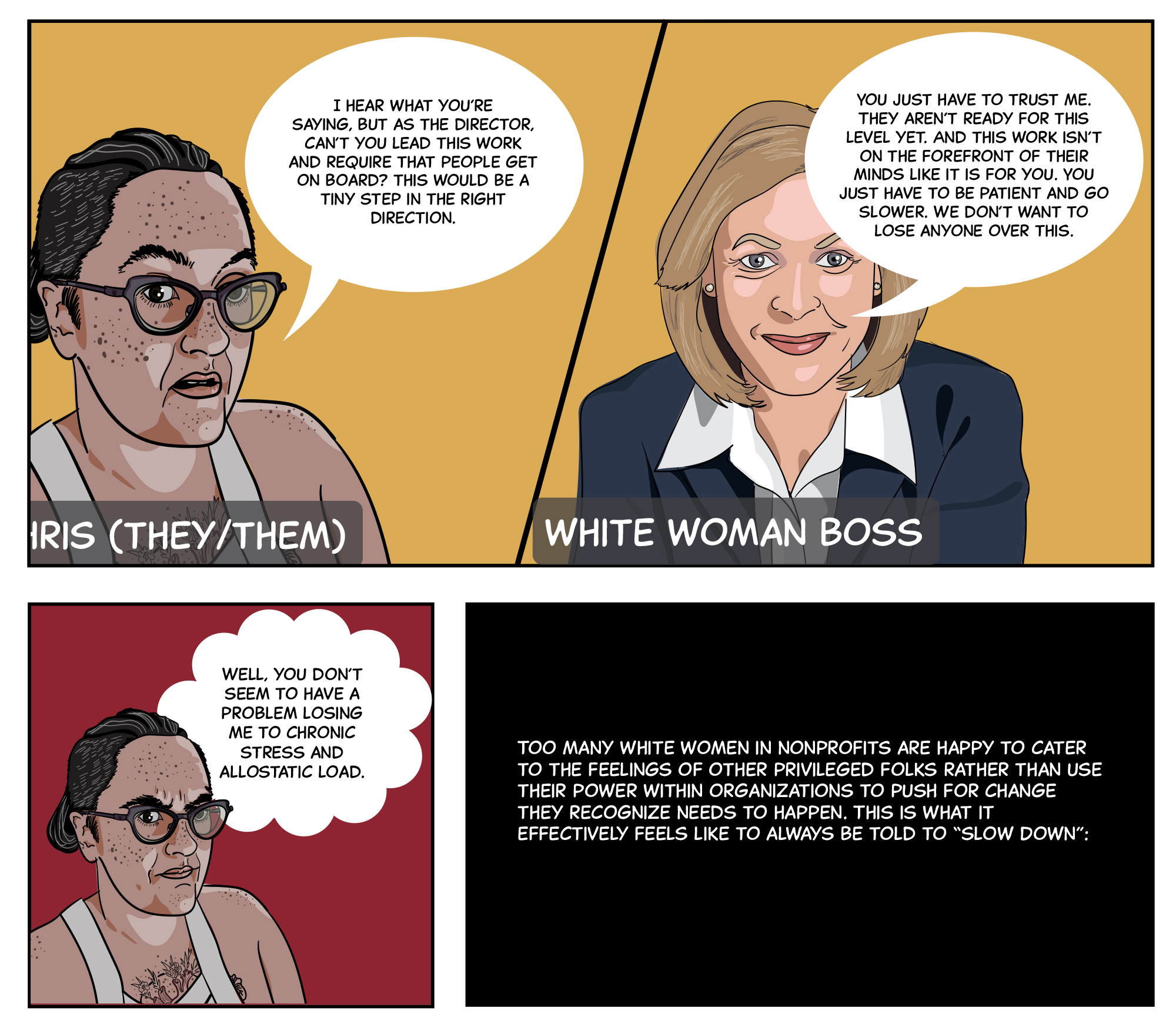
In the next cell, I’m saying “I hear what you’re saying, but as the Director, can’t you lead this work and require that people get on board? This would be a tiny step in the right direction.

In the next cell, the white woman boss is staring straight to camera and her background is now yellow. She says “You just have to trust me. They aren’t ready for this level yet. And this work isn’t on the forefront of their minds like it is for you. You just have to be patient and go slower. We don’t want to lose anyone over this.

In the following cell, my background is now red and I’m angry. A word bubble says “Well, you don’t seem to have a problem losing me to chronic stress and allostatic load.”

Second section introduction

Too many white women in nonprofits are happy to cater to the feelings of other privileged folks rather than use their power within organizations to push for change they recognize needs to happen. This is what it effectively feels like to always be told to “slow down”:

Second section

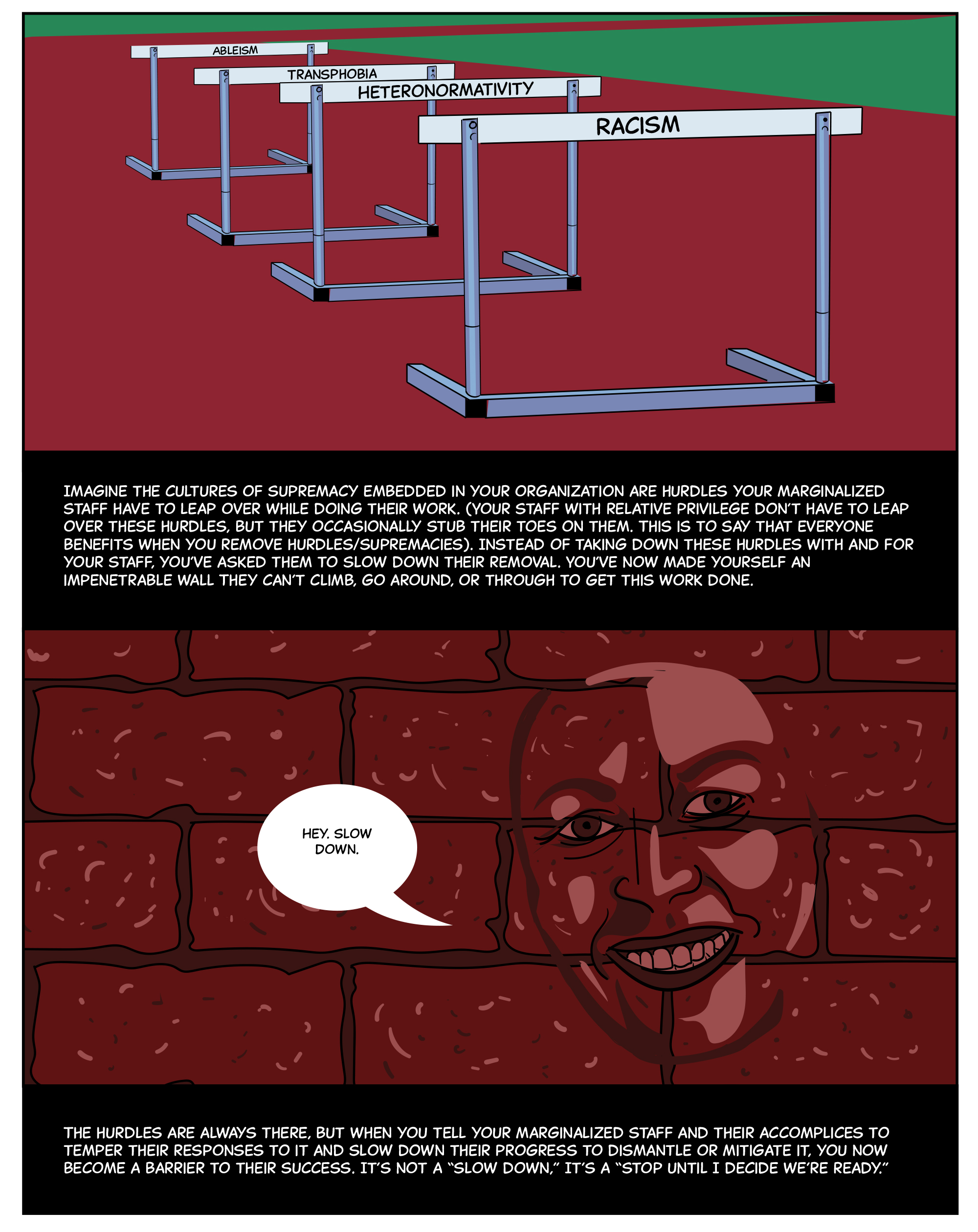
On a red track, there are hurdles set up. They are labeled “racism,” “heteronormativity,” “transphobia,” and “ableism.” Text says “Imagine the cultures of supremacy embedded in your organization are hurdles your marginalized staff have to leap over while doing their work. (Your staff with relative privilege don’t have to leap over these hurdles, but they occasionally stub their toes on them. This is to say that everyone benefits when you remove hurdles/supremacies). Instead of taking down these hurdles with and for your staff, you’ve asked them to slow down on their removal. You’ve now made yourself an impenetrable wall they can’t climb, go around, or through to get this work done.”

In the next cell, there’s a brick wall with the white woman boss’s face superimposed saying “Hey. Slow down.” Text says “The hurdles are always there, but when you tell your marginalized staff and their accomplices to temper their responses to it and slow down their progress to dismantle or mitigate it, you now become a barrier to their success. It’s not a “slow down,” it’s a ‘stop until I decide we’re ready.”

Third section

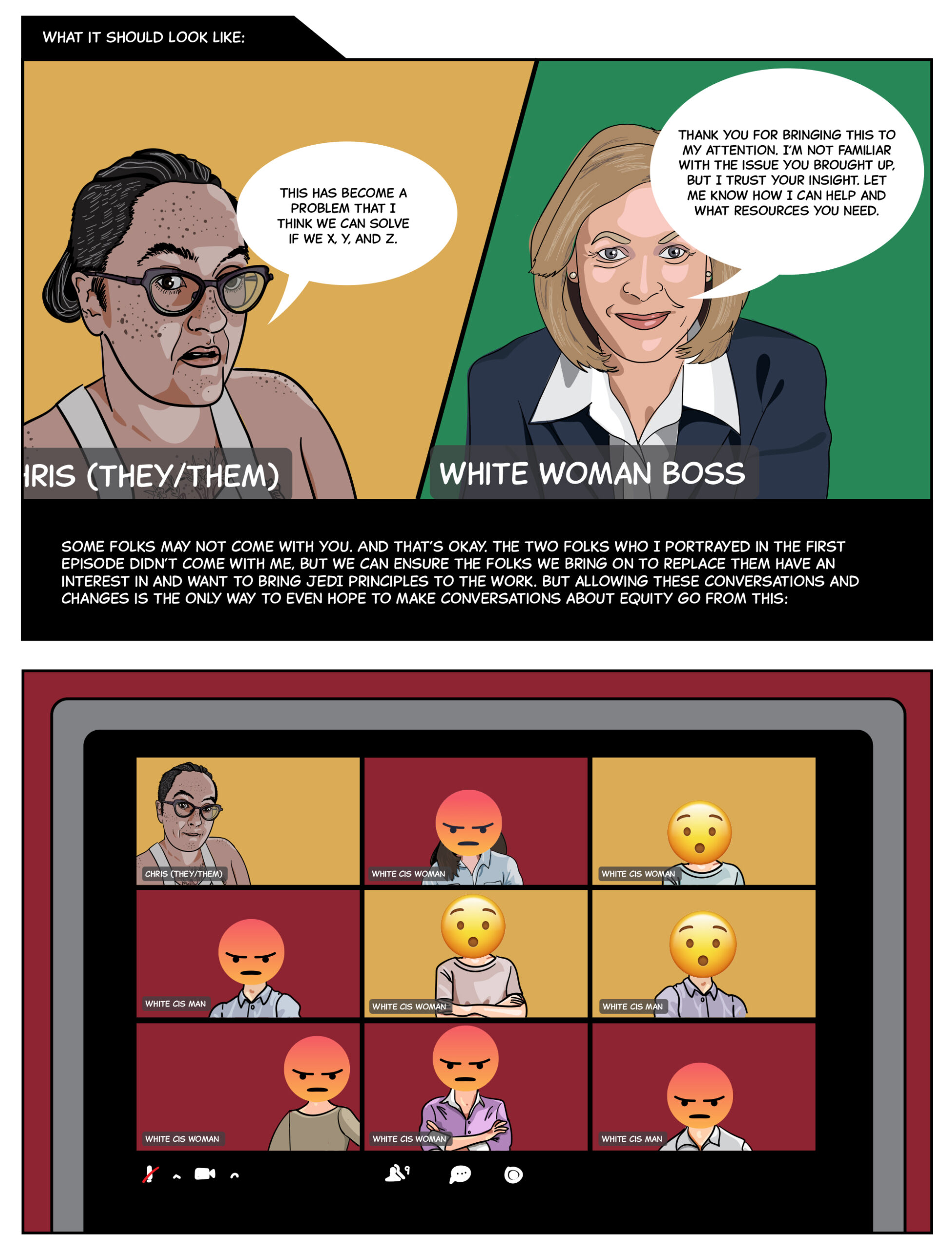
Text says “What it should look like.” There’s an illustration of a split Zoom screen. On the left, there’s an illustration of me against a yellow background. I’m saying “This has become a problem that I think we can solve if we x, y, and z.” On the left, the white woman boss is shown with a green background. She says “Thank you for bringing this to my attention. I’m not familiar with the issue you brought up, but I trust your insight. Let me know how I can help and what resources you need.”

Conclusion

Text says “Some folks may not come with you. And that’s okay. The two folks who I portrayed in the first episode didn’t come with me, but we can ensure the folks we bring on to replace them have an interest in and want to bring JEDI principles to the work. But allowing these conversations and changes is the only way to even hope to make conversations about equity go from this:”

In the next cell is an illustration of nine people in a Zoom call. In the upper left, I am there looking perplexed. Across the screen are people with yellow backgrounds and their faces replaced with the “wow” Facebook emoji and people with red backgrounds and their faces replaced with the “angry” Facebook emoji.

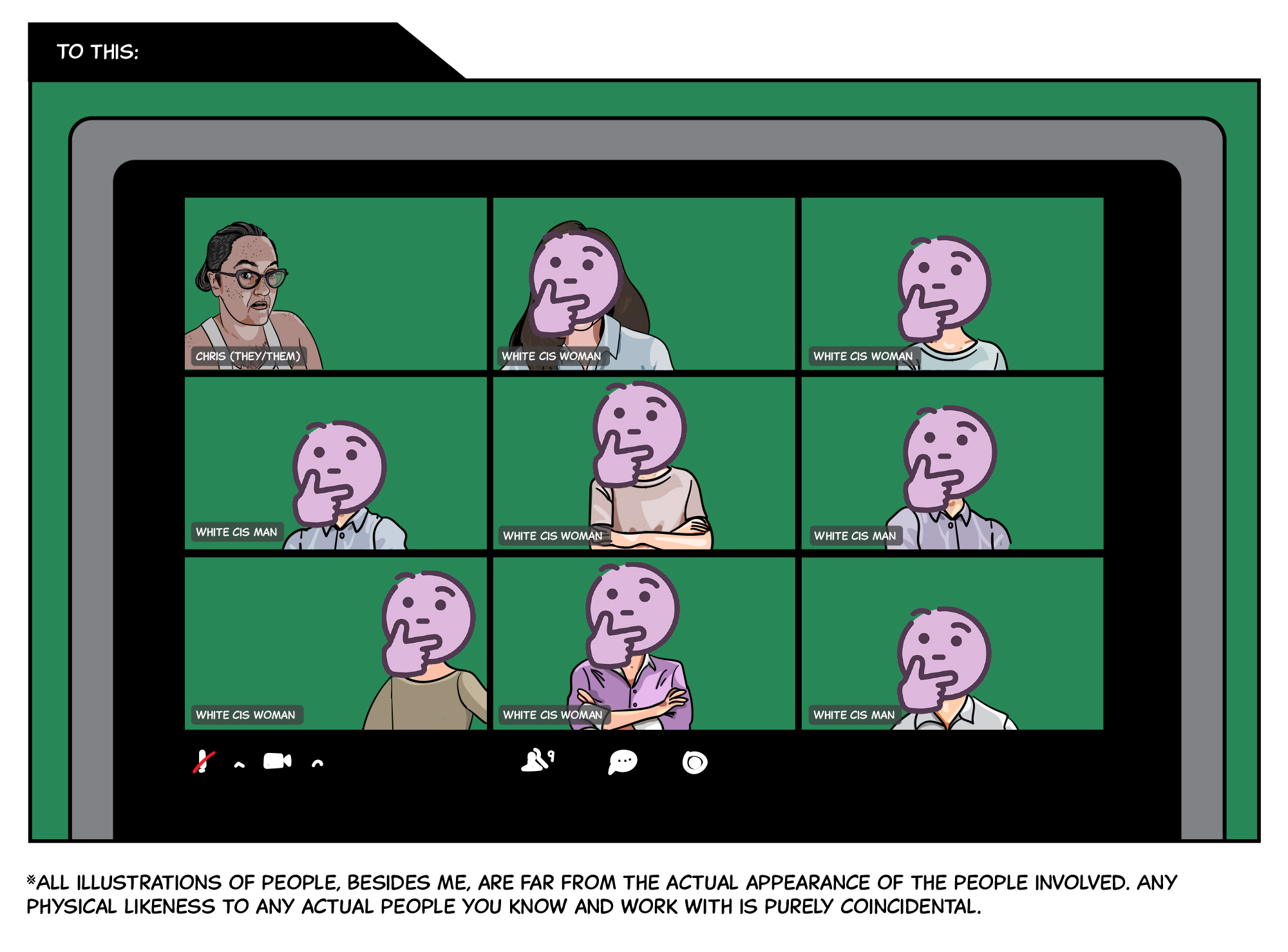
Text says “To this:”

In the next cell is an illustration of nine people in a Zoom call. I am in the upper left after just speaking. Across the screen are people with green backgrounds and their faces replaced with the “curious” LinkedIn emoji.

Text at the bottom says “All illustrations of people, besides me, are far from the actual appearance of the people involved. Any physical likeness to any actual people you know and work with is purely coincidental.”

Chris Talbot

Chris Talbot

Chris Talbot (they/them) is a queer, trans nonbinary, mixed-race artist, activist, and nonprofit employee. When they aren’t working the day job, they spend their free time editing art and literature magazines, writing and illustrating educomics to help folks affirm their nonbinary pals, creating a graphic novel to describe what it’s like to be nonbinary in a gender binary world, cuddling their cat, and quad skating in the park. 

You can find Chris at talbot-heindl.com, on LinkedIn, Instagram, Bluesky, and Twitter — and tip them on Venmo or PayPal or join as a patron on their Patreon

4 profound, professionally enhancing insights from a silent meditation retreat

4 profound, professionally enhancing insights from a silent meditation retreat

By Michelle Dominguez, proud teammate at Social Justice Partners Los Angeles

A spider, a runner, a hiker, and a leaf became some of my greatest teachers this year. In a search for enlightenment, I went on two silent meditation retreats. That’s five days of alternating sitting and walking meditation from 6:30 am to 9:30 pm with no speaking or eye contact. When I tell folks about it, most people respond, “I wouldn’t be able to go away and stay silent for five days!” Which made me wonder, how many of us have the support and spacious conditions at work to even allow for such time off?

Some organizations see rest and reflection time as productivity loss, characteristic of white supremacy culture’s focus on capitalism, urgency, quantity over quality, and progress as bigger and more. I am grateful I spent 10 days this year in silent meditation, a privilege that many nonprofit workers are not granted due to supremacy work cultures. During this time I came to four profound, professionally enhancing insights as it relates to my nonprofit work. Here are the stories behind these four insights:

The Still Spider: On Presence and Connectedness

White supremacy culture’s individualistic value perpetuates oppression, but we can imagine something different when we understand that we are all connected.

The retreat grounds are on gorgeous land which has many hiking trails, and I was on a quest to hike them all. I woke up early one rainy morning to wander through a forest trail. The sights of the towering green trees, the sounds of the chirping birds, and the smell of wet earth were all sensational treats in contrast to the 15 hours a day spent with my eyes closed or softly focused as I meditate.

As I stepped downhill, I noticed a silk thread shining from a sunray. It was a web, the home to a spider that lay still on its intricate creation. I carefully stared at the spider and its web, studied where the fiber connected to the trees beside it, and did a slow limbo to avoid destroying the spider’s resting place.

The following morning, my waking thought was, “I am no more or less important than that spider.” Had I not been more present to notice the web or more mindful with my step, I could have mistakenly disrupted that spider’s life. I felt empathy and a deep connection to the creature.

It was a lasting insight for me about the importance of being present in my work processes and with my colleagues. White supremacy culture’s individualistic value perpetuates oppression, but we can imagine something different when we understand that we are all connected.

The Fit Runner: On the Stories We Make Up About Others

I thank my brain for using cognitive shortcuts to get by the day, but if I’m not careful it does lead to bias and creating a false reality.

I had completed every hiking trail but one, which was an incredibly steep, two-hour hike. I was suffering, sweating profusely, and climbing uphill when a fellow retreatant passed me as he ran downhill. I thought, “Wow, this guy is pretty fit to be running downhill on a long trail in this heat! He really has his shit together.”

Well, it turns out he did not have his shit together, literally. I crossed paths with the runner again as we left the retreat. Now able to speak, I complimented him for running down the trail. He laughed and first hesitated before sharing, ”the reason I was running was because I really had to take a shit. Five minutes after I ran past you, I was squatting in the woods using my mask as toilet paper because I couldn’t hold it in anymore.”

I burst out laughing and told him he made my day. I was reminded how easily we make up stories about other people when in fact, we don’t know their personal experience. We do this with strangers, loved ones, colleagues, and when reading grant applications and donor profiles. I thank my brain for using cognitive shortcuts to get by the day, but if I’m not careful it does lead to bias and creating a false reality. Pair this without presence and connectedness and it can lead to serious harm, but take the space to reflect and we can positively impact our communities through mindful decisions.

The Distant Hiker: On Lived Experience

“those closest to the problems are also those closest to the solutions.”

The day after the steep hike, I went on an easier hike with a lovely bench under a shade tree. I sat on the bench to take in the view of the rolling hills and noticed in the distance a speck moving up that steep hike near the spot where the runner had passed me. The moving speck was another hiker, and I was struck by how small they appeared from my comfortable spot on the bench.

I could have easily disregarded the speck, just as I could have ignored the spider, but I remembered how I suffered on that steep hike, sweating in the sun and struggling to catch a breath as I tried to reach the top. I realized that the moving speck was a whole human being, and while I could not fully understand their experience, I made yet another cognitive shortcut and assumed they may be suffering as I did. I felt empathy for them and realized, “this is why following the lead of those with lived experience is important.”

I learned about the value of following the lead of people with lived experience through my work at Social Justice Partners Los Angeles (SJPLA). A colleague framed it for me as, “those closest to the problems are also those closest to the solutions.” I was reminded of this as I sat on the bench looking at the distant hiker. Had I not direct lived experience of that steep hike, I would not have paid much attention to the moving speck; but because I had, I felt intimately closer to the hiker despite the miles between us.

The Falling Leaf: On Systems

I think the more we can engage in systems thinking… the better we can understand the complexity of the problem and implement meaningful, systemic solutions.

I had just finished eating lunch outdoors as I sat on a bench. Witnessing the retreatants at mealtime is an interesting, rare sight. You don’t see people mindlessly scrolling their phones as most of us surrendered our device at the beginning of the retreat. Instead, you see quiet, slow, still people like myself post-meal, staring at nature. At this moment, my eyes followed a yellow leaf dancing side-to-side in the air, drifting towards the floor after it had fallen from the tree. I immediately thought, “it was simply the leaf’s time to fall.”

I thought about how ridiculous it would be to blame the leaf for falling (“You should have been stronger, leaf!”). If we wanted to place blame for the leaf falling, do we blame the wind for pushing the leaf to its brink, the tree for not holding onto it longer, the water for dehydrating the tree, the weather for changing, or Earth’s axial tilt for causing the seasons? When you think about it, isolating agents and pointing blame in this situation sounds ridiculous considering the intricate ecosystem involved in one leaf falling to the ground. But, this is exactly what we do when we approach problems in our communities.

Let’s look at housing and homelessness as an example. Some “blame the leaf for falling” and believe people experiencing homelessness are at fault for the “choices they made” which impact housing insecurity. Others blame federal, state, and local governments for lack of accountability. There are also agents that impact factors like housing availability and affordability, the job market, mental and physical health, poverty, racism, classism, and more.

The seemingly distinct issue of “homelessness” is actually several complex systems interacting and evolving like a living organism. I think the more we can engage in systems thinking, as defined by Drs. Derek and Laura Cabrera from The Cabrera Research Lab, the better we can understand the complexity of the problem and implement meaningful, systemic solutions. This is what one yellow leaf taught me.


This year, I’ve come to understand nature is one of my greatest teachers; I have the above four insights to show for it. While insights can be a very personal matter that retreatants may choose to keep to themselves, I’m happy to share with you how they’ve enriched the mental models I rely on at work.

More important to me than the insights themselves is my hope that our sector creates healthy workplaces that tend to the wellness and wholeness of our people. Let’s foster spacious work conditions that support employees taking time off to do as they please, whether that be a meditation retreat or otherwise. Let’s promote rest and reflection at work, not because it “enhances worker productivity and business operations,” but because we treat our colleagues with the same care we wish to see in our communities at large. And in our time of rest, if we do happen to gain some insights, we may choose to share them, and our sector can choose to listen. But if you need some work inspiration, step outside–there may be a spider, a runner, a hiker, or a leaf giving out free lessons.

Michelle Dominguez

Michelle Dominguez

Michelle Dominguez (they/them/elle) is a Queer and Trans Los Angeles native born to Colombian immigrants. After a decade-long career in higher education student affairs, they switched sectors in 2021 to join the team at Social Justice Partners Los Angeles. What brings Michelle joy? Quality time with loved ones, mindfulness, audiobooks, vegan chocolate desserts, and Disney magic. You can find Michelle on LinkedIn and tip them via Venmo @MMissy003.

The Ethical Rainmaker: Shame On You and Guilt Too ft. Dr. Anu Taranath

The Ethical Rainmaker: Shame On You and Guilt Too ft. Dr. Anu Taranath

By Michelle Shireen Muri, Freedom Conspiracy Principal and CCF co-chair


Episode Summary

We throw shade and cause guilt and shame in social justice work all the time! But is finger pointing effective or does it just make us feel better to make someone else wrong? In this ep, Michelle and Anu, author of Oprah-loved book Beyond Guild Trips, build analysis through a lens of travel ethics and what it means to truly move forward.

About the Ethical Rainmaker podcast

In the United States alone, philanthropy is a $427 million dollar industry, of which 68% comes from individual donors. Yet the practices, theories, and foundation of modern philanthropy and fundraising often ignore the ways in which the industry perpetuates harm.

The Ethical Rainmaker, hosted by Michelle Shireen Muri, is a podcast that hosts authentic conversations grappling with the questions that we don’t often ask in the nonprofit world. Join us as we explore some of the practices that undermine our missions and navigate the way forward with today’s resisters, reimaginers, and the re-creators of the third sector. It’s time to think differently.

Michelle Shireen Muri

Michelle Shireen Muri

Michelle Shireen Muri (she/her) is the co-chair of the founding Seattle chapter for Community-Centric Fundraising and the host of the podcast, The Ethical Rainmaker. She is the founder of Freedom Conspiracy, a small collective of fundraising consultants focused on bringing values-aligned practices to clients in the nonprofit and philanthropy spaces. She can be reached at @freedomconspiracy on Instagram. You can send her a tip via Patreon.

Strategy, partnerships, implementation: where to start?

Strategy, partnerships, implementation: where to start?

By: Maria Rio10+ years of experience in nonprofit project/people management

In my piece “The highs and lows of CCF in practice: 9 approaches we’ve championed,” Carolyn commented:

Maria, I would love to hear a follow up, especially donor response to honest conversations about source of wealth, how your team was able to achieve buy-in from your board, and more lessons learned. You know, in your copious free time ha

Well Carolyn, this one is for you and any other fundraisers out there looking to get buy-in.

Here are the three steps my team and I took in transforming our fundraising:

  • Audit – where are you now and where do you want to be?
  • Get buy-in – build a case for support, find champions, educate about CCF
  • Implement – expect to pivot a few times

While working on the above, here are some tips for you to consider:

The Do’s

When you open the door to the conversation, donors will ask you questions about CCF-aligned practices.

  1. Give yourself, your board, and your supporters some grace. Fundraising is not their strong suit, but they are willing to listen and learn. CCF is a relatively new movement to many in the fundraising world, let alone outside it.If it feels like you’re reinventing the wheel, you probably are, and that’s okay! Take time to understand concepts, explain them to others, and answer questions without using jargon; explain it in easily digestible plain language.
  2. Gather allies. Is your team aligned? Executive Director? Some or all members of the board? Donors? Other orgs? Build partnerships internally and externally to push ethical fundraising practices forward
  3. Openly talk about systemic barriers, capitalism, politics, tax evasion, white supremacy, and racism. If I don’t have these conversations with a donor, partner, or supporter, how else would I know their values align with our mission? This is not a conversation that you need to prep a donor for.How I approach it is: causes like ours subsidize poor government supports; my work is keeping the status quo alive, but we can’t stop providing emergency support until there is real systemic change. Changes like reducing the wage gap, dismantling ableism, taxing the rich, fighting white supremacy, etc., greatly impact and improve the lives of our community members.
  4. Give concrete examples of CCF things you want to implement and why they matter. Use an example that donors and board members can easily understand, i.e., we don’t accept donations from corporations who exploit child labour abroad because our mission is to ensure kids can receive an education, no matter where they are born; we don’t allow donors to tour programs because it is a form of poverty tourism, etc.Donors will often surprise you with how far they have already thought through their privilege. I have heard their thoughts on galas (“it always felt off and a bit 1%er-y”), naming rights (“these women in shelters are trying to get their lives together and just have names of rich people staring at them? Gross”), tax evasion (“wow, I just did my taxes and used as many tools I could to reduce my tax obligations, I now understand that’s problematic”), and CCF in general (“now I know why I had negative gut feelings towards being invited to watch a program, these practices were not CCF aligned”).

    When you open the door to the conversation, donors will ask you questions about CCF-aligned practices. Donors have asked me about the problems caused by restricting funding, creating programs for them, the nonprofit industrial complex, the issues with having a DAF, and more. I am extremely proud of the type of supporter we have cultivated, and think of many of our donors as true partners in our work.

  5. Ask your donors about the donation they are most proud of. Contributing to their community, donating to their kids’ school, and setting up an event for their charity are often their top answers. It’s rarely a transactional sponsorship or gift.
  6. Empower fundraisers to ask for help or to end a relationship. If a donor says something problematic or triggering, ask for another fundraiser to step in and educate the donor. Leaning on your white colleagues can be super helpful in educating donors or board members.If the donor is not open to learning and intentionally continues to be sexist, racist, homophobic, etc., you don’t have to continue the interaction. We are partners in the work, not subservient. Donors get to push forward meaningful programs just as much as we do; if we wouldn’t tolerate those behaviors from colleagues, we should have the same standard for board members, volunteers, and donors.
  7. Build relationships with other fundraisers already working on CCF. I’ve connected with local and international superstars and have had a safe space to vent, workshop ideas, and continue learning.

The Don’ts:

The system was designed by the few for the few, keeping the cycle in check and keeping people oppressed. We play a role in that. The way we work makes it difficult for us to achieve social change because the set up is meant to maintain the status quo.

  1. Don’t come unprepared to make your case. Know the CCF principles. Know how they can be applied to different portfolios. Know which social justice issues you’re well versed in and where your gaps are. Know the impacts on funds and set realistic expectations.
  2. Don’t sit quietly when a donor says or does something problematic. Many will appreciate your insight and education. The ones that don’t may not be the best partners for your service users or brand.
  3. Don’t let your insight be the only exposure to CCF that partners get. Link to NonprofitAF. Link to the CCF hub. Show them that cool podcast! Ask donors to provide their perspective and if they are far enough in their learnings, ask them to write a blog post.
  4. Don’t frame your organization as being apart from the problem; we are a part of it. Capitalism depends on the exploitation of people. Wealth is accumulated by a few and passed down through generations. Nonprofits have been a tool for the few to avoid paying taxes. The system was designed by the few for the few, keeping the cycle in check and keeping people oppressed. We play a role in that. The way we work makes it difficult for us to achieve social change because the set up is meant to maintain the status quo.
  5. Don’t assume people understand jargon or social issues as well as you do. As fundraisers, we often work with multi-millionaires or even billionaires who have had a very different lived experience than our service users. Meet people who want to work toward equity where they are at. Answer their questions openly and honestly. Help them understand the problems you, your org, the sector, and your community face.
  6. Don’t assume donors feeling good about their giving is bad or not CCF-aligned. Partners who participate in the work should all feel valued for their contributions. Donors who give money should feel valued. Volunteers who give time should feel valued. Staff who provide labour should feel valued. The focus should always be on moving the issues your org is facing forward, together.An easy way to think about this is: would you thank a partner org for skill sharing? A volunteer for their time? Would you think it weird if a donor thanked you for your work?  Showing donors appreciation on par with how you show other collaborators appreciation is very appropriate and does not glorify the donor in a saviour manner.

Fundraisers have so much power to push forward equitable practices at the organizations we represent. We know the donors, educate them, and connect them to causes they believe in. You can commit to using that influence to encourage your nonprofit and partners to push for systemic change.

Maria Rio

Maria Rio

Maria Rio (she/her) is the Director of Development at The Stop Community Food Centre, a mid-sized non-profit that provides emergency food access, community building programs, and urban agriculture. Having come to Canada as a refugee at an early age, Maria developed a passion for human rights that now fuels her drive to help locally and make a difference in the lives of people of various marginalized and often inter-sectional groups. After being assisted by many charities and going through an arduous 12-year immigration process to become a Canadian citizen, Maria devoted herself to working in a charity setting to give back to the industry, which had drastically and undeniably improved the course of her life. As a woman, a racialized person, an immigrant, and a member of the LGBTQ2+ community, Maria works diligently every day to ensure that she can make a meaningful difference in the lives of these and other often underrepresented groups.

You can follow or connect with Maria on LinkedIn here.