Data Says!: Nonprofit professionals are unhappy with fundraising

By Anna Rebecca Lopez, AR Lopez Consulting

infographic

This infographic is part of a multi-part series. View part two of the series here. Follow CCF on Instagram, Facebook, or sign up for our mailing list to get notified of the next part!

Anna Rebecca Lopez

Anna Rebecca Lopez

Anna Rebecca Lopez (she/they) is an experienced Evaluator and consultant, using mixed-method approaches to social science research, statistical analysis, community engagement & collaboration, digitization and more. She is the Principal Evaluator at AR Lopez Consulting, where she specializes is disaggregating data in a way that tell authentic and useful stories. You can find her on IG @anna_.rebecca

NONPROFIT PROFESSIONALS ARE UNHAPPY WITH FUNDRAISING

By Anna Rebecca Lopez, AR Lopez Consulting

Go back to the infographic via this link

(Introduction text)

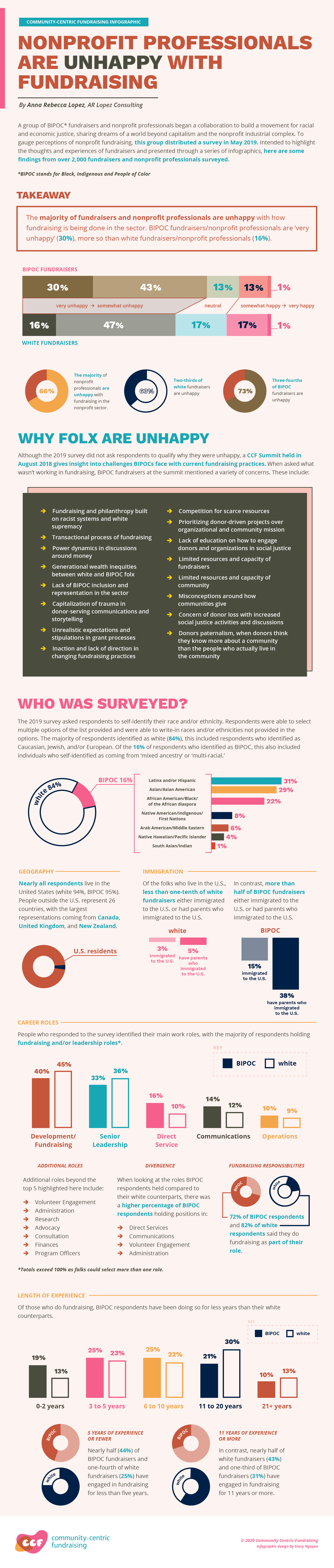
A group of BIPOC* fundraisers and nonprofit professionals began a collaboration to build a movement for racial and economic justice, sharing dreams of a world beyond capitalism and the nonprofit industrial complex. To gauge perceptions of nonprofit fundraising, this group distributed a survey in May 2019. Intended to highlight the thoughts and experiences of fundraisers and presented through a series of infographics, here are some findings from over 2,000 fundraisers and nonprofit professionals surveyed.

*BIPOC stands for Black, Indigenous and People of Color

THE TAKEAWAY

(The following section is visualized through a brown box wrapped around the following text:)

The majority of fundraisers and nonprofit professionals are unhappy with how fundraising is being done in the sector. BIPOC fundraisers/nonprofit professionals are ‘very unhappy’ (30%), more so than white fundraisers/nonprofit professionals (16%).

(The following section is visualized through two line graphs stacked on top of each other, one of BIPOC fundraisers, which is colored in browns, tans, sea green, and pink-coral, and the other graph is of white fundraisers, which is colored in dark greens, sky blue, and cotton pinks. The charts show the happiness levels of fundraisers.)

(The BIPOC graph:)

BIPOC fundraisers who are very unhappy with how fundraising is done in the sector: 30%
BIPOC fundraisers who are somewhat unhappy with how fundraising is done in the sector: 43%
BIPOC fundraisers who are neutral with how fundraising is done in the sector: 13%
BIPOC fundraisers who are somewhat happy with how fundraising is done in the sector: 13%
BIPOC fundraisers who are very happy with how fundraising is done in the sector: 1%

(The white graph:)

White fundraisers who are very unhappy with how fundraising is done in the sector: 16%
White fundraisers who are somewhat unhappy with how fundraising is done in the sector: 47%
White fundraisers who are neutral with how fundraising is done in the sector: 17%
White fundraisers who are somewhat happy with how fundraising is done in the sector: 17%
White fundraisers who are very happy with how fundraising is done in the sector: 1%

(The following section shows three circle/pie charts in yellow, dark green, and lighter green. It  depicting the above data more broadly.)

(Pie chart #1 has a 66% wedge colored in, in yellow)

The majority of nonprofit professionals are unhappy with fundraising in the nonprofit sector.

(Pie chart #2 has a 63% wedge outlined in indigo)

Two-thirds of white fundraisers are unhappy

(Pie chart #3 has a 73% wedge colored in, in lighter green)

Three-fourths of BIPOC fundraisers are unhappy

(The following section is a new section. It features introductory text and then a dark green box with a bulleted list in white writing and yellow arrows as the bullets. It says:)

WHY FOLX ARE UNHAPPY

Although the 2019 survey did not ask respondents to qualify why they were unhappy, a CCF Summit held in August 2018 gives insight into challenges BIPOCs face with current fundraising practices. When asked what wasn’t working in fundraising, BIPOC fundraisers at the summit mentioned a variety of concerns. These include:

  • Fundraising and philanthropy built on racist systems and white supremacy
  • Transactional process of fundraising
  • Power dynamics in discussions around money
  • Generational wealth inequities between white and BIPOC folx
  • Lack of BIPOC inclusion and representation in the sector
  • Capitalization of trauma in donor-serving communications and storytellingUnrealistic expectations and stipulations in grant processes
  • Inaction and lack of direction in changing fundraising practices
  • Competition for scarce resources
  • Prioritizing donor-driven projects over organizational and community mission
  • Lack of education on how to engage donors and organizations in social justice
  • Limited resources and capacity of fundraisers
  • Limited resources and capacity of community
  • Misconceptions around how communities give
  • Concern of donor loss with increased social justice activities and discussions
  • Donors paternalism, when donors think they know more about a community than the people who actually live in the community

(The following section is a new section. It takes about the demographics of respondents surveyed and is a mix of color graphs and charts along with accompanying text.)

WHO WAS SURVEYED?

The 2019 survey asked respondents to self-identify their race and/or ethnicity. Respondents were able to select multiple options of the list provided and were able to write-in races and/or ethnicities not provided in the options. The majority of respondents identified as white (84%), this included respondents who identified as Caucasian, Jewish, and/or European. Of the 16% of respondents who identified as BIPOC, this also included individuals who self-identified as coming from ‘mixed ancestry’ or ‘multi-racial.’

(Here, there is a dark indigo pie chart showing that 84% of respondents were white and 16 percent of respondents, shown as a pink wedge, were BIPOC.)

(Next to the BIPOC percentage, there is deeper-dive information. There is a breakdown of ethnicities of respondents who were surveyed. The list is shown as a bar graph in descending order, from highest percentage to smallest percentage. The list says:)

Latinx and/or Hispanic – 31%
Asian/Asian American – 29%
African American/Black/of the African diaspora – 22%
Native American/Indigenous/ First Nations – 8%
Arab American/Middle Eastern – 6%
Native Hawaiian/Pacific Islander – 4%
South Asian/Indian – 1%

(The following sections are subsections of the demographics info. The subsections are arranged side-by-side with yellow headings that say “Geography” and “Immigration.”)

GEOGRAPHY

Nearly all respondents live in the United States (white 94%, BIPOC 95%). People outside the U.S. represent 26 countries, with the largest representations coming from Canada, United Kingdom, and New Zealand.

(There is a brown pie chart here that has a dark indigo wedge in it. The chart shows that nearly all respondents were from the U.S.)

IMMIGRATION

Of the folks who live in the U.S., less than one-tenth of white fundraisers either immigrated to the U.S. or whose parents immigrated to the U.S.

(There is a small pink line graph here featuring two data points with the word “white” over the top of both graphs. The graphs show:)

3% [of white respondents] immigrated to the U.S.
5% [of white respondents] have parents who immigrated to the U.S.

In contrast, more than half of BIPOC fundraisers either immigrated to the U.S. or had parents who immigrated to the U.S.

(There is a small indigo line graph here featuring two data points with the word “BIPOC” over the top of both graphs. The graphs show:)

15% [of BIPOC respondents] immigrated to the U.S.
38% [of BIPOC respondents] have parents who immigrated to the U.S.

(The next subsection is titled “Career Roles” and features bar graphs in multiple colors, showing what jobs white respondents and how BIPOC respondents hold in nonprofit.)

CAREER ROLES

People who responded to the survey identified their main work roles, with the majority of respondents holding fundraising and/or leadership roles*.

*Totals exceed 100% as folks could select more than one role.

Development/Fundraising
BIPOC – 40%
white – 45%

Senior Leadership
BIPOC – 33%
white – 36%

Direct Service
BIPOC – 16%
white – 10%

Communications
BIPOC – 14%
white – 12%

Operations
BIPOC – 10%
white – 9%

(Underneath the chart are three sections that expand on the information conveyed in the chart. The first two are portrayed through bulleted lists and the third is portrayed through two pie charts.)

ADDITIONAL ROLES

Additional roles beyond the top 5 highlighted here include:

  • Volunteer Engagement
  • Administration Research
  • Advocacy
  • Consultation
  • Finances
  • Program Officers

DIVERGENCE

When looking at the roles BIPOC respondents held compared to their white counterparts, there was a higher percentage of BIPOC respondents holding positions in:

  • Direct Services
  • Communications
  • Volunteer Engagement
  • Administration

FUNDRAISING RESPONSIBILITIES

72% of BIPOC respondents and 82% of white respondents said they do fundraising as part of their role.

(The last subsection is titled “Length of Experience” and features bar graphs in multiple colors, showing how long respondents have worked in nonprofit.)

LENGTH OF EXPERIENCE

Of those who do fundraising, BIPOC respondents have been doing so for less years than their white counterparts.

0-2 years
BIPOC – 19%
white – 13%

3 to 5 years
BIPOC – 25%
white – 23%

6 to 10 years
BIPOC – 25%
white – 22%

11 to 20 years
BIPOC – 21%
white – 30%

21+ years
BIPOC – 10%
white – 13%

(The last part shows two sets of pie charts, depicting the difference in years of experience between white respondents and BIPOC respondents. The pie charts are in dark indigo and brown.)

5 YEARS OF EXPERIENCE OR FEWER

Nearly half (44%) of BIPOC fundraisers and one-fourth of white fundraisers (25%) have engaged in fundraising for less than five years.

11 YEARS OF EXPERIENCE OR MORE

In contrast, nearly half of white fundraisers (43%) and one-third of BIPOC fundraisers (31%) have engaged in fundraising for 11 years or more.

(The very bottom of the infographic shows the CCF logo on the left hand side. On the right hand side, it says: “© 2020 Community Centric-Fundraising” and “Infographic design by Stacy Nguyen.”)

This infographic is part of a multi-part series. Read part two of the series here. Follow CCF on Instagram, Facebook, or sign up for our mailing list to get notified of the next part!

Anna Rebecca Lopez

Anna Rebecca Lopez

Anna Rebecca Lopez (she/they) is an experienced Evaluator and consultant, using mixed-method approaches to social science research, statistical analysis, community engagement & collaboration, digitization and more. She is the Principal Evaluator at AR Lopez Consulting, where she specializes is disaggregating data in a way that tell authentic and useful stories. You can find her on IG @anna_.rebecca

8 ways to make fundraising more accessible for people with disabilities

In early 2019, I brought together a group of community members to form the Seattle Cultural Accessibility Consortium, which connects arts and cultural organizations to information and resources to improve accessibility for people of all abilities. We have several workshops per year on accessibility-related topics and help organizations with accessibility planning.

In King County, with almost 2 million people, 9.5% have a disability. That may seem like a small number, but when you consider that 210,000 new people could now participate in a virtual fundraising event, the donor potential is powerful.

As a deaf woman, accessibility is something I deal with every single day. And as a lover of the arts, I decided to do something about the inequities people with disabilities face when trying to enjoy our region’s thriving arts and culture arena.

And now the pandemic has forced us to hunker down, convert our home spaces into work areas, and change the way we communicate with others. Instead of in-person meetings and events, our communication has been transformed through a variety of digital platforms. The Consortium had to quickly adapt to doing our accessibility workshops through virtual platforms and to think about how to make those programs accessible to all.

I also saw organizations scramble to raise money in this new, virtual world we are living in. Fundraisers were quickly being converted to online platforms and accessibility was being left behind.

There is so much potential to engage a largely untapped donor audience — people with disabilities. One in 4 people in our country has a disability.

In King County, with almost 2 million people, 9.5% have a disability. That may seem like a small number, but when you consider that 210,000 new people could now participate in a virtual fundraising event, the donor potential is powerful.

Disabilities can be auditory, visual, cognitive, or physical. They also encompass invisible disabilities such as PTSD, traumatic brain injury, chronic pain, depression, anxiety, etc. Then you’ve got an aging population in this country — by 2030, 1 in 4 people will be 65 and older. And elderly people develop disabilities as they age.

Many of these people could not attend fundraising events in person because of their inaccessibility (lack of accommodations, absence of elevators, difficulty in parking, and more) but now they can attend fundraising events from the comfort of their own homes. People with disabilities are more likely to live in poverty so access to technology can be an issue. Regardless, many desire to make a difference through their time, talents and money.

The upsides of making your fundraisers more accessible

There are two main reasons why fundraising efforts ought to be accessible to people with disabilities:

Planning any kind of program or event should be all-inclusive, benefit everyone and it cannot be piecemeal.

ONE — It makes good business sense.

If you include people with disabilities in your events and make them feel welcomed at your events, they will show up. Their friends, families, colleagues, and circle of supporters will notice, and they will return over and over to support you with their dollars.

TWO — From a universal design perspective, it is the right thing to do.

Planning any kind of program or event should be all-inclusive, benefit everyone and it cannot be piecemeal. Accessibility needs to be integrated within the structure of an organization and that includes every department having a budget line item devoted to accessibility.

So how does one get started in this journey?

Here are 8 ways to make fundraising more accessible for people with disabilities.

1.

Assume people with disabilities will attend your virtual events.

2.

Budget for accessibility. You may have to get your board on board with this. Put a budget line item for all the elements of accessibility that need to be included in your fundraising event: captioning, ASL interpreters, audio description, large print programs, making the website accessible, marketing — and so much more.

3.

Designate an accessibility point person in your organization. If a participant needs an accommodation, make it easy for that person to make the request and for someone to respond to that person.

4.

Make it clear in your marketing materials that there is a way for people to request accommodations.

5.

In slideshows, read all the text and describe the images you are showing. If people have vision issues, they may not be able to see the words or images.

6.

Include a physical description when you first introduce yourself. For example: “Hello, I am Alicia, your auctioneer for tonight! I am Black and have short black hair with a white hat. I am wearing bright red lipstick and a black and white striped dress.” Simple actions like this can really help a person with low vision have an image of who is speaking and in turn make them feel included as part of the festivities.

7.

Provide any written or visual materials in advance in an accessible file format so people know what to expect and can plan ahead.

8.

Outline what will happen so that attendees know what to expect. Some people with invisible disabilities appreciate knowing when there are breaks so they can plan for things like shifting positions, using the restroom, and more. For others, knowing what happens ahead of time helps reduce uncertainty or anxiety.


This is not an exhaustive list and there are more ways to head down this road of including people with disabilities in your fundraising practices. The bottom line is, starting somewhere will help set you in the right direction and yield positive results.

Funders need to be better about including people with disabilities in philanthropy and as fundraisers, it is imperative that you jump on this bandwagon.

Elizabeth Ralston

Elizabeth Ralston

Elizabeth Ralston (she/her) has more than 20 years of experience working with nonprofits, government agencies, and academic institutions. She works with organizations to engage constituents through capacity building, program delivery, strategic communications and accessibility. Her objective is to showcase an organization’s story and impact in a compelling way, attracting more program participants, volunteers, donors, and community partners to its mission. She also helps nonprofits, fundraisers and event planners make their programs, communication materials and events more accessible.

Elizabeth is deaf and uses two cochlear implants to hear. An avid patron of the arts, she founded the Seattle Cultural Accessibility Consortium, a grassroots effort to connect arts and cultural organizations with information and resources to improve accessibility for people of all abilities. She can be reached at elizabeth@elizabethralston.com. You can also follow and like the Consortium on Facebook!

The Ethical Rainmaker: “Tokenism is NOT transformation” with Chuck Warpehoski

By Michelle Shireen Muri, Freedom Conspiracy Principal and CCF co-chair

Episode Summary

From tokenism to using community as unpaid consultants, from structural oppression to…more gatekeeping, and identity-based privilege, former City Councilman turned DEI consultant, Chuck Warpehoski, talks with Michelle about the common and -tired- ways in which institutions perform or attempt to work with the community and common pitfalls. Chuck also shares personal stories of mistakes he’s made while working to serve the community as a white man.

Find episode notes and the podcast transcript here.

About the Ethical Rainmaker podcast

In the United States alone, philanthropy is a $427 million dollar industry, of which 68% comes from individual donors. Yet the practices, theories, and foundation of modern philanthropy and fundraising often ignore the ways in which the industry perpetuates harm.

The Ethical Rainmaker, hosted by Michelle Shireen Muri, is a podcast that hosts authentic conversations grappling with the questions that we don’t often ask in the nonprofit world. Join us as we explore some of the practices that undermine our missions and navigate the way forward with today’s resisters, reimaginers, and the re-creators of the third sector. It’s time to think differently.


Michelle Shireen Muri

Michelle Shireen Muri

Michelle Shireen Muri (she/her) is the co-chair for Community-Centric Fundraising and the host of the new podcast, The Ethical Rainmaker, launching July 29. She is the founder of Freedom Conspiracy, a small collective of fundraising consultants focused on bringing values-aligned practices to clients in the nonprofit and philanthropy spaces. She can be reached at @freedomconspiracy on Instagram.

Six reasons why tiered event sponsorship needs to go!

By Phuong Pham, Director of Knowledge & Communications, Southern California Grantmakers

However, fundraising for events has often felt the most transactional — neither selfless nor magical.

Recently, I was included in conversations about fundraising for an annual conference. My colleagues and I discussed sponsorship levels and benefits. We brainstormed how to make it worthwhile for funders to support our event and how to display our gratitude virtually.

Subsequently, I was invited to a prospect call with a funder for a $5,000 sponsorship. On the call, my team answered all possible questions about why we do what we do, what every line item in our budget means, and how we can help amplify the funder’s brand visibility.

After an hour, the answer to the $5,000 sponsorship request was a disappointing “no.”

The perils of event sponsorship and its transactional nature

I admire fundraising colleagues tremendously. If the nonprofit sector is like air as Vu Le so beautifully describes us in the first episode of the Ethical Rainmaker podcast, nonprofit professionals are the ocean producing oxygen.

Yes, the ocean generates at least half of the oxygen on Earth! And yes, we all keep our sector alive in selfless and magical ways!

As a membership association, my organization’s development team’s efforts range from generating membership dues and generational operating support to fundraising for specific projects and conferences. Each of these revenue streams is critical and helps keep our organization financially sustainable.

So, why do we still fundraise for events when we can fundraise for meaningful social change?

However, fundraising for events has often felt the most transactional — neither selfless nor magical.

The different levels in our sponsorship offerings correspond with specific numbers of complimentary tickets, precise forms and frequencies of logo displays, and verbal recognition throughout the event.

It didn’t feel great for my colleagues and me to pour our hearts out and then not get $5,000 for our organization. But more importantly, this particular experience left me perplexed and with a few unanswered questions.

Does the hierarchy of sponsorship levels imply that we value some sponsors more than others? If presenting sponsors get more for their dollars than bronze sponsors, do we appreciate the former more than the latter? Additionally, if our organizational messaging is that we value all funders the same regardless of their contribution amounts, are we then sending out the wrong message with our sponsorship packets?

Besides looking at the impact of a conference and how it’s received by attendees, are our sponsors really counting how many times we recognize their names verbally and visually? Also, we currently acknowledge our general operating support and project funders without logo recognition as a grant requirement, so why is it that our relationships with sponsors and other funders so different?

While every dollar feels like it matters to the livelihood of a nonprofit organization, not every dollar matters when it comes to our liberation and sanity.

Not unlike grants, event sponsorships can ideally help us convene funders, share knowledge, advance equity, and foster collaborations. However in practice, conference sponsorships are often so removed from the rest of our fundraising strategies. Unlike generational support fundraising, raising dollars for events requires distinct outcomes that have little to do with our mission and impact.

So, why do we still fundraise for events when we can fundraise for meaningful social change? Why do we shortchange the hundreds of hours it takes to put on a one-day conference by putting forward sponsorship packages that count how many times a sponsor’s logo should be displayed?

As a field builder in philanthropy, my organization helps to build momentum around movements that value relationships, such as the full cost project and trust-based philanthropy. Now, it’s time to hold ourselves accountable and live into the same values. It’s time for us to stop perpetuating the transactional nature of event fundraising and prioritize community-building.

Why we should get rid of tiered sponsorship levels

The truth is my organization has great partners. The prospective $5,000 sponsor mentioned above isn’t typical at all for us. But I suspect that the story is common in other organizations. Most nonprofits are likely not as privileged as we are to have most sponsors renewing their support generously without questions. And so, we need to change the way we fundraise for events.

Let’s be honest: While every dollar feels like it matters to the livelihood of a nonprofit organization, not every dollar matters when it comes to our liberation and sanity.

Before investing time in a new sponsor relationship, let’s remind ourselves to ground it in Community-Centric Fundraising principles. Although there are many types of nonprofit events, I’m speaking directly to those of us who produce educational conferences because that’s the system that I’m operating in. There is likely a lot that we can do to unlearn traditional conference fundraising practices; however, at the minimum, let’s get rid of those tiered sponsorship levels! Here are six reasons why we should do it.

1. It takes a lot of time to come up with those sponsorship levels and benefits

Time is money. There is only so much time in the day, and we are constantly making choices of how to use our time wisely. Virtual conferences are already taking away many options from our regular repertoire of sponsor benefits. It is not worth it to spend time coming up with the most creative vanity benefits.

2. Logo display and name mentions are not the true benefits

Sponsoring a conference is an investment in our mission. The true benefits of partnering are opportunities to connect with colleagues across geographies and backgrounds, participate in fresh and challenging conversations, hear from leaders whom we wouldn’t normally work with — you get the idea!

3. Because of the above benefits, our conferences are transformative, not transactional

Even if we don’t mean it, what screams transactional more than a list that includes complimentary conference tickets, logo placement in digital marketing, verbal recognition from podium, and opportunity to address attendees?

4. We would recognize sponsors anyway

Isn’t it fundraising 101 to give funders the recognition they deserve for believing in our work? It might not be necessary to uphold such specific benefits around logo display and name mentions if our deep appreciation already moves us to do so regardless of a sponsorship contract. Could some combination of the transactional benefits above be offered to all sponsors?

5. Tiered sponsorship levels divide our community instead of fostering belonging

Why create a sense of othering when we can foster belonging by building a community of grantmakers who believe in our impact? Every relationship matters and begins with trust. We don’t need to distinguish between conference sponsors and operational funders if all aspects of our work serve the same mission and priorities.

6. Instead of discussing sponsor benefits, we could spend time talking about race, equity, and social justice

Again, how do we want to use our time? Negotiating transactional benefits could bring certain sponsors. But it is more meaningful to have uncomfortable discussions regarding the real reasons why we host conferences. Ultimately we do what we do and the nonprofit sector exists because racial inequities and disparities are persistent and deep-rooted. Our conferences are one of many strategies to solve much larger issues.


Conference sponsorships have been donor-centric for so long. I believe that we can free ourselves from the rigidity of tiered sponsorship levels because our time is valuable and our events are transformative, not transactional. As my organization is planning for next year’s budget, we are weighing what we might lose and what we might win as we move away from transactional sponsorships. I know that it will be challenging but we are building our muscles to have difficult conversations.

Phuong Pham

Phuong Pham

Phuong Pham (she/her) is a creative professional working at the intersection of digital media and philanthropy. Phuong is an avid home chef and dreams of creating a community space that inspires others to eat well. She believes in the healing power of food and enjoys bringing people together around her dinner table. She can be reached via email, LinkedIn, or on Instagram.