Why does equitable need-based pay make white folks so scared?

By Chris Talbot, communications professional and perpetually underpaid nonprofit laborer

“I’m writing an article about how to start offering equitable pay and I’m remembering an organization that had every person’s salary band start the same, regardless of their position, and had it based on need (those with more dependents earned at the higher end of the band, those without generational wealth, earned at the higher end, etc). But I can’t, for the life of me, remember the name of the organization or where I saw it. Can anyone offer guidance?”

This is what I asked three different groups as I set out to research something for my last article “Underpaid staff don’t need motivation, they need dollar bills and benefits.

I asked because I knew I had heard of an organization doing just this and assumed I had heard it in one of these three groups. It was a straightforward question, and I expected a straightforward answer.

In two of the groups, one composed entirely of BIPOC members and one that is BIPOC-led with white members, a straightforward answer was what I received.

A lot of our white, cisgender, heterosexual, abled colleagues are comfortable with the status quo and either consciously or unconsciously seek to maintain it because it (typically) works out fine for them.

In the third group, a primarily white one with a listed raison d’être of moving the nonprofit sector “toward one that is more equitable and just,” I began to receive notification after notification of comments. Excited to see that maybe there were more organizations than the one I was thinking of who worked in this model, I clicked through …

… only to find out a bunch of white women in the group had begun to subject me to a deluge of ways in which this model could be perverted with white supremacy culture and patriarchal values to become injurious.

A few white women even came in to say that they would be angry, upset, and one said: “sick to my stomach” that people with dependents would be paid more.

Why?

(They need more money to survive! Why would you want children or otherwise dependent people to live in poverty? You aren’t getting less because they need and are receiving more. You are getting what you need, and they would be getting what they need.)

So many white women commented to say that they didn’t want to be forced to disclose personal information to get better pay, and it would likely result in women taking less and men taking more.

(Even if this was the case, how would that differ from now?)

That assumed that the organization in question structured things in a white philanthropy sing-for-your-supper style, where the biggest sob story gets the greatest attention and funding.

(Why was that the assumption? And why was I being held to account for it?)

Sigh.

To say I was disappointed would be an understatement. I was angry.

I added an edit, saying:

“I asked this to find out what the organization was, not to hear the ways in which it could be implemented through a lens of white supremacy to become a bad thing. Please, respect that it was a Black-owned or queer-owned organization, based in radical justice and equity, and not whatever you fear it might be perverted and turned into. I don’t need to hear it. I [already] heard it in the original article’s comments. I just want to know what the organization is. If you want to discuss your fears, make a new post, please.”

But that didn’t stop white women (and a few others) from making up ways in which equal salary bands would be inequitable (and then holding me accountable for their imaginings).

It’s one thing to bring up potential pitfalls. It’s quite another to immediately view a potential solution to a huge problem in our sector with a hostile lens and speak to it with a vilifying framing before you even explore how it could be or has been implemented!

For me, it pointed to other problems indicative of the nonprofit sector:

  • We have a propensity to do things the same as they’ve always been done for no discernible reason other than we’re afraid any change will fail, even as we recognize that the way we are doing things now has failed (inequity being operationalized is a failure).
  • A lot of our white, cisgender, heterosexual, abled colleagues are comfortable with the status quo and either consciously or unconsciously seek to maintain it because it (typically) works out fine for them.

There are a number of problems at work in how people responded to my simple question, and it’s incredibly important that we investigate what these problems are and how we’ve perpetuated white supremacist characteristics in our organizations — and how this has stopped us from making headway in equity in the sector.

In order to solve pay inequity, we have to recognize that it exists and furthers the chasm between privileged and marginalized peoples’ wealth

In the BIPOC-only and BIPOC-led groups that I posed my question to, I received answers of “It might be this one!” and “I don’t know but I would like to learn more!” Eye emojis and follow-up questions were posted in the threads. People leaned in with curiosity, wanting to see who implemented this strategy of pay equity and how it worked. We discussed the harm in hierarchical models.

Our sector has been rife with doing things the wrong way because it’s easier, cheaper, and we can get away with it. But when we’re trying to fix things because they’re inequitable, I don’t think we need to assume that structuring them with inequities is inevitable. I think we can spend our time envisioning and working towards something better.

In the group with mostly white people, there was a range of grievances (entirely fictional), discomforts with the model and how it could be implemented, and anxieties about how they would be personally affected. I was told several times that following market value was the obvious answer.

But we already know the market isn’t a great way to base pay. We know that certain positions have an inflated “worth” and many incredibly important careers are devalued.

Throughout the first year of the pandemic, we cheered (and, in Denver, howled) for our grocery store workers who worked through the lockdown, who made sure that all of us could survive. But the market rate doesn’t reflect the necessity, or the danger, of this job. The range of salaries for a grocery store worker in the US is $17,440-34,760, with a median salary of $21,010.

We also know that the market values positions historically (and still overwhelmingly) held by white workers. That didn’t happen by accident — that is a racial inequity woven into our societal fabric that we have yet to disentangle.

And while the education, credentialing, and skills gap has closed between Black workers and white workers, the wage gap hasn’t. White workers are more likely to get hired for good-paying jobs. Black and Latinx workers are more likely to be laid off when technology advances and fewer workers are needed. Black workers will spend more of their careers at lower-level positions and will be paid less than their white counterparts for doing them.

I’ve had the displeasure of witnessing racial bias play out in real-time, several times. In a board meeting, a board member (all members of this board were white and cisgender, by the way), unblinkingly said something akin to: “And maybe we can save one board seat for a person of color. But their skin color can’t be all they bring to the table. They have to have skills, too.”

In another meeting, a co-worker (all my co-workers at this job were white and cisgender, except me) unblinkingly said something akin to: “Of course, we should bring more diversity into the staff, but we should do that at the intern level so that they can learn and work their way up.”

Both these statements betray the fact that the white people in these white-led organizations can’t fathom that a BIPOC person would have the skillsets to enter the work hierarchy in a space as high as they occupy — rather, they imagined that a BIPOC person would have to work their way up into it from the bottom.

If one looked at my resume and LinkedIn profile, this bias is the story it would tell. It displays a series of low-level jobs and internships since I started in the nonprofit sector in 2001, all with no opportunity for advancement — or even ending because I was “difficult” for bringing inequities to light (I didn’t advertise that bit on LinkedIn.).
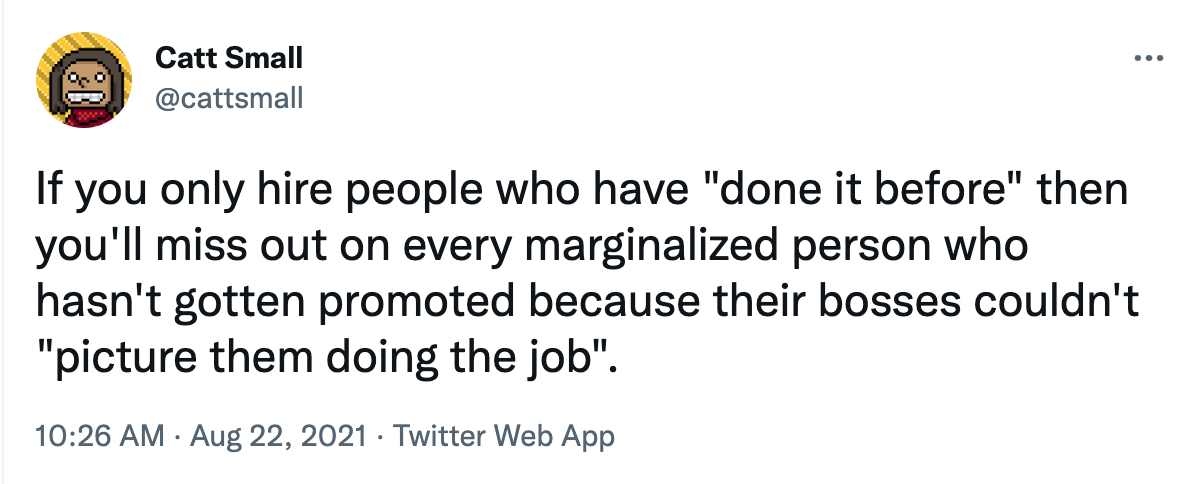
Tweet by Catt Small that says “If you only hire people who have ‘done it before’ then you’ll miss out on every marginalized person who hasn’t gotten promoted because their bosses couldn’t ‘picture them doing the job.’”

(A great Tweet by Catt Small that says “If you only hire people who have ‘done it before’ then you’ll miss out on every marginalized person who hasn’t gotten promoted because their bosses couldn’t ‘picture them doing the job.’” Original tweet)
If you deep dive into Catt Small’s blog after seeing that tweet (a totally normal thing to do, right — my spouse thinks it’s a sort of low-key cyberstalking, LOL), you’ll get to her amazing article “If you’re risk-averse, you’ll never have a diverse leadership team,” which brings us to the next point:

In order to solve the problems we are tasked to solve, we need to be prepared to be brave and to fail and learn from those failings

In her blog, she states, “Risk-aversion reinforces systemic injustices and harms businesses.” This is true about hiring and promoting marginalized workers and it’s also true about seeking out imbalances and inequities in our organizational structures and rectifying those.

In the organization I work for, we’re a team of five. All team members are needed to complete the work we do. Yet, I was paid (before Colorado enacted a minimum salary) in a way that indicated that I was not a valued or worthy member of the team. Now, I finally make Colorado’s minimum salary. There is no equity in paying me well below a livable wage — especially as I am the only non-white, non-cisgender, and not-heterosexual member on staff — and the only one with DEI expertise.

As a multiple marginalized individual, I was expected to live below a livable wage because of the importance of the mission, while my teammates (who had better circumstances and more safety nets in place than me) did not.

But our mission does not move forward without me (or someone else in my position) communicating what we do, fundraising so we can do what we do, and organizing our events.

That’s why when I heard about the Black- and queer-led organization that had enacted the same salary band for all employees, no matter their position, I was intrigued. After all, what could be more equitable than removing hierarchical models of ‘worth’ amongst employees that are all necessary?

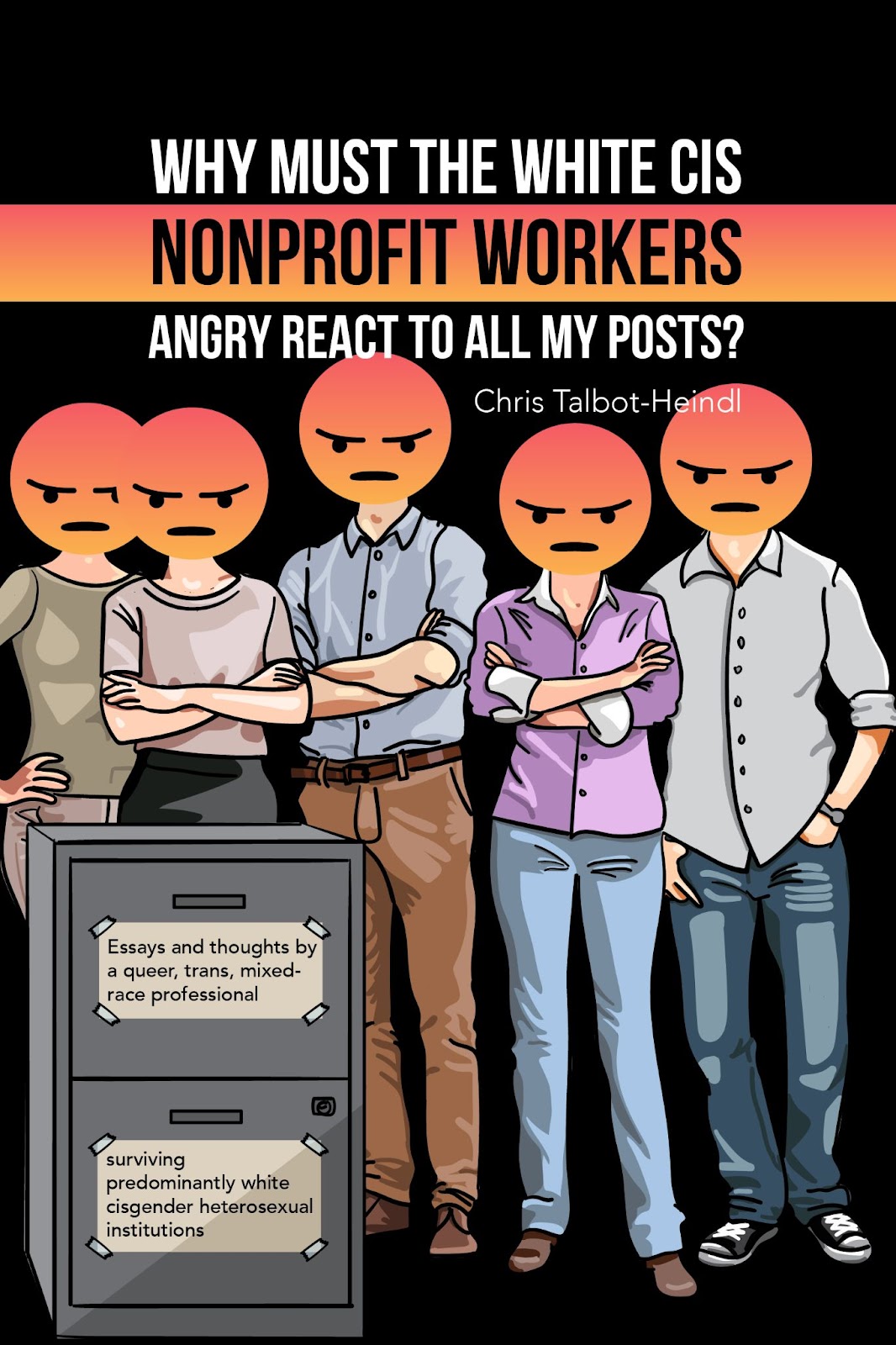
But in the third group, the white-dominant one, that I asked my question to, staying the course was treated as the better solution than trying a band structure and failing. (I also received a lot of angry reacts, which has led me to write a chapbook that I am affectionately calling “Why must the white cis nonprofit workers angry react to all my posts? Essay and thoughts by a queer, trans, mixed-race professional surviving predominantly white cisgender heterosexual institutions.”) Here is my cover for the collection, for your amusement:
angry white people graphic
(A cover depicting white people in business casual clothing with their faces replaced by Facebook angry react emojis. The title across the top reads “Why must the white cis nonprofit workers angry react to all my posts? Chris Talbot-Heindl.” The subtitle is on labels taped to a gray filing cabinet and says “Essay and thoughts by a queer, trans, mixed-race professional surviving predominantly white cisgender heterosexual institutions.”)
Our sector has been rife with doing things the wrong way because it’s easier, cheaper, and we can get away with it. But when we’re trying to fix things because they’re inequitable, I don’t think we need to assume that structuring them with inequities is inevitable. I think we can spend our time envisioning and working towards something better. (And at the very least, stop angry reacting and directing fears to a queer, trans, mixed-race person simply asking for the name of an organization).

Since a lot of our white, cisgender, heterosexual, abled colleagues are comfortable with the status quo and either consciously or unconsciously seek to maintain it because it (typically) works out fine for them — their logic is: Why change something, and create a devil you don’t know, when the devil you do know isn’t disenfranchising you?

They aren’t being paid well below their coworkers and well below liveable wages due to their marginalizations. The inequities already at play don’t affect them as much, so they aren’t being braver in rectifying the issues. They don’t have to be. It isn’t affecting their long-term financial sustainability like it is mine.

However, for people who do live consistently too close to the poverty line, who don’t have generational wealth to fall back on, who don’t have inheritances to look forward to, we need something to change, even if it isn’t the most perfect, polished thing yet. Our objective isn’t perfection. We can learn and adjust from every misstep. But we have to be taking steps towards something transformational instead of continuing practices we know harm the most marginalized among us.

So what about those salary bands?

The good news is that for every angry white person who subjected me to their fears and anger, there was someone else answering my question or showing interest in knowing, and I learned that there are a lot more organizations than the one I was originally thinking about, who are doing this. Here are just a few of those organizations and quotes from them about how they chose to implement their bands.

Sylvia Rivera Law Project — $100,000/year.

“Consistent with our values as a collective, all staff receive salaries based on the same hourly rate. An increased salary is possible based on need, such as for people supporting family members.”

Momentum Community — $55,000–$70,000/year.

“Our current staff practices needs-based compensation rather than market-based compensation, which means that staff are not compensated on the basis of the ‘value’ of their work (which is invaluable!), or on their level of experience or expertise, but rather on the basis of their financial needs.”

Sunrise Movement — $48,000–$80,000/year.

“Sunrise has a unique, needs-based compensation policy in which all staff are able to choose the compensation rate that best meet their needs within the $48–$80k range.”

I would highly recommend that all the white women (and others) that presented their fears about salary bands to think further and envision the solutions to those fears, rather than throw away the whole process based on imagining how this might be implemented with white supremacy and patriarchal values at the forefront.

And maybe salary bands won’t work for every organization. Maybe they won’t work for you. But I appreciate these organizations trying, learning, and adjusting. I appreciate the people with open minds, who were willing to hear how it is being implemented.

Instead of fearing change and not taking steps because we’re afraid to risk harm, we should work through how we will heal those that are the most impacted if our changes do end up causing harm. We need to be making steps because we know the status quo is harmful already. Taking steps, any steps, rooted in equity will be how we start to heal.

Chris Talbot

Chris Talbot

Chris Talbot (they/them) is a queer, trans nonbinary, mixed-race artist, activist, and nonprofit employee. When they aren’t working the day job, they spend their free time editing art and literature magazines, writing and illustrating educomics to help folks affirm their nonbinary pals, creating a graphic novel to describe what it’s like to be nonbinary in a gender binary world, cuddling their cat, and quad skating in the park. 

You can find Chris at talbot-heindl.com, on LinkedIn, Instagram, Bluesky, and Twitter — and tip them on Venmo or PayPal or join as a patron on their Patreon
The Ethical Rainmaker: “How I Figured Out I Suffer From Toxic Productivity,” ft. Marina Martinez-Bateman

By Michelle Shireen Muri, Freedom Conspiracy Principal and CCF co-founder

Episode Summary

Are you slowly killing yourself or your joy through over-working? Toxic productivity may be a buzz phrase currently, but it’s also becoming the norm — and it can ruin your life! In this episode of The Ethical Rainmaker podcast, Marina Martinez-Bateman and Michelle talk about Work with a capital W — whether it’s laboring for labor unions, the carrots of accolades, work culture, and the bedtime story moment that changed everything for Marina.

Find the episode notes here.

About the Ethical Rainmaker podcast

In the United States alone, philanthropy is a $427 billion dollar industry, of which 68% comes from individual donors. Yet the practices, theories, and foundation of modern philanthropy and fundraising often ignore the ways in which the industry perpetuates harm.

The Ethical Rainmaker, hosted by Michelle Shireen Muri, is a podcast that hosts authentic conversations grappling with the questions that we don’t often ask in the nonprofit world. Join us as we explore some of the practices that undermine our missions and navigate the way forward with today’s resisters, reimaginers, and the re-creators of the third sector. It’s time to think differently.

Michelle Shireen Muri

Michelle Shireen Muri

Michelle Shireen Muri (she/her) is the co-founder for Community-Centric Fundraising and the host of the podcast, The Ethical Rainmaker. She is the founder of Freedom Conspiracy, a small collective of fundraising consultants focused on bringing values-aligned practices to clients in the nonprofit and philanthropy spaces. She can be reached at @freedomconspiracy on Instagram. You can send her a tip via Patreon.

Stop the sabotage: Why Millennials like us must add chairs at the table for Gen Z

Stop the sabotage: Why Millennials like us must add chairs at the table for Gen Z

By Rachel D’Souza, Founder + Chief Purpose Officer, Gladiator Consulting, Sr. Director, Resource Development + Justice Philanthropy, Forward Through Ferguson

Friends. I am turning 40 this summer. I am milleniOLD. An elder millennial. Some might say a geriatric millennial — which is just rude, y’all. I still feel young, despite listening to chats that my children — both born after 2010 and currently categorized as Gen Alpha —— have songs and trends and technology that I’m completely clueless about.

Gen Z is entering the workforce and I can see my Millennial peers, along with Gen X and Boomer leadership, dismissing the youth perspective in favor of “what we know works.”

Sometime in the last decade, I went from being one of the youngest people in the room to one of the oldest. I did not realize this shift had occurred until recently, when I was on a Zoom with a client. During an icebreaker, we all had the chance to share one of our favorite teenage/coming-of-age movies.

I could not wait to drop “Empire Records” and “Can’t Hardly Wait” in the chat.

Not a single person on this call had seen either film. For shame, all. For shame.

There was a brief moment where I felt insecure about it — like, am I out of touch now? Have I suddenly become the eclectic auntie who jokes about “the Tik Tok” and tells too many stories about her children?

In a blink, I moved past the shock. Because with age, comes power. And, if simply being an elder millennial afforded me a new level of influence and power, then I must use this privilege for good. But how?

When I began my first nonprofit job in 2007, my new workplace was dominated by Gen X and Boomers; even a few Silent Generation employees walked the halls.

(BTW, I know that these generational labels, while useful to talk about those born during a specific time frame, are not scientific in any way. Sometimes these labels tend to offer stereotypes and generalizations that are not accurate for every person born during that generation span and often ignore the experience of marginalized groups. I’m using these terms to mostly refer to age and will do my best to leave out the generalizations (i.e. latchkey kids, avocado toast, Euphoria stans, Among Us players, etc).

I was excited. I was ready to bring the full scope of my academic education, lived experience, and passion to the organization. In my middle-management role, I was ready to change the world.

It turns out that no one was particularly interested in or ready for me.

There was hierarchy.

There was formal and informal organizational culture.

There was, “This is the way we do things around here.”

The first challenge on my plate was to get in line. Learn how to work within the system. Get comfortable with a slow pace of change. I felt that I had so much to learn and so much to offer, but that I needed to keep myself small — to take up very little space — in order to be heard and respected.

It made me feel disheartened and at times, unmotivated. I remained a dedicated employee and worked hard to excel in my role though, even earning a couple promotions during my time there.

Millennials: Could we be the generation that puts a stop to this harmful cycle in the nonprofit workplace?

But, I never really learned what I wanted to learn or changed what I believed needed to be changed — and often, I wonder what I should have done differently.

Here we are, fourteen years later. As I became milleniOLD, I founded and continue to lead a successful boutique consultancy, which gives me and my team the privilege to work with many nonprofit organizations in our local community and more recently, across the country.

And friends, it kills me to watch history repeat itself.

Gen Z is entering the workforce and I can see my Millennial peers, along with Gen X and Boomer leadership, dismissing the youth perspective in favor of “what we know works.”

Einstein famously offered, “Insanity is doing the same thing over and over and expecting different results.”

Millennials: Could we be the generation that puts a stop to this harmful cycle in the nonprofit workplace? Could we offer Gen Z what we were denied in the early days of our careers? Are we the ones we’ve been waiting for?

Millennial leaders in any role within your organization, I invite you to try the following in 2022:

Make space at the table for Gen Z — or make a new table.

Let’s stop the practice of keeping young people out of the room where decisions are being made. Instead, what if we invited their experience and gave them some responsibility to advance the work of our organizations? Alternatively, you could coordinate a space where Gen Z could collaborate with peers and offer recommendations to institutional decision-makers. Either way, it’s time to listen.

Provide resources to support their ideas.

Few things have made me more frustrated than to watch leaders chuckle while giving members of their team “enough rope to hang themselves.”

WHAT IS THAT?

What is it about our own unresolved workplace trauma that drives this behavior? We have the choice to stop. Our younger peers do not just need us to listen — they need us to use our power and influence to resource their ideas. They need the budget to support their learning through mentorship, coaching, and professional development opportunities. They need us (or someone) to help them figure out how to access the technology or other resources needed to support the changes and shifts they seek.

Help them fly — or fail.

Learning opportunities are not a waste of time. Growth and change don’t happen without audacity and risk-taking. Ask your Gen Z colleague how you can show up for them. Offer space and time for them to test ideas.

And when they experience success or failure, help them parse out what they learned. Hold space for the reality that learning from failure is an excellent way to grow. Then, help them plan for their next try.

We have so much on our plates these days. It is challenging to juggle the flaming torches that are our daily priorities and frankly, it might be hard to get out of bed some mornings. And yet, we chose this line of work because we wanted to drive change. We must choose to break the institutional patterns of dysfunction and lead differently in our ever evolving, intergenerational workplace.

Rachel D'Souza

Rachel D'Souza

Rachel D’Souza (she/her) is the Founder+Principal of Gladiator Consulting in St. Louis, Missouri. Through Gladiator, Rachel has combined her knowledge of organizational culture and fund development with her deep personal commitment to centering community, seeking justice and creating belonging for those who have been disenfranchised or targeted by institutions, systems, and policy.

Born to parents who immigrated to the U.S. from India, Rachel has always been passionate about bridging differences and celebrating what’s possible when we collaborate from a mindset of abundance, learning, and risk-taking. Rachel loves cooking, snuggling her kids, and Instagram.

Tip Rachel — PayPal: rachel.d.siebert@gmail.com; Venmo: @RD-Siebert0620; CashApp: $GladiatorRDS

How I achieved MY version of emotional sustainability

How I achieved MY version of emotional sustainability

By Meenakshi Das, fundraising consultant

For a long time in past jobs, early in my career, a bad day meant needing to go back to college career fairs. There, after trying to deliver a just-decent elevator pitch to the few companies who could sponsor international students, I’d always stumble upon two groups I hoped to avoid.

It was only recently when I turned to entrepreneurship that I started living my version of emotional sustainability — one where my mental health doesn’t dip way, way deep down with every setback.

The first group was made up of those very put-together girls — the ones whose fancy jackets and matching shoes always made me second-think my own outfit.

The second group were students who killed their elevator pitches with the perfect ratio of words to smiles and every other formula that resulted in excellent pitch delivery.

I remember, whenever I encountered either of these two groups, I needed to pause, almost always, for a few hours after the job fair to probe and ask myself: Hmm, what else am I missing that I can work on?

Now, this question wasn’t all a bad one to reflect on. Pausing to observe and learn from others — that’s okay.

But, feeling like I was missing something — that’s the not-so-great part of my internal narrative. That insecurity was the reason why, for a long time, a bad day on the job meant going back to college career fairs.

It was only recently when I turned to entrepreneurship that I started living my version of emotional sustainability — one where my mental health doesn’t dip way, way deep down with every setback.

I want to share five such ideas that I included in my life over time, to build better overall mental health. (And, you don’t have to turn to entrepreneurship to try them!)

1. Create space to relive a favorite childhood memory

Trust me — this is fun. I have always carried a particularly favorite memory from my childhood. My grandma, mom, and I would sit on the couch with snacks to watch an old black and white Indian film every Sunday afternoon.

Now, back then, we watched movies on live TV. Without the power of the internet, we didn’t get to choose which movie we would get to watch. That added to the fun — we often didn’t know what we were watching or what was coming, but we had faith it’d be a great time anyway. Predicting the next scenes and chatting with my grandma and mom was the highlight of my Sundays.

These days, every Friday afternoon, I have dedicated two hours at the end of the day to picking a random black and white Indian movie. I watch it from YouTube with my favorite popcorn. My calendar even has a recurring event in big, colored text: “b&w movie” — for every week. I wholeheartedly look at this event every time something is off in my week — so that I remember that I have something I am very much looking forward to.

The thing is, we cannot control every moment in a week, but to block a portion where we can effortlessly leave thoughts of work, clients, and dollars, is pure gold. So, find those happy memories from your childhood and create a recurring space to relive them. Our bodies know how to react to those happy moments, which becomes a win for our mental health.

2. When you feel envious of others, remind yourself of where you started

Whether or not we are able to consistently admit it to ourselves, there are days when we get adversely affected by competition. A colleague did way better on their annual goals? A peer from our network achieved something stellar? These things can inexplicably bum us out.

Now, how we exhibit our insecurities may look different from each other.. Some of us may quietly feel distant from work. Others of us may vocally share some self-doubting thoughts. In either case, a blanket statement like, “Let’s not compare” doesn’t really help anyone. It has never worked on me.

So, I tried a different flavor of ‘comparing’ — I started comparing myself to myself. Some mornings, I have a practice of recalling past-me versions: me six months ago (when I began entrepreneurship), me a year ago (when I decided to leave my decent-enough full-time job), me six years ago (when I moved to the U.S.), and me 15 years ago (when I first stepped into the role of a human rights activist).

The me of today has evolved from all those past-mes. Those past-mes make up the foundation of who I am today. I wouldn’t change a thing in the — good or the bad — because they led to experiences shaping me. When I compare my current self to them, I always end up being in gratitude and a winner.

So, next time you have that question of, “Am I good enough? give a visit to your past selves. You will realize the long path you have already covered! You have nothing to prove to anyone else or yourself.

3. Reach out for help and share gratitude generously!

Asking for help has always been a tough one for me. You see, I have always been the silent one. I was the one who quietly tried to figure out my tasks because I did not want to trouble others. And after walking on the path of entrepreneurship, I realized (countless times) — that one of the biggest reasons I was bad at asking for help was due to the fear of hearing back “no.” As in, “No, I won’t help you, Meena.” The fear of this type of “no” is especially prominent in my head.

But then I realized that the word “no” is actually not a discredit of me or my work. No is often a normal part of entrepreneurship.

I realized that it is only when I ‘give in’ and risk getting a no — when I take the chance and seek that help I need — that’s when I can truly build my vision.

And, what I learned is that once you finally begin reaching out, it is not actually that hard. Generally, you ask — then you get.

Now, I not only ask for help, but I ask for exactly what I need. In asking, you often learn about the limitations of the resources around you, and so you also learn to be clearer in your asks in order to reach your goal. That’s the benefit of including a practice of asking for help into your life and work.

As I started to get the support I needed, I decided to go the extra mile to send my gratitude back to my community. Every Friday, I now pick two to four different names from my network and send them a message of gratitude for their support and their presence in my life.

So, don’t overthink and reach out with an ask! It only takes one ask and some gratitude to begin realizing you indeed have a support system!

4. Scared or anxious? Turn to radical honesty

As someone who never felt comfortable with confrontation, I have unknowingly always been in the camp of blatantly agreeing to everything everyone says — to the point of personal discomfort at times. While that made me a ‘nice colleague,’ it also affected my mental health over time.

So, I created a new mantra in the past few months. Scared or anxious? Turn to radical honesty.

Now, if I am joining a Zoom full of people who make me nervous with their accents, positions, or titles — I don’t beat myself up via over-preparation or giving myself endless points to remember. I simply tell myself: Be honest.

In the past, trying too hard didn’t necessarily lead to the results I wanted. Sometimes trying too hard actually resulted in the opposite of what I wanted. So, why invest my limited energy into doing something that doesn’t guarantee I will succeed?

(To be clear, being honest doesn’t guarantee success either. But it does guarantee being at peace with our most authentic self.)

The next time you are in a situation that’s making you nervous, listen to your gut. That gut feeling you got — give that power and voice. You will notice saying, “I disagree,” is no longer the end of the world.

5. Talk, and I mean really talk to your neighborhood

Some of you may already know — I moved to Vancouver from Seattle three weeks before the pandemic hit. Before I could learn street names or where all the cute neighborhood coffee places are, everything shut down.

My only way to learn about my new city was through a Google search on the city’s social sites. I started taking inventory of stores, noticing information like which stores stayed open and for how long. My curiosity for my new city resulted in many more self-recorded small details.

And then a few months ago, I decided I needed to take the next step in my relationship with this city.

I started to go beyond, “Hey, how are you doing today?” with the restaurant and grocery store assistants. I learned to have real conversations with my neighborhood — about paying student loans through a pandemic, having families not in the same city/country, being scared of giving up on the restaurant lease because there are no longer nearly as many customers — issues that affected us all.

And, I learned to do this graciously through my face mask. While I may not remember every name or understand every word because of our accents, I now share a friendship with many around my neighborhood, people who reciprocate and share a glimpse of their own feelings and thoughts, so I know that none of what I feel or think is absurd or strange.
Now, chances are you may not have moved like me, but still! Reach out to the community around you. Go beyond your comfort level to learn about someone else while expecting nothing in return. It will be worth it.

You don’t have to walk on the path of entrepreneurship like I have, to define your version of emotional sustainability. Unlike our physical health, which sometimes is about what vitamins we need, caring for our mental health is sometimes more opaque and requires a little more care and patience.

Slow down and imagine: What does your mental health need to thrive?

Your answers will lead you to your version of emotional sustainability. From there, you can put measures in place too to achieve that version of emotional sustainability.

Meenakshi Das

Meenakshi Das

Meenakshi (Meena) Das (she/her/hers) is a fundraising analytics consultant with her own practice, NamasteDataShe specializes in designing survey-based research tools and analyzing engagement. Meena appreciates spending her time outside work as a mentor to immigrants and as pro bono research advisor to small shops. Her three recent favorite projects are talking about IDEA-led data and research through her newsletter “data uncollected”, publishing her first e-book “Some Data Posts” — a collection of essays on the intersection of inclusive research and personal identity, and starting her virtual school for nonprofits, “Data Is For Everyone”. Connect with Meena on LinkedIn. If you’d like to tip her, you can do so through her PayPal.

The Ethical Rainmaker: “Why honesty is my favorite form of poetry” featuring Matthew Cuban Hernandez

The Ethical Rainmaker: “Why honesty is my favorite form of poetry” featuring Matthew Cuban Hernandez

By Michelle Shireen Muri, Freedom Conspiracy Principal and CCF co-chair

Episode Summary

Honesty. We crave it and we don’t get enough of it! In this episode, award winning poet, hip hop artist and teacher Matthew Cuban Hernandez of Street Poets Inc. (LA) talks with Michelle about honesty in our interpersonal relationships and in our organizations, rites of passage, structural racism and ageism in working with young people and…giving work away! ​

Find the episode notes and the podcast transcript here.

About the Ethical Rainmaker podcast

In the United States alone, philanthropy is a $427 billion dollar industry, of which 68% comes from individual donors. Yet the practices, theories, and foundation of modern philanthropy and fundraising often ignore the ways in which the industry perpetuates harm.

The Ethical Rainmaker, hosted by Michelle Shireen Muri, is a podcast that hosts authentic conversations grappling with the questions that we don’t often ask in the nonprofit world. Join us as we explore some of the practices that undermine our missions and navigate the way forward with today’s resisters, reimaginers, and the re-creators of the third sector. It’s time to think differently.

Michelle Shireen Muri

Michelle Shireen Muri

Michelle Shireen Muri (she/her) is the co-chair for Community-Centric Fundraising and the host of the podcast, The Ethical Rainmaker. She is the founder of Freedom Conspiracy, a small collective of fundraising consultants focused on bringing values-aligned practices to clients in the nonprofit and philanthropy spaces. She can be reached at @freedomconspiracy on Instagram. You can send her a tip via Patreon.