By CCF
CCF en Español embraced unity, creativity, and so much love for our bilingual communities. We’re looking forward to continuing to engage bilingual and Spanish-speaking communities through CCF principles. This tract was a testament to how deeply CCF principles resonate across language and culture and how much richer they become when allowed to blossom in the languages that raised some of us and still live at the heart of our community organizing work.
This year’s Community-Centric Fundraising (CCF) Family Reunion included a tract of sessions presented entirely in Spanish! CCf wanted to start planting seeds for Spanish language engagement and language justice, to ensure that our Spanish-speaking familia can be seen, heard, and celebrated in this work. We are so grateful for the response from participants who joined our Spanish sessions!
A special thank you to our three presenters who brought this tract to life:
Jenny: CCF Principles in a Latin American context
Jenny Brandt opened the session by powerfully sharing what CCF in Spanish looks like in real and concrete ways. The CCF Principles were shared through examples of what these principles actually look like in practice within Spanish-speaking communities like hometown associations and liberation theology.
Jenny shared a warm and welcoming CCF ecosystem that traversed lands, cultures, and intersectionalities. We laughed, we engaged and CCF en Español gave us something hard to describe (but if I had to choose one word, it felt like “casa” or home).
I opened the presentation with a recognition of the women that are, and have been part of CCF´s founding—Global Council members, Erika Murica and Martha Lidia Oxy Chuy, and current North American Council members, Shantel Suaréz Ávila and Naya Díaz. Then I tried to bring examples of Latin American concepts that are CCF in practice today like: hometown associations where migrants send money back home to communities for communal projects and needs; the concept of Buen Vivir from the Kichwa Indigenous concept which says a communities´ well-being comes from harmony with nature; and the famous Liberation Theory of Latin American priests—as well as the concept of padrinos and madrinas, who always assure that there is ample food, music, and drink at every quinceñera, wedding, or baptism, and so on.
Naya: Plurality without Neutrality
Naya Díaz brought us into the heart of her work with the Mythic Plurality project through her session, Plurality Without Neutrality. She explored CCF principles through the lens of post-heroic worlds, inviting us to imagine a philanthropic space that becomes possible when we stop waiting for a single savior narrative to carry us forward.
She introduced us to the Trickster as a guide for navigating new, plural, uncharted worlds. Sometimes that means channeling Trickster energy to midwife new possibilities; other times, it means hospicing outdated and harmful practices in the philanthropic space. Often, it means navigating non-linear paths and decentering the heroic, monomythic journey.
The Trickster finds creative openings, has the courage to name what others won’t, and moves with imagination in the thresholds between worlds.
She closed her session with a clip from Selena showing a scene many of us recognized and related to in our own lives. Selena, told she wasn’t Mexican enough for some and not American enough for others, spent her life being asked to choose. But she never really did. Selena embraced the music, the food, and her whole self. She loved both cultures on both sides and showed us how to embrace even the parts of ourselves that society tells us to hide.
In many ways, Selena was the Trickster Naya invoked earlier in the session. She refused the narrative that says you must choose one identity, and we witnessed how she lived in that threshold itself, and made that in-between space her home. She named what others wouldn’t let her be, midwifed a new kind of cultural belonging simply by living fully as herself, and hospiced the old “pick a side” narrative by showing it was never actually necessary. It was a reminder that existing between worlds is where magic happens, and that we often find our way by living in the in-between. It was inspiring to see how she navigated different worlds in a world that so often wants us to just pick one.
Carlos: Rebellion is part of our culture: Arts and culture sectors are at the heart of our movement
Carlos, the professional Trickster, shared with us examples of art, culture, and history from Latine communities in the US and beyond. This is a small sampling of what he shared:
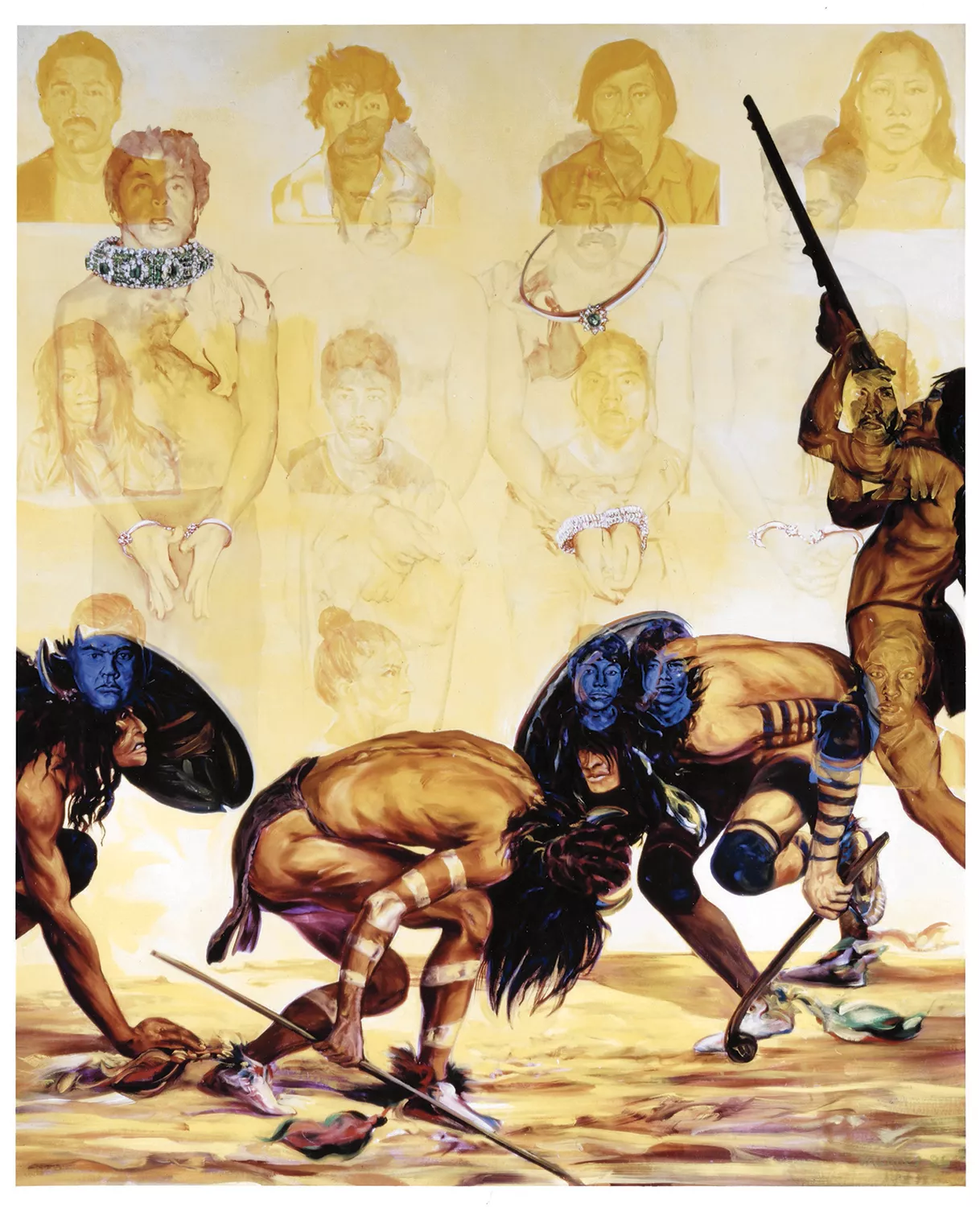
John Valadez (n. 1951)
Savages and Glitter
(1986)
Carlos talked about the National Museum of Mexican Art that is located in their neighborhood of Pilsen, a primarily Mexican/Mexican-American neighborhood of Chicago. They showcased this as both a declaration of how important it is to have a cultural organization in a city and also that even before the current administration’s cruel treatment and rhetoric of immigrants, immigrants were viewed as savages and criminals regardless of the positive impact we have had in the countries we immigrate to.
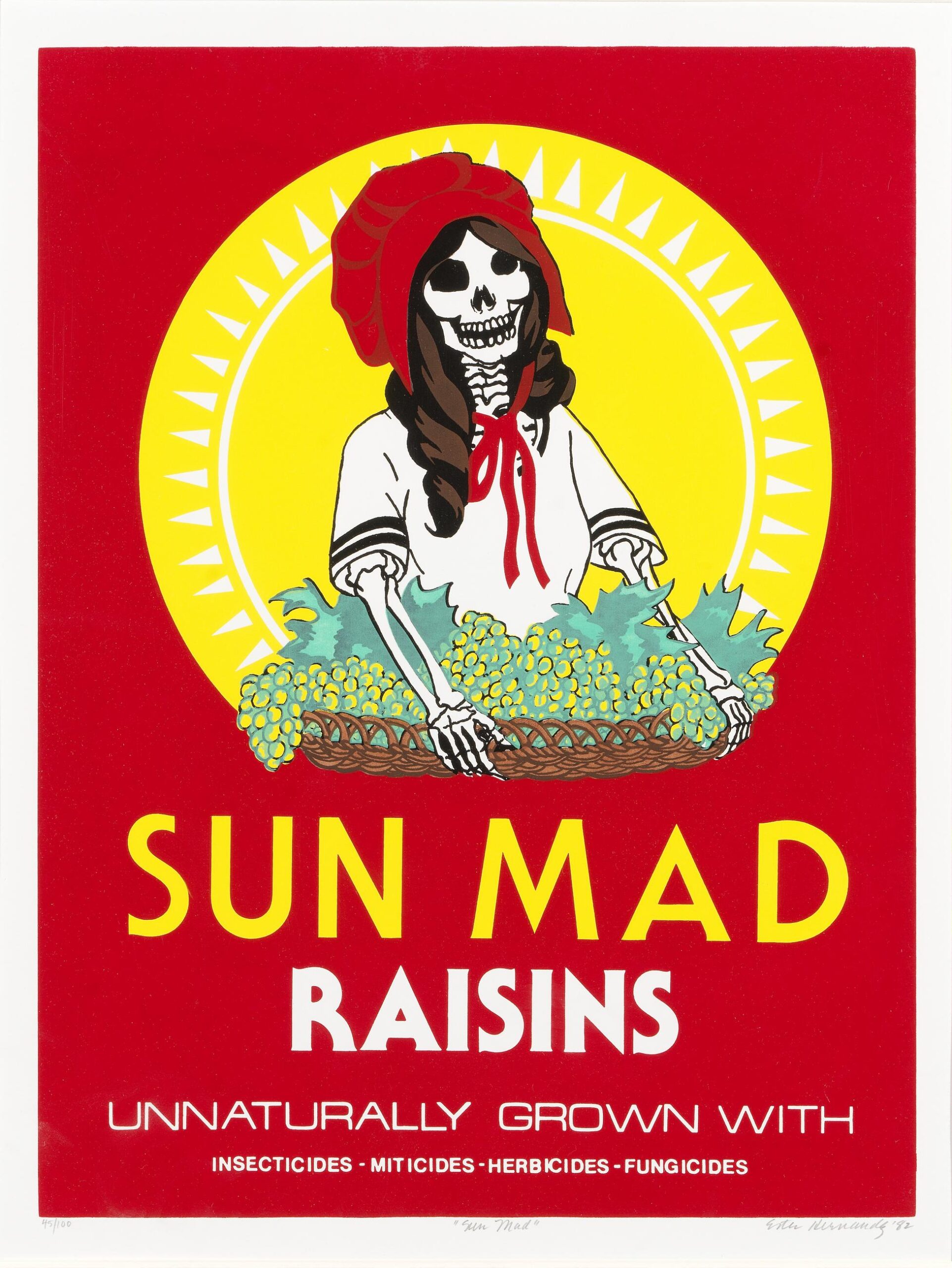
Ester Hernández (n. 1944),
Sun Mad
(1989)
This piece is a demonstration that the exploitative characteristics of capitalism are killing workers, who often are immigrants, folks of the global majority, and those who are desperate and willing to do what is necessary to have some financial income.
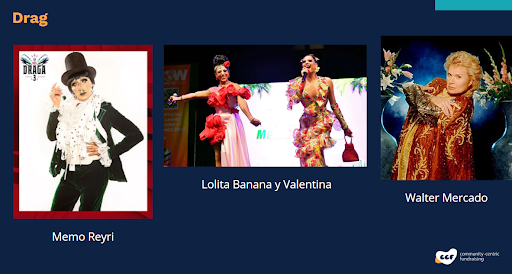
Carlos later shared that their favorite form of art is drag, which is the performance of gender. This is demonstrated beautifully through drag artists like Lolita Banana and Valentina, who judge RuPaul’s Drag Race Mexico, but also through bio kings and queens like Memo Reyri, a Mexican drag artist who competed in Mexico’s drag competition La Más Draga, who is a man and a drag king to exemplify that gender can be and is performative. Another favorite example would be Walter Mercado who often expanded the notion of gender through his outfits and expressions. All of these artists rebel against the notion that gender is binary and showcase the spectrum of gender through the Latine lens.
Additionally he shared a video of Bad Bunny’s Super Bowl halftime show, where Bad Bunny took the stage and reframed America not as one country, but as all countries within the American continents. That the identity of “American” should not be held hostage only by the U.S., but that it should be an identity label for all folks of North, Central, and South America. Bad Bunny’s halftime show demonstrates that art may not be necessarily universal but it can be enjoyed and appreciated universally.
He shared that art is and has always been socio-political and that we can all be part of art and culture. Liberation is achieved with love, joy and imagination. The arts and culture sector is not dedicated to solving issues in the present but responsible for allowing everyone to envision and fight for a better world and to pull up a mirror to the present when it is not doing enough for all.
What Comes Next?
CCF en Español embraced unity, creativity, and so much love for our bilingual communities. We’re looking forward to continuing to engage bilingual and Spanish-speaking communities through CCF principles. This tract was a testament to how deeply CCF principles resonate across language and culture and how much richer they become when allowed to blossom in the languages that raised some of us and still live at the heart of our community organizing work.
We are so grateful to Jenny, Naya, and Carlos for their generosity, their brilliance, their wisdom and their willingness to lead. And we’re grateful to every participant who brought their full selves into the room.
This was a first. It will not be the last.
Discover more from CCF
Subscribe to get the latest posts sent to your email.