What charity runs can accomplish: Why I’m running 26 miles alongside my dad to support a suicide helpline

What charity runs can accomplish: Why I’m running 26 miles alongside my dad to support a suicide helpline

By Isabella Lock, a freelance journalist with an interest in mental health and cultural identity

CW: This essay deals with death by suicide and the trauma from surviving a loved one’s fatal suicide, which may be triggering to some readers. Please proceed with caution. If you need immediate assistance, please follow this link to International Suicide Hotlines. If you are in the UK or the Republic of Ireland, you can contact the Samaritans mentioned in this essay 24/7 via phone call (116 123), email (jo@samaritans.org), letter (Freepost SAMARITANS LETTERS), or use their self-help app.

Dave wearing a telephone costume with Samaritans written across the top

While I cannot go back in time and change the past, I can help to prevent this terrible loss from happening to others. If running the marathon saves just one life, then it would have been more than worth it.

For as long as I can remember, my dad has been running marathons dressed as Dave the Running Telephone for the Samaritans. This UK-based charity works to ensure that fewer people die by suicide by reducing the risk factors that make some people more likely to take their lives, ensuring that people who are at increased risk of suicide are supported, making it less likely that people who do experience suicidal thoughts act on them, and reducing the likelihood that people will develop suicidal thoughts.

As the 2024 TCS London Marathon Charity of the Year, the Samaritans aims to raise £1.7 million to maintain their mental health services.

In the past year, I increasingly wondered where it all began – my dad’s marathon obsession. He explained that he always had a passion for running. He soon became addicted to the camaraderie among like-minded people, the cheering crowds, and the emotional roller-coaster of marathons. 

Having supported my dad at every London Marathon, I can absolutely confirm that there is a sort of magic in the air. I know that no matter the weather or one’s mood, the London Marathon is always a day full of joy and love for both participants and spectators. 

As for the choice of charity, my dad tells me that it goes back to when he reached out to the Samaritans in his own times of despair. 

They listened without judgement and helped my father feel a little less alone. It was then that he realised the power of listening and chose to become a helpline volunteer himself. He became increasingly passionate about their work and aspired to make as many people aware of the Samaritans as possible. 

And so he got creative. He merged his two passions, running and the Samaritans, to produce “Dave the Running Telephone.”  By running marathons in a life-sized green telephone, my dad became an iconic mascot associated with the Samaritans and, in turn, created a huge profile for the charity.

On the streets, the telephone captures the attention of all and allows my dad to speak one-on-one with gathered spectators. Every year someone pulls my dad to the side and tells him how they have battled with suicide or lost someone from it. My dad always offers support and a shoulder to cry on. In doing so, my father creates an image of the Samaritans as a group of real people wanting to help people feel a little less alone in their hardships.  

My dad has also spoken every year on the radio with Eddie Nester about his charity work for over four years. The uniqueness of my father’s telephone costume marathons hooks listeners in and spreads awareness of suicide prevention.
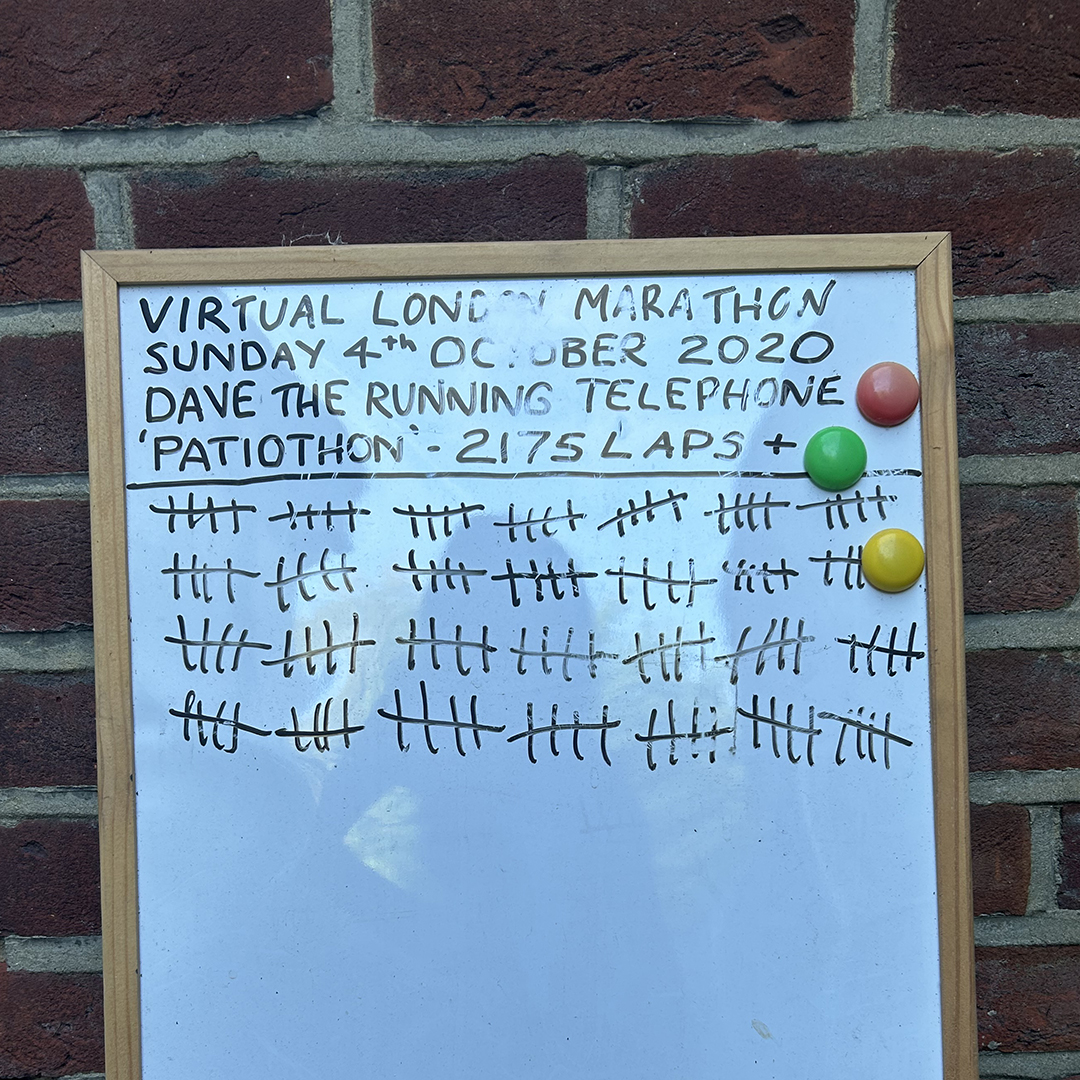
A white board with a lap tally leans against a brick wall.

My dad has maintained his annual tradition of running the London Marathon in costume for 24 years. Even during the pandemic. But instead of the bustling streets of the city, he took to our garden patio and ran back and forth a whopping 2,175 times.

I have profound respect for my father, and to run alongside him has always been a goal of mine.

However, unlike my father, I have never been truly passionate about running. Consequently, I have always found excuses here and there to hold off participating.

But then, earlier this year, my paternal uncle sadly took his own life. I realized then that I had to stop making excuses, get over my lack of love for running, and complete the marathon alongside my dad. 

While I cannot go back in time and change the past, I can help to prevent this terrible loss from happening to others. If running the marathon saves just one life, then it would have been more than worth it.

Today is World Suicide Prevention Day. Many push through emotional turmoil alone in silence, contributing to a further decline in their mental well-being. The 2023 report from National Confidential Inquiry into Suicide and Safety in Mental Health revealed that 73% of people who died by suicide between 2010 and 2020 in the UK were not in contact with mental health services in the year before they died. I believe these services are necessary, do make a difference, and ultimately save lives. 

The NHS (UK free healthcare system) funding for suicide prevention measures will end by March next year. Measures included suicide prevention training for GPs and non-mental health professionals and have been effective according to recipients. Moreover, a new study has revealed that one in four people with mental health problems have to wait a minimum of three months to start NHS treatment. Although private therapy is available in the UK to avoid long waiting times, the cost of one session can be up to £70. 

In other words, national mental health services are simply not accessible to all. However, helplines offer 24/7 free support to everyone. 

Still, maintaining the helpline is no easy task. Every 10 seconds, a volunteer responds to a call for help. If we want to prevent suicide, through monetary aid or awareness, we need to continue supporting charities like the Samaritans, Shout (for folks who prefer to receive support through text), Papyrus HOPELINEUK (for folks under the age of 35), the Community Advice and Listening Line (for folks in Wales), and Switchboard (for folks who identify as LGBTQ+, available from 10 am-10 pm daily).

We also need to break the stigma around mental health and suicide. In 2021 alone, over 5,000 suicides were registered in the UK. Yet, we are not talking enough about it. 

By training for and running the marathon, my father and I aim to initiate conversations about suicide and mental health. We intend to achieve this by talking to people both personally and in the media. 

My dad and I have also had the chance to speak on BBC Radio London about the marathon and the helpline. Moreover, our father-daughter marathon journey has caught the attention of newspapers across the UK, including The Independent.

The more suicide and mental health are spoken about both in casual conversation and in the media, the less stigmatised they will be.

We also want everyone to know that no one is truly alone and that there is always someone to listen. 

This World Suicide Prevention Day, I would like to invite you to join me and ask that you think and talk openly about suicide this September and continue the conversation throughout the year. By talking more about it, we can collectively erase the fears and discomfort that we all too often feel when talking about our struggles. 

I dream that we all may become samaritans to each other, listening without judgement and offering support in this all too often intense world.

My uncle used to support my dad at the end of the London Marathon at Embankment Station. On 21st April 2024, after 26 miles of tears, joy, and laughter, I imagine I will feel a sense of honour and pride in completing my first marathon alongside my dad in my home city. And I like to think that when we both look up at the finish line, we will see my uncle cheering us on.
Isabella Lock

Isabella Lock

Isabella (she/her) is a freelance journalist with an interest in mental health and culture. Her written work has been published in The Independent and Metro. Isabella has also co-produced a short film and independently released a podcast. All her work can be found here: @Isabellalock | Linktree and Isabella can be contacted via Instagram: @isabellalock_journoIf you are interested in supporting the Samaritans, please see here: https://www.samaritans.org/support-us/.
How our liberation and joy are being hijacked by the LGBTQ+ nonprofit sector

How our liberation and joy are being hijacked by the LGBTQ+ nonprofit sector

By Mikail Khan, communications specialist and trans activist

People of the global majority have to deal with racism, classism, transphobia, and white supremacy (to name a few social ills) on a daily basis. Too often, these oppressive norms are perpetuated by people from dominant cultures in progressive spaces. 

More prominently, since the 2020 #BlackLivesMatter summer uprisings, many social justice nonprofits and philanthropic institutions have been rapidly co-opting radical language and making public announcements of their ‘organizational transformations’ when the very real manifestations of white supremacy remain within those structures. 

Similar performative displays have been demonstrated by well-funded mainstream LGBTQ+ nonprofits in metropolitan cities across the U.S. that have historically been founded by white, cis, upwardly mobile gay men and women.

A brief history of the LGBTQ+ nonprofit landscape

…once I completed the onboarding process and became more familiar with various dynamics, the messaging used in the marketing plan’s audience-facing collateral was in stark contrast to the internal value systems and carceral HR processes of these organizations. 

These past two decades have seen numerous BIPOC trans professionals slowly and, at times, unwillingly inserting themselves into the progressive nonprofit industrial complex (NPIC). Due to our current social order’s fixation on trans bodies, where our basic human rights are being stripped away, a lot of us have now ended up in this seemingly ‘social good’ sector where we want to fight for a good cause. 

Yet this naive promise and pursuit of equality for all has created a false separation of injustice from our everyday lives. The NPIC and philanthropy are easily self-perpetuating systems (aka: working toward its self-preservation), and not a fundamental restructuring of power and society. It is futile to think that nonprofits can stand in the way of failing states, failing democracies, and failing economies. Still, as workers, we often project these aspirations onto ‘cause-driven’ workplaces. 

This rigged model doesn’t allow trans nonprofit workers from oppressed backgrounds to challenge the status quo as we try to work from the inside to change the fabric of these institutions. The same logic applies to an employee within LGBTQ+ institutional settings, where we are working harder than ever, but unable to secure meaningful power or impact.

I have worked in the LGBTQ+ mission-specific nonprofit sector in New York for the past six years.  As someone with an abolitionist mindset, I knew there would be various contradictions working as a trans, chronically ill, immigrant of color in the NPIC. How could there not be? The work being done in this complex is uncomfortable and messy, given the neoliberal capitalist alliances between governments, funders, and charitable entities. 

I got involved in nonprofit communications and development activities because I genuinely wanted to work for the liberation of Black and brown trans, gender nonconforming, and intersex folks, whether it be diverting resources back into the community, or building narrative power. For some time, it was difficult to get hired by non-LGBTQ+ organizations due to my ongoing medical transition as a transmasculine individual. 

Given my upbringing in Bangladesh and lack of access to LGBTQ+ professional settings, I also felt I should be grateful for getting a chance to work at these organizations. I dedicated myself to the work with the hopes that we trans BIPOC folks might be encouraged to demonstrate leadership and courage and reimagine the world we live in to pursue queer and trans liberationthe premise by which I was brought in to craft progressive marketing and communications messaging at these institutions. 

However, once I completed the onboarding process and became more familiar with various dynamics, the messaging used in the marketing plan’s audience-facing collateral was in stark contrast to the internal value systems and carceral HR processes of these organizations. 

A majority of these rooms were dominated by cis straight, gay, and/or lesbian liberals in various shades (Caucasian white, white Latine, Savarna, brown, Black) whose sole purpose was to keep churning the wheels of liberal “advocacy” and “allyship,” and who didn’t seem invested in confronting the cycles of violence facing some of the most marginalized community members.

Unsurprisingly, the organizational hierarchy determined who was deemed the most valuable worker and who could be discarded. The lowest rung of the hierarchy tended to be working-class Black and brown trans folks with minimal safety nets but who were performing essential public-facing work (front desk personnel, support group facilitators) at minimum wage, while the cis white CEO was earning close to mid-level six figures. 

The whiplash intensified when the Diversity, Equity, and Inclusion (DEI) consultants were brought in regularly to engage the organizations in racial and gender equity transformative dialogues. These sessions concluded with some colleagues, most of whom were white/white-aligned and cis, feeling a sense of accomplishment, while Black and brown trans folk left feeling even more disenchanted.

When equity work becomes self and community betrayal

Phrases such as ‘liberation’ and ‘trans joy’ are now neatly packaged within newsletters, social media channels, cause marketing products, and end-of-year fundraising appeals to convey messages of healing and accountability when these values and actions have not been meaningfully embedded within the organization.

Let’s acknowledge that things are really fucked up in the world today. In the realm of LGBTQ+ rights in the U.S., over four hundred anti-LGBTQ bills were introduced between January and April of this year alone, including laws to ban drag performances, erase public school curricula of LGBTQ+ content, censor books from public libraries, ban gender-affirming care for minors as well as adults, and forcibly de-transition adults. Fascism has been creating a chokehold on trans people’s existence for some time now, and it is up to everyone, especially cis people, to illuminate and counter the attacks on our bodily autonomy and right to claim space.

Equity work should consider how contemporary social crises coupled with race, gender, disability, and other vulnerabilities might impact the life cycle of an employee within the organization. The focus should be to help the employee flourish in their roles so they, in turn, can help serve the organizational base and community members’ visions of healing and justice. Instead, I have observed that cis LGBQ+ nonprofit leaders and DEI consultants work together to use movement-building language from frontline organizers as a public relations and fundraising strategy. A narrative of healing, accountability, and progress is carefully constructed (read: branded) without staking any claim in material redistribution or furthering our political demands. 

Phrases such as ‘liberation’ and ‘trans joy’ are now neatly packaged within newsletters, social media channels, cause marketing products, and end-of-year fundraising appeals to convey messages of healing and accountability when these values and actions have not been meaningfully embedded within the organization. 

Don’t get me wronginternal contradictions are a product of external forces. Institutional changes do take time and consistent efforts from invested workers. Additionally, nonprofit workers will not be 100% aligned with one another on the various tactics needed to achieve our collective freedom. So many of our culture and political wars have also pitted us against one another, creating an environment of distrust and conflict. 

Considering all these nuances, I am providing an example of top-heavy institutions that don’t have a strategic plan or theory of change in place and are taking up space in the LGBTQI progressive landscape. Such spaces have not internally engaged in a robust power analysis to create people-centered and trauma-informed infrastructures, yet are financing their public rebrands to hoard more resources that our trans and intersex BIPOC communities desperately need to build joyful worlds.

The cost of neoliberal identity politics on trans of color lives

Merely identifying oppressive behaviors and systems does not mean people are willing to step out of their comfort zone to do the hard and necessary work of dismantling them. For all the trans representation and candidacy appointments in the media and electoral offices that LGBTQ+ nonprofit executives have pushed forth, it has not mobilized larger society to stop the tidal wave of violence that trans people from oppressed backgrounds are facing in the U.S. and across the world. 

The need to build power for those facing the most harm in our communities is becoming eclipsed by the politics of representation and identity.

Due to the narrow requests that are part and parcel of trans visibility campaigns, things have started shifting for mostly elite trans people. Recognizing some of these disparities, DEI measures are working with mainstream LGBQ+ cis-led organizations to actively recruit multiply marginalized candidates with various lived experiences, namely those from working-class, disabled, trans, and intersex backgrounds. But how have these organizations developed internal practices to ensure the safety and leadership development of these candidates without their identities being infantilized? 

Safety for trans people within LGBTQ+ mission-specific organizations will demand that cis leaders reject a respectability politics that is pushing entry and mid-level BIPOC trans workers from oppressed backgrounds to embody the white cis supremacist foundations that these 30+ year-old organizations claim to be actively moving away from. The imposition of cis dominated culture thoughts and values on trans folks trying to build new worlds needs to stop.

Moving away from neutrality and toward principled struggle

We all deserve to play a part in shaping a world that works for us. For the foreseeable future, this will come through the self-organization and solidarity economies being built by workers and some of the most oppressed community members.

Most cis LGBQ+ leaders need to acknowledge that demanding a seat at the table is not ‘joy’ or ‘liberation’ that they are so intent on copy-pasting into their values statements. It’s a desire to be acknowledged by those in power. 

It’s the liberal notion of individual success which makes structural change unrealistic or unnecessary. If nonprofits continue operating neutrally, they will keep diverting our attention toward things overwhelming our nervous systems. These methods are causing LGBTQ+ nonprofit leaders to invest in solutions that aren’t addressing our community’s basic needs that would allow them to survive and eventually thrive. I’ve observed this decision-making ladder to be a source of regular conflict between the lower echelon of workers and the leadership structure–where direct service or program nonprofit workers are overworked and underpaid to meet the communities’ immediate needs, but the leadership teams cannot fulfill said requests due to their ‘profits over people’ mindset. 

As workers, we also don’t know how to deal with conflict effectively. With no training on how generative conflict can be practiced, reactionary LGBQ+ cis leadership use tactics such as performance improvement plans, to push out ‘difficult’ trans and queer employees who want to engage in values-aligned work. 

A perfect example is the recent union busting of Trevor Project’s unionization efforts by a volatile leadership team who went against their mission and values and laid off 12% of the bargaining unit employees

Under these constraints, how can decisions be made that reflect the organizational values LGBTQ+ mission-specific institutions seek to uphold? Here are a few considerations I would like to bring to the table:

  1. Solutions over critique: One way to make better decisions is not to let critique be the end goal of workplace equity conversations. Hollow proposals of organizational change without encouraging regular feedback and implementation sessions from both employees and community members are creating illusory hopes for some of the most promising workers from oppressed backgrounds, who eventually quit. More points of alignment for trans and intersex BIPOC workers need to be built on an internal scale, particularly because our communities have been constantly sidelined and dehumanized by cis LGBQ+ people since the beginning of the contemporary ‘gay rights’ movement.
  2. De-professionalizing and unionizing the workplace: Professionalization, as an industry, has harmed trans and intersex BIPOC workers more so than any other identity group, where we’ve had to follow rigid gender roles to keep our jobs. If these LGBTQ+ organizations want to bring about ‘liberation’ as per their values statements, they will need to stop treating their most oppressed workers as instruments of productivity. They must stop perpetuating the current system that values efficiency (e.g., harsh performance reviews and surveillance) over workers’ rights. Workers should have the freedom and resources to unionize and convey the strong message that our lives are not disposable, no matter how we choose to show up in the workplace.
  3. Recognizing NPIC’s limits and building alternate structures: Nonprofits are an extension of the current governmental and corporate establishments that aren’t improving LGBTQ+ people’s material conditions. Understanding this limitation is critical in developing an alternate long-term strategy for building the power of our various movements. Talking to conflicted audiences, supporters, and donors will be very difficult, but sharing these tactics within organizations’ annual strategic plans will inspire hope and build trust between workers on all levels. 

Overall, my observations while working at LGBTQ+ mission-specific organizations have highlighted the need for a fundamental transformation of the LGBTQ+ mission-specific nonprofit organizational superstructure. Such spaces need to bring in principled leadershipthose that will honor worker-owned control of resources, provide financial transparency, and prioritize workers’ health over profits. The same leaders must confront the truth that most systemic changes will not arrive through the nonprofit sector, which upholds the capitalist system. 

We all deserve to play a part in shaping a world that works for us. For the foreseeable future, this will come through the self-organization and solidarity economies being built by workers and some of the most oppressed community members. Whether the end result will be the dismantling of the non-profit or philanthropic industry and the co-creation of new ways of working together will depend on whether we are ready to engage in the vulnerable conversations and strategic coalitions needed to safeguard our planet against rising global authoritarianism. What will we choose?

Mikail Khan

Mikail Khan

Mikail Khan (they/he) is a Bangladeshi transvisionary & immunocompromised queer Muslim communications specialist, organizer, and film curator/worker living between New York and South Asia. You can follow them at @banglatheyshi on Instagram.

Knowing

Knowing

By Abigail Oduol, a Black planned gift fundraiser in Southern California

This piece is for Black and Indigenous people of color to find themselves in and ask how they define themselves… and for everyone, especially white allies, to more deeply interrogate how they uphold cultural Whiteness in workplaces where we exist.

Artist Statement

The following is a poem that I wrote after returning home from a three-year immersive schooling and working experience in Kenya. I began my experience studying transformational urban leadership in a Kibera slum and grappling with my identity. Then I worked as a refugee resettlement caseworker, interviewing refugees as a part of their acceptance into the US Refugee Admissions Program. 

Several years later, I came back to this piece while in my current role at an environmental nonprofit and reflected on how my identity – as an American, Black, cisgender, heterosexual woman trying to raise bicultural Kenyan children while working in planned gift fundraising –  has since evolved and what it means considering recent experiences.

I reflected on the complexities of how I define myself internally, how others define me, and how other external experiences have affected my self-definition. And how those influences gradually shifted my identity from an individualistic definition into a collectivist perception. 

This piece is for Black and Indigenous people of color to find themselves in and ask how they define themselves – the positive, negative, and neutral – and for everyone, especially white allies, to more deeply interrogate how they uphold cultural Whiteness in workplaces where we exist.   — Abigail

Knowing

I know in America.
Knowing only one person out of the entire Black neighborhood went to college, but that the others were restrained by invisible hands and so I am the only in my school, department, program.
Unworthiness for a request for consent to touch hair with dirty hands, to touch my body while dancing.  

Knowing even in a fictional universe, I exist only to provide contour and character development.

Knowing that looking “exotic” will never be the same as “beautiful.”
Realizing cameras were not designed to capture your special moments, nude products not for your nudity, your hair, skin, history, and cooking techniques not for standard curriculum.

I know.
Knowing that I choose my hairstyle, but do not choose that it is a political rather than personal expression.

Knowing my color stands between me and a relationship, me and an upgraded hotel room, me and the border to the next town.

Knowing the gap between I did it independently and I am an undeserving recipient of charity in the eyes of ever watching others.

Knowing in the dark corners that systems fight me at every turn, and I must violently war against them in unavailing self-sacrifice or die patiently in chains waiting to be released.

Knowing to tattle on the system or support those who do, you are discredited as an angry, paranoid conspiracy theorist.


I know. Our mother is abusive, and I love and hate her equally. I know.
Today I am exhausted, and in no ways tired.

Knowing that regularly is a direct or indirect betrayal of humanity, smiling while minimizing contributions to the space and selectively wielding bureaucracy as a blunt object, claiming plausible deniability.

Knowing that in sharing the struggle to exist, nods in agreement too often point at a soulless other and never their own reflection.

Knowing that exercises in accountability cause a white lash of arguments on good intentions, of hyper vigilance, of police union comradery. Of you, the ungrateful, not enjoying your charitable pennies.
 

I know. Blackness was created here as a foil for whiteness. I know it is fluid and complex. I know.

It is the ignored pebble that creates the avalanche.

Knowing bellowing songs sung within chains of the past and present, and the blinding streaks of hope across my landscape.

It is the blank space that creates afresh.

Knowing it is pigeons forced to adapt to an invading city now destroy structures with their acidic droppings.

It is my past and my hope, the small window at the top of a prison cell that maintains dreams amid pain, oppression and struggle.

Knowing it is hot glowing coals beneath a fire walker’s bare feet, the embodiment of the moving current.

It is inhabiting a world both not yet and fully realized as we shape it.

Abigail Oduol

Abigail Oduol

Abigail Oduol’s (she/hers) surname is not Irish or Pennsylvania Dutch. It’s Kenyan. She keeps her escape pod in Kenya ready, and checks on it regularly with her young kids and husband. Abigail serves on the CCF Global Council, NACGP D&I committee and with her local PTA.  Follow her musings on threads @abby_oduol and longer thoughts on LinkedIn. You can send tips and micro reparations to her Cashapp $AbbyOduol.

Beyond Philanthropy: Disrupting Through Organizing #BringAFoldingChair

Beyond Philanthropy: Disrupting Through Organizing #BringAFoldingChair

I think there’s plenty to learn from this experience in Montgomery…That could have ended so badly, as we’ve seen in the news, right? And it didn’t, and like the racists got their comeuppance…I think this is the energy we need…we need to stop talking about like being nice and civil, or whatever, and start organizing, and pushing back and grabbing a chair…

— Vu Le

About the podcast episode

In this episode, Monique and Valerie sit down with Vu Le, Creator of NonprofitAF and one of the Founders of Community Centric Fundraising, to discuss how nonprofits leaders need to grab a folding chair and organize to save our communities and how funders need to shift practices to do the same.

About Beyond Philanthropy

Beyond Philanthropy is a podcast about how we can move beyond traditional philanthropy from co-hosts Monique Curry-Mims & Valerie Johnson. This season, each monthly episode examines systemic change and how to be disruptive in your philanthropy practice, with a mix of episodes featuring our co-hosts and episodes featuring guests from across the country.

Episode Transcript

Read the full episode transcript here.

Monique Curry-Mims (she/her) and Valerie Johnson (she/her) are cohosts of Beyond Philanthropy Podcast

Monique Curry-Mims

Monique Curry-Mims

Monique Curry-Mims has over 15 years of business and leadership experience in both the nonprofit and for-profit sectors. As Principal of Civic Capital Consulting, an international social impact consulting firm, Monique delivers innovative strategies that help organizations meet their mission and goals, education services that empower solutions and equity, and funding to help communities working on the ground be part of the change they need. To further change impact, Monique serves as a steering committee member of Philadelphia Black Giving Circle, Trustee and the Allocations Chair of Union Benevolent Association, and a Committee Member of AFP Global’s Government Relations Committee. Additionally, Monique serves as Founder and Convener of PHLanthropy Week and co-host of Beyond Philanthropy alongside Valerie Johnson.

Valerie Johnson

Valerie Johnson

Valerie Johnson joined Pathways to Housing PA as Director of Institutional Advancement in 2018, and was promoted to VP of Advancement and Special Projects in 2021. She co-hosts a podcast, Beyond Philanthropy, alongside Monique Curry-Mims. She was also the Director of Advancement for Council for Relationships and worked as a fundraiser for Valley Youth House and the American Association for Cancer Research. Valerie, a Certified Fundraising Executive, holds a Bachelor’s degree in Marketing and an MBA from Drexel University. A member of the Association of Fundraising Professionals since 2012, she serves on the Greater Philadelphia Chapter’s Board of Directors as Vice President of Education and Professional Development. Valerie has been a featured speaker for the Pennsylvania Association of Nonprofit Organizations, NTEN, AFP GPC, and AFP Brandywine, and contributes to Generocity. You can find her on Twitter and Instagram, where you’ll see plenty of running and baking content alongside her cats, Agador and Spartacus. 

To tip Valerie and Monique for their work on their podcast, Venmo them at: @valer1ej

Using my experience with inequities in traditional grant writing to create a better opportunity for others

Using my experience with inequities in traditional grant writing to create a better opportunity for others

By Helin Taskesen, MENA-X Founder and Student

One of my main goals for MENA-X was to keep the mentorship program free so there would be no financial barriers for families. As a student from a public high school and without much knowledge of financial literacy and entrepreneurship I first needed to learn how to sustain and expand MENA-X.

Even in the diverse school district I attend as a Middle Eastern immigrant, few people look like me, share similar cultures, or have similar experiences. This made me afraid to discuss the Middle East and North Africa (MENA) region, culture, and my experiences. 

When I first started attending elementary school in the United States of America, I just wanted to fit in. When I saw people talking about things different from what people were used to, they would get laughed at and bullied. So I chose to stay quiet because I assumed no one would try to defend me.

As I got older, I realized trying to fit into other people’s cultural norms meant losing touch with my culture and things that I cared about. As a result, during my freshman year of high school (2020-21), I started a club called MENA-X to bring people interested in or from the MENA region together at my school. Over time I realized MENA-X could be more than a club and decided to expand it into an organization

The central part of the organization, the MENA-X Mentorship Program, is an after-school program allowing underserved elementary school students to learn about Science, Technology, Engineering, Art, and Math (STEAM) fields and MENA culture. The cultural aspect emphasizes breaking the bias and stereotypes formed around MENA cultures and people and instead shows the positive impacts that MENA cultures, people, and communities have had on the world. 

One of my main goals for MENA-X was to keep the mentorship program free so there would be no financial barriers for families. As a student from a public high school and without much knowledge of financial literacy and entrepreneurship, I first needed to learn how to sustain and expand MENA-X. 

Adventures in learning the barriers involved in the traditional grant process

With the help of supportive staff at Grover Cleveland STEM High School, I took a chance in applying for my first-ever grant, the Youth-Led Social Justice Mini-Grant from the Seattle Department of Education and Early Learning. Spending over 25+ hours, I wrote a script, edited and recorded multiple videos, created a budget sheet, and asked for constructive criticism from those willing to review my application. 

As a newly formed organization founded by a high school student, especially one serving people from a region with such a negative political spotlight, the chance of me receiving a grant was not too high. I spent hours reviewing my video, written proposal, and budget, adding links to specific items, and writing exact costs and why we needed each item. 

I submitted my application for exactly $1,950.12 in October. 

After a delay in award notifications, in February I received a notification that MENA-X would receive the amount applied for! 

Though $1950 may not seem like a lot for an organization, it is enough to ensure the MENA-X Mentorship Program stays free for all students and makes MENA-X a more self-sustainable and professional organization. 

Sadly, the grant-receiving process took much longer than expected. With continuous contact and update request emails over the course of 5 months, I realized that we might not have been the priority for this grant. 

After hearing about my project, a local education-focused nonprofit, Southeast Seattle Education Coalition (SESEC), stepped up and offered to be the fiscal sponsor for my grant. The offer came in October, we received the steps to confirm the fiscal sponsorship in June, and by mid-July, we finally received the grant money. But with this grant, we were required to spend all the funds before 2023, leaving us with less time to design, purchase, and receive items. 

Although I was so grateful to have received that grant, the lack of communication and support during the paperwork stage to get the money to SESEC minimized its impact. The grant timeline stated that the program would receive funds by March if selected, so I planned accordingly. 

The MENA-X Mentorship Program starts annually around October, so the goal was to use the grant at the end of the 2021-22 school year and prepare items for the upcoming years. Because there was a delay in receiving the grant, I had to cover additional costs from money I had saved up from my part-time job. 

While working with SESEC, my contact recommended I apply for the SESEC Youth Grantmakers Program. As a woman of color who decided to venture into the world of grant writing, organizational leadership, and community impact, I had to learn about the grant writing world alone. However, this was an opportunity to take the initiative and create an equitable grant writing process for other organizations.

Reimagining what a more equitable process could be with the SESEC Youth Participatory Grant Making project

While experiencing the grant world as both a grant writer and a grantor, I got to see the possibilities along with the difficulties of providing an equitable and fair opportunity. And an opportunity to create a process for providing organizations with the support they need to continue the positive change they are making in their communities.

The SESEC Youth Participatory Grant Making (YPGM) project brought together youth of color from across the city of Seattle to design, market, and award $10,000 worth of grants to local nonprofit organizations that we chose. It gave us the opportunity to learn from established people of color working in philanthropy about the racial inequities in traditional grant-making. The project also connected us with grant writers and grantors from College Spark, Phila Engaged Giving, and the Initai Foundation, and tasked us with figuring out how we could do things differently to make sure the money we were granting had an impact in our community of South Seattle. 

Some of our main goals were to 1. pick organizations that have people of color from the community in executive positions, and 2. pick organizations that fight homelessness or educational inequalities. We designed an application process with questions to see the change these nonprofits wanted to make and that they were willing to create that change and continue pursuing their goals. 

Before reviewing applications, we created a scoring rubric to eliminate as much bias as we could, and while reviewing, everyone had a chance to voice their opinions and we made decisions together. 

We asked organizations to provide information about their organization, representation on the executive board, past projects, how they wanted to spend their funds, and more. Questions on the rubric were composed of general responses to the questions in the application, but also by tying together multiple aspects of the organization, for example:

How big is the organization? What is the annual budget (if given the information)? Is the organization run by the community it serves?

3 points — The organization’s leaders are from the community it serves. It has a small staff and budget.

2 points — The organization has representation from the community that it serves. It has a medium staff and budget.

1 point — The organization has no representation from the community it serves. It has a large budget and staff.

Using a more holistic approach, as a group, we decided on the organizations that should receive the funds from this grant. 

While experiencing the grant world as both a grant writer and a grantor, I got to see the possibilities along with the difficulties of providing an equitable and fair opportunity. And an opportunity to create a process for providing organizations with the support they need to continue the positive change they are making in their communities.

From our choices, I know those funds were going to organizations in my community and organizations my friends and classmates participated in. Knowing the intended usage of the funds and the genuine strengths of the organizations we funded, I know that the money will come right back to help support the South Seattle community.

Helin Taskesen

Helin Taskesen

Helin Taskesen (she/her) is the Founder of MENA-X, an organization aimed at providing STEAM mentorship with a focus on Middle Eastern North African (MENA) cultures. She is currently a high school senior, and plans on pursuing a degree in applied mathematics and computer science or engineering. She is also a 2023 Bank of America Student Leader and works as a Site Assistant at Team Read. With a passion for community service and leadership, Helin is dedicated to fostering educational opportunities for underserved students and promoting diversity in STEAM. Follow her on Medium to read about cultural and regional change-making and connect with her on LinkedIn!