Ways whiteness shows up in CCF to the detriment of everyone (including white folks), part 2: “Stop using that word.”

Ways whiteness shows up in CCF to the detriment of everyone (including white folks), part 2: “Stop using that word.”

By Chris Talbot, nonprofit laborer and born activist

UPDATE: An earlier version of this essay read, “There was also an email from a white woman, Kimber (not her real name), stating that she would not be financially supporting CCF because a BIPOC member of our collective movement made a statement supporting Palestinians’ right to live, which she found offensive.” This line was interpreted as Kimber didn’t believe Palestinians had a right to live rather than Kimber was offended at the statement made, which was, in whole, about Palestinians’ right to live and actions we can take to stop the genocide. Chris regrets the phrasing they used, which led to this interpretation. The whiteness Kimber exhibited in the original email and in the two she sent today will be covered further in part 3, which is about how whiteness has shown up as retribution for speaking out in support of Palestine.

White cisgender women especially, but white folks of all persuasions, have flooded the CCF channels where BIPOC folks are having fruitful and honest conversations, derailing them and re-enacting the worst bits of whiteness, at times making the spaces feel like a glorified replica of every white-led organization I’ve had the displeasure of navigating.

A couple of weeks ago, I wrote the first part of this three-part series dissecting recent examples of whiteness infiltrating the CCF movement and making some moments as toxic as your standard white-led nonprofit consistently is, destroying the spirit of what CCF could and should be. (Read Part 1: “Do something about her.”)

Since then, I’ve received a response from Emmy (not her real name) that made it abundantly clear that she hadn’t read what I wrote, much less truly sat with the questions I posed. She just wanted to define the CCF movement in a way that is antithetical to our values and the recent statement made by the (BIPOC-led) Global Council’s Communications Committee and instead mirrors the oppressive white “professionalism” we’ve been forced into. 

I also received a series of comments (which have since been dirty deleted) on our Instagram post about the first essay, declaring I lacked intellect and demanding that I refrain from describing differences in power and interactions based on race. There was also an email from a white woman, Kimber (not her real name), stating that she would not be financially supporting CCF because a BIPOC member of our collective movement made a statement supporting Palestinians, which she found offensive.

These are just three more concrete examples of whiteness trying to penalize BIPOC-led efforts and voices attempting to bring community care back into the nonprofit industrial complex to protect white comfort. 

*Sigh.* It’s tiring AF.  

White cisgender women especially, but white folks of all persuasions, have flooded the CCF channels where BIPOC folks are having fruitful and honest conversations, derailing them and re-enacting the worst bits of whiteness, at times making the spaces feel like a glorified replica of every white-led organization I’ve had the displeasure of navigating.

It’s a disheartening thing to see happening to CCF — a movement that first opened my eyes to the fact that what I had experienced in the nonprofit industrial complex was abuse, and a movement that gives me life with how much potential it has to transform the sector and more importantly, the world.

“Stop using that word.”

CCF is a movement made by BIPOC folks, for BIPOC folks, in which white folks are allowed in as fellow accomplices. But as the editor of The Hub and the person who manages our social media, the DMs, emails, and comments we receive from white folks on a pretty regular basis would make you think that the movement centered around their comfort.

I often get demands to edit our BIPOC creators’ words and truths for the sake of white comfort. (I can just imagine the nonsense coming my way after this goes live on the site.)

Kimber’s email was an attempt to prompt me to apologize for another BIPOC individual’s (completely balanced and appropriate) words to sing for the CCF movement’s supper and place distance between our movement and this BIPOC thought leader. Why else send me an email like that? She could have simply ignored the ask and not donated.

Whiteness demands that white folks feel 100% comfortable all the time, which is antithetical to this movement or any push for social, environmental, or economic justice. But that doesn’t stop white folks from expecting and commanding it. 

One such email came in from someone I’m going to call Bethy. She took umbrage with a word choice from one piece and immediately came to our DMs to demand I change it. In the exchange, she whitesplained what the word meant — putting her own spin on it. And she continually demanded I change it, no matter how I responded. I told her the actual meaning and why it was apt in the essay and asked her to sit with why it bothered her.

“I’d also encourage you to sit with why you felt it appropriate to message an editor of color to lecture them about the meaning of a word and demand they edit a writer of color while leveraging your education level. I’d invite you to examine if that behavior was the way you would like this movement to look and feel and if you believe it embodies the principles and values this movement is built on.”

Bethy responded with condescension, telling me she’d like to meet with me to further whitesplain (my word, not hers) nonprofit event planning — something I have done in every nonprofit job I’ve had for the last 22 years. “In the meantime, I wish you all the best in your activism.” 

Whiteness showed up here in a myriad of ways. Demands for deference for her preferences, demands for my time so she could “educate” me, and an inability to recognize two people of color’s expertise, all to uphold the status quo, not support the movement.

Another white woman I’ll call Addy emailed me complaining about a creator’s title and branding, claiming it was “meme-ifying nonprofit work” which “cheapens our labor.” She accused me of moving The Hub away from “principle-based content” for clicks. As part of her takedown of me as the editor and the author’s decisions (who is a woman of color and well-known in the movement), she also decided to disparage another BIPOC thought leader in our network who happens to be a friend, mentor, and someone I admire greatly.

I immediately reminded Addy that the movement was begun by and led by BIPOC since its inception. And the two people she had disparaged were dear members of our community and invaluable leaders of color in the movement. I reminded her that while some of the content may not appeal to her specifically, I’m not in the business of changing how our BIPOC members show up — not for white comfort or any other reason — nor to be a gatekeeper of content. My job as the editor, editing with equity in mind, is to offer guidance and coaching to help creators put out the incredible work they create and maximize its visibility.

When Addy continued to demand I change our BIPOC creatives’ words to her preferences, I asked her to sit with why the title bothered her so much when she knew the content was impeccable. I asked her to sit with why she felt the need to demand that I edit the words of BIPOC thought leaders, and why she believed it was her place to police me as an editor. There was no response.

How does this type of whiteness harm white people?

I think if you asked any BIPOC nonprofit laborer the most common request or demand their white colleagues have made to them since 2020, it would be, “I don’t know enough. I need you to educate me.”

There seems to be (at least performatively) a desire to know and do better. But how are we ever going to get there if whiteness derails any and all conversations because a word or phrase made a white person uncomfortable? 

Let’s look at a more blatant example from one of my workplaces: I’m the Justice, Equity, Diversity, and Inclusion (JEDI) Chairperson at one of the places I work, and I curated a tailored training on nonviolent, intentional communication because we had a couple of incidents and I thought it the next best step after being asked to “educate” on the subject.

A white member of my committee derailed the entire meeting, where discussing any last-minute changes to the training was just one agenda item, to discuss the phrase “perfectionism is a white supremacy culture characteristic,” which was hyperlinked to Tema Okun’s generally accepted list

There was hemming and hawing about the phrase, concern for BIPOC individuals seeing the phrase and feeling left out (yes, really, even after the two BIPOC people on the Zoom call said this was definitely a non-issue), etc. The entire hour was spent on her discomfort with that phrase (I need facilitator training so I can interrupt that white nonsense, stat!). Despite the efforts of the rest of the committee — one BIPOC individual tried to ask her to do some internal investigation as to why the phrase bothered her, and a white member asked her to look beyond the words and to the intention behind it — nothing worked because this white woman wasn’t interested in moving beyond it. She wanted it changed. And she wanted it changed now! 

White folks recognize that they can’t be in meaningful community without learning and doing better to build inclusive and equitable spaces. Still, they get in their own and each other’s way with the learning, with the building, and by competing with or separating from each other. They derail a conversation that is happening or could be had over one or two words and won’t move beyond it to the intention behind it because the objective is deference, not community.

And that’s at the most benign level. Other times, they use their discomfort to police or call for “the police” in whatever form it takes to penalize people for words and phrases that are uncomfortable for them to hear. 

No matter how it’s done, it ends the same: we never get beyond talking Remedial Race Relations 101; too much BIPOC transformational energy is spent continually trying to educate someone who, at their core, doesn’t respect or trust our expertise or lived experiences (“I guess I disagree with the DEI experts, then” was an actual phrase used by this white member of the JEDI Committee); and there remains a massive rift between the BIPOC thought leaders and change-makers and the white folks who won’t let us proceed toward transformational change.

How to restore what whiteness has done

White folks: before you email, DM, make a comment, or otherwise order a BIPOC person to separate from another BIPOC person for your comfort, like white folks often do to each other, ask yourself why you are doing that. Work to build your emotional regulation muscles, learn to differentiate between discomfort and true harm (in brief: discomfort is a temporary feeling that can be unpleasant and is often needed to signify growth is necessary; harm is long-term or ongoing pain — like racism, xenophobia, homophobia, transphobia, ableism, Islamophobia, antisemitism, etc — that a specific incident can trigger), and talk to your fellow white folks about your discomfort and really listen to their feedback.

Suppose you are continually experiencing discomfort with a word, phrase, or topic. In that case, it’s your responsibility to grow that edge or seek outside help (self-help books and articles, support groups, counseling, therapy, etc.) to help you grow that edge and examine that discomfort.

It is not your BIPOC colleagues’ responsibility to make sure you never read a word, phrase, or topic that causes you discomfort. And some of y’all don’t listen to us anyway. This is why you continually email, DM, make comments, and otherwise make me responsible for the discomfort you experience with the words of BIPOC individuals speaking truth to power and order me to remove the word, phrase, or topic from your and everyone else’s view – including those who found the word, phrase, or topic to be a huge part of their learning or cathartic to see named explicitly.

To white folks observing: interject. Do the labor that otherwise falls to the BIPOC person being ordered to silence other BIPOC folks for white folks’ comfort. But, again, as I said in the last essay, do so outside the lens of whiteness. Bring people in with compassion and grace, not condescension, superiority, or power. You have less labor to do in these spaces than BIPOC folks do.

As Dana James, a member of our Global Council, said during a one-on-one, “Privilege is the responsibility to not center your own emotions knowing you have the capacity to absorb more, and doing so for the collective.” Please do so for the collective.
Chris Talbot

Chris Talbot

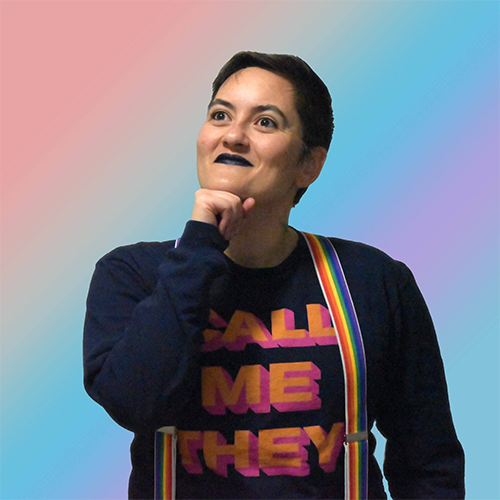
Chris Talbot (they/them) is a queer, trans nonbinary, mixed-race artist, activist, and nonprofit employee. When they aren’t working the day job, they spend their free time editing art and literature magazines, writing and illustrating educomics to help folks affirm their nonbinary pals, creating a graphic novel to describe what it’s like to be nonbinary in a gender binary world, cuddling their cat, and quad skating in the park. 

You can find Chris at talbot-heindl.com, on LinkedIn, Instagram, Bluesky, and Twitter — and tip them on Venmo or PayPal or join as a patron on their Patreon
Meeting our missions by moving from Power Hoarding to Power Sharing

Meeting our missions by moving from Power Hoarding to Power Sharing

By Kristin Cheung, arts administrator, executive director, and co-founder of Future Arts Network

One way organizations can grow their audience base (and equity in the field) is to share their power and connect with smaller groups such as unincorporated groups, collectives, and grassroots groups.

For the first 15 years I’ve spent working in arts nonprofits, I’ve worked with different types of leaders, and now that I’m in a leadership position myself, I want to use this position of power to be part of systems change work. In the past two years as an Executive Director, I’ve worked to build an organization with transparency and clear communication, and one that strives to be equitable.

To build an equitable organization, we must first face the reality that there are many traits in a traditional nonprofit work environment that are actually characteristics of white supremacy culture. Characteristics like: Perfectionism, Sense of Urgency, Quantity over Quality, Either/Or Thinking, Power Hoarding, and Individualism. 

For this article, I want to expand on how I worked to combat Power Hoarding by sharing my non-profit’s charity status and institutional power to support smaller grassroots groups and collectives. 

The traditional thinking that leads to Power Hoarding

The traditional thinking for many long-term institutions is that power is limited, with only so much to go around. Many institutions and their leaders feel threatened if others suggest changes or criticisms. Many institutions have leaders who hold and control much of the information within the organization without sharing it widely – this builds an environment with a lack of transparency and distrust in the organization. 

Instead of power hoarding, we should seek to “power share” across the aspects of organizations. 

First, we must understand there is power and privilege involved in holding non-profit and charitable status. With these designations, you can access funding, resources, and, for some people, credibility. 

Under the status quo, these institutions keep their power status by applying for funding to hire staff, and the staff grows the budget, program, and audience numbers. But overall, the organization does not share their resources or knowledge of them widely, except for the annual general meeting where they’re legally required to share their financial statements and “impact reporting” to the community. 

Meeting our mission through Power Sharing

One way organizations can grow their audience base (and equity in the field) is to share their power and connect with smaller groups such as unincorporated groups, collectives, and grassroots groups. These larger institutions should be able to develop meaningful partnerships with these groups and use their charitable status to apply for more funding with the smaller groups and connect them with more resources such as funding, staffing, meeting rooms, donors, and so on. 

Here in Canada, institutional funders are slowly shifting to allow these nonprofits to support smaller groups. I work in Vancouver and the City of Vancouver’s Cultural Services Department has opened up funding so non-profit organizations can sponsor applications for collectives or individuals. This means a larger institution can sponsor a smaller grassroots group (that does not have non-profit status) and apply for funding. 

The City of Vancouver has several arts and culture grants and one of them is the “Communities and Artists Shifting Culture (CASC) Grant,” this grant has the option to support “sponsored application for individual artist or collective.” From the granting application guide, “Groups and individuals from equity-deserving communities that are not incorporated as registered non-profits, co-ops, or charities may submit an application via a sponsor organization that is a registered non-profit society, co-op, charity or First Nations Band council. The sponsor organization must have a mandate to serve the same equity-deserving community(ies) as the group or individual.” 

In the past few years, the CASC grant has had an increased number of successful sponsored applications. In April 2022, sponsored applications were 12% of successful applications, and in 2023, sponsored applications were 25% of the successful applications. More smaller groups are applying for grants through registered non-profit societies that serve the same equity-deserving communities! 

Another path of sharing power is through changes at the Canadian federal government level. Senators are creating paths to shift the way charities and non-charities are able to have more meaningful collaborations.

In March 2021, Independent Senator Ratna Omidvar said, “The Income Tax Act is perpetuating systemic racism and colonialism in Canada in how it deals with charitable organizations.” She has since raised the issue, made reports, and introduced a new private member’s bill to help change the system. The overall goal is to build a more equitable system for all groups – including marginalized communities – who rely on charitable donations. 

In November 2021, Senator Ratna Omidvar introduced Bill S-216, “The Effective and Accountable Charities Act,” which will amend the Income Tax Act to enable charities to establish equal partnerships with non-charities, empowering the voices of BIPOC organizations and ensuring accountability and transparency. Overall, the bill aims “to eliminate the deeply-rooted and historic paternalism that many see embedded in the current rules about how charities can operate.” The bill still needs to be passed by both Chambers and will take a few years to receive royal assent. But overall this is a positive step in the right direction to empower the voices of BIPOC organizations while ensuring accountability and transparency. 

In my work, running a non-profit charitable arts organization, I have worked with several grassroots community groups and collectives and in the past 12 months sponsoring their applications and we’ve been successful in receiving over $110,000. I also use my knowledge as a grant writer to mentor and support other individuals and artist’s grant applications. In the past few years they’ve been successful in receiving over $229,000 in funding. By using our positions of powers, we can share power and knowledge to support the wider community beyond our own. 

Kristin Cheung

Kristin Cheung

Kristin Cheung | 冮雪莉 (she/her) is an executive director, arts administrator, and cofounder of Future Arts Network. She is currently residing on the traditional territories of the Semiahmoo, Katzie, Kwikwetlem, Kwantlen, Qayqayt, and Tsawwassen First Nations.

She is passionate about working with and supporting the work of underrepresented communities and has co-founded Future Arts Network, a free community mentorship program for young women of colour and marginalized genders in the arts. This intersectional feminist program aims to build a future with strong, diverse women in leadership positions, reflective of the current cultural landscape. Kristin has a Masters in Arts Administration & Cultural Policy from Goldsmiths University of London. She can be reached at @cheung_kristin on X (formerly Twitter) and Instagram. To send her a tip for this essay, PayPal her at @kristincheung.

Ways whiteness shows up in CCF to the detriment of everyone (including white folks), part 1: “Do something about her.”

Ways whiteness shows up in CCF to the detriment of everyone (including white folks), part 1: “Do something about her.”

By Chris Talbot, nonprofit laborer and born activist

While it’s not your fault that you were conditioned to act this way, it’s your responsibility to heal from it so we – the People of the Global Majority – can focus on transformational change.

Last month, I had the opportunity to virtually meet Regina Jackson during a Next 100 Colorado Conversation with Our Elders session. Regina is one-half of the team behind Race2Dinner, the documentary Deconstructing Karen, and the book White Women: Everything You Already Know About Your Own Racism and How to Do Better.

Before listening to Regina’s experiences, I would have classified myself in the category of a mixed-race, Indigenous person of color who doubted myself so much that I often held my tongue when experiencing harmful whiteness in the spaces I navigate, including – or more accurately, specifically – in Community-Centric Fundraising.

After meeting with her and hearing her talk about our power as People of the Global Majority and our responsibility to disrupt, I’ve been a bit more outspoken. “Don’t be afraid to have hard conversations,” she shared. “The worst thing that can happen is you get your feelings hurt, and fuck that.”

As I started to show up differently, I started to name things I saw happening and invite folks in to consider how they showed up. 

This hasn’t been taken very well.

I know whiteness leads white folks to separate themselves from each other, declaring themselves “one of the good ones” when concrete examples aren’t provided, so I want to give recent examples of whiteness infiltrating the movement. 

(I’m sharing this with the hope that white folks who do things akin to the examples I’m listing – and honestly, this essay could be a full-length book, so understand these incidents are stand-ins for thousands I’ve experienced or witnessed – truly examine them for similarities in their behavior. I ask white folks to really sit with these examples and meditate on how to change your impulses and behavior from whiteness in the future. While it’s not your fault that you were conditioned to act this way, it’s your responsibility to heal from it so we – the People of the Global Majority – can focus on transformational change. And the good news is you don’t have to heal separately; you can heal together, and that can be part of the healing!)

“Do something about her.”

We’ve all seen it happen in the forums for nonprofit work. A white person, especially a white woman, will goad, needle, or mock someone who’s clearly going through something and who has less emotional tolerance in the moment. They’ll pick at and diminish the person while staying on the “right” side of the listed “rules” of the space until the person they’re goading reacts.

Then, without fail, the white person will call for a moderator or another person of authority without consideration of the emotional load everyone carries. It’s basically a call for police without calling the actual police.

After all, they’re a white person who has experienced discomfort. It’s everyone’s responsibility to come to their rescue.

Other white people witnessing these things in real-time will usually either stay silent or pile on the person who reacted with terms like “unprofessional,” “inappropriate,” “violent” without consideration of the context of the encounter. They collectively pretend the white women provoking bears no responsibility. But they absolutely do.

Whiteness teaches white women since birth that this is their power – manipulate into bad behavior and then rally everyone to protect them.

When the People of the Global Majority have to spend time moderating and mitigating this white nonsense, they have less time and energy to build and move the movement forward. Who wants to stick around long-term when your transformative energies are being used to quell white nonsense? I don’t have endless energy for that.

This recent moment drained me in particular: A follower on CCF’s Instagram DMed me and asked if I would share her request for mutual aid for her and her children, who were trying to escape an abusive situation. I directed her to Slack and encouraged her to post in the “random” channel to see if she could get some help from our community. She initially DMed folks because she was unfamiliar with the platform, but once I explained it to her, it didn’t happen again.

Immediately, whiteness began to act as the de facto police to stop her – a Black woman trying to find much-needed help for her family. There were some gentle call-ins suggesting it might be an inappropriate ask, and then Emmy (not her real name), a white woman, tagged our entire moderator team to “do something” about her.

Let’s pretend that asking for mutual aid wasn’t directly within what we’re doing here. What harm is an ask for mutual aid doing in the random channel of our Slack? It’s sitting there innocuous AF. But Emmy tagged the women of color thought leaders who act as our moderators to “do something” about her.

I want folks to sit with the violence of that demand. “Do something” about a Black woman trying to escape abuse with her daughters, asking for mutual aid. Emmy was calling for the “police” (in a space that intentionally doesn’t have any).

Whiteness called a white woman mildly annoyed about a Black woman asking for mutual aid to demand other women of color police her.

As a mixed-race, nonbinary person of color who has been unhoused three times and had to escape an abusive situation once, this hit me at my core.

But this is not uncommon in whiteness. We see white people calling the actual and figurative police on Black people all the time. In our carceral system, Black people are disproportionately represented, and racial injustice is rampant. More than half of death row exonerees are Black, not just because Black people are blamed for crimes they didn’t commit (they are seven times more likely to be wrongfully convicted of murder than innocent white people) but also because they are overrepresented on death row. 

Outside of our carceral system, we see kids of color, and especially Black kids, who are disproportionately disciplined in school, and Black kids are 3.5 times more likely than their white classmates to be suspended or expelled. Workers of color, even in the nonprofit sector, are under more scrutiny than their white counterparts, meaning their mistakes (that everyone makes) are quickly caught, they receive worse performance reviews, lower wages, and more punitive whiteness bearing down on them. It shows up in online forums like Nonprofit Happy Hour, and now it’s also showing up in Community-Centric Fundraising.

How does this type of whiteness harm white people?

Community can’t thrive with white supremacy and whiteness acting out. When we act out of whiteness and white supremacy, we act individually. When we lean into asking for the “police,” whichever form that may take – especially after goading someone into acting out – how are we going to form meaningful community that holds space for one another?

Most of the time, when I see the goading I previously mentioned, it’s white-on-white violence. Because you do this to each other mercilessly. That’s because whiteness calls on y’all to outdo each other. It pits you against each other. Rather than coming in community like a lot of People of the Global Majority do, you are in constant competition with each other.

What about demanding the “police” on BIPOC members of the community? Every Person of the Global Majority in that forum saw that too. And saw it for what it was. 

I’ve been with my spouse, who is white, as he lamented the distrust he received from members of the BIPOC community before they knew him. “I get it, but it sucks,” he says. We’ve had the discussion about what Dr. Darlene Hall calls “healthy cultural paranoia,” – which is a response of mistrust towards white society and a defense against potential acts of racism and discrimination – so he truly does get it. But yes, it sucks. It sucks harder to have to be culturally paranoid of the white folks we navigate space with because we just never know when that shoe will drop.

This type of whiteness causes “healthy cultural paranoia” in BIPOC members of your community and keeps white folks isolated. It keeps us from making meaningful change together.

How to restore what whiteness has done

If you’re with me and you’re white, I’m going to need you to call in and bring your people along. But I’m going to need you to do this outside of the lens of whiteness.

Part of this was my fault for not anticipating how whiteness in the group would show up before encouraging this person to post. But I need white folks in the movement to investigate why they are here in the first place. 

Are we here to make a difference in our sector and to support each other with care and compassion to envision and build transformational change? Or are we here merely to find resources to do our day jobs a little differently, making incremental and ultimately insignificant changes? Are we here to hold space for asks of all kinds and to hold each other as we all navigate the complex ills of the nonprofit industrial complex and capitalism in general? Or are we here to create hierarchies, bring whiteness to the forefront, compete with each other, and demand the “police” whenever someone does something we don’t like?

Because this is a movement, not an organization, we all must ask ourselves these questions. Hopefully, the collective answer is that we’re here to make transformational change. Hopefully, that means we will act in ways that embody that.

Once you’ve decided, check out the Community-Centric Fundraising Community Update, and in particular, the “Our values and how we embody them while interacting on Slack,” and truly commit to them. 

If you’re with me and you’re white, I’m going to need you to call in and bring your people along. 

But I’m going to need you to do this outside of the lens of whiteness. Whiteness doesn’t know how to be in true community and competes rather than supports. Bring people in with compassion and grace, not condescension, superiority, and power. There are no exceptional white people; y’all should be encouraging and helping each other through your unlearning. Start there.

Don’t hold back because you’re afraid of not saying something perfectly. As Regina shared during her talk, “When we’re talking about difficult subjects, there is no wrong thing to say.” Spend the time necessary to really guide your people along in a way that upholds community, not whiteness.

This is how we restore what was lost and begin to rebuild trust in the space.

Chris Talbot

Chris Talbot

Chris Talbot (they/them) is a queer, trans nonbinary, mixed-race artist, activist, and nonprofit employee. When they aren’t working the day job, they spend their free time editing art and literature magazines, writing and illustrating educomics to help folks affirm their nonbinary pals, creating a graphic novel to describe what it’s like to be nonbinary in a gender binary world, cuddling their cat, and quad skating in the park. 

You can find Chris at talbot-heindl.com, on LinkedIn, Instagram, Bluesky, and Twitter — and tip them on Venmo or PayPal or join as a patron on their Patreon

The Absurd Hierarchy of Culture

The Absurd Hierarchy of Culture

By Monica Fernandez, a visual artist and art administrator

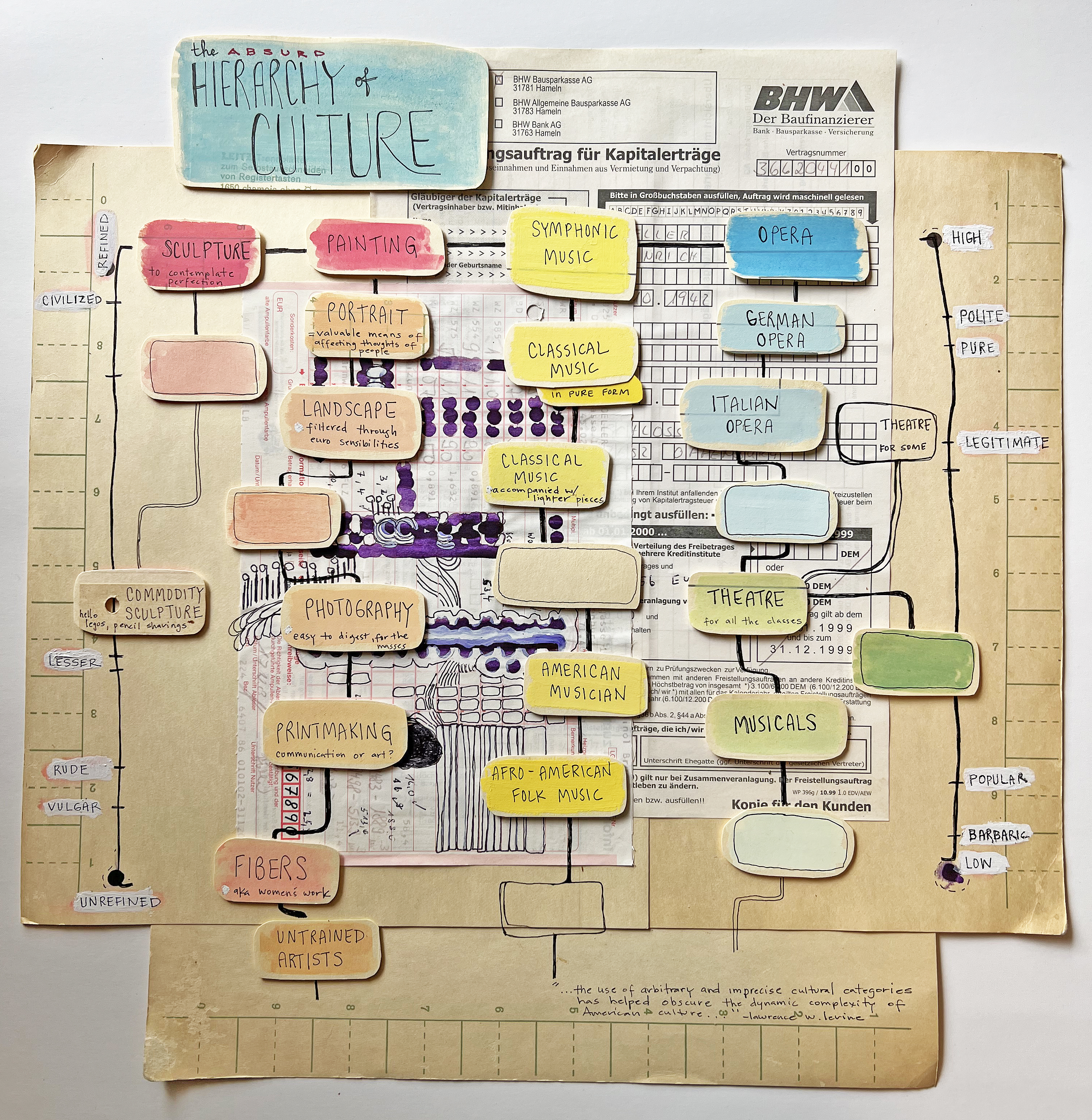
The Absurd Hierarchy of Culture is meant to consider ideas of value within the context of the human experience and the profound contradictions and arbitrary value systems embedded in the arts.

Artist Statement

Interested in the tension between truth and memory, observation and perception, Monica’s work investigates the inner chatter of inherited untruths and the archaic social beliefs she was born into.  Her work, approached as forms of documentation through drawings and mixed media, is a pragmatic attempt at recognizing the fallacies of how we live to instead uphold the reverence and awe in each of us. 

As an artist, immigrant, and POC, I have been deeply entrenched in the nonprofit arts world that preaches inclusivity and diversity as essential ingredients in our work. My experience has shown me it’s a field jam-packed with contradictions low brow art vs brow art, fine art vs craft, museums vs community centers, MFA’s vs self-taught artists. These contradictions assign value to the creative expression of people by using a set of arbitrary rules, establishing which artists are valuable enough to collect, whose work is esteemed enough to preserve, and what form of creative expression is good enough to consider art at all. The arts have the power to hold and represent what words cannot, and they absolutely have the force humanity needs to heal and find resolve.  However, until we question how our art spaces operate, the peering head of white supremacy and donor-centric culture that emerges will continue to exclude POC, and LGTBQ+ communities, further stigmatize people with disabilities, and silence the lived experiences of people living untraditional, unorthodox lives.

The Absurd Hierarchy of Culture is meant to consider ideas of value within the context of the human experience and the profound contradictions and arbitrary value systems embedded in the arts.  When the spaces responsible for holding the artifacts and self-expression of communities assert exclusivity, who is left out? Who is invited in? And who decides?  If artists are only worthy when they’ve claimed a particular space, what are the implications for artists who don’t? When we honor the life experience of people, regardless of class, education, race, ability, or socio-economic realities, we uplift a belief that all human expression is valuable and deserves to be championed as part of who we are as a broader community. 

An art piece that shows a graph of what is considered refined and unrefined or high brow vs low brown when it comes to art

Monica Fernandez

Monica Fernandez

Monica (she, her, ella) is a visual artist and arts administrator. She has dedicated the last 15 years to helping artists and arts organizations build a solid infrastructure to boldly assert their massive contributions to society. Her work has shaped exhibitions, arts education programs, access and inclusion initiatives, community-building efforts, and professional development programs. Monica earned an undergraduate degree in Studio Art from California State University, Long Beach, and a Masters in Arts Management from Claremont Graduate University.  

Motivated by the idea of building a more supportive arts field, Monica formed Arts Plotter – a management service firm for organizations and creatives seeking specialized support so they can focus on the work only they can do. Her clients include artists, non-profit organizations, municipalities, and creative entrepreneurs whose work centers around equity, racial, and economic justice.  

When she’s not working, Monica spends her time listening to one too many podcasts, drawing to think, and looking for things to take apart, only to rebuild them as something new. Monica is from Lima, Perú, and lives in Claremont, California, occupied territory of the Serrano and Tongva peoples.

Community-Centric Fundraising Community Update

Community-Centric Fundraising Community Update

By Community-Centric Fundraising Global Council Communications Committee

Community-Centric Fundraising, the Global Council, the Slack channel, and all other forms that the CCF movement may take are part of a grassroots movement, not an organization. We honor that, as such, what we do and how we treat each other and ourselves defines that movement.

Dear Community-Centric Fundraising Community,

Our CCF Slack community was built to create a space for CCF folks to convene and build community with each other. This digital community is for CCF members to gather, and exchange information, job postings, news, and any relevant content. It’s a space for CCF folks created by CCF folks.

It has evolved into a channel with over 7,000 members. We have 3 volunteer moderators — all women of color who have full-time jobs and fuller lives who have dedicated their labor to supporting this community.

We write to you today because a former member of our community has repeatedly shown up in ways that caused harm to several people within our Slack community. After receiving serious complaints from a few individuals, we engaged in follow-up discussions with the individual that were not successful. After it was clear that there was no alignment on our community safety guidelines, and the need to respect stated boundaries of others, we asked them to step away.

Our community guidelines include a list of what we do when harm has occurred within this space. We believe in restoration, and if individuals who inadvertently cause harm are interested in engaging in a restorative process, we work with the Global Council to initiate it.

Here are some updates the Communications Committee wanted to share, in an effort to be perfectly transparent:

Mental Health & Our Community

We take any mentions of mental health distress seriously. CCF acknowledges that the realities of society and the nonprofit industry often contribute to mental health crises, and want to be upfront that our Slack container cannot adequately meet mental health crisis needs.

The time we received a direct request for this Slack community to help someone navigate a real-time, mental health crisis, we promptly researched known non-carceral, potential resources and forwarded them on. If you have any ideas about how we can both acknowledge the importance of this topic while being upfront that we cannot facilitate mental health care, please share your thoughts and resources with us!

Also, we’d encourage community members to read about how mental health is more than “take a bath” and “do less unpaid labor,” as there are people experiencing a variety of realities in this and every space. It is each of our jobs to better educate ourselves on things such as ableism, sanist ways of framing things, etc.

What is the Purpose of the CCF Slack?

CCF Slack is a peer-led community for sharing, connection, and resources. This community is a place where our CCF values of equity, courage, community, integrity, and movement-building can live in action. We are also a community founded by BIPOC fundraisers and a community that centers the expertise, needs, and voices of Black, Indigenous, and People of the Global Majority.

CCF moderators keep the pulse on our Slack community. We keep an eye out on conversations to ensure they stay within our CCF guidelines, seek out ways to connect people, and are available to answer questions that may come up about Slack, CCF resources, or specific posts. 

We are not here to “police” this space or discipline people. Major issues requiring mediation are referred to the Global Council.

Slack does not offer security features, and the only way for moderators to prevent someone from rejoining after an accountability process is to manually remove the account once known.

This community is moderated frequently, but not 24/7. We ask that white members be respectful of the emotional and time labor of this role when interacting with moderators.

Our Values and How We Embody Them While Interacting on Slack

Equity: We believe that while there is space for everyone, the work must be led by the people more affected by injustice.

What this looks like on Slack: We recognize that there is space for everyone, and everyone is needed in the movement, and we prioritize the voices, expertise, and needs of people who are part of systemically oppressed communities including those who are BIPOC, LGBTQIA, or who have a disability. We recognize the work must be led by those most impacted by injustice, and so we value and trust lived experiences when they are shared. We also recognize and respect that people with shared identities need their own spaces to meet and will not join a channel that was not made for us.

Courage: We believe in challenging the way things have been done, including talking about difficult matters, taking bold actions, and embracing failure.

What this looks like on Slack: What this looks like on Slack: We tackle difficult topics, including race, anti-Blackness, and white supremacy without putting constraints on how impacted people share their experience (e.g. tone policing, compulsory disclosure, or timing demands). We try and suggest things that haven’t been done before rather than rehashing old techniques that haven’t contributed to our liberation or silencing voices in favor of “content experts.” We suggest and take actions when there is sufficient information to act, and accept failure as part of learning, while not shaming each other for failures or demanding perfection as we define perfection.

Community: We believe the work can be done most effectively when we build community.

What this looks like on Slack: We make the time to know one another and try to understand each other’s perspective while not giving into the Internet-engagement pull to make assumptions and shame or pile on. We care about and support each other in this work and are thoughtful of each other’s cultural traditions. We respect boundaries shared by community members.

Integrity: We strive to do the right thing consistently while doing this work, including following through, admitting to mistakes, and treating people well.

What this looks like on Slack: Taking responsibility when a mistake is made, We engage with care and kindness, without expecting our marginalized moderators to paternally police channels and others, instead choosing to show up as our best selves. We show up ready to communicate our needs, honor others’ needs, give and receive grace, and tend to harm and impact without centering our feelings or intentions. We take full accountability for the impacts of our actions and seek to make repairs, recognizing that, at times, this may mean doing so without access to the Slack channel.

Movement Building: We believe that a movement is the most effective way to transform fundraising philosophies to be more equitable and effective.

What this looks like on Slack: We recognize that Community-Centric Fundraising, the Global Council, the Slack channel, and all other forms that the CCF movement may take are part of a grassroots movement, not an organization. We honor that, as such, what we do and how we treat each other and ourselves defines that movement. We will strive to build solidarity with each other, holding each others’ truths, and pushing for transformative, rather than incremental change. We will also recognize and honor that each member is showing up in a way that is authentic, accessible, and sustainable for them in the movement at the moment.

Community-Centric Fundraising Communications Committee

Community-Centric Fundraising Communications Committee