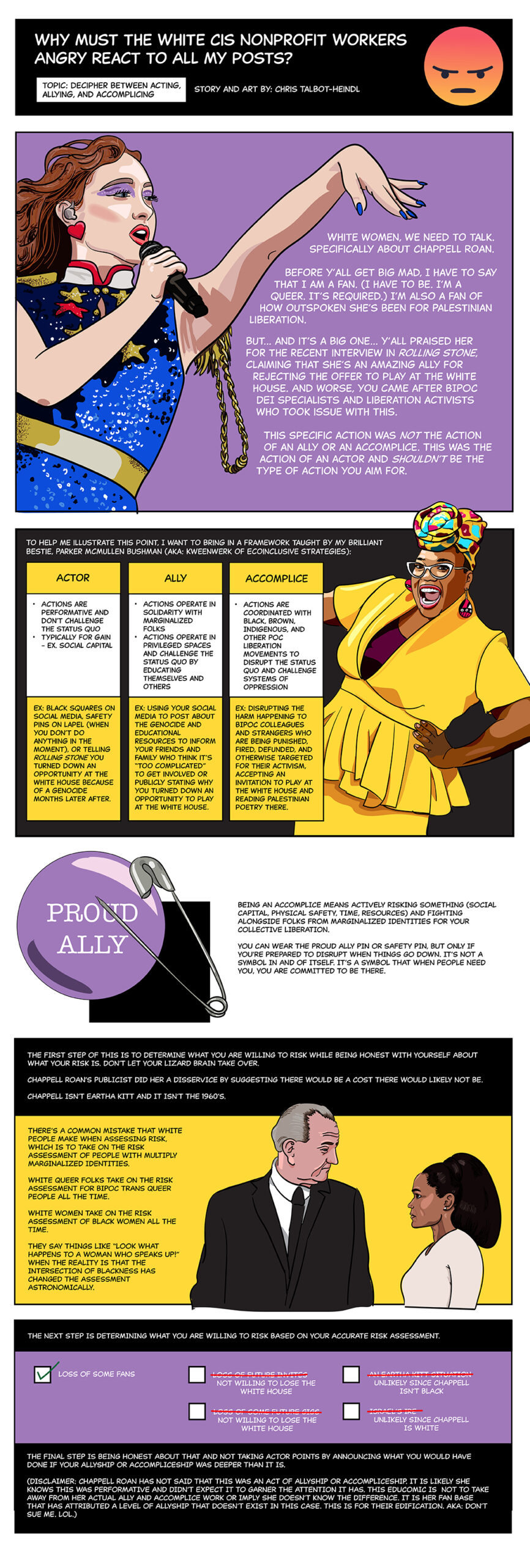
Why must the white cis nonprofit workers angry react to all my posts? Ep: Decipher between acting, allying, and accomplicing

Why must the white cis nonprofit workers angry react to all my posts? Ep: Decipher between acting, allying, and accomplicing

By Chris Talbot, communications professional and educomics creator

View accessible/text-only version

The educomic Why must the white cis nonprofit workers angry react to all my posts? Ep: Decipher between acting, allying, and accomplicing." Full alt-text is available using the link at the top of the page.
Chris Talbot

Chris Talbot

Chris Talbot (they/them) is a queer, trans nonbinary, mixed-race artist, activist, and nonprofit employee. When they aren’t working the day job, they spend their free time editing art and literature magazines, writing and illustrating educomics to help folks affirm their nonbinary pals, creating a graphic novel to describe what it’s like to be nonbinary in a gender binary world, cuddling their cat, and quad skating in the park.

You can find Chris at talbot-heindl.com, on LinkedIn, Instagram, Bluesky, and Twitter — and tip them on Venmo or PayPal or join as a patron on their Patreon

Photo credits: Makeup by Brittany Blaze-Shearz; Direction and photograph by Chermetra Keys/The Female Shoota; cattoo by Aura Rain Heindl-Rockman.

Remaking the relationship between nonprofit organizations and schools

Remaking the relationship between nonprofit organizations and schools

By Alex Chadwell, musician, teaching artist, administrator, artist-researcher

Thousands of education nonprofit organizations across the country, in urban and rural areas of every state, provide supplemental, supportive, and sometimes essential services for millions of students. They utilize diverse programming, from academic support and English language learning to arts and recreation to health education and meal provision to summer programs and beyond. They are active before, during, and after the school day, on weekends, on school campuses, and at other locations such as community centers, arts venues, and religious centers. 

They have effectively become de facto extensions of the public school system and, in this way, have become embedded in the civic and social fabric of the United States. 

While this arrangement has become normalized, we must examine the relationship between education nonprofit organizations and public schooling in the U.S. and how education nonprofit organizations often inadvertently provide ineffective and problematic programs. This, in turn, produces a means for the ruling class to conservatively address societal inequities without indicting themselves, relinquishing power and money, or making structural change.

Access paradox in the nonprofit industrial complex

The current iteration of the interconnection between education nonprofit organizations and public schools in the United States can be traced to mid-twentieth-century liberalism and its respective policies. In her book Nonprofit Neighborhoods, historian Claire Dunning writes that among the core beliefs of this ideology were “the need to expand opportunity rather than restructure society, a faith in social scientific evidence and the replicability of experimental findings, . . . the assumptions that local solutions could address structural problems, [and that] increasing participation via private routes could substitute for a sharing of public power” (2022, p. 58). In the destructive wake of urban renewal[1]⸺a federal program that, between 1949 and 1973, decimated 2,500 neighborhoods, the majority of which were comprised of Black and working-class communities, in 993 cities across the United States⸺the American federal government began to address and attempt to ameliorate the public and structural problems of poverty and the lack of or inadequacy of education, housing, health services, and employment, etc. through public-private partnerships with nonprofit organizations, businesses, and corporations. 

Late capitalism and the consequent increasing wealth disparity, the continuously growing yet unregulated philanthropic sector, and the neoliberalist policies that address the deficiencies of public institutions through private means have led to the current political economy, sometimes referred to as the “nonprofit industrial complex.”

One of the economic ways that the ruling class sustains the nonprofit industrial complex is by creating an environment of scarcity that foments competition and division through its strategic deployment of resources via grantmaking and other methods of fund distribution. Dunning writes that fundamentally, “grantmaking is an expression of power by those with resources over those seeking them . . . and by definition, a grant exists as a privilege to be won rather than an obligation to be fulfilled” (2022, p.10). The “power of grantmaking [is] the ability to set priorities, demand information, assess budgets, and define time horizons for change” (2022, p. 143), therefore limiting how, where, and for whom nonprofits can serve. The nonprofit organization is, thus, operationalized as a way to keep specific communities surveilled, policed, and disempowered. 

My first encounter (that I was cognizant of) with the nonprofit industrial complex was when I was a teaching artist in New York City. I found myself assigned to teach at underfunded schools in divested neighborhoods that had cut arts education from their curricula years ago, sometimes dating back to the city’s near bankruptcy in the 1970s. To address this shortcoming, principals contracted nonprofit arts organizations, using governmental grants and private funding, to provide fill-in arts programming. 

It was then that I began to see the inequity (and irony) of nonprofit arts organizations providing fill-in arts programs with the deferred tax dollars that could’ve been funding those same schools that I was at and how, by circumventing the public education system, programs were less substantive, consistent, and accountable. 

In many communities across the country, arts and cultural institutions and arts education organizations have essentially created their own industry of providing arts programs for underfunded and under-resourced public schools. School districts have largely relied on these organizations to offer arts programming. Rather than address the systemic underfunding of public schools in the U.S.[2], this short-term turned long-term arrangement has created a vicious cycle. 

Artists and the experiences that they facilitate in schools, afterschool programs, community centers, and summer camps have the potential to be powerful instigators of transformative and radical education, but they are not replacements for full-time arts teachers. Not only are they not replacements, but artists and arts organizations can also, and often do, perpetuate the hegemonic heteropatriarchal, capitalist, colonial, Eurocentric world system that sociologist John Law calls a one-world world: “a world that has granted itself as exclusive, cancels possibilities for other worlds, and by, presenting itself as exclusive, cancels possibilities for what lies beyond its limits” (Cadena & Blaser, 2018, p. 3). 

This is often accomplished through the process of democratizing culture—a top-down, center-out scheme where the dominant and approved cultural products and beliefs are distributed to everyone under the pretense that access and exposure to this “high” culture is equality. The approved cultural products, beliefs, and dogma are primarily from deceased, white, Western European, heterosexual, cisgender men and their respective values, norms, and perspectives. Providing access and exposure for “underserved” (i.e., marginalized, disinvested, and oppressed) communities and individuals is almost always showcased as an act of benevolence. 

Among the many reasons for its persistent existence is the “access paradox.” By withholding access to the social and cultural capital of the dominant culture, people from the non-dominant culture are prevented from succeeding in the dominant culture’s world. However, if access is provided, the dominant culture and its hegemony are solidified and reinforced.

Many nonprofit organizations face a similar paradox. By seeking and accepting government funds and philanthropic dollars to provide social services, they are participating in and perpetuating the nonprofit industrial complex. However, if they stop providing services or cease to exist entirely, they would leave millions of people without essential services.

A more recent experience provided me with an opportunity to see how the nonprofit industrial complex also impacts non-arts education nonprofit organizations. As part of my graduate program in literacy education, I mentored a tutor at a nonprofit organization that provides, among other things, one-on-one after-school tutoring.

Like the example of arts education mentioned above, this organization provides programming, using tax-deferred and restrictive dollars, for students who are actively being disenfranchised by the school district – usually students of color and students from low socioeconomic status who attend underfunded schools. While not always the case, organizations often do not provide equal or better services than a fully funded school could. Even without considering the quality of services offered, nonprofit organizations will never be a one-for-one replacement for a public institution like public education. 

Two causes of problematic program offerings: Volunteer labor and structural organizational deficiencies

Nonprofit organizations often rely on volunteer labor to carry out some or all of their programming. Common in the education sector is a reliance on volunteer tutors, who usually do not have a background or training in education, to implement programming. The tutor I mentored was a well-intentioned retiree who, with additional free time in retirement, sought out a volunteer opportunity without considering if he had the appropriate skillset.

People volunteer for various reasons: to boost social capital, because they are required to by work or school, due to an implicit belief of “it’s the right thing to do,” or to learn new things, among other reasons. 

Volunteering is a common-sense[3] value in America. In fact, people’s dedication to volunteering is a defining characteristic of American culture in that it embodies the highly regarded individualism that influences so much of America’s social policy.

The intense pressure from funders and taxpayers for low-cost, high-efficiency, and easily measurable activity from nonprofits prevents a critical examination of the limits of volunteer labor. In a blog post, Volunteerism and Expertise, artist-educator-scholar Pablo Helguera challenges us to consider why certain skills are deemed acceptable to be carried out by volunteers versus professionals. Using the programming at an art museum as an example, he suggests that an institution would never rely on volunteers to curate an art museum; however, when it comes to the education department, volunteers providing programming is not only normalized, but often suggested as a best practice and cost-saving measure.

Unsupported and untrained volunteers contributed to this organization offering suboptimal, sometimes problematic, tutoring under the guise of charity. I will provide a few examples from working with my tutor, Robert (a pseudonym), that demonstrate how volunteerism resulted in ineffective and problematic tutoring:

    • Curriculum – Robert did not follow a curriculum, and the organization did not provide one. He had no literacy or general education training, and again, the organization did not provide any. He created a curriculum based on his current understanding of what education “should” be, influenced by his own private high school education fifty years ago. For example, the vocabulary words he chose for his student to learn were words he “thought she should know.”
    • Culturally sustaining pedagogy – Nonprofit organizations are disproportionately located and provide services in divested neighborhoods where public social services have failed or been withheld. Education nonprofits frequently aim to support students of color, students of low socioeconomic status, English language learners, and immigrants or children of immigrants. Simultaneously, volunteers in the U.S. are disproportionately white.

      This was the case for Robert and his student.

      Robert is a white cishet male; his student is Latina and a child of immigrant parents. Robert lacked the cultural competency essential to facilitating culturally sustaining pedagogy. Like many white volunteers, Robert viewed those he was helping through a deficit-based and assimilationist perspective. In his mind, he was there to help her successfully navigate an English-centered, white world, thereby dismissing her culture.
    • Teaching style – Informed by the two deficiencies listed above, Robert taught in a didactic manner that reinforced the banking model of education[4] and undercut the student’s agency in her learning.

Coalescing with these individual-level deficiencies were various, common organizational shortcomings that further exacerbated issues of equity and quality. It was unclear if or how the organization was evaluating its tutoring program. While certainly not a holistic measure of success, they did not track measurables such as test scores or report card grades.

To be clear, I am not advocating for educational programs’ worth to be measured solely by changes in grades and test scores, but there must be some metrics to assess program value and growth. Relatedly, the scope of programming was small; tutoring was strictly limited to one hour a week. To serve as many students as possible and make claims of more significant impact, the organization limited the amount of tutoring per student that could occur, perhaps unintentionally putting their interests before those of the students. 

In recent years, many organizations have been considering barriers to access; typically, organizations focus on surface-level accessibility, such as financial and geographical. Fewer organizations are tackling issues such as decolonizing white spaces and supporting multicultural onto-epistemologies. 

This program was offered free of charge, aside from a nonrefundable deposit, but it was housed in the organization’s downtown building with limited parking. In a city with subpar public transportation, this barrier results in exclusion for many students and families. 

I was struck by how such problematic and ineffective aspects of the tutoring program went unquestioned while being marketed and seen as altruistic charity. But this is often how white saviorism manifests collectively. White saviorism is often seen as an individual occurrence, carried out by a white individual or group of white individuals who “fix” something, but less attention is given to how other white people appropriate that savior activity to repress feelings of guilt, responsibility, and accountability, and ultimately remain complacent. 

Teju Cole sums it up in his book of essays, Known and Strange Things, “the white savior supports brutal policies in the morning, founds charities in the afternoon, and receives awards in the evening” (2016, p. 340).

Ineffective and problematic programs like these function more as a “patina of caring and concern to the ruling class which funds the work” (Kivel, 2007/2017, p. 130) than an asset to the community. Dunning adds that this function of nonprofits “provides the perfect avenue by which to express . . . concern for poverty [and other inequities] without threatening the political-economic status quo” (2022, p.58).

The number of nonprofit organizations in the U.S. will almost definitely continue to expand in the coming decades. The question then is, “How can progress toward equity and liberation be achieved within the nonprofit structure?” Viewing this through a lens of worldmaking, it is a question of how to create new worlds within our existing worlds. As Nelson Goodman puts it in his book Ways of Worldmaking, “Worldmaking as we know it always starts from worlds already on hand; the making is a remaking” (1978, p. 6). Both the classroom and the nonprofit structure offer possibilities for this (re)making. Speaking directly to the nonprofit industrial complex, authors Zac Chapman and Nairuti Shastry propose in their recent essay, Will the Revolution Be Funded?, that we “build strategic alignment across groups working within, without, and against philanthropy.” Below, I offer a few thoughts on how educational nonprofits can work within, without, and against the nonprofit industrial complex.

Remaking the relationship: Locations of possibility

I am reminded of bell hooks’ assertion that “the classroom, with all its limitations, remains a location of possibility . . . [where] we have the opportunity to . . . collectively imagine ways to move beyond boundaries, to transgress” (1994, p. 207). 

Education is a tool that can either function to perpetuate the hegemonic one-world world or be the means by which we collectively create a pluriverse[5] of new worlds. 

Using the example of the access paradox of English language education, literacy scholar Hilary Janks argues that to disrupt it, educators must remind themselves and their students that “the power of English is neither natural nor unassailable” (2004, p. 36). She suggests that as teachers provide access to the English language, they must also provide an understanding of how English became dominant and how it continues its hegemony today. 

Teaching must also remind students of the ephemerality of language and that English is continually reinvented, identifying the existing diversity even within this dominant language. Then, they can be encouraged to redesign and transform English to dismantle systems of domination. 

Concurrently, students must be supported in maintaining and developing their home languages so as to simultaneously weaken the linguistic capital[6] of English.

Similar to the possibility for radical (re)making found in the practice of education, Soniya Munshi and Craig Willse write in the foreword to the seminal book, The Revolution Will Not Be Funded, that “the nonprofit can be a vital site from which a great range of workers, activists, advocates, and community members collaboratively transform the conditions of everyday life” (2007/2017, p. xx). 

I have spent a lot of time focusing on how nonprofit organizations participate in and perpetuate the nonprofit industrial complex. However, in their third sector role, blurring the lines between the public and private sectors, nonprofits have a unique capacity and positionality for disruption and transformation. I offer the following questions for education nonprofit organizations to consider:

  • Are the programs and services offered responsive to the community that the organization serves? How is that determined and known?
  • Is the organization constantly assessing and reassessing programs for quality, efficacy, relevance, and responsiveness? 
  • How does the organization determine if it is the right organization to offer its programs and services? And if the programs and services are appropriate?
  • How does the organization partner and work with schools, families, students, and communities? Are power relations examined? Do students, families, and other community members have decision-making power? Is the organization operating from a deficit-based and assimilationist approach?
  • Does the organization incorporate some level of advocacy and movement work to serve both the local and individual needs of the community it is accountable to while also working to dismantle the systems of oppression that perpetuate the need for the organization’s services?
  • Should the organization continue to exist? or give itself a time limit? Scholar and prison abolitionist Ruth Wilson Gilmore reminds us, “The purpose of the work is to gain liberation, not to guarantee the organization’s longevity” (2007/2017, p. 51).
  • How is the organization working to disrupt the ways that American schooling sustains the dominant onto-epistemologies of the one-world world?

Our neoliberal and technocratic society has convinced us that scalability, efficiency, and replicability are characteristics of success. It has also persuaded us to believe that stopping equates to failing and that recognizing and admitting our weakness and limitations is a sign of inadequacy. Cultural thinker Diane Ragsdale writes in her essay To What End Permanence? that because of this “nonprofits are quite often established with perpetuity in their sights” (p. 121, 2019). 

Specifically about arts organizations deciding whether or not to continue existing, she writes that “the decision … needs to be about something more than whether there is a stash of fixed assets, sufficient cash in the bank, subscribers and donors willing to renew, players wanting to play, and individuals technically qualified and desiring to take over” (p. 121, 2019). This is just as applicable to education nonprofit organizations. 

In addition to sustaining the status quo, assumed permanence and rigidity prevents the innovation, responsiveness, and flexibility that is required to continually address community needs and desires while simultaneously disrupting systems of oppressions. Let’s use our creativity, responsiveness, and unique position to continually (re)define the function of both the nonprofit sector and education in the United States.

Footnotes

  1. For a detailed history of urban renewal and its impact on United States’ cities, I recommend Dr. Mindy Fullilove’s book, Root Shock: How Tearing Up City Neighborhoods Hurts America, And What We Can Do About It.
  2. For more information about how U.S. public schools receive and spend money, I recommend Bruce Baker’s book, Educational Inequality and School Finance.
  3. I am using Antonio Gramsci’s concept of senso comune (common sense) “the term he uses for all those heterogeneous beliefs people arrive at not through critical reflection, but encounter as already existing, self-evident truths” (Crehan, 2016, p. x).
  4. See Paulo Freire’s Pedagogy of the Oppressed.
  5. “the practice of a world of many worlds . . . heterogeneous worlding coming together as a political ecology of practices, negotiating their difficult being together in heterogeneity” (Cadena & Blaser, 2018, p. 4).
  6. See Pierre Bourdieu’s Language and Symbolic Power.

References

Baker, B. (2022). Educational inequality and school finance: Why money matters for America’s students (2nd ed.). Harvard Education Press. (2018)

Bourdieu, P. (1991). Language and symbolic power (J. Thompson, Ed., G. Raymond & M. Adamson, Trans.). Harvard University Press.

Cadena, M., & Blaser, M. (2018). Pluriverse: Proposals for a world of many worlds. In M. Cadena & M. Blaser (Eds.), A world of many worlds (pp. 1 – 22). Duke University Press.

Chapman, Z., & Shastry, N. (2024, June 11). Will the revolution be funded? The Forge. https://forgeorganizing.org/article/will-revolution-be-funded 

Cole, T. (2016). Known and strange things: Essays. Random House.

Crehan, K. (2016). Gramsci’s Common Sense: Inequality and its narratives. Duke University Press.

Dunning, C. (2022). Nonprofit neighborhoods: An urban history of inequality and the American state. The University of Chicago Press.

Freire, P. (2000). Pedagogy of the oppressed: 30th anniversary edition. The Continuum International Publishing Group Inc. (1970).

Fullilove, M. T. (2016). Root shock: How tearing up city neighborhoods hurts America, and what we can do about it (2nd ed.). New Village Press.

Gilmore, R. W. (2017). In the shadow of the shadow state. In INCITE! (Ed.), The revolution will not be funded: Beyond the non-profit industrial complex (pp. 41 – 52). Duke University Press. (2007).

Goodman, N. (1978). Ways of worldmaking. Hackett Publishing Company.

Helguera, P. (2021, October 29). Volunteerism and expertise: If we truly value the museum education profession, why should it be expected to be volunteer work? Beautiful Eccentrics. https://pablohelguera.substack.com/p/volunteerism-and-expertise 

hooks, b. (1994). Teaching to transgress: Education as the practice of freedom. Routledge. 

Janks, H. (2004). The access paradox. English in Australia, 129, (33 – 42).

Kivel, P. (2017). Social Service or Social Change? In INCITE! (Ed.), The revolution will not be funded: Beyond the non-profit industrial complex (pp. 129 – 149). Duke University Press. (2007).

Morris, A. J. F. (2009). The limits of voluntarism: Charity and welfare from the New Deal through the Great Society. Cambridge University Press.

Munshi, S., & Willse, C. (2017). Foreword. In INCITE! (Ed.), The revolution will not be funded: Beyond the non-profit industrial complex (pp. xiii – xxii). Duke University Press. (2007).

Ragsdale, R. (2019). To what end permanence? In M. Joseph & D. Bruin (Eds.), A moment of the clock of the world: A foundry theatre production (pp. 111 – 122). Haymarket Books.

Alex Chadwell

Alex Chadwell

Alex Chadwell (he/him) is a musician, teaching artist, administrator, and artist-researcher originally from Harrisburg, Pennsylvania and currently based in Lexington, Kentucky. A full time graduate student and research assistant at the University of Kentucky, his research focus areas are arts in education, critical literacy, and culturally sustaining pedagogy. An experienced teaching artist and administrator, he has designed and facilitated programs, residencies, and workshops with Bethel Woods Center for the Arts, Brooklyn Arts Council, Center for Arts Education, Highbridge Voices, Kentucky Education Development Corporation2, Lexington Philharmonic, the New School’s College of Performing Arts, the New York Philharmonic’s Very Young Composers program, the Southeastern Theatre Conference, and the University of Kentucky, among others. You can email him here, or follow him on LinkedIn or Instagram.

Fundraising is education: Utilizing transformative learning theories to inspire social justice-focused growth and giving

Fundraising is education: Utilizing transformative learning theories to inspire social justice-focused growth and giving

By Jonathan Meagher-Zayas, nonprofit strategist and equity warrior

Given the state of our society, intentionally incorporating educational strategies into your fundraising efforts can be an effective way for your organization to generate support and build a movement for your cause. 

The world has a lot going on right now. With the increased political divisiveness, complicity in genocide and colonization, and an overall decrease in giving, working as a social justice fundraiser can be tough right now. 

I am sure many of you reading this may be finding it harder to have conversations with individuals related to inequity and white supremacy. I certainly feel that way. 

I do remind myself most people do not wake up one day ready to dismantle our current oppressive systems, especially after years of being told this is the way the world works. With this in mind, I have been giving more grace as people navigate their journeys. However, a colleague at Cause Effective shared giving grace means going soft on the person but hard on the problem

A major issue facing our sector (not the only one!) is the lack of effective educational strategies to help staff, board members, and donors shift their thinking towards more anti-oppressive mindsets. This presents opportunities for us as fundraisers; we can educate our donors to steward more social justice advocates and more social justice giving. 

As a fundraiser, I have always considered myself an educator for my donors. I had to make them aware of my organization and the community’s needs, inform them of how our programs and services addressed those needs, and educate them on the opportunity for them to support the mission. 

I recently started a doctoral education program, which helped me realize I was utilizing various adult learning theories in my fundraising efforts to engage donors and make it easier to inspire giving. Given the state of our society, intentionally incorporating educational strategies into your fundraising efforts can be an effective way for your organization to generate support and build a movement for your cause. 

I’d like to share some adult learning theories we can all utilize for our fundraising engagement activities. 

Assessing Donors with the Learning Zones 

Before engaging in any equity-focused work, I highly recommend people engage in some form of assessment. There are many assessments to understand a person’s learning needs, and one of the most helpful for me is the Learning Zones. 

The current learning zone model I use has many iterations, but it is based on the Learning Zone Model developed by Tom Senninger, a German educator

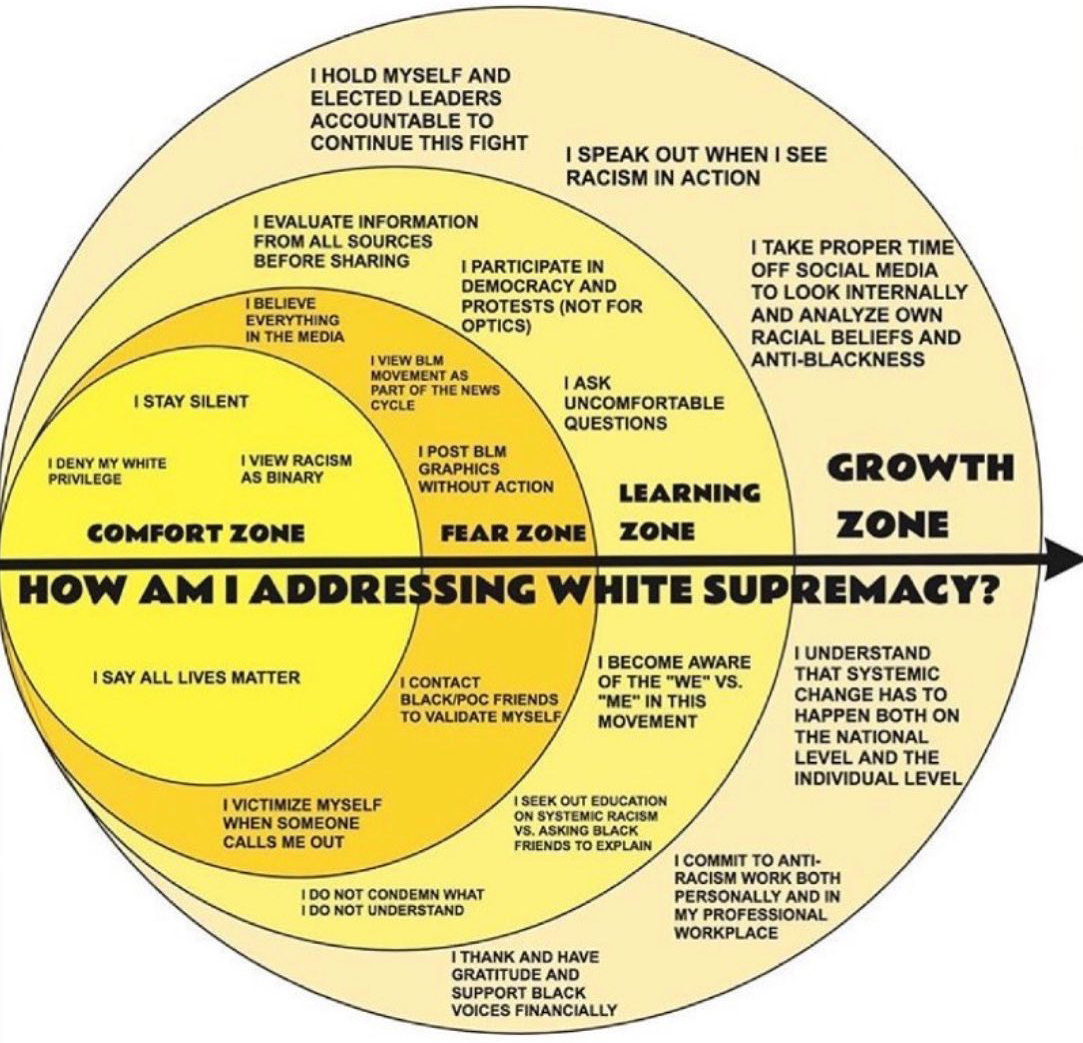
Image is a graph titled How am I addressing white supremacy? The first section is called the comfort zone and is described as I stay silent, I deny my white privilege, I view racism as binary, and I say all lives matter. The second section is the Fear Zone. It is described with I believe everything in the media, I view the BLM movement as part of the news cycle, I post BLM graphics without action, I contact Black/POC friends to validate myself, and I victimize myself when someone calls me out. The next section is the Learning Zone. It is described with I do not condemn what I do not understand, I seek out education on systemic racism vs. asking Black friends to explain, I become aware of the "we" vs. "me" in this movement, I ask uncomfortable questions, I participate in democracy and protests (not for optics), and I evaluate information from all sources before sharing. The next area is the Growth Zone. It is described with I hold myself and elected leaders accountable to continue this fight, I speak out when I see racism in action, I take proper time off social media to look internally and analyze my own racial beliefs and anti-Blackness, I understand that systemic change has to happen both on the National level and the individual level, I commit to anti-racism work both personally and in my professional workplace, and I thank and have gratitude and support Black voices financially.

This is a graphic of the Learning Zone Model I use for anti-racist training. (It was one of the images circulating on social media beginning in the summer of 2020, typically without credit. The earliest I could find it online was in a post by Rebecca Walker, but others claim it was first shared by Ibram X. Kendi.)

I know it was effective because it made some fragile people uncomfortable! Regardless, the graphic can help us assess how people say and act and where they are in their learning stage. 

Comfort Zone – I do not want to change. 

Many people do not want to change. Change is uncomfortable, and people tend to work towards a stage where they do not have to change. 

If you have any donors who say things in their comfort zone, such as “All Lives Matters,” or they deny their privilege, view racism as binary, or stay silent on issues, they are most likely in the Comfort Zone. Before engaging with people at this stage, I consider gauging my energy and influence. I ask myself, “Do I have the resources and energy to help them change?” and “Am I the right person to help them change?” 

There are opportunities to help donors in their comfort zone (I’ll share them later in the article), but make sure you have the right support to ensure it can happen, otherwise, I recommend focusing your energy on people in the later zones. 

Learning Zone – I am afraid to change. 

I wrote last year that fear is often a significant barrier to social change. Many people in the nonprofit sector are currently in this zone. 

In the Fear Zone, people know they need to change but are afraid to commit fully. They are considering risks, afraid of doing the wrong thing, or frankly, fear giving up their access to power. 

If you have donors who believe everything they read on social media about social justice, post graphics like the black square or a pride flag without any action, contact their friends of color to validate their actions, or only focus their social justice efforts at a time where it’s popular, they are likely afraid of change. Fear can also show in many ways, like freeze, flight, fight, or fawn, and people can get defensive when called out they are in this zone. 

I’ll share specific fundraising strategies you can utilize later to help donors who are afraid. You can check out my previous CCF article on strategies to support someone who is afraid.

Learning Zone – I am ready to change, but I need to know how.

After someone has overcome their fear of change and decided to be brave, people step into the Learning Zone. The Learning None is where people start understanding the information they were afraid to learn and the skills to help them move forward. 

If you have donors who think critically about the sources of their information, participate in actions like pro-democracy activities and protests, ask uncomfortable questions, think of collective action instead of individual action, seek out education on their own instead of asking their friends of color to explain, and do not get defensive when they do not understand something, they are in the Learning Zone. 

They may not fully embrace social justice ideologies, but they are here to listen and learn without pushback. 

Growth Zone – I understand I am constantly changing and learning. 

The final zone in this model is the Growth Zone. Here we have people who, for lack of better words, “just get it.” These are people you trust to hold themselves accountable for their own actions, understand how to apologize and learn from their mistakes, understand that systemic change occurs at multiple levels of our society, critically self-assess and analyze their beliefs and biases, and commit to anti-racism in various ways. They also follow up their intentions with actions like speaking out when they see racism or injustice, committing to distribute their resources, helping others analyze their perspectives, and participating in education to improve the impact of personal, organizational, and societal changes. 

As with all frameworks, these are guides to help you understand, but not everyone will fit perfectly inside one zone. Also, some people might be in the Growth Zone for some issues, but in the Comfort Zone for others. 

My hope is these learning zones can help you strategize how to engage with a donor, leading to a stronger commitment. 

Using Transformative Learning for Donor Engagement Ideas

After understanding where your donor is, it’s time to think about how to best cultivate and engage with them. While we build relationships with donors, in a way, we are helping them develop new perspectives. By supporting our organizations, they can address inequities in our community.

To help me in this work, I have embraced Jack Mezirow’s Transformative Learning Theory. This theory identifies different stages in which educators can help people develop a new worldview. 

The theory has over ten steps, and many scholars have conducted extensive research about what works best. I’ll be identifying key areas with accompanying fundraising strategies: 

Disorienting Dilemma 

The first stage of transformative learning is what scholars call a disorienting dilemma. It is essentially a situation where someone realizes the world doesn’t function the way they thought or believed it did. 

I worked with an organization that organized tours exposing how underfunded some human services initiatives were, and people walked away shocked they had not known about it. Think of it as an epiphany or “a-ha” moment. This is a pretty important experience that can be uncomfortable or challenging, but it is the beginning of someone going through a new perspective. 

Some donors may come to you after experiencing a disorienting dilemma, which led them to give, and others may need to experience it before deeper engagement. If you are trying to help donors go through a disorienting dilemma, here are some strategies to think about:

  • Create compelling forms of media such as videos, articles, artwork, or imagery to showcase the inequity you are solving
  • Utilize ethical storytelling strategies to spark compassion for someone your organization supports
  • Organize experiences, without exploiting people, that allow people to discover the issues your organization is trying to address  
  • Embrace data and organize messaging exposing a reality
  • Launch a targeted online giving campaign focused on a single need or issue area 

Self-Examination

After someone realizes the world doesn’t function as they thought it did, it is time to help them self-examine why they did not know. 

This stage is where people are afraid. We have to go through the uncomfortable process of unlearning what we know before we can understand something better. 

I remember providing a lot of support to donors following the racial reckoning of 2020. Many were home with no one to talk to and afraid of not finding the right resource, so I shared resources with them to learn and process. 

As a fundraiser, we can help donors self-examine their beliefs in our resource generation activities in several ways:

  • Strategize with a consistent communications plan with engagement opportunities to continue their changed thinking from the disorienting dilemma 
  • Create direct mail or email appeals walking a donor through a process of self-reflection 
  • Organize a “did you know” campaign with facts and data to spark thinking 
  • Distribute surveys to collect information but also help people assess their thinking
  • Invite them to one-on-one conversations with someone they trust to help discuss their confusion or fear

Meaningful discourse

Following the self-examination process, people are ready to engage in conversations to spark deeper learning. 

Critical discourse is a huge component of Paulo Freire’s Pedagogy of the Oppressed. Specifically, Freire argues people with varying degrees of power must come together to have conversations to end oppression. People often have to talk things out to truly understand an issue. It’s a reason I think people love podcasts so much. Someone is talking things out for them. 

Organizing ways for donors to converse with others can help them transform their thinking and spark more support. 

I remember working for a gender justice organization where we hosted “teach-in” events where people with specific knowledge and experiences had conversations with donors about issues impacting the organization.  

Fundraising strategies to consider include: 

  • Launching monthly giving campaigns with invitations to events where donors can connect 
  • Facilitating discussions around topics diving into the reasoning behind inequities and what your organization is doing about them 
  • Hosting educational events that allow for processing and group thinking 
  • Creating online discussion forums where donors can pose questions and engage in conversation digitally 
  • Organizing events like a world café where groups of donors can come together and process tough issues facing your community 

Action and Engagement

The final stage is action and engagement. In this stage, people engage in activities to help them integrate their new way of thinking into their lives. 

This is also where your most engaged supporters will be, and there’s an opportunity to turn their learning into action for your organization. While advocating or volunteering, people come closer to the organization’s issues and embed them into their own identities. 

Strategies at this stage to activate their learning and giving include:

  • Creating ambassador programs that include education, resources, and opportunities to promote your organization
  • Invitations to committees, advisory groups, and board positions 
  • Asking them to highlight their own personal growth journeys in appeals or donor communications 
  • Hosting training to develop their skills and spark motivation 
  • Tailored ask opportunities that allow them to embrace their new way of thinking 


I hope sharing my learnings sparked some thinking on how you can better approach relationship building and what activities help lead others to change. As with any framework or theory, it won’t be exact, and adapting to your organization and intended audiences is key.

Jonathan Meagher-Zayas

Jonathan Meagher-Zayas

Jonathan Meagher-Zayas (he/him) is a Queer Latinx Millennial nonprofit strategist dedicated to addressing equity issues, building capacity, engaging the community, motivating new impact leaders, and getting stuff done. He wears many professional hats, including Equity Warrior & Inclusion Consultant, Nonprofit Capacity Building & Community Engagement Strategist,  Educator, Coach, Facilitator, Award-Winning Fundraiser/Resource Mobilizer, MACRO Social Work Professor, and Social Justice Champion. He can be reached at jonathan@equitywarriorstrategies.com or on LinkedIn.

The unbearable hypocrisy: Fundraising in a world of compromised integrity

The unbearable hypocrisy: Fundraising in a world of compromised integrity

By Maria Rio, tired in-house DoD turned Consultant

Divestment from practices and structures that perpetuate harm is a necessary step towards fostering belonging and ensuring that all employees can thrive.

Being a fundraiser dedicated to aligning money with mission is a relentless battle. 

I am tired of organizations claiming to stand for justice while accepting money from those who perpetuate the very injustices we fight against. 

These organizations have detailed statements about their values, citing their commitment to social justice in the media, annual reports, and anywhere else they can possibly get attention for it. But when it comes to funding, these principles are easily compromised and often completely abandoned. The dissonance between what we preach and where our funding comes from is not just frustrating—it’s infuriating. 

The irony is that while we fight for systemic change, we are often trapped in systems that resist it. We face the same old excuses: “We need the money,” “We can’t afford to be picky,” and “The end justifies the means.” But does it? At what point do we draw the line and say enough is enough?  

The mental and emotional labor, the pressure to meet fundraising goals, and the personal cost of fighting for ethical standards cannot be understated. For BIPOC, this burnout is compounded by systemic issues within many organizations: lack of HR support, performative allyship, and tokenism. These ongoing challenges not only affect the immediate work environment but also have long-term implications on the mental wellbeing of BIPOC employees. 

This is why divestment is crucial. 

By reallocating resources towards creating genuinely supportive, inclusive, and equitable work environments, organizations can help mitigate the mental and emotional toll on BIPOC staff. Divestment from practices and structures that perpetuate harm is a necessary step towards fostering belonging and ensuring that all employees can thrive.

Why We Demand Divestment 

When we demand divestment from problematic funders, it’s because we understand what integrity truly means—maintaining consistency between our values and actions, between our organizational persona and our operations. If we expect companies and universities to divest from unethical sources, why should nonprofits be any different?  

Here are seven reasons why divestment is crucial: 

1. Aligning Money with Mission: Accepting money from sources that contradict our mission of collective liberation is hypocritical, undermines our credibility, and breaches trust. It’s a personal affront to those of us who pour our hearts into this work. It turns fundraisers into performers of empathy rather than genuine activists. Divestment ensures that every dollar supports, rather than contradicts, our mission. 

2. Avoiding Complicity: Accepting funds from unethical sources makes organizations complicit in the harm those funders cause. This financial relationship provides these companies with a veneer of respectability and a shield against criticism. Divestment sends a clear message: we will not be used as a tool to launder your reputation. 

3. Upholding Values and Integrity: Values must guide actions including financial decisions. Refusing to divest signals that our values are flexible, negotiable, and ultimately for sale. Our integrity should not be for sale to the highest bidder. Divestment stands for unwavering integrity. 

4. Building Trust: Donors, volunteers, and service users are paying attention. They want to know if the organizations they support are true to their word. Trust is built on consistency between stated values and actions. Divesting from problematic funders demonstrates a commitment to ethical principles, building deeper trust and stronger community ties. 

5. Encouraging Ethical Business Practices: Demanding divestment puts pressure on companies to change their ways. When organizations refuse to accept tainted money, funders are forced to reconsider their practices. This ripple effect can lead to broader industry changes, encouraging more ethical and sustainable business practices. 

6. Avoiding Long-Term Repercussions: Short-term financial gains from unethical sources can lead to long-term damage. Organizations that fail to divest risk their reputations and the trust they’ve built with their communities. The costs of such damage far outweigh any immediate financial benefit. 

7. Standing in Solidarity: Divestment is a powerful act of solidarity with affected communities. It’s about standing with those harmed by the practices of unethical funders and saying, “We see you, and we will not stand with those who harm you.” This solidarity strengthens the moral fabric of the organization and aligns it more closely with the communities it aims to serve. 

Divestment says the quiet part out loud, rejects complicity in harm, and stands shoulder-to-shoulder with affected communities. By aligning every dollar with our collective mission, nonprofits can ensure that their actions reflect stated values, leading to a more profound and authentic impact. 

It’s past time to walk the walk, not just talk the talk.

Refuting Common Justifications 

Diversifying income streams and finding mission-aligned funding alternatives is not just possible—it’s necessary.

“We need the money.” Yes, fundraising is crucial for any organization. But if the cost is our integrity, then the price is too high. Money that undermines our mission does more harm than good. It’s a short-term fix that leads to long-term damage, eroding trust and credibility. 

Consider the fallout from Me to We’s acceptance of funds from Unilever. Amnesty International revealed that Unilever, among other global brands, was profiting from child and forced labor in its palm oil supply chains. This clashed with Me to We’s mission of supporting communities, specifically children, through ethical consumerism and social change. The resulting backlash damaged their reputation and trust among supporters, illustrating the severe consequences of aligning with funders whose practices contradict the organization’s values.

In contrast, Ben & Jerry’s decision to end sales of their ice cream in the Occupied Palestinian Territory demonstrates the power of standing by one’s values. Despite potential financial repercussions or backlash, the company chose to act in accordance with its stated commitment to social justice. This decision displays their integrity, earning respect and admiration. Side note: it always upsets me that an ice cream vendor has a stronger commitment to their morals than most nonprofits.

“We can’t afford to be picky.” This is a false dichotomy. We can and should be selective about our funding sources. Diversifying income streams and finding mission-aligned funding alternatives is not just possible—it’s necessary. It may require more effort and creativity, but it’s worth it to maintain our integrity. 

While working in the food banking space, I have seen organizations that refuse to take food or funds from predatory payday loan businesses, police forces, nuclear plants, and more. We also turned down nonsense gifts (like 50 single mismatched socks) that did not align with the values of dignified service provision.

Alternatively, I have also seen organizations heavily rely on food and funds from businesses not aligned with their stated values, such as Amazon and Walmart. In the end, these organizations put their brand on the line, and their staff feel misaligned with the funding sources.

Recently, nonprofits have been debating whether to accept funds from grantors with anti-advocacy clauses. “If anyone on your team posts publicly about supporting Palestine…if these funds are used to benefit a specific racial group…” 

If nonprofits take all gifts with little to no intentionality, our collective mission of social justice is compromised. We can’t afford not to be picky.

“The end justifies the means.” This is the most dangerous fallacy. When we accept money from sources that contradict our values, we compromise the very principles we stand for. True change cannot be achieved through hypocrisy. We must embody the change we advocate for, starting with our funding sources. 

The part that irks me most about this argument is that usually, the funds were generated by white people off of the backs of BIPOC communities. These funds are then given to white-led organizations that tell themselves, “Well, at least I can use the funds to help BIPOC people—it all works out!” 

However, if that is the case, why not direct the funder to a BIPOC-led organization for it to decide if that is the best use of funds? If the intention is to bolster the community of service users, it is nonsensical to take the agency of choice away from them and their communities. 

It is paternalistic as hell for a white-led organization to operate this way. You don’t decide what justifies the means because you don’t decide what health and wealth look like for our communities.

“All money is dirty anyway.” The argument that “all money is dirty” implies that because every dollar has, in some way, been tainted by unethical practices, it is acceptable to take funding from any source. This view dismisses the importance of ethical considerations in fundraising and is completely antithetical to the principles of CCF.

While it is true that money circulates through various channels and may have (in)direct links to unethical practices, actively choosing to accept funds from known harmful sources is a different matter altogether.

Let me give you an example. Let’s say you have a good friend who you set up with someone who turns out to be an abuser—not your fault. But if you set up that good friend with someone you know is an abuser, even if they have other “redeeming” qualities (like wealth, connections, access to opportunities, etc)—definitely your fault. In this case, the community is your good friend, and you are the gatekeeper deciding who gets closer (physically and metaphorically) to the community. You play a large role in deciding who gets invited into the community, and must responsibly balance raising funds with the best interests, safety, and will of those most impacted by injustice.

Look, I am not 100% against taking dirty money, but I am 100% against doing so without any donor education, talks of reparations, or significant action by the injuring party. I am also against it when the organization, its governance, and its operations are not reflective of the impacted community.

A Call to Action 

Demanding divestment is a bold stand for integrity, accountability, and true change. It’s a call to ensure that every dollar supports the mission, that values are upheld without compromise, and that organizations build lasting trust with their community. 

Here are ways to get started:

Conduct a Funding Audit:

  • Review all current funding sources and identify any that conflict with your organization’s mission and values.
  • Evaluate the ethical implications of each funding source, considering their origins and the business practices of the donors.

Engage the Community:

  • Involve staff, board members, partners, service users, and volunteers in discussions about ethical fundraising.
  • Gather input and build consensus on what ethical funding means for your organization.
  • Communicate your commitment to ethical funding to your donors.
  • Provide donors with information about why certain funds are being rejected and the importance of mission-aligned donations.

Develop a Gift Acceptance Policy:

  • Create a clear policy outlining the types of donations your organization will and will not accept.
  • Ensure the policy reflects your organization’s values and is communicated to all stakeholders.

Seek Alternative Funding Sources:

  • Diversify your funding streams to reduce reliance on any single source, especially those with ethical concerns.
  • Explore grants, individual donations, corporate partnerships, and fundraising events that align with your values.

Focus on Ethical Partnerships:

  • Collaborate with organizations and businesses that share your commitment to ethical practices.
  • Build partnerships that reinforce your mission and enhance your impact.
  • Join or form coalitions with other nonprofits committed to ethical fundraising.
  • Advocate for industry-wide standards and practices that promote integrity and accountability.

Lead by Example:

  • Set a standard for ethical fundraising in the nonprofit sector.
  • Share your experiences and best practices with other organizations to inspire widespread change.
  • Continuously monitor the ethical implications of your funding sources.
  • Regularly evaluate the effectiveness of your gift acceptance policy and make adjustments as needed.

Real change starts with the courage to say “no” to compromised integrity and “yes” to ethical, mission-aligned funding. 

If we expect it from companies and universities, we must demand it from nonprofits, too. If we ask donors to put their money where their mouth is, we should, too. Only then can we truly make a difference and inspire genuine, lasting change. 

Maria Rio

Maria Rio

Maria Rio (she/her) has over a decade of fundraising experience. Arriving in Canada as a refugee, her lived experience inspired a deep commitment to human rights and community advocacy. Maria is the founder of Further Together, has been featured in national publications, and serves on the Board of Living Wage Canada. Follow her on LinkedIn.

A note to the capitalists in America

A note to the capitalists in America

By A. Chowdhury, MSW student at the University of Houston who has a deep conviction in the principles of equality, social justice, and advocacy for people’s rights

By prioritizing equity in fundraising efforts, organizers can ensure that these communities receive the necessary support, helping to bridge the resource gap and promote fairness. Aligning fundraising efforts with the organization’s mission and values will help to ensure that the organization’s actions are consistent with its principles during fundraising.

Dear Capitalists in America, 

The relationship between nonprofit fundraising, social justice, and advocating is complex and contentious in our current social environment. 

My view on this friction arose when I witnessed a heated discussion at a recent annual fundraising event about how far capitalists will go to satisfy their self-righteous desires–even pushing non-profit organizations to exploit recipients’ storytelling.  

That discussion highlighted the lengths capitalists, like yourself, will demand fundraisers go to, prioritizing profit over integrity. 

You leverage people’s stories for personal and financial gain, primarily when representing marginalized communities. 

If you, as a capitalist, are reading this, you may be tempted to label me “ungrateful” or even suggest ceasing your “philanthropic” efforts. However, I urge you to consider the historical context of wealth and its distribution in America. 

And, not to rain on your parade, but how much of it is yours? The property you hold so near and dearly! 

For all individuals, regardless of their capitalist identity, I encourage you to look beyond personal interests and consider the more significant implications of your actions on social justice and equity. By doing so, you can contribute to building a more just and equitable society for all. 

This emphasis on collective responsibility promotes a more inclusive approach to addressing social issues.

My journey through poverty, involvement with social justice issues through the Master of Social Work (MSW) program, and my recent nonprofit experience have all given me a unique perspective. They have shown me how societal structures can continue to exploit, tokenize, and marginalize people in poverty. 

For example, consider this scenario: a prominent nonprofit organization hosted an annual fundraising event. At this event, a significant number of donors represented the dominant class. To create an impactful narrative, the host presented a woman of color, stating, “Your donation not only helped us, but we helped her – not only once, but the entire year during Hurricane Harvey!” 

Showcasing one person of color as a token – speaking for her and using her as a prop – is problematic on many levels between the power dynamics, monetary exchange, and societal degradation. These practices call for a change that respects individual dignity and promotes equity.

My experience of poverty, involvement with social justice issues through the MSW program, and recent nonprofit experience demonstrated to me how societal structures continue to exploit, tokenize, and marginalize people in poverty. And these experiences have shaped my understanding and fueled my passion for advocating for a more just and equitable society.

Let’s dive into the example of this woman of color at the event even more deeply. 

Karl Marx introduced us all to the theory of exploitation. He described exploitation as the theft of economic power in all class-based societies by forcing the working or exploited class to sell their labor for meager wages. When capitalists control resources, such as factories, they often exploit workers. Workers are paid less than the value of goods or services they produce. In recent years, Marx’s theories regarding exploitation may seem flawed, but applying the concept of ‘re-fixing’ to specific stories can help us understand the general definition of exploitation.

Jonathan Wolf explains that using the concept of re-fixing helps us understand exploitation as broader than Marx’s theory of exploitation. We modify the actual definition to fit a specific circumstance in real-life examples. In our example of women of color being showcased in a fundraising event, “re-fixing” could involve expanding the concept of exploitation to her race or gender being used to raise funds. She was presented to appeal to donors to gain sympathy and raise more funds without concern for diminishing her self-dignity.

It should anger people when capitalists use tokenism to benefit their self-righteous purposes at the expense of marginalized people. This reveals societal inequality, as narratives are crafted solely to serve the dominant interest. Additionally, using marginalized people’s presence to promote diversity undermines inclusivity and diversity.

This brings us to my final point about learning to act more humanely. Many people use ethics subjectively when it benefits them or helps them advance their agenda. In our scenario, one person’s storytelling generates thousands of dollars, which must provide more assistance to marginalized people. But if the evidence shows we are raising these funds by showing only one person of color, and when it comes to redistribution, we put that money elsewhere, then I beg to differ. 

The question before us is, where do we go from here? Do we simply hope for the best and assume that our fundraising practices will improve over time? This approach is passive and unlikely to result in meaningful change. However, by proactively addressing issues of tokenism and implementing policies that genuinely celebrate diversity, organizations can pave the way for a more inclusive future.

One step is actively involving marginalized individuals in the conversation, seeking their feedback on improving existing fundraising activities. This engagement can help identify areas where tokenism may exist and develop strategies to eliminate it. By empowering individuals from all backgrounds during the fundraising process, organizations can create a more inclusive and equitable environment that respects diversity and leverages it as a strength. This approach cultivates genuine inclusivity and helps ensure that all voices are heard and valued.

Solutions like this are why I started to appreciate many of the Community-Centric Fundraising values. But, if I were to pick one, what stands out to me the most is how fundraising should be grounded in race, equity, and social justice. 

When fundraising practices include race, equity, and social justice, they can address systemic inequalities in resource distribution. History has shown that marginalized communities often have less access to resources, and the ability to access them worsens during crises like the pandemic.

By prioritizing equity in fundraising efforts, organizers can ensure that these communities receive the necessary support, helping to bridge the resource gap and promote fairness. Aligning fundraising efforts with the organization’s mission and values will help to ensure that the organization’s actions are consistent with its principles during fundraising.

So, when you start your fall or winter fundraising, empower yourself to discuss the wealth gap disparities and consider how you tell your organizational story. This is a crucial step in our journey towards a more equitable society, and your role in this discussion is of utmost importance. 

Capitalists in America: please examine whether your organizations are engaging in tokenism. Consider your organization’s potential negative impact on racialized people, equity, and social justice during fundraising efforts. Remaining silent on this issue can be seen as an endorsement of such practices. 

Capitalists in America: actively verify the organization’s financials to ensure that funds are distributed equitably rather than just highlighting one racial identity for appearances. Participate in the event-organizing process to ensure marginalized individuals have a voice in shaping fundraising events, empowering these communities, and preserving their dignity.

Sincerely,

Asif Chowdhury

A. Chowdhury

A. Chowdhury

A. Chowdhury (he/him). Mr. Chowdhury is deeply committed to the principles of equality, social justice, and advocacy for people’s rights! He earned his Bachelor’s degree with a 3.5 GPA and interned at Harris County Probate Court 3. His dedication lies in advocating for adults with mental health challenges and supporting their families and communities, aiming to improve the lives of this underserved group. He is pursuing a Master of Social Work (MSW) with a Macro concentration at the University of Houston at the Graduate College of Social Work (GCSW), maintaining a 3.7 GPA in his second year. You can follow A. Chowdhury on X at @UnitedOfHistory


I want to express my profound gratitude to Dr. Joshua Wilkey for his invaluable guidance on exploitation. I also thank Michelle Flores Vryn, MSW student A.S., and others who provided valuable insights during the initial consultation stages.