
By Carlos García León, queer, Latine, arts lover, and an anti-capitalist
For me, there is no justifying the means with the end because the damage GenAI is doing is collectively worse than the little short-term good it brings.
If you were not able to attend the second annual CCF Family Reunion in San Diego, worry not! We aren’t gatekeepers over here, so CCF has asked some of us to share our perspectives on what you missed.
Full disclosure: I, the writer of this article, was on the AI panel. I have hot takes and personal opinions on the topic of AI, but also will do my best to highlight the thoughts and statements of the other panelists, too. While my fellow panelists’ comments are noted throughout, it is ultimately still my article and I have the sentiment that my thoughts are the least spoken and shared on AI in fundraising webinars, conferences, and professional settings, which in my experience have been primarily basic how-to AI and pro-AI based.
To set the scene, discussing AI can mean a lot of things from autocorrect to the algorithm of social media to generative AI like ChatGPT, Claude, and Gemini. For this conversation, we focused on generative AI, primarily because it is the type of AI that is affecting the workforce. In our field, it ranges from telling the GenAI to write an appeal, an email, or a draft of a grant proposal, or if you use dedicated GenAI services, it could include finding grants, analyzing CRM’s data, selecting donor prospects, or even creating personalized outreach to donors.
Between the three panelists, we covered the range of feelings towards GenAI. Jennifer Li Dotson is pro-AI and the Strategic Advisor for AI in Fundraising, I, famously, am vocally anti-AI and proudly have never purposefully used it, and Lucas Land falls in the middle, understanding its ability to help fundraisers and organizations and also the harms that GenAI does in the world.
Our moderator, Abigail Oduol, had a few questions for us as panelists:
Why draw a line at AI compared to other technology?
I do think that other technology also deserves to have a line drawn, and by that I mean: that it should be regulated. Australia, for example, now bans social media for individuals under the age of 16. It is also influencing other countries to do similar bans. This regulation stems from the many studies demonstrating that usage of social media affects the mental health of teens and children in a bad way. Bitcoin and Crypto—other examples of new technology at the time—also had regulations imposed after its disruption of the finance field.
But all three panelists agreed: GenAI needs to be regulated. From Jennifer’s perspective, GenAI “requires collaborative voices to address the lack of systemic guardrails.” Lucas added that data center reliance is harmful, and regulations are needed in relation to uses, copyright infringement, and reliance on scraping material created by others.
I believe GenAI desperately needs regulation simply because of the massive ecological, environmental, psychological, and human damage it is causing across the world. The easiest example of harm is the cost of data centers. These centers consume massive amounts of water and electricity that are, by no coincidence, in communities of color and low-income communities. Simply put, date centers are taking advantage of and continuing the long legacy of environmental racism in this country. No other technology (so far) has caused and is causing such massive destruction in our environment and to our humanity as GenAI is doing.
Is there an ethical use for AI?
My fellow panelists thought that there is some goodness that can derive from AI usage. Jennifer brought up the raised contributed revenue that her clients have brought from utilizing the technology, and some of the work that has been offloaded to AI, freeing their time for other tasks. She added that “for neurodivergent individuals navigating a dominant culture or for immigrant and ESL communities, AI can be a bridge for autonomy, executive dysfunction, and language justice.” She believes the key is separating “AI for corporate extraction” from “AI for human accessibility.”
Lucas acknowledged that some disability advocates have pointed out uses for AI to assist, but that other advocates have concerns about how AI could harm people with disabilities as well. “This is an area that is often ignored in ethical discussions of technologies or changes. Paper straws are a great example. Able-bodied folks advocated for them to reduce environmental harm, but Alice Wong pointed out that plastic straws were essential for her as a disabled person.”
Lucas also mentioned the potential benefits in medical applications. Machine learning AI can recognize and highlight discrepancies in imaging that might be missed by the human eye, improving patient outcomes.
I am of the mindset that there are no ethics to GenAI—which differs from AI for language justice or medical diagnoses. GenAI is already being used to determine who and who doesn’t get approved from health insurance, turning into more cases of wrongful denials and lack of transparency. Additionally, GenAI (as opposed to translation AI) is only available for the language of the humans building the AI, which is why it is not helpful for non-English speakers, leading to exclusion rather than language justice.
How can a technology that is causing all the damage aforementioned, diminishing the critical thinking of humans, widening the gap of human interactions for human health decisions, furthering the privileged enough to make AI programs and understanding AI language, and distorting what is real and what is not ever be ethical?
Do I think that there is talent in using it well? Yes, it takes some skill to use it and write the correct prompt to get it to answer coherently. However, I, personally, do not care if using AI brought your organization more money, saved an hour or two of work a day, or even helped you find a grant and write that proposal, because it ultimately is negatively affecting a community somewhere else.
For me, there is no justifying the means with the end because the damage GenAI is doing is collectively worse than the little short-term good it brings.
As a former musician and fundraiser in the arts and culture sector, my anti-AI foundation stems from the theft of creativity and labor of artists and creatives. My favorite part of working in the arts and culture sector is that creatives truly envision a world that is better than the world we live in currently. They challenge us to, for a moment, live in these alternate dimensions that showcase humanity, place a mirror to the privileged, make us question our reality (and if it is one we even like), and make us feel something.
Whether it’s through writing, the stage, music, visual art, a show, or even a mural on the streets— especially a mural on streets— artists always have a message that can only be learned through living experiences. Let me repeat that, the message can only be learned through living experiences.
One of my favorite shows, Hacks, shortly after the panel had an episode that engaged and battled with AI sort of summarizing many of my feelings about it:
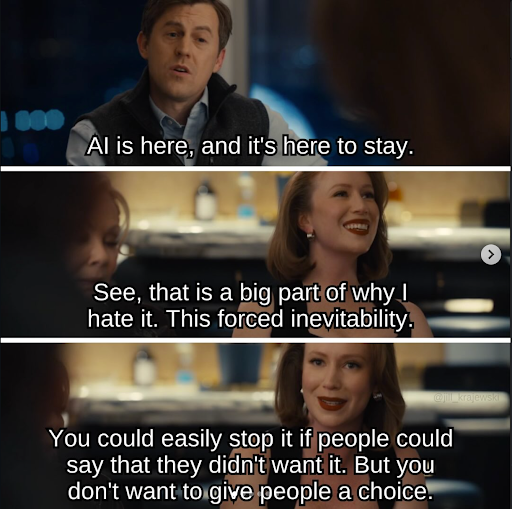
![The character from Hacks says Now, why should we believe that [AI] is this amazing thing that is gonna change the world? Obviously, you want us to believe that because you stand to profit from it.](https://communitycentricfundraising.org/wp-content/uploads/2026/07/hacks2.png "hacks2")
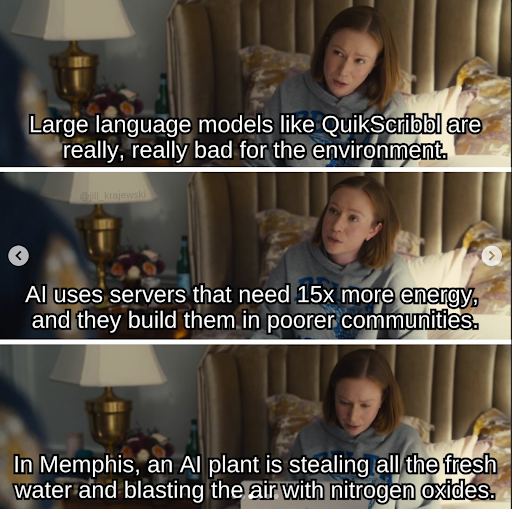
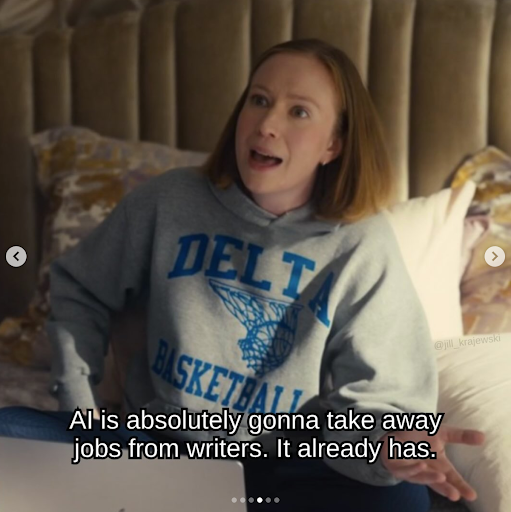
![Back to the people arguing from the episode of Hackers. One says How did you traing [AI] to sound like Deborah already? The other person responds Well, by scraping material that's online. The first says Oh, so you stole it.](https://communitycentricfundraising.org/wp-content/uploads/2026/07/hacks5.png "hacks5")
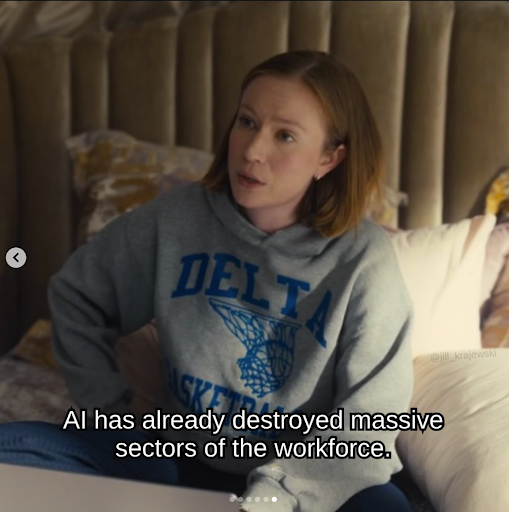
To add on to these images, the main thing fueling my fire against AI is that it is killing creative and critical thinking. This majorly starts alarms in my head because, well, this country already struggles with critical thinking, to put it kindly. I simply cannot stand by allowing those in power to further exploit folks. This non-consensual contract was truly put into the software we were using without our say so. It’s the reason we find it in our emails, our web searches, and why some of our workplaces (especially in the for-profit sector) have made deals with AI big tech and then force their employees to use it so that the AI company can then brag about how many people are using it.
Many of us didn’t agree to putting our brains into a machine, and it’s like the folks who created this technology and those who use it never saw the movies I, Robot, or Her, or 2001: A Space Odyssey, or read any science fiction novel about artificial intelligence.
Hello?! Have we not seen a single episode of Black Mirror?! If we force folks to lose the ability to think for themselves, to learn from their errors, to dream of a better world, how are we ever going to fight for one?
This brings me to the question I asked at the Family Reunion:
Can anyone call themselves a community-centric fundraiser if they do utilize GenAI?
I want to start off by saying: I do not blame anyone for utilizing GenAI. We are constantly being pushed to do more with less and under this capitalist regime, it surely helps when there is a proposed resource that promises to make your life easier. However, when the root principles of CCF are about social and racial equity, it makes no sense to call oneself community-centric, know the damages and harms of GenAI, and still use this wretched technology.
I have been called and do reclaim the title of an anti-capitalist fundraiser, and yes, I do believe that fundraising, much like the field of philanthropy, should work to end itself. As such, in theory, I would be such a proponent for a technology that allows me to do less work and spend the saved time with family and friends.
However, I have yet to see a case or study that demonstrates that those who have installed AI in their usage are doing less work or having more time. On the contrary, I have seen more folks utilize AI to do some work, to then do more work that was being saved for later. Not to mention that as positions are being laid-off and replaced by AI, and the people that stay now have to do more work to look over the generated “AI-slop” that is being produced by GenAI. Furthermore, this will be double trouble as GenAI starts cannibalizing itself, consuming its own slop as a resource for search queries.
To quote Dr. Joy Buolamwini in her 2023 book “Unmasking AI: My Mission to Protect What is Human in a World of Machines:”
In a world where decisions about our lives are increasingly informed by algorithmic decision-making, we cannot have racial justice if we adopt technical tools for the criminal legal system that only further incarcerates communities of color. We cannot have gender equality if we employ AI tools that use historic hiring data that reflect sexist practices to inform future candidate selections that disadvantage women and gender minorities. We cannot say we are advocating for disability rights and create AI-powered tools that erase the existence of people who are [disabled] by adopting ableist design patterns…If the AI systems we create to power key aspects of society—from education to healthcare, from employment to housing—mask discrimination and systemize harmful bias, we entrench algorithmic injustice. We swap fallible human gatekeepers for machines that are also flawed but assumed to be objective. And when machines fail, the people who often have the least resources and most limited access to power structures are those who have to experience the worst outcomes.
So yeah, if you are for the cause of CCF you cannot also be purposely utilizing GenAI. That’s my hot take.
My co-panelists have different views on this topic. Lucas doesn’t disagree with my hot take per se, but believes that we need to “put the emphasis on the billionaires and companies who are using a new technology to exploit people and the earth,” rather than say that individuals can’t be or aren’t CCF if they use the technology.
They shared, “This is the common response to issues like climate change, racial justice, and many others: to make it the responsibility of the individual to not participate or boycott in order to make a difference, when the reality is that billionaires and corporations are the source of this issue, and they should be held responsible and regulated rather than putting the burden on individuals to somehow be ethically pure consumers under capitalism.” They added that CCFers need to be thoughtful, intentional, and careful about their use of all technologies.
For Jennifer, community-centrism is “about our active accountability to people, not achieving absolute consumer purity under a capitalist system where these tools are increasingly prevalent in the core software we use daily. If we demand a total individual boycott of AI, we must also ask why we aren’t policing each other’s use of smartphones or social media platforms, which carry their own deep ethical violations. A true community-centric approach means we pragmatically use the tools available to advance our local missions and keep our organizations alive, while simultaneously focusing our collective energy on holding tech monopolies accountable.”
As an exclusive to you, my dear reader, I agree that we should emphasize and focus energy against the billionaires and tech regimes forcing this rotten technology onto us. But it is because I see CCF as a collective that I believe as a collection of individuals, refusing to participate in using GenAI is both a pushback against the AI tech corporations and keeps with the CCF mission and vision. It is not an or but an and.
As for a response to Jennifer, I would like to bring up one of Audre Lorde’s famous quotes:
For the master’s tools will never dismantle the master’s house. They may allow us temporarily to beat him at his own game, but they will never enable us to bring about genuine change. And this fact is only threatening to those women who still define the master’s house as their only source of support.
While Audre Lorde was talking about the liberation of women—especially queer and Black women—the sentiment is transferable. True liberation cannot be achieved by using the systems, ideologies, and logic of the very oppressors we are fighting.
How do we fight back against GenAI technology?
The last two questions, to simplify, were about what can we do—as a sector, as fundraisers, as individuals—to rein in, control, or in essence, to fight back against this technology that is being forced upon us from multi-million and billion dollar companies and individuals?
The not-so-fun answer is that it is hard not to use it. A quick google search automatically prompts up an AI answer unless you manually type in “ no AI” or “-AI” on the search. Even writing an email on Google, unless you manually set it off on your setting, starts writing it for you. Wild! Let me do my own writing, Gemini! I have a brain that thinks for itself, thank you very much.
The only thing we can do as a sector is continue being informants of the harm and damages. It’s not the first time that fundraising is doing something with the claim of doing good, only to later find out it wasn’t that good to begin with. Maybe you, too, have attended another AI panel where the damages aren’t even mentioned. So our main job is to just be knowledgeable about it and tell the harms to others. Bring them up in the Q&A portion of these sessions. Back it up with the data, some of which you can find in Vu’s article that was published after the panel. Double down when the panelists, speakers, and moderators try to avoid the information.
Yes, we can also reduce our use of it. That helps, too. However, speaking up for other communities and advocating for the regulation of GenAI are our current best courses of action, in my opinion.
Lucas shared that we should all “support moratoriums on data centers in your area, support campaigns to tax billionaires and get corporate money out of politics, and advocate for regulations and restrict uses of AI (i.e. no military applications for targeting or piloting drones).”
On an individual level, they ask us to be mindful of how we use it if we choose to. “Notice how it affects your thinking and writing. Notice how you become reliant on the technology and notice when it gets things wrong and ends up requiring more work than if you just did something yourself.
“Go analog and create things that AI would or could never think of. Celebrate human creativity!”
Jennifer shared that we fight back “by moving away from individual moral policing and moving toward collective, systemic advocacy. The CCF movement is made up of the most brilliant minds and the nonprofit sector holds massive financial and moral weight. We can fight back by auditing our tech vendors, demanding transparent data infrastructure, lobbying for strict algorithmic accountability laws, and pushing for ‘opt-in’ frameworks that protect community data from non-consensual grabs.”
Returning to Dr. Buolamwini’s book, “AI will not solve poverty, AI will not solve discrimination, AI will not solve climate change because the conditions that lead to societies that pursue profit over people are not technical… As Dr. Rumman Chowdhury reminds us in her work on AI accountability, the moral outsourcing of hard decisions to machines does not solve the underlying social dilemmas.”
To end my soapbox, I want to leave you with a question I continue bringing up when it comes to those who claim utilizing AI is more efficient—which is such a capitalist-coded statement…ugh: How much are we willing to kill our humanity for the sake of efficiency? Let the answer to that question be your guide.

Carlos García León
Carlos García León (he/they; el/elle) is a queer, non-binary, Latine, Mexican-Statesian, and cute little revolutionist. They were born in Atlixco, Puebla, Mexico, and reside in the stolen land of the Peoria, Potawatomi, Kickapoo, and Kaskaskia tribes, also known as Chicago, Illinois. Their work is driven by a fight for cultural equity, decolonizing the arts, and social justice. As such, Carlos describes themselves as an anti-capitalist, community-centric, theoretical fundraiser.
Carlos has spoken at multiple conferences introducing the concept of Community-Centric Fundraising and building a more gender-inclusive workplace to hundreds of attendees. Carlos holds a B.M. in Bassoon Performance from the University of Illinois at Urbana-Champaign, and a M.A. in Arts Administration and an MBA from the University of Cincinnati. They enjoy their leisure time by hanging with friends, resisting capitalism by taking naps, dancing to Latin, disco, and house music, and exploring new Chicago food spots. They can be reached via email or on Instagram, Twitter, and other social media platforms @cgarcia_leon. You can tip them for their work via Venmo @cgarcia_leon or via PayPal using their email. Carlos would be eternally grateful for any tips during their Funemployment 2: Electric Boogaloo era.
Discover more from CCF
Subscribe to get the latest posts sent to your email.