
By Adrianne Yiu, inclusive leadership coach, accidental entrepreneur, and amateur climber
The conversation I want to have is about the internal cost of relying on capitalist tools built for profit, extraction, and domination. And how ChatGPT is weakening our capacity to reimagine liberated futures.
The allure of ChatGPT is hard to ignore.
The nonprofit sector is chronically underfunded, underresourced, leaders are burnt out, and staff are overworked. And then along comes a shiny new tool that promises to reduce workload with a click of a button.
Despite tech activists sounding the alarm about the cost of GenAI on marginalized communities and the planet, it’s not surprising that many find it hard to ignore ChatGPT’s promise to free us from the vicious cycle of busy work.
I don’t use ChatGPT, and I’m not here to shame people who use it because I don’t think the conversation is as binary as “to use or not to use.”
The conversation I want to have is about the internal cost of relying on capitalist tools built for profit, extraction, and domination. And how ChatGPT is weakening our capacity to reimagine liberated futures.
To reimagine liberated futures, movement activist Grace Lee Boggs emphasized the importance of growing our souls. In a conversation with Angela Davis in 2012 at the University of California, Grace Lee Boggs said:
“I first used the concept of growing our souls about 10 years ago. Radicals don’t usually talk about souls—but I think we have to. What I mean by souls is the capacity to create the world anew, which each of us has. How do we talk about that with one another? It’s not only important to act, it’s important to talk because when you talk you begin to create new ideas and new languages. We’ve all been damaged by this system—it’s not only the capitalists who are the scoundrels, the villains; we are all part of it. And we all have to change what we say, what we do, what we think, what we imagine.”
I like to think of our capacity to create the world anew as a muscle. We build this muscle by learning about ourselves and how we’re connected with others. We strengthen this muscle by seeding new ways of knowing through curiosity, critical thinking and dialogue rooted in care. We rehab this muscle—especially when we’re feeling despair—by healing in community.
And we weaken this muscle by relinquishing our agency to Big Tech.
Confronting who we are
Growing our souls starts with ourselves. It requires us to do the quiet but powerful work of knowing who we are. It also means interrogating things like who we should be vs. want to be.
When capitalism convinces us that our worth is defined by our productivity, this can keep us stuck in a busy spiral. In that anxious state, it’s easier to fall for false narratives like “rest is lazy.”
So we keep going because it’s more uncomfortable (and sometimes too painful) to ask ourselves: Who am I without my labour?
So we turn to external sources like ChatGPT for immediate answers. Because it’s easier than sitting with the messy parts of ourselves.
In my leadership coaching and consulting work, I see more and more leaders using ChatGPT to get unstuck. And what I’ve noticed is that when we rely on Big Tech to resolve internal tension, it weakens the muscle that helps us learn about our values, gifts, stressors, and triggers.
We need to know ourselves so deeply so that we don’t lose ourselves in the oppressive systems we’re trying to dismantle.
For leaders who are committed to Community-Centric Fundraising (CCF) principles, this means giving yourself permission to feel—without judgment and shame. It means recognizing your capacity to cause harm, no matter your intentions.
We do this by sitting with discomfort and confronting the narratives we’ve unconsciously internalized. We do this by accepting the contradictions we carry. We do this by speaking our truth and having our community mirror it back to us. We do this by seeking out restorative community spaces for our big feels and lived experiences.
Confronting who we are is essential healing work that cannot be bypassed with ChatGPT prompts. And you don’t have to do it alone.
Seeding new ways of knowing
While ChatGPT normalizes binary and immediate solutions to complex topics, generative conversations can seed new ways of knowing through dialogue that centres agency.
Growing our souls requires us to see the interconnectedness of our struggles and invite others to do the same.
During a time when a 23-month live-streamed genocide has proven how morally bankrupt some of the world’s most powerful leaders are, we urgently need generative conversations that help us discern between the realities we’re witnessing and the propaganda we’re told to believe.
For leaders who embody CCF values, this means engaging in intentional conversations that cultivate curiosity, reflection and clarity. It means turning thought into words—no matter how imperfect. It means facilitating nonjudgmental spaces that allow others to do the same.
We do this by resisting the need to control the outcome of conversations. We do this by asking open-ended questions that help people to know themselves better. We do this by interrupting reactivity to create room for intentionality (when we can, since community work sometimes needs urgent, immediate responses). We do this by creating relational spaces that can co-create a world with new norms, narratives, and values.
Oftentimes, we communicate to change people’s minds. But one thing I’ve learned as a leadership coach and facilitator is that it’s so much more powerful for somebody to arrive at something on their own terms rather than prescribing solutions. That’s because you’re centring the other person’s agency. And it’s honouring the fact that we carry different lived experiences, stories, and traumas that determine our capacity to receive new truths.
While ChatGPT normalizes binary and immediate solutions to complex topics, generative conversations can seed new ways of knowing through dialogue that centres agency.
Resisting the urge to isolate
The inner work of liberation cannot be outsourced to ChatGPT because it cannot be done in isolation.
The reality is that we’ve never been more connected (through tech) and lonely at the same time. And Big Tech is on a mission to commodify emotional support 👇
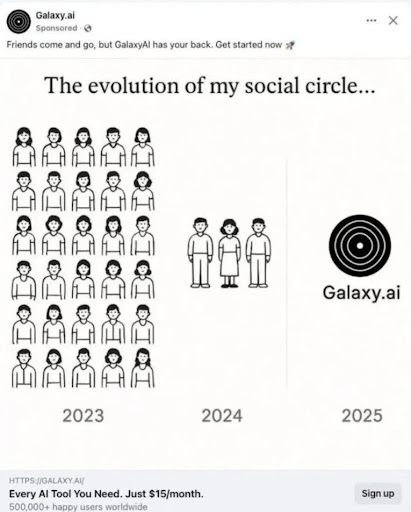
While ChatGPT pushes us to relinquish our agency—which is at the heart of liberation—it weakens our ability to think for ourselves, creates self-doubt in the wisdom we already have, and severs our connection with others.
So the next time you turn to ChatGPT to get unstuck, I invite you to pause and ask yourself these 3 questions:
- What might I be relinquishing in the process?
- How can I move forward with more intention?
- How can I turn to my community right now?
Don’t let ChatGPT convince you that you can and ought to do this alone. We need each other to create the world anew.

Adrianne Yiu
Adrianne Yiu (she/her) is a second gen Chinese-Canadian immigrant and settler in Tkaronto on Treaty 13 territory. She is a leadership coach and change consultant who believes in a version of leadership that heals, liberates and disrupts. Prior to launching her practice in 2022, Adrianne spent over a decade facilitating systemic change across sectors—including curating award-winning inclusive leadership programming, leading people-centred digital transformations, and developing agile and compassionate teams in tech. She now partners with racialized women and non-binary folks to lead with more intention and less self-doubt.
Adrianne is a mentor with Empower’em, an organizer for Climbers for Palestine, and co-creator of Dragon Centre Stories—a storytelling project honoring the untold histories of immigrant communities. Adrianne is also a 2022 Alum and 2026 Regional Co-Chair of the Governor General’s Canadian Leadership Conference.
If you’d like to partner with Adrianne, book a discovery call here. If you’re interested in more musings like this, subscribe to her newsletter here. Follow her on LinkedIn here.
Discover more from CCF
Subscribe to get the latest posts sent to your email.