
By nae vallejo, a Black, queer, trans, disabled experiential archivist and access designer
Artist Statement
Mexican Dahlia: Ancestry in Bloom honors the parts of myself shaped by migration, silence, grief, ceremony, rupture, and return. The dahlia is not simply an emblem. It is a living bloom of memory, rooted and reaching at once.
Mexican Dahlia: Ancestry in Bloom is a meditation on lineage, how it forms us, eludes us, and continues to root inside our bodies even when history has been interrupted. The dahlia, Mexico’s national flower, carries a layered story of migration, renaming, extraction, and reclamation. It is a flower that has traveled, been carried, traded, misunderstood, and adored, yet it always returns to itself. In drawing this piece, I was thinking about how diasporic memory works in the body: what we inherit, what was stolen, what was softened or reshaped, and what refuses to disappear.
I come to this piece as a disabled, autistic, Black, Native, queer and trans Mexican survivor living on stolen Turtle Island, held by land that predates every border. Diaspora has made me a keeper of fragments, languages I receive in pieces, foods I remember through touch as much as taste, stories offered in portions, histories I gather through care rather than certainty. The dahlia mirrors that experience. Native to the soil that birthed it, renamed by empires, used for medicine, ceremony, and ornament, the dahlia carries a geography of rupture and return. It blooms through contradiction, refusing to flatten its complexity.
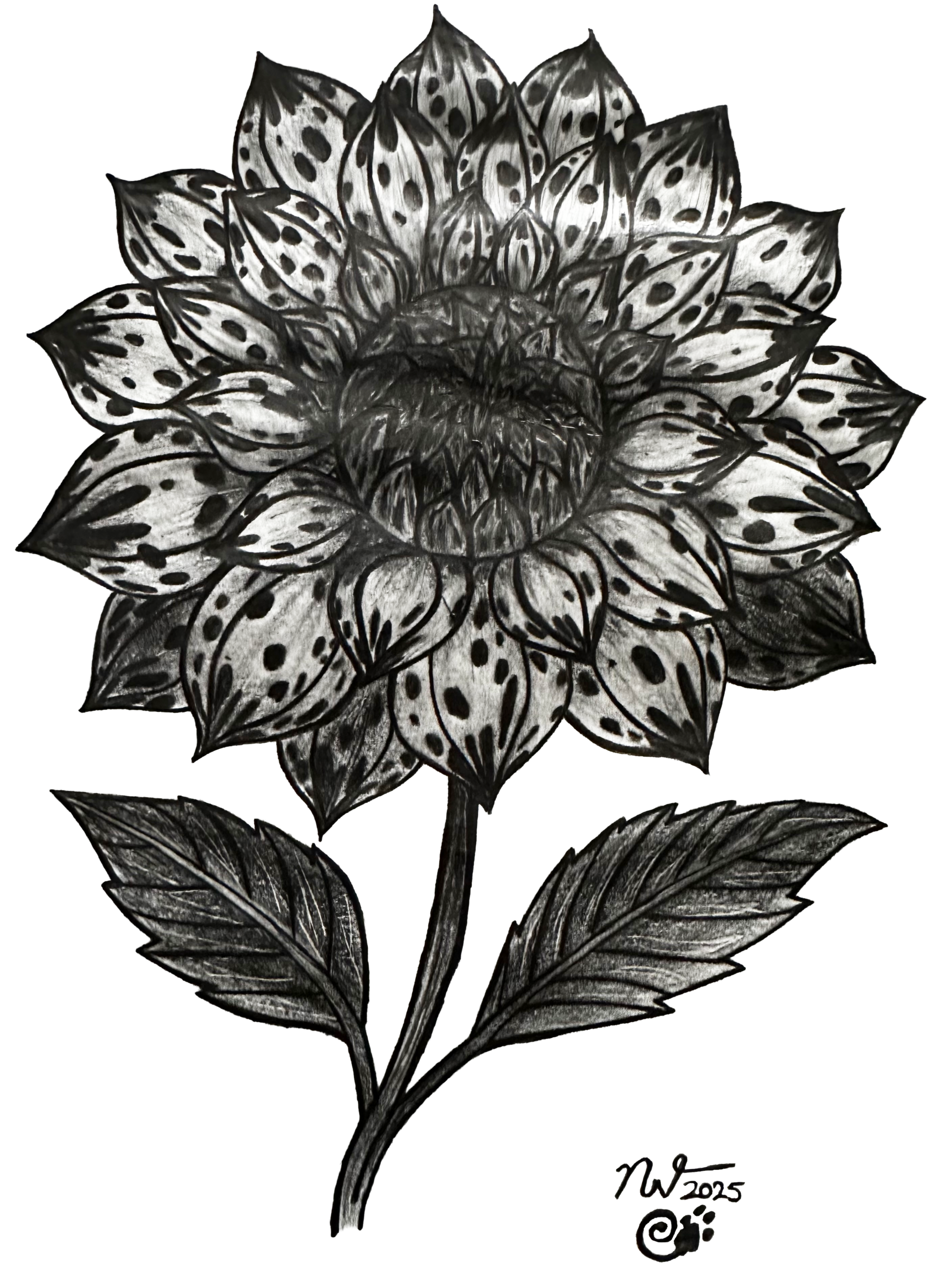
The graphite medium felt essential for this drawing. Graphite stains, blurs, holds fingerprints. It remembers pressure. Its softness echoes the fragile and persistent nature of cultural memory, how it smudges, reappears and hides in the folds. Each petal is layered with intention: speckled, shadowed, and overlapping. That variation mirrors how lineage behaves. Memory folds into memory. Knowledge preserved through craft, story, ritual, and improvisation gathers shape the way petals do, repetitive but never identical. Some petals feel sharp, others softened, some smudged as though time has worn them thin. I wanted the drawing to hold the truth that memory is not linear. Memory is textured, interrupted, and alive.
The stem, narrowing like a spine, anchors the bloom. I often imagine diaspora as a kind of archaeology, digging through gestures, songs, recipes, language, seeking belonging without
having to prove it. The stem leans slightly, as if reaching for something just beyond what the body can name. That reaching is part of the lineage, too.
As an experiential archivist, my art emerges from the archives my body carries: grief and joy, rupture and repair, silence and sound, ancestry and improvisation. My disabled, neurodivergent, trans, and survivor ways of knowing shape how I draw and what I honor. Memory is not only inherited. Memory is felt, created, and re-created. It is learned through slowness, sensory detail, and the repetition of craft. This piece remembers the labor of that repetition, the steady shading that asks the hand to return again and again, trusting what is revealed by the process.
Mexican Dahlia: Ancestry in Bloom honors my elders who migrated, the ones who did not, and the ones who died before I could ask the questions I now carry like seeds. It honors disabled, neurodivergent, immigrant, queer, trans and survivor kin who assemble home through village, through care, through refusal, through art. It honors those who bloom sideways, out of order, out of season, against what systems imagined for us. It is for everyone who has been told their identity is too layered, too contradictory, or too much.
To draw a flower is to think about futurity. Every bloom gestures toward a seed; every seed toward another bloom. I am interested in how lineage can be remade, composted, tended into something that sustains rather than harms. The dahlia reminds me that beauty is not decoration, it is witness. It holds story. It remembers.
This drawing insists that heritage is not static. It mutates, expands, adapts, and returns. The dahlia is still unfolding, just as we are. Mexican Dahlia: Ancestry in Bloom honors the parts of myself shaped by migration, silence, grief, ceremony, rupture, and return. The dahlia is not simply an emblem. It is a living bloom of memory, rooted and reaching at once.
Visual details:
Title: Mexican Dahlia: Ancestry in Bloom
Medium: graphite on cardstock paper
Alt text: graphite drawing of a Mexican dahlia with layered, marked petals and veined leaves, symbolizing lineage, diaspora, memory, and renewal.

nae vallejo
nae vallejo (they/he) is a Black, Caddo, Mexican, queer, trans, disabled experiential archivist and access designer. their work moves through memory, rememory, and care, exploring how survivors leave trace across body, land, and story. as the founder of naeborhood projects, nae creates art that weaves disability justice, sensory attunement, and community connection into everyday practices of survival and tenderness. a hard of hearing, neurodivergent service dog guardian and lifelong educator, he centers interdependence, ritual, and storytelling as tools for collective care. follow their offerings on Instagram @naeborhoodprojects and support their labor via Venmo @nae-vallejo or Paypal @naevallejo.
Discover more from CCF
Subscribe to get the latest posts sent to your email.